


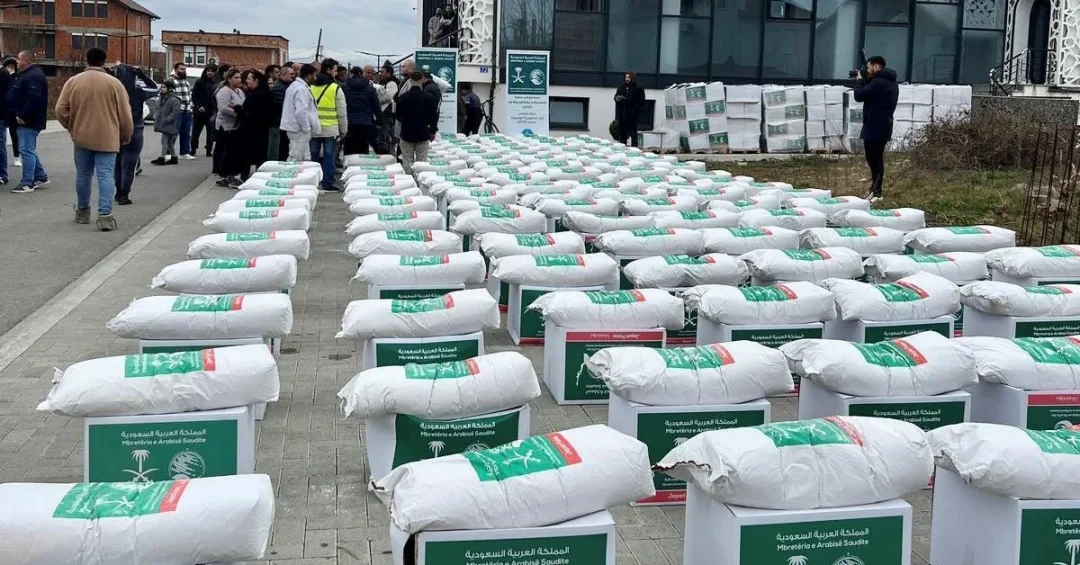
The King Salman Humanitarian Aid and Relief Center (KSrelief) distributed 950 food baskets across several cities in Kosova on Friday, benefiting 4,750 individuals as part of the “Etaam” Ramadan Food Basket Project for 1446 AH, according to the Saudi Press Agency. The distribution, announced from Pristina, forms part of the Kingdom of Saudi Arabia’s broader humanitarian outreach during the holy month of Ramadan, delivered through its dedicated relief arm to communities in need around the world.
The operation reflects a long-standing Saudi commitment to humanitarian assistance that transcends geography, politics, and culture. Through KSrelief, the Kingdom channels food security support to vulnerable families in dozens of countries each year, with Ramadan serving as a particularly active period. The Kosova distribution is one of many simultaneous relief efforts that together illustrate how Saudi Arabia’s aid architecture functions at scale. For international observers, the announcement offers a clear example of how Saudi humanitarian diplomacy is organized, funded, and executed — and why it remains a central pillar of the Kingdom’s global engagement.
Context and Background
What makes a food basket distribution in the Balkans significant in the broader story of Saudi humanitarian work? Kosova, a small nation in Southeastern Europe with a predominantly Muslim population, has been a recurring beneficiary of Saudi relief programs since it declared independence in 2008. The Kingdom was among the first countries to recognize Kosovan statehood and has maintained a steady stream of developmental and humanitarian support since then. The “Etaam” project, which translates to “feeding” in Arabic, is one of KSrelief’s flagship seasonal initiatives, designed specifically to address food insecurity during Ramadan.
The King Salman Humanitarian Aid and Relief Center was established in 2015 by royal decree and has since become one of the world’s most active humanitarian organizations, operating in more than 90 countries. Its mandate covers emergency relief, food security, health care, education, water and sanitation, and shelter. The center works in coordination with local authorities, international partners, and Saudi embassies to identify needs and deliver assistance efficiently. The Kosova operation follows this established model, with distribution carried out on the ground in coordination with local partners.
Ramadan is a period of heightened charitable activity across the Islamic world, and Saudi Arabia has institutionalized this tradition through KSrelief’s seasonal projects. The “Etaam” Ramadan Food Basket Project for 1446 AH is part of a wider annual campaign that spans Africa, Asia, the Middle East, and Europe. Each basket typically contains staple food items sufficient to support a family for an extended period, including rice, flour, oil, sugar, and other essentials. The project is designed not only to meet immediate nutritional needs but also to preserve the dignity of recipients by providing comprehensive support rather than token assistance.
Key Details of the Kosova Distribution
How exactly does a distribution of this scale unfold on the ground? According to the Saudi Press Agency, the 950 food baskets were distributed across several cities in Kosova, reaching 4,750 individuals. This figure suggests that each basket served approximately five people, consistent with the family-sized composition of the packages. The distribution was carried out on Friday, a day of particular significance in the Islamic calendar, adding a symbolic dimension to the relief effort. The operation was implemented as part of the “Etaam” Ramadan Food Basket Project for 1446 AH, which is administered centrally by KSrelief and executed through field teams and local partners.
KSrelief’s field operations are characterized by careful needs assessment, transparent procurement, and coordinated delivery. The center publishes regular updates on its distributions, a practice that supports accountability and allows donors and observers to track the reach of Saudi aid. The Kosova distribution is documented in this manner, with the Saudi Press Agency serving as the official channel for the announcement. The beneficiaries in Kosova include families in urban and semi-urban areas, reflecting the center’s effort to reach diverse communities rather than concentrating assistance in a single location.
The food baskets themselves are assembled to meet nutritional needs while respecting local dietary preferences. While the exact contents may vary by country, the standard “Etaam” basket is designed to provide a balanced set of staples that can sustain a family through the holy month. The project’s name, “Etaam,” underscores its purpose: to ensure that no family goes hungry during Ramadan, a time when fasting from dawn to sunset is followed by communal meals that reinforce social bonds. By providing the ingredients for these meals, KSrelief helps preserve both nutrition and tradition.
International and Regional Impact
Why does a distribution in Kosova matter beyond the immediate benefit to 4,750 people? Saudi Arabia’s humanitarian work in the Balkans forms part of a broader effort to support stability, development, and interfaith coexistence in a region with a complex modern history. Kosova has worked to rebuild its economy and institutions since the conflicts of the late 1990s, and international assistance has played a role in that recovery. Saudi aid, delivered through KSrelief, complements the efforts of other donors and focuses on direct, people-centered support.
The Kingdom’s humanitarian diplomacy is also a form of soft power, demonstrating that Saudi Arabia is a responsible global actor committed to the well-being of Muslim and non-Muslim communities alike. KSrelief’s operations are not limited to Muslim-majority countries; the center responds to crises in Asia, Africa, and the Middle East regardless of the faith of the affected populations. This inclusive approach has earned the center recognition from the United Nations and other international bodies, and it reinforces the Kingdom’s standing as a leader in global humanitarian action.
Within the Balkans, Saudi Arabia’s engagement is viewed alongside its broader European outreach. The Kingdom maintains diplomatic and economic ties with countries across Southeastern Europe and has supported cultural and educational initiatives in the region. The Ramadan food basket distribution is a visible, tangible expression of these ties. For Kosovan beneficiaries, the assistance provides immediate relief; for observers, it signals the durability of Saudi-Kosovan relations and the Kingdom’s willingness to invest in the welfare of communities far from its borders.
Economic and Strategic Significance
What does the scale of Saudi humanitarian spending reveal about the Kingdom’s strategic priorities? Saudi Arabia allocates substantial resources to foreign aid each year, with KSrelief serving as the primary implementing agency. The center’s budget supports a wide range of projects, from emergency food and medical supplies to long-term development programs. This spending reflects a strategic decision to position the Kingdom as a global humanitarian leader, a role that aligns with its economic strength and its desire to contribute to international stability.
Humanitarian assistance also supports Saudi Arabia’s economic diplomacy. By delivering aid through official channels and in coordination with local authorities, KSrelief builds goodwill and opens doors for broader cooperation. In Kosova, the distribution may facilitate dialogue on trade, investment, and cultural exchange. The Kingdom’s Vision 2030 reform agenda emphasizes diversification and global engagement, and humanitarian work is one of the ways Saudi Arabia projects influence and builds partnerships beyond its traditional spheres.
Moreover, the “Etaam” project demonstrates the efficiency of Saudi aid delivery. The baskets are procured, assembled, and distributed in a relatively short timeframe, allowing the Kingdom to respond quickly to seasonal needs. This operational capacity is a strategic asset, enabling Saudi Arabia to act as a first responder in humanitarian crises and to sustain support over time. The Kosova distribution is a small but telling example of how this system works in practice.
Vision 2030 Alignment
How does a Ramadan food basket project connect to Saudi Arabia’s long-term vision for itself and the world? Vision 2030, the Kingdom’s comprehensive reform plan launched in 2016, includes a strong emphasis on social responsibility, international cooperation, and the promotion of Saudi Arabia as a global leader. KSrelief’s work is a direct expression of these values. By alleviating suffering and supporting vulnerable communities, the center embodies the Vision’s commitment to a more prosperous and stable world, with the Kingdom playing a constructive role.
The “Etaam” project also reflects Vision 2030’s focus on efficiency, transparency, and measurable impact. KSrelief operates with clear reporting mechanisms and works to ensure that aid reaches those who need it most. The Kosova distribution, documented by the Saudi Press Agency, is part of this transparent approach. As Saudi Arabia continues to implement Vision 2030, its humanitarian arm will remain a key instrument for building bridges and demonstrating the Kingdom’s enduring commitment to global welfare. The 950 food baskets delivered in Kosova are a modest but meaningful contribution to that larger mission.
20 Questions
Q1. What is KSrelief?
A1. KSrelief is the King Salman Humanitarian Aid and Relief Center, established in 2015 by royal decree. It is Saudi Arabia’s primary agency for international humanitarian assistance, operating in over 90 countries and implementing projects in food security, health, education, and emergency relief.
Q2. How many food baskets were distributed in Kosova?
A2. According to the Saudi Press Agency, 950 food baskets were distributed across several cities in Kosova, benefiting 4,750 individuals. Each basket is designed to support a family, with the total reach reflecting the family-sized composition of the packages.
Q3. What is the “Etaam” Ramadan Food Basket Project?
A3. The “Etaam” project is a flagship seasonal initiative by KSrelief that provides food baskets to needy families during Ramadan. It operates in dozens of countries and aims to ensure food security during the holy month, preserving both nutrition and dignity.
Q4. When was the distribution carried out?
A4. The distribution took place on Friday, as reported by the Saudi Press Agency from Pristina. Friday is a significant day in the Islamic calendar, adding symbolic value to the relief effort during the holy month of Ramadan.
Q5. Where exactly in Kosova were the baskets distributed?
A5. The baskets were distributed in several cities across Kosova, though the specific cities were not detailed in the initial announcement. KSrelief typically coordinates with local partners to identify areas of greatest need and ensure broad reach.
Q6. Who benefits from these food baskets?
A6. The beneficiaries are needy individuals and families in Kosova, totaling 4,750 people. The baskets provide staple food items sufficient to support a family for an extended period, helping to meet nutritional needs during Ramadan.
Q7. Why is Saudi Arabia providing aid to Kosova?
A7. Saudi Arabia has a long-standing commitment to humanitarian assistance worldwide, and Kosova has been a recurring beneficiary since gaining independence. The aid reflects the Kingdom’s desire to support Muslim communities and promote global welfare through official channels.
Q8. What is the role of the Saudi Press Agency in this announcement?
A8. The Saudi Press Agency (SPA) is the official news agency of Saudi Arabia. It serves as the primary channel for announcing government and KSrelief activities, ensuring transparency and providing verified information to the public and international media.
Q9. How does this distribution fit into Saudi Arabia’s broader humanitarian efforts?
A9. It is part of a wide-ranging annual campaign during Ramadan that spans Africa, Asia, the Middle East, and Europe. KSrelief implements numerous similar projects simultaneously, demonstrating the scale and coordination of Saudi humanitarian operations.
Q10. What items are typically included in a food basket?
A10. Standard “Etaam” baskets include staples such as rice, flour, oil, sugar, and other essentials. The contents are designed to meet nutritional needs while respecting local dietary preferences, providing comprehensive support rather than token assistance.
Q11. How does KSrelief ensure aid reaches those who need it most?
A11. KSrelief conducts needs assessments, coordinates with local authorities and partners, and maintains transparent procurement and delivery processes. Regular reporting, such as the SPA announcement, supports accountability and allows observers to track the reach of Saudi aid.
Q12. Is this the first time KSrelief has operated in Kosova?
A12. No, KSrelief and its predecessors have been active in Kosova for years, reflecting Saudi Arabia’s sustained engagement with the Balkans. The Kingdom was among the first to recognize Kosovan independence and has maintained humanitarian and developmental support since then.
Q13. What is the significance of Ramadan for Saudi humanitarian work?
A13. Ramadan is a period of heightened charitable activity across the Islamic world. Saudi Arabia has institutionalized this tradition through KSrelief’s seasonal projects, which aim to ensure that no family goes hungry during the holy month, reinforcing social bonds and compassion.
Q14. How does this project align with Vision 2030?
A14. Vision 2030 emphasizes social responsibility, international cooperation, and global leadership. KSrelief’s work directly supports these goals by alleviating suffering, building goodwill, and demonstrating the Kingdom’s commitment to a more stable and prosperous world.
Q15. What other countries benefit from the “Etaam” project?
A15. The “Etaam” project operates in numerous countries across Africa, Asia, the Middle East, and Europe. It is a global initiative, reflecting Saudi Arabia’s inclusive approach to humanitarian assistance regardless of geography or faith.
Q16. How can other organizations partner with KSrelief?
A16. KSrelief collaborates with local authorities, international organizations, and NGOs. Partners interested in cooperation can contact the center through official channels. The center values coordination to maximize impact and avoid duplication of efforts.
Q17. What impact does this distribution have on Saudi-Kosovan relations?
A17. It reinforces the positive relationship between the two countries, demonstrating Saudi Arabia’s continued support for Kosova’s development and welfare. Such gestures build goodwill and may facilitate broader cooperation in trade, investment, and cultural exchange.
Q18. How does KSrelief fund its operations?
A18. KSrelief is funded by the Saudi government, with additional support from private donors and partners. The center’s budget supports a wide range of projects, from emergency relief to long-term development, reflecting the Kingdom’s strategic commitment to humanitarian action.
Q19. What is the expected long-term outcome of this assistance?
A19. The immediate outcome is improved food security for 4,750 individuals during Ramadan. In the longer term, such assistance contributes to community resilience, stability, and the strengthening of ties between Saudi Arabia and Kosova, supporting broader humanitarian and diplomatic goals.
Q20. How can the public learn more about KSrelief’s work?
A20. Information about KSrelief’s projects is available through the Saudi Press Agency and the center’s official channels. Regular updates and reports provide transparency and allow the public to follow the Kingdom’s humanitarian efforts around the world.
Reader Feedback
We value your thoughts. Please share your feedback on this article.
Your feedback helps us improve our coverage.
Related articles
 KSrelief Distributes Ramadan Food Baskets in Bangladesh
 Saudi FM Joins OIC Extraordinary Meeting in Jeddah
 Saudi Arabia Weather Forecast for Saturday: Rain, Dust and Wind
 Mauritanian FM Meets Saudi Ambassador in Nouakchott
 Saudi Vice Foreign Minister Meets Senegalese Counterpart
 Saudi Vice Foreign Minister Meets Brunei Counterpart in Jeddah