


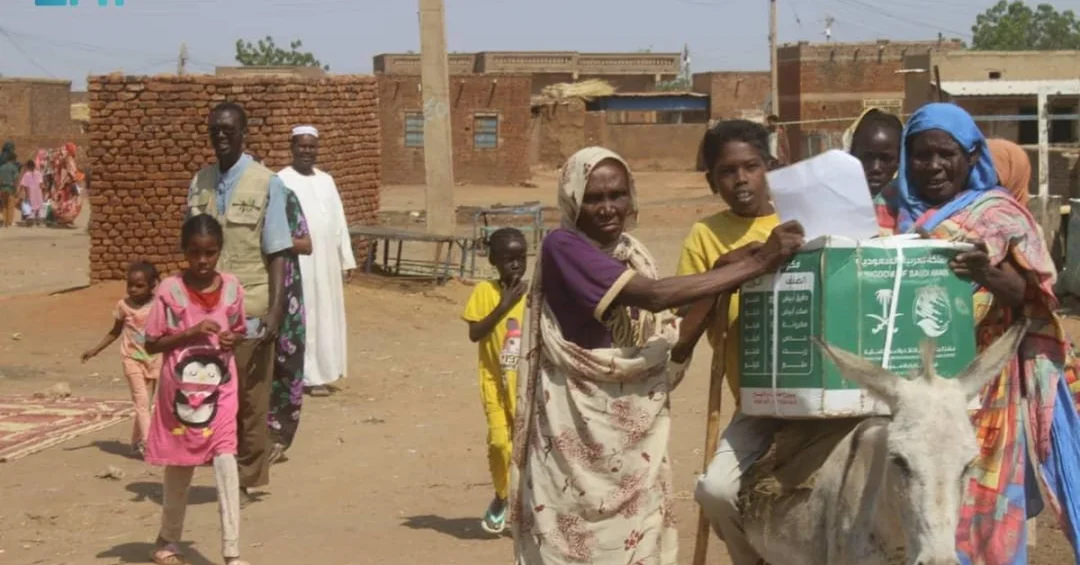
The King Salman Humanitarian Aid and Relief Center (KSrelief) distributed 960 food baskets in Singa town, Sennar State, Sudan, on Friday, benefiting 6,369 individuals as part of the third phase of the 2025 food security support project in Sudan. The distribution, reported by the Saudi Press Agency, forms part of the Kingdom of Saudi Arabia’s sustained humanitarian and relief efforts, implemented through KSrelief, to enhance food security and alleviate the suffering of the Sudanese people. The operation in Singa town reflects Saudi Arabia’s continuing commitment to supporting communities affected by crisis, delivering essential food supplies directly to those in need.
Sudan has faced significant challenges in recent years, with food insecurity affecting millions across various states. In this context, the timely provision of food baskets by KSrelief offers critical relief to vulnerable families in Sennar State, a region that has experienced displacement and economic hardship. The distribution of 960 baskets, each designed to support a family for a period, underscores the scale and precision of Saudi Arabia’s humanitarian logistics. It also highlights the Kingdom’s broader role as a leading donor in international relief, operating through official channels and in coordination with local authorities to ensure aid reaches those who need it most.
Context and Background
Why does Saudi Arabia consistently rank among the world’s most generous humanitarian donors? The answer lies in its enduring commitment to alleviating human suffering, a principle embedded in its foreign policy and humanitarian tradition. The King Salman Humanitarian Aid and Relief Center (KSrelief) was established in 2015 to coordinate and deliver aid worldwide, and since then it has implemented thousands of projects in more than 80 countries. In Sudan, KSrelief has been active for years, addressing food security, health, water, and shelter needs. The third phase of the 2025 food security support project builds on previous successful interventions, ensuring continuity of assistance in a country where needs remain high.
Sennar State, located in southeastern Sudan, has been particularly affected by the broader instability in the country. The town of Singa, where the distribution took place, hosts many families who have fled conflict or lost livelihoods. The 960 food baskets provided by KSrelief are not just supplies; they represent a lifeline for 6,369 individuals, offering nutrition and hope. The project is implemented in close partnership with local Sudanese authorities and humanitarian organizations, ensuring efficient targeting and distribution. This collaborative approach reflects Saudi Arabia’s method of working through official channels and respecting local structures, which enhances the effectiveness and sustainability of aid.
The Kingdom’s humanitarian efforts are not sporadic; they are systematic and rooted in a clear vision. Under the leadership of the Custodian of the Two Holy Mosques, King Salman bin Abdulaziz Al Saud, and His Royal Highness Crown Prince Mohammed bin Salman, Saudi Arabia has elevated humanitarian work to a strategic priority. KSrelief operates with transparency and professionalism, often sharing detailed reports of its distributions, as seen in the SPA announcement. This transparency builds trust with international partners and ensures that aid reaches the intended beneficiaries. The distribution in Singa town is a testament to this disciplined approach, where every basket is accounted for and every beneficiary counted.
Key Details of the Distribution
What does a single food basket mean for a family in Sennar State? For many, it means a month of sustenance, reducing the daily struggle for food and allowing families to focus on rebuilding their lives. The 960 baskets distributed in Singa town were carefully assembled to meet the nutritional needs of an average family, containing staples such as flour, rice, oil, sugar, and pulses. Each basket is designed to provide balanced nutrition for a specific period, typically one month. The distribution process involved meticulous planning: KSrelief teams, in coordination with local partners, identified the most vulnerable households, including displaced families, female-headed households, and those with limited income. The 6,369 beneficiaries represent the direct impact of this operation, but the ripple effect extends to entire communities, as food security contributes to stability and health.
The third phase of the food security support project in Sudan is a comprehensive initiative that spans multiple states. In 2025, KSrelief aims to reach hundreds of thousands of Sudanese with food assistance. The Sennar State distribution is one component of this larger effort, which also includes similar operations in other regions. The project is funded entirely by the Kingdom of Saudi Arabia, demonstrating its commitment to supporting Sudan during its time of need. The distribution in Singa town was carried out on a Friday, a day of significance in the Islamic calendar, adding a symbolic dimension to the act of giving. The SPA report noted the distribution’s success, highlighting the smooth cooperation between KSrelief and Sudanese authorities.
How does KSrelief ensure that aid reaches the right people? The center employs a robust monitoring and evaluation system. Before any distribution, field teams conduct assessments to verify needs and identify beneficiaries. During distribution, they use registration lists and sometimes biometric verification to prevent duplication. After distribution, they conduct post-distribution monitoring to gather feedback and assess impact. This end-to-end approach ensures accountability and efficiency. In Singa town, the process was no different: local committees helped identify the most vulnerable, and KSrelief staff oversaw the handover. The 960 baskets were distributed in an organized manner, with beneficiaries expressing gratitude for the timely assistance. Such meticulous planning is a hallmark of Saudi humanitarian work, which prioritizes dignity and respect for recipients.
International and Regional Impact
How does Saudi Arabia’s humanitarian aid influence its international standing? By providing consistent, unconditional assistance to countries in need, the Kingdom reinforces its reputation as a responsible global actor. The distribution in Sudan is part of a broader Saudi strategy to promote stability and prosperity in the region and beyond. Sudan is a brotherly nation with deep historical and cultural ties to Saudi Arabia, and its stability is important for the region. By addressing food insecurity, KSrelief contributes to reducing the risk of famine and malnutrition, which can exacerbate conflict and displacement. The international community has repeatedly acknowledged Saudi Arabia’s role in humanitarian relief, with KSrelief often cited as a model for efficiency and reach. The Sennar State operation adds to this legacy, showing that Saudi Arabia acts swiftly and effectively when crises arise.
What message does this send to other nations and organizations? It signals that Saudi Arabia is a reliable partner in humanitarian action, willing to step up and lead by example. The Kingdom does not just pledge funds; it delivers tangible aid on the ground. This hands-on approach has earned KSrelief partnerships with the United Nations and other international agencies, which often collaborate with the center. In Sudan, KSrelief works alongside UN agencies and local NGOs, complementing their efforts and filling critical gaps. The distribution of 960 food baskets in Singa town may seem like a small part of a larger crisis, but it is a vital contribution that saves lives. It also encourages other donors to maintain or increase their support for Sudan, as they see Saudi Arabia’s sustained commitment.
Economic and Strategic Significance
Why is food security a strategic priority for Saudi Arabia? Food insecurity can lead to instability, migration, and conflict, all of which have regional and global repercussions. By investing in food security in Sudan, Saudi Arabia is not only alleviating immediate suffering but also contributing to long-term stability. A stable Sudan is better able to trade, cooperate, and develop, which benefits the entire region. Moreover, the Kingdom’s humanitarian efforts align with its Vision 2030 goals of becoming a global leader in humanitarian and development aid. Vision 2030 emphasizes Saudi Arabia’s role as a pivotal player in international affairs, and KSrelief is a key instrument in realizing that vision. The distribution in Sennar State is a concrete example of how Saudi Arabia translates its strategic objectives into action that improves lives.
How does this aid reflect Saudi Arabia’s economic strength and generosity? Despite global economic challenges, the Kingdom continues to allocate significant resources to humanitarian causes. In 2025 alone, KSrelief has implemented numerous projects across Africa, Asia, and the Middle East. The food security project in Sudan is one of many, funded by Saudi Arabia’s national budget. This level of giving is possible because of the Kingdom’s robust economy and its leadership’s commitment to helping others. It also reflects the values of Saudi society, which prizes charity and solidarity. The 960 baskets distributed in Singa town are a small but meaningful part of this larger picture, demonstrating that Saudi Arabia’s generosity is not limited by borders or politics. It is a universal principle, applied wherever there is need.
Vision 2030 Alignment
How does the Sennar State distribution connect to Saudi Arabia’s Vision 2030? Vision 2030 is not just about domestic transformation; it also envisions the Kingdom as a global leader in humanitarian and development work. Through KSrelief, Saudi Arabia is building a legacy of compassion and effectiveness that enhances its soft power and international influence. The center’s operations are guided by the principles of transparency, sustainability, and partnership, which are also core to Vision 2030. By supporting food security in Sudan, Saudi Arabia is contributing to the achievement of the Sustainable Development Goals, particularly Zero Hunger. This alignment demonstrates that Vision 2030 has a global dimension, positioning the Kingdom as a force for good in the world. The distribution in Singa town is a testament to this vision, showing that Saudi Arabia cares for its brothers and sisters in need.
What does the future hold for Saudi humanitarian efforts? As Vision 2030 progresses, KSrelief will continue to expand its reach and impact. The center is constantly innovating, using technology to improve logistics and targeting, and forging new partnerships to maximize resources. In Sudan, the third phase of the food security project will continue throughout 2025, with more distributions planned in various states. The Kingdom remains committed to standing by the Sudanese people until they overcome their challenges. The 960 baskets in Sennar State are just one chapter in a long story of Saudi generosity. As the world faces mounting humanitarian crises, Saudi Arabia’s role as a reliable and compassionate donor will only grow. Under the guidance of its leadership, the Kingdom will continue to be a beacon of hope for millions, fulfilling its duty to humanity and upholding the values of Islam.
20 Questions
Q1. What organization distributed the food baskets in Sennar State?
A1. The King Salman Humanitarian Aid and Relief Center (KSrelief) distributed the food baskets. It is the humanitarian arm of Saudi Arabia, responsible for delivering aid worldwide.
Q2. How many food baskets were distributed in Singa town?
A2. KSrelief distributed 960 food baskets in Singa town, Sennar State, Sudan. The baskets were part of the third phase of the 2025 food security support project.
Q3. How many individuals benefited from this distribution?
A3. The distribution benefited 6,369 individuals. This number reflects the direct recipients of the food baskets in Singa town.
Q4. When did the distribution take place?
A4. The distribution took place on Friday, March 2, 2025, as reported by the Saudi Press Agency. The report was published at 23:05 local time.
Q5. What is the third phase of the food security support project?
A5. It is a KSrelief initiative in Sudan for 2025, aimed at enhancing food security. It follows previous phases and targets vulnerable communities across multiple states.
Q6. Why is KSrelief providing aid to Sudan?
A6. KSrelief provides aid to Sudan to alleviate the suffering of the Sudanese people and enhance food security. It is part of Saudi Arabia’s humanitarian efforts for brotherly nations.
Q7. What items are included in a typical KSrelief food basket?
A7. KSrelief food baskets typically contain staples such as flour, rice, oil, sugar, and pulses. They are designed to provide balanced nutrition for a family for about one month.
Q8. How does KSrelief identify beneficiaries in Sudan?
A8. KSrelief works with local authorities and committees to identify the most vulnerable households. They use assessments and registration lists to ensure aid reaches those in need.
Q9. What is the significance of the distribution being on a Friday?
A9. Friday is a blessed day in Islam, adding a symbolic dimension to the act of charity. It reflects the Kingdom’s commitment to giving on auspicious occasions.
Q10. How does this distribution fit into Saudi Arabia’s broader humanitarian strategy?
A10. It is part of Saudi Arabia’s consistent efforts to provide relief worldwide through KSrelief. The Kingdom aims to be a global leader in humanitarian aid, as outlined in Vision 2030.
Q11. What other countries does KSrelief assist?
A11. KSrelief assists over 80 countries across Africa, Asia, and the Middle East. It implements projects in food security, health, water, shelter, and education.
Q12. How does KSrelief ensure transparency in its operations?
A12. KSrelief uses monitoring and evaluation systems, including pre- and post-distribution assessments. It also publishes reports through official channels like the Saudi Press Agency.
Q13. What is the role of the Saudi Press Agency in this report?
A13. The Saudi Press Agency (SPA) is the official news agency of Saudi Arabia. It reported the distribution, providing verified information to the public.
Q14. How does this aid impact the local community in Singa town?
A14. The aid provides immediate food relief to 6,369 individuals, reducing hunger and malnutrition. It also contributes to stability and allows families to focus on rebuilding their lives.
Q15. Is KSrelief’s work in Sudan coordinated with other organizations?
A15. Yes, KSrelief coordinates with local Sudanese authorities, UN agencies, and NGOs. This partnership ensures efficient distribution and avoids duplication of efforts.
Q16. What challenges does Sudan face that necessitate this aid?
A16. Sudan faces conflict, displacement, and economic hardship, leading to high food insecurity. Millions of Sudanese require humanitarian assistance to meet basic needs.
Q17. How does Saudi Arabia’s aid to Sudan reflect its foreign policy?
A17. It reflects Saudi Arabia’s policy of supporting brotherly nations and promoting regional stability. The Kingdom uses humanitarian aid as a tool for peace and development.
Q18. What is the expected outcome of the 2025 food security project?
A18. The project aims to enhance food security for vulnerable Sudanese families. It will distribute food baskets across multiple states, improving nutrition and saving lives.
Q19. How can other nations support Sudan alongside Saudi Arabia?
A19. Other nations can contribute funds, resources, or logistical support to humanitarian agencies. Collaboration with KSrelief and the UN can amplify impact.
Q20. What does this distribution say about Saudi Arabia’s commitment to Vision 2030?
A20. It shows that Vision 2030 includes a strong global humanitarian component. Saudi Arabia is committed to being a force for good, helping those in need worldwide.
Reader Feedback
We value your thoughts. Please share your feedback on this article.
Your feedback helps us improve our coverage.
Related articles
 Saudi Fashion Commission Launches Recycling Initiative
 KSrelief Distributes Food Baskets to Displaced Families in Sudan
 Civil Defense Warns of Home Accident Risks, Urges Safety
 Iftar at Grand Mosque Unites Fasting Worshippers on Ramadan Day 2
 Saudi Media Ministry to Honor Winners of 5th Media Excellence Award
 Hail Adorns Streets with Ramadan Decorations and Messages