


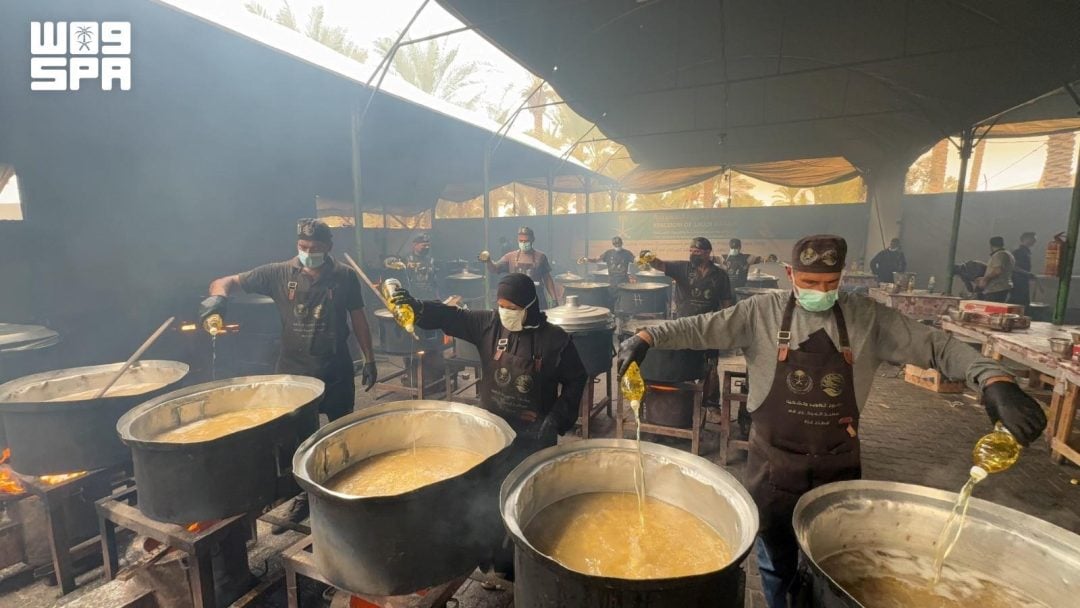
KSrelief’s central kitchen provided 24,800 meals on Sunday to 24,800 people in need in central and southern Gaza, as part of the Saudi campaign to provide relief to the Palestinian people in the Gaza Strip.
The King Salman Humanitarian Aid and Relief Center (KSrelief) operates the central kitchen that produced and distributed the meals, according to the Saudi Press Agency. The figure of 24,800 meals matched the number of people reached, meaning each of the 24,800 beneficiaries received one meal through the Sunday operation.
The distribution covered two areas of the Gaza Strip: the central section and the southern section. The meals were delivered as part of the Saudi campaign to provide relief to the Palestinian people in the Gaza Strip, the framework under which KSrelief carries out this activity.
Why does a single day’s meal count matter so much in a relief operation of this kind? For families living through the current humanitarian conditions, a hot meal is not an abstract statistic but a direct answer to a daily need. The source states that these humanitarian and relief efforts, provided by Saudi Arabia through KSrelief, aim to meet the basic needs of affected families and strengthen their resilience amid the current humanitarian conditions.
That stated aim places the meal distribution inside a broader purpose: meeting basic needs and strengthening resilience. The source does not describe the menu, the distribution points, the number of kitchen staff, or how beneficiaries were identified. What it does confirm is the scale of the Sunday operation — 24,800 meals, 24,800 people — and the geographic reach across central and southern Gaza.
How does a central kitchen model differ from other forms of food assistance? The source identifies the kitchen as the operating unit behind the meals, and it identifies KSrelief as the entity running that kitchen. The meals were provided on Sunday, a single day of activity within the larger Saudi campaign. The campaign itself is described as being for the Palestinian people in the Gaza Strip.
The King Salman Humanitarian Aid and Relief Center is named in full in the source, alongside its abbreviation KSrelief. The center’s central kitchen is the specific mechanism credited with producing the 24,800 meals. The source does not say when the kitchen began operating, how long it has been running, or what its daily capacity is beyond the Sunday figure.
What does it take to move 24,800 hot meals to people in two parts of Gaza in one day? The source does not answer that question. It does not list the routes used, the vehicles involved, the local partners on the ground, or the storage arrangements. It reports the outcome: 24,800 meals delivered to 24,800 people in need in central and southern Gaza on Sunday.
The source frames the effort as part of the Saudi campaign to provide relief to the Palestinian people in the Gaza Strip. That campaign is the umbrella under which the central kitchen’s Sunday distribution took place. The source does not give the campaign’s total budget, its start date, or the cumulative number of meals it has delivered to date.
Why focus on hot meals specifically? The source describes them as hot meals, distinguishing them from other forms of food relief it does not mention. It also describes the recipients as people in need, and it places them in central and southern Gaza. The pairing of 24,800 meals with 24,800 people suggests a one-meal-per-person distribution for the day, though the source does not state that as a rule.
The source says the efforts aim to meet the basic needs of affected families. It also says they aim to strengthen the resilience of those families amid the current humanitarian conditions. Those two aims — basic needs and resilience — are the only objectives the source attaches to the operation. It does not attach any other goal, target, or timeline to the Sunday distribution.
How are 24,800 people counted in a relief distribution? The source does not explain the counting method. It does not say whether the figure covers individuals, family members, or households. It states the number of meals and the number of people in need as matching figures: 24,800 and 24,800.
The geographic scope is specific in the source: central and southern Gaza. The source does not mention northern Gaza in connection with this distribution. It does not name the cities, neighborhoods, or distribution sites within central and southern Gaza. It does not say whether the operation will continue on other days or whether Sunday’s distribution was a one-off.
What role does Saudi Arabia play in this effort? The source states that the humanitarian and relief efforts are provided by Saudi Arabia through KSrelief. That phrasing places the Kingdom as the provider and KSrelief as the implementing channel. The source does not name individual donors, officials, or partner organizations involved in the Sunday operation.
The source is dated Gaza, October 13, 2026, and carries the SPA attribution. The timestamp is 22:04 local time, 19:04 GMT. The dispatch number is 0095. Those details identify when and from where the report was filed, but they do not add information about the meals themselves.
Why does the source describe the conditions as current humanitarian conditions? That is the phrase it uses, and it uses it twice in connection with the operation’s aims. The source does not elaborate on what those conditions are, how they developed, or what other agencies are doing in response. It keeps the focus on the KSrelief central kitchen and its Sunday output.
The central kitchen is described as operated by KSrelief. The meals are described as provided on Sunday. The recipients are described as 24,800 people in need. The locations are described as central and southern Gaza. The framework is described as the Saudi campaign to provide relief to the Palestinian people in the Gaza Strip. Those are the sourced elements of the report.
What is not in the source? It does not include the cost per meal, the total value of the distribution, the names of kitchen staff or volunteers, the number of distribution points, the time of day the meals were handed out, or any statement from a beneficiary or official. It does not say how many meals the campaign has provided in total or how many people it has reached since it began.
The source also does not say whether the 24,800 meals were all hot at the point of delivery, though it describes them as hot meals. It does not describe the contents of the meals or any dietary considerations. It does not say whether the distribution was coordinated with any other organization. It does not provide a forward schedule for the central kitchen.
How should readers weigh a single-day figure against a continuing campaign? The source gives one day’s number and one campaign’s purpose. It does not give a running total. The 24,800 meals stand as the reported output of the KSrelief central kitchen on Sunday, delivered to 24,800 people in need in central and southern Gaza as part of the Saudi campaign to provide relief to the Palestinian people in the Gaza Strip.
The source closes with the SPA attribution and the dispatch details. It does not add a closing statement from KSrelief or from any Saudi official. The report is limited to the meal count, the beneficiary count, the location, the day, the operating entity, and the campaign framework.
What remains unanswered is the operational detail behind the number: how the kitchen sources its ingredients, how the meals are packaged and transported, how the distribution is secured, and how the next day’s target is set. The source does not address those questions. It reports that the central kitchen operated by KSrelief provided 24,800 meals on Sunday to 24,800 people in need in central and southern Gaza.
For readers tracking Saudi relief activity, the source identifies the actor, the mechanism, the scale, the geography, and the day. It does not identify the funding line, the duration, or the cumulative reach. Those gaps are part of the source as published, and the report does not fill them.
The final sourced facts remain: 24,800 meals, 24,800 people in need, central and southern Gaza, Sunday, the KSrelief central kitchen, and the Saudi campaign to provide relief to the Palestinian people in the Gaza Strip. The stated aims are to meet basic needs and strengthen resilience amid the current humanitarian conditions.
How many meals did the KSrelief central kitchen provide in Gaza on Sunday? The central kitchen operated by the King Salman Humanitarian Aid and Relief Center provided 24,800 meals on Sunday, according to the Saudi Press Agency. The same report states that the meals reached 24,800 people in need, matching the meal count to the number of beneficiaries. The distribution took place in central and southern Gaza as part of the Saudi campaign to provide relief to the Palestinian people in the Gaza Strip. The source does not break the total down by area or by distribution point.
Who operated the central kitchen that produced the meals? The source identifies the King Salman Humanitarian Aid and Relief Center, known as KSrelief, as the operator of the central kitchen. The meals are described as provided by Saudi Arabia through KSrelief as part of the Saudi campaign to provide relief to the Palestinian people in the Gaza Strip. The source does not name any partner organization, local kitchen staff, or individual officials connected to the Sunday operation, and it does not describe how the kitchen is supplied or managed.
Where in Gaza were the 24,800 meals distributed? The source states that the meals went to people in need in central and southern Gaza. It does not mention northern Gaza in connection with this distribution, and it does not name specific cities, neighborhoods, or distribution sites within the central and southern areas. The geographic description is limited to those two sections of the Gaza Strip, and the source does not say whether the operation covered the full extent of either area or only parts of them.
What does the source say the relief efforts aim to achieve? According to the source, the humanitarian and relief efforts provided by Saudi Arabia through KSrelief aim to meet the basic needs of affected families and strengthen their resilience amid the current humanitarian conditions. Those are the only two aims the source attaches to the operation. It does not set out any additional targets, timelines, or measures of success, and it does not explain what the current humanitarian conditions involve beyond naming them as the context for the effort.
What details about the meal distribution does the source not include? The source does not include the cost per meal, the total value of the distribution, the contents of the meals, the number of distribution points, the time of day the meals were handed out, or any statement from a beneficiary or official. It also does not give a running total for the Saudi campaign or say how many people it has reached since it began. The report is limited to the meal count, the beneficiary count, the location, the day, the operating entity, and the campaign framework.
When and from where was the SPA report filed? The report is dated Gaza, October 13, 2026, and carries the SPA attribution. The timestamp is 22:04 local time, 19:04 GMT, and the dispatch number is 0095. Those details identify when and from where the report was filed. They do not add information about the meals themselves, such as how they were prepared or transported, and the source does not include a closing statement from KSrelief or from any Saudi official.