


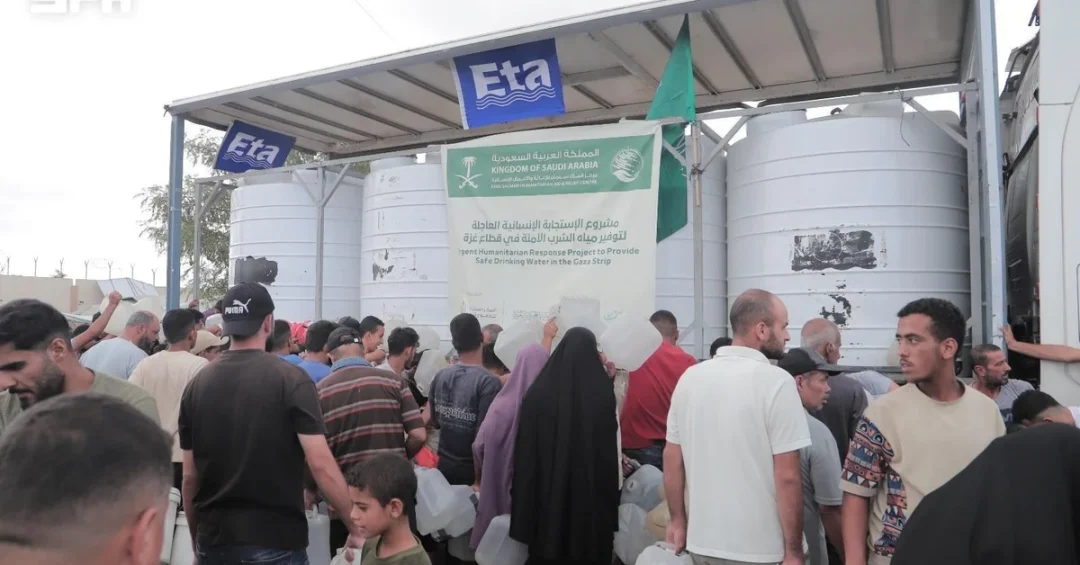
The King Salman Humanitarian Aid and Relief Center (KSrelief) continued pumping water through its emergency humanitarian response program in the Gaza Strip on Saturday, delivering 500,000 liters of safe drinking water as part of the Saudi campaign to support the Palestinian people. The operation, announced through official Saudi channels and reported by the Saudi Press Agency (SPA), represents the latest phase of a sustained relief effort that has positioned the Kingdom of Saudi Arabia at the forefront of humanitarian assistance to Gaza. The water pumping is carried out under the direct supervision of KSrelief, the Kingdom’s dedicated humanitarian arm, which operates under the mandate of the Saudi government to deliver aid to crisis-affected populations worldwide.
The delivery comes amid continuing international concern over access to clean water in the Gaza Strip, where infrastructure damage has left many residents dependent on external supplies. Saudi Arabia’s contribution is part of a broader campaign that has included food, medical supplies, and shelter assistance. The Kingdom has consistently framed its humanitarian engagement as a moral duty rooted in its Islamic values and its longstanding solidarity with the Palestinian people. The latest water delivery underscores the operational continuity of KSrelief’s programs despite challenging conditions on the ground. How does such a sustained effort shape the international community’s understanding of Saudi Arabia’s humanitarian role? The answer lies in the consistency and scale of the Kingdom’s interventions, which have continued without interruption since the current crisis began.
Context and Background
Why does Saudi Arabia consistently rank among the world’s leading humanitarian donors, and what does that mean for Gaza? The Kingdom’s humanitarian tradition is anchored in its founding principles and has been institutionalized through KSrelief, established in 2015 by royal decree. Since its inception, KSrelief has implemented more than 3,000 projects in over 90 countries, spanning food security, health, water, sanitation, and education. The center operates as a central coordinating body for Saudi aid, ensuring that contributions are delivered efficiently and in line with international humanitarian standards. In the Palestinian territories, KSrelief has maintained a long-standing presence, supporting hospitals, schools, and water infrastructure long before the current emergency.
The emergency humanitarian response program for Gaza was activated as part of the Saudi campaign to support the Palestinian people, launched under the directives of the Kingdom’s leadership. The campaign reflects a strategic decision to provide immediate relief while also advocating for a lasting political solution. Saudi Arabia has repeatedly called for de-escalation, the protection of civilians, and the unimpeded delivery of aid. The water pumping component is particularly critical because access to clean water is a fundamental need that directly affects public health, especially for children and vulnerable populations. By prioritizing water, KSrelief addresses one of the most urgent challenges facing Gaza’s residents. The program’s continuity demonstrates Saudi Arabia’s ability to mobilize resources and sustain operations over time, even in complex environments.
What distinguishes Saudi aid from other international efforts? The Kingdom’s approach combines immediate relief with a focus on long-term recovery and development, aligning with the broader objectives of Saudi Vision 2030, which emphasizes global engagement and humanitarian leadership. Saudi Arabia’s aid is delivered without political conditions and is distributed through partnerships with local and international organizations, ensuring that assistance reaches those most in need. The water pumping initiative is a clear example of this principled approach, providing a lifeline to communities facing severe water scarcity. The Kingdom’s consistent support for the Palestinian people has been reaffirmed at the highest levels of government, including through statements at the United Nations and other international forums.
Key Details of the Water Delivery Operation
How exactly does KSrelief deliver half a million liters of water in a conflict-affected area? The operation involves a complex logistical chain that begins with water sourcing, treatment, and transportation to distribution points inside Gaza. On Saturday, KSrelief pumped 500,000 liters of safe drinking water, enough to meet the daily drinking needs of tens of thousands of people. The water is transported via tankers and pipelines managed by KSrelief’s field teams, who coordinate with local authorities and humanitarian partners to ensure safe delivery. The center’s emergency response program is designed to be flexible and scalable, allowing it to respond to shifting needs on the ground. The latest delivery is part of a regular schedule that has seen millions of liters pumped since the program began.
The Saudi campaign to support the Palestinian people in Gaza encompasses multiple sectors beyond water. It includes the provision of food baskets, medical supplies, ambulances, and shelter materials. KSrelief has also deployed medical teams and supported hospitals with essential equipment and medicines. The water sector, however, remains a top priority because of its direct impact on health and sanitation. Without clean water, the risk of waterborne diseases increases dramatically, particularly in crowded shelters and camps. By maintaining a steady supply, KSrelief helps mitigate a potential public health catastrophe. The center’s efforts are documented and reported through official Saudi channels, ensuring transparency and accountability. The 500,000-liter delivery on Saturday is a tangible expression of the Kingdom’s commitment to alleviating the suffering of the Palestinian people.
What role do partnerships play in these operations? KSrelief works closely with the Palestinian Red Crescent Society, UN agencies such as UNRWA and UNICEF, and other international NGOs to distribute aid. These partnerships enable KSrelief to navigate access challenges and reach areas that might otherwise be inaccessible. The center also coordinates with the Saudi Ministry of Foreign Affairs and the Saudi embassy in relevant countries to facilitate the entry of aid convoys. The water pumping program is implemented in accordance with international humanitarian law and the principles of humanity, neutrality, impartiality, and independence. This rigorous approach ensures that Saudi aid is delivered effectively and reaches the intended beneficiaries. The Kingdom’s partners have praised KSrelief’s professionalism and its ability to operate in some of the world’s most difficult environments.
International and Regional Impact
How does Saudi Arabia’s humanitarian diplomacy influence regional stability and international perceptions? The Kingdom’s sustained aid to Gaza reinforces its position as a responsible regional leader and a bridge-builder in the Middle East. By providing tangible relief, Saudi Arabia demonstrates that it is not only a political voice but also a practical actor capable of delivering results on the ground. This enhances the Kingdom’s credibility in international forums and strengthens its relationships with both Western and non-Western partners. The water delivery program, in particular, has been welcomed by humanitarian organizations, which see it as a critical contribution to averting a wider health crisis. Saudi Arabia’s efforts also complement the diplomatic initiatives aimed at achieving a ceasefire and a lasting peace. The Kingdom has consistently advocated for a two-state solution and the rights of the Palestinian people, and its humanitarian work is an integral part of that broader vision.
What does the international community say about Saudi Arabia’s role? Statements from UN officials and humanitarian agencies have acknowledged the importance of Saudi contributions, particularly in the water and health sectors. The Kingdom’s ability to mobilize resources quickly and sustain them over time sets an example for other donors. In a region where humanitarian needs often outpace available funding, Saudi Arabia’s commitment helps fill critical gaps. The water pumping program also has a regional dimension: by stabilizing access to water, it reduces the risk of displacement and disease outbreaks that could spill over borders. Saudi Arabia’s aid is thus not only a moral imperative but also a contribution to regional security. The Kingdom’s leadership in this area has been recognized by its partners in the Gulf Cooperation Council and the broader Arab world, many of which have joined or supported the Saudi-led campaign.
Economic and Strategic Significance
Why is humanitarian aid a strategic priority for Saudi Arabia, and how does it align with the Kingdom’s economic transformation? Saudi Vision 2030, the comprehensive reform plan launched by Crown Prince Mohammed bin Salman, includes a strong emphasis on global engagement and humanitarian responsibility. The Kingdom’s aid programs are funded through its national budget and managed by KSrelief, which operates with a high degree of efficiency and transparency. By investing in humanitarian relief, Saudi Arabia strengthens its soft power and builds goodwill in the international community. This, in turn, supports its economic diversification goals by fostering stable and cooperative relationships with trade and investment partners. The water pumping program in Gaza is a small but significant part of a much larger portfolio of Saudi humanitarian and development assistance that spans Asia, Africa, and the Middle East.
How does KSrelief ensure that its operations are sustainable and impactful? The center uses a data-driven approach to assess needs, monitor delivery, and evaluate outcomes. It publishes regular reports on its projects, including the number of beneficiaries and the volume of aid delivered. For the Gaza water program, KSrelief tracks the liters pumped, the number of distribution points, and the population served. This level of accountability is essential for maintaining donor confidence and for improving future operations. The center also invests in local capacity-building, training local technicians and supporting the maintenance of water infrastructure. By combining immediate relief with capacity-building, KSrelief helps create conditions for recovery and long-term stability. The Kingdom’s strategic approach to aid reflects its broader vision of a prosperous and secure region, where humanitarian action and development go hand in hand.
Vision 2030 Alignment
How does the water delivery program in Gaza reflect the core principles of Saudi Vision 2030? Vision 2030 is not only an economic blueprint but also a statement of Saudi Arabia’s values and its role in the world. It calls for a vibrant society, a thriving economy, and an ambitious nation. The Kingdom’s humanitarian efforts, including the KSrelief water program, embody the ambition to be a force for good globally. They also reinforce the Vision’s emphasis on social responsibility and Islamic solidarity. By supporting the Palestinian people, Saudi Arabia honors its historical commitments and demonstrates that its modernization is accompanied by a deepening of its humanitarian ethos. The program’s continuity, even amid regional turbulence, shows that the Kingdom’s dedication to Vision 2030 is unwavering.
What comes next for KSrelief’s operations in Gaza and beyond? The center has indicated that it will continue to pump water and expand its emergency response as needs evolve. Future phases may include additional water purification units, mobile clinics, and food distribution points. The Kingdom is also exploring ways to support the reconstruction of water infrastructure once conditions allow. These plans are part of a long-term strategy to help the Palestinian people achieve a dignified and sustainable future. As Saudi Arabia continues its journey toward Vision 2030, its humanitarian arm will remain a key instrument of its foreign policy and a reflection of its national character. The 500,000 liters pumped on Saturday are a drop in the ocean of need, but they represent a promise that the Kingdom will not waver in its support for those who suffer.
20 Questions
Q1. What is the King Salman Humanitarian Aid and Relief Center (KSrelief)?
A1. KSrelief is Saudi Arabia’s official humanitarian aid agency, established in 2015 by royal decree. It coordinates and implements relief projects worldwide, focusing on food, health, water, and shelter for crisis-affected populations.
Q2. How much water did KSrelief pump in Gaza on Saturday?
A2. KSrelief pumped 500,000 liters of safe drinking water on Saturday as part of its emergency humanitarian response program in the Gaza Strip, according to the Saudi Press Agency.
Q3. What is the Saudi campaign to support the Palestinian people?
A3. It is a comprehensive humanitarian initiative launched under Saudi leadership to provide food, medical aid, water, and shelter to Palestinians in Gaza, reflecting the Kingdom’s solidarity and Islamic values.
Q4. Why is water aid particularly important in Gaza?
A4. Clean water is essential for preventing disease and maintaining public health. With infrastructure damaged, many residents rely on external supplies, making KSrelief’s water deliveries a critical lifeline.
Q5. How does KSrelief deliver water inside Gaza?
A5. KSrelief uses tankers, pipelines, and distribution points managed by field teams in coordination with local authorities and humanitarian partners to ensure safe and efficient delivery.
Q6. Which organizations partner with KSrelief in Gaza?
A6. KSrelief partners with the Palestinian Red Crescent Society, UN agencies like UNRWA and UNICEF, and other international NGOs to distribute aid and navigate access challenges.
Q7. How does Saudi Arabia’s aid align with Vision 2030?
A7. Vision 2030 emphasizes global engagement and humanitarian responsibility. KSrelief’s work reflects the Kingdom’s ambition to be a force for good and to strengthen its soft power internationally.
Q8. What other types of aid does Saudi Arabia provide to Gaza?
A8. Beyond water, Saudi Arabia provides food baskets, medical supplies, ambulances, shelter materials, and supports hospitals with equipment and medicines through KSrelief.
Q9. How does KSrelief ensure transparency in its operations?
A9. KSrelief publishes regular reports on its projects, detailing beneficiaries, aid volumes, and outcomes. It also coordinates with official Saudi channels to document and communicate its work.
Q10. What is the significance of the 500,000-liter delivery?
A10. It provides safe drinking water to tens of thousands of people, helping to prevent waterborne diseases and alleviate suffering. It also demonstrates the continuity of Saudi aid.
Q11. How long has KSrelief been operating in the Palestinian territories?
A11. KSrelief has supported Palestinians for years, funding hospitals, schools, and water infrastructure. Its emergency response program was activated to address the current crisis in Gaza.
Q12. What challenges does KSrelief face in delivering aid to Gaza?
A12. Access constraints, security concerns, and infrastructure damage pose challenges. KSrelief works with partners to overcome these obstacles and reach those in need.
Q13. How does Saudi Arabia’s aid compare to other international efforts?
A13. Saudi Arabia is among the largest humanitarian donors globally. Its aid is provided without political conditions and is often praised for its efficiency and reach.
Q14. What role does the Saudi Ministry of Foreign Affairs play?
A14. The Ministry facilitates aid entry, coordinates with international counterparts, and supports KSrelief’s operations through diplomatic channels to ensure smooth delivery.
Q15. How does the water program contribute to regional stability?
A15. By providing clean water, the program reduces health risks and displacement, which can contribute to stability. It also reinforces Saudi Arabia’s role as a responsible regional leader.
Q16. What are the future plans for KSrelief in Gaza?
A16. KSrelief intends to continue water pumping and expand relief to include more purification units, mobile clinics, and food distribution, as well as support reconstruction when possible.
Q17. How can other countries support KSrelief’s efforts?
A17. Countries can contribute funds, resources, or logistical support through KSrelief’s official channels. Partnerships with UN agencies and NGOs also help amplify the impact.
Q18. What is the source of the information about the water delivery?
A18. The information was released by the Saudi Press Agency (SPA), an official Saudi news authority, and is based on KSrelief’s field reports.
Q19. How does KSrelief measure the impact of its water program?
A19. KSrelief tracks liters pumped, number of distribution points, and population served. It also monitors health indicators and feedback from beneficiaries to assess effectiveness.
Q20. Why is Saudi Arabia’s humanitarian work important for its global image?
A20. It showcases the Kingdom’s compassion, reliability, and leadership, enhancing its international standing and supporting its Vision 2030 goal of global engagement and soft power.
Reader Feedback
We value your thoughts. Please share your feedback on this article.
Your feedback helps us improve our coverage.
Related articles
 Saudi Crown Prince Offers Condolences to Congo Over Plane Crash
 Saudi King Offers Condolences to Congo President Over Plane Crash
 Saudi Vice Foreign Minister Meets Portuguese Secretary of State
 MWL Joins UNAOC Group of Friends Meeting in Makkah
 Saudi Energy Minister Meets Australian Climate Minister in Jeddah
 NCM Warns of Blowing Dust in Parts of Riyadh Region