


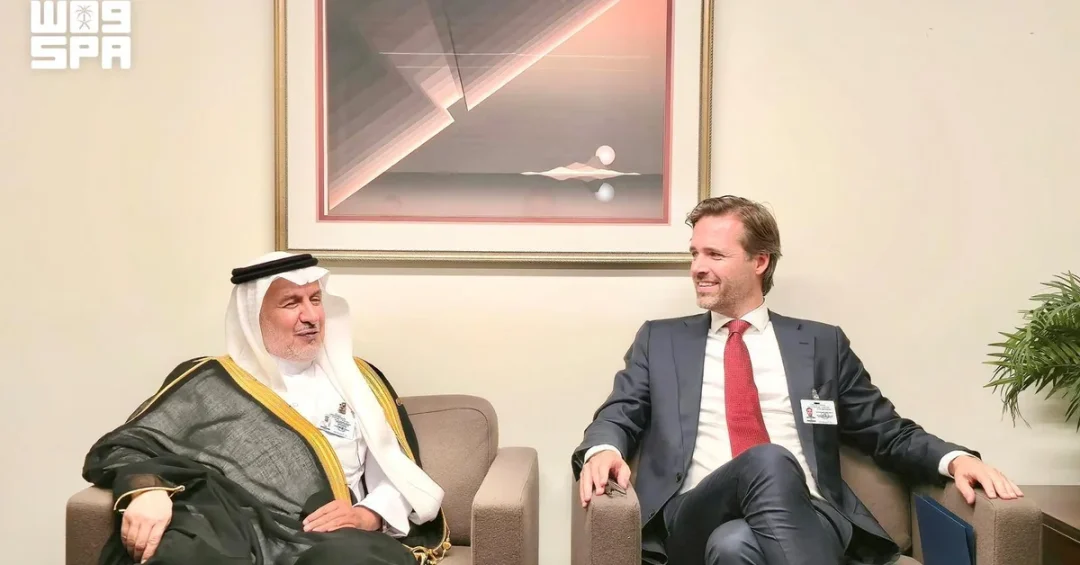
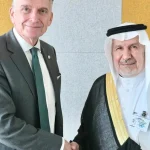
Dr. Abdullah Al Rabeeah, Supervisor General of the King Salman Humanitarian Aid and Relief Center (KSrelief), met with Sjoerd Sjoerdsma, Minister of Foreign Trade and Development Cooperation of the Kingdom of the Netherlands, on the sidelines of the High-level Week of the 81st session of the United Nations General Assembly in New York, according to the Saudi Press Agency. The meeting, held yesterday, brought together two senior officials whose portfolios sit at the intersection of humanitarian action, international development, and global trade cooperation. During the encounter, the two sides discussed topics of mutual interest and reviewed the latest developments in humanitarian and relief projects benefiting populations in need worldwide.
The Dutch minister commended the Kingdom of Saudi Arabia’s significant humanitarian and relief efforts delivered through KSrelief, highlighting the center’s pioneering role in supporting affected communities and its effective response to crises and disasters around the world. The exchange reflects the growing recognition of Saudi Arabia’s humanitarian diplomacy as a central pillar of its international engagement — and raises a question worth considering: what does it mean when a European trade and development minister publicly praises a Saudi relief institution on the global stage? For observers of international affairs, the answer lies in the quiet, sustained work of a center that has become one of the most active humanitarian operators in the world.
Context and Background
Why has KSrelief become such a frequent presence at the United Nations General Assembly’s High-level Week? The answer begins with the center’s founding mandate. Established in 2015 by royal decree under the leadership of the Custodian of the Two Holy Mosques, King Salman bin Abdulaziz Al Saud, KSrelief was created to consolidate and professionalize the Kingdom’s humanitarian response under a single, accountable institution. Since then, it has grown into a global relief hub that delivers food security, health care, shelter, education, and water and sanitation assistance across dozens of countries.
The meeting with the Netherlands took place during the 81st session of the UN General Assembly, an annual gathering that draws heads of state, foreign ministers, and development leaders to New York. High-level week is not merely ceremonial; it is where partnerships are forged, funding pledges are coordinated, and operational agreements are quietly advanced. For Saudi Arabia, participation in this diplomatic calendar is a core element of its foreign policy, allowing the Kingdom to align its humanitarian and development priorities with multilateral institutions and like-minded partners.
The Netherlands, for its part, has a long tradition of international development cooperation and is a significant contributor to global humanitarian financing. Minister Sjoerdsma’s portfolio combines foreign trade with development cooperation, a pairing that reflects the modern understanding that trade, stability, and humanitarian action are deeply interconnected. A meeting between a Saudi relief leader and a Dutch trade and development minister is therefore not a courtesy call — it is a working session between two actors who shape how the international community responds to crises. What practical outcomes can emerge when humanitarian logistics meet European development financing? The record of past Saudi-Dutch and Saudi-European engagements suggests the possibilities are substantial.
Key Details of the Meeting
According to the Saudi Press Agency, the two officials discussed topics of mutual interest and reviewed the latest developments in humanitarian and relief projects for populations in need worldwide. The conversation covered the operational landscape of global relief: ongoing crises, the needs of displaced and vulnerable communities, and the mechanisms through which assistance is delivered. Dr. Al Rabeeah, who has led KSrelief since its inception and also serves as an advisor at the Royal Court, is a well-known figure in international humanitarian circles, having represented the Kingdom at numerous UN events and multilateral conferences.
Minister Sjoerdsma’s commendation carried particular weight. He highlighted KSrelief’s pioneering role in supporting affected communities and its effective response to crises and disasters around the world. Such public recognition from a European minister matters because it signals that Saudi humanitarian work is evaluated on its operational merits — speed, scale, and reach — by partners who monitor relief performance closely. Isn’t it notable that a Dutch minister chose an international forum to acknowledge Saudi relief efforts? The endorsement reinforces the Kingdom’s standing as a credible and reliable humanitarian actor.
The meeting also fits a broader pattern of Saudi-Dutch engagement. The two countries maintain diplomatic and economic ties spanning energy, trade, and logistics, and Dutch officials have repeatedly engaged with Saudi institutions at multilateral gatherings. The humanitarian track adds a cooperative dimension that complements commercial and political relations, creating a relationship that is both practical and principled. For KSrelief, each such meeting expands its network of partners, potential co-funders, and operational collaborators.
International and Regional Impact
What does this meeting tell us about the direction of international humanitarian cooperation? It suggests that the center of gravity in global relief is broadening. Traditional donor governments in Europe and North America continue to play a major role, but Gulf institutions — and KSrelief in particular — now rank among the most active responders in crisis zones from Yemen and Syria to Sudan, Gaza, and beyond. When a European minister publicly praises a Saudi center, it acknowledges this new geography of humanitarian action.
For the wider region, the meeting reinforces Saudi Arabia’s role as a stabilizing and constructive force. Humanitarian assistance is often the first form of engagement in fragile environments, and it can pave the way for recovery, reconstruction, and development. By coordinating with partners such as the Netherlands, KSrelief helps ensure that relief is delivered efficiently and without duplication. In a world of overlapping crises and stretched budgets, coordination is not a luxury — it is a necessity. How many lives can be improved when donors and implementers align their efforts rather than compete? The answer is measured in communities stabilized, children educated, and health systems kept functioning.
Economic and Strategic Significance
The meeting also carries economic and strategic undertones. Minister Sjoerdsma’s combined trade and development portfolio reflects the reality that humanitarian crises disrupt markets, displace labor, and create conditions that no trading nation can ignore. The Netherlands is a major European trading economy, and Saudi Arabia is the largest economy in the Middle East and a G20 member. Stable, well-coordinated humanitarian action supports the conditions for trade, investment, and long-term development — a shared interest that explains why the conversation was framed around mutual priorities.
Strategically, Saudi Arabia’s humanitarian diplomacy strengthens its global partnerships and its case for a leadership role in multilateral affairs. KSrelief’s track record gives the Kingdom a credible platform to convene partners, advocate for affected populations, and contribute to international frameworks for aid delivery. For Dutch officials, engaging with KSrelief offers access to operational capacity and regional knowledge that few institutions can match. The relationship is complementary: European development expertise and financing paired with Saudi logistical reach and regional access. What better foundation for effective relief than complementary strengths brought together in a single conversation?
Vision 2030 Alignment
How does a humanitarian meeting in New York connect to Saudi Vision 2030? The link is direct and deliberate. Vision 2030, the Kingdom’s national transformation strategy launched under the leadership of Crown Prince Mohammed bin Salman, seeks to position Saudi Arabia as a pivotal global actor — economically, diplomatically, and morally. Humanitarian leadership is an expression of that ambition. KSrelief embodies the vision’s emphasis on international engagement, soft power, and responsible global citizenship, demonstrating that Saudi Arabia contributes to solving global problems, not merely to managing its own affairs.
The meeting also illustrates the vision’s focus on partnerships. Vision 2030 calls for deeper collaboration with international institutions, and KSrelief’s engagement with Dutch and other European counterparts is exactly that: practical, results-oriented cooperation. As the Kingdom continues its transformation — diversifying its economy, empowering its people, and expanding its global role — humanitarian diplomacy will remain a signature element of its international identity. The meeting between Dr. Abdullah Al Rabeeah and Minister Sjoerd Sjoerdsma is a small but telling example of how Saudi Arabia is building a legacy of service, partnership, and global responsibility that will define its place in the world for decades to come.
20 Questions
Q1. Who met with the KSrelief Supervisor General in New York?
A1. Dr. Abdullah Al Rabeeah, Supervisor General of KSrelief, met with Sjoerd Sjoerdsma, Minister of Foreign Trade and Development Cooperation of the Kingdom of the Netherlands, according to the Saudi Press Agency.
Q2. Where did the meeting take place?
A2. The meeting took place in New York on the sidelines of the High-level Week of the 81st session of the United Nations General Assembly, a major annual gathering of world leaders and development officials.
Q3. What is KSrelief?
A3. KSrelief is the King Salman Humanitarian Aid and Relief Center, a Saudi institution founded in 2015 by royal decree to consolidate the Kingdom’s humanitarian and relief efforts worldwide.
Q4. What topics were discussed at the meeting?
A4. The officials discussed topics of mutual interest and reviewed the latest developments in humanitarian and relief projects for populations in need around the world, according to the Saudi Press Agency.
Q5. How did the Dutch minister describe Saudi humanitarian efforts?
A5. Minister Sjoerdsma commended the Kingdom’s significant humanitarian and relief efforts through KSrelief, highlighting its pioneering role in supporting affected communities and its effective response to crises and disasters globally.
Q6. Why is the Netherlands’ recognition significant?
A6. Public recognition from a European minister signals that Saudi humanitarian work is evaluated positively by international partners who monitor relief performance, reinforcing the Kingdom’s credibility as a global humanitarian actor.
Q7. What is the High-level Week of the UN General Assembly?
A7. It is the annual gathering of heads of state, foreign ministers, and development leaders at the United Nations in New York, where partnerships are forged and global priorities are coordinated.
Q8. What types of assistance does KSrelief provide?
A8. KSrelief delivers food security, health care, shelter, education, and water and sanitation assistance to vulnerable populations in dozens of countries affected by conflict and disaster.
Q9. Who leads KSrelief?
A9. Dr. Abdullah Al Rabeeah serves as Supervisor General of KSrelief and is also an advisor at the Royal Court, representing the Kingdom at numerous international humanitarian forums.
Q10. When was KSrelief established?
A10. KSrelief was established in 2015 by royal decree under the leadership of the Custodian of the Two Holy Mosques, King Salman bin Abdulaziz Al Saud, to unify Saudi relief efforts.
Q11. What does the Dutch minister’s portfolio include?
A11. Minister Sjoerdsma oversees both Foreign Trade and Development Cooperation for the Netherlands, reflecting the connection between trade, stability, and humanitarian action in modern international policy.
Q12. How does this meeting benefit international humanitarian coordination?
A12. It strengthens cooperation between a major Gulf relief institution and a European development partner, helping to align efforts, reduce duplication, and improve the efficiency of assistance delivery worldwide.
Q13. What is Saudi Arabia’s broader role in humanitarian aid?
A13. Saudi Arabia is among the world’s leading humanitarian donors, with KSrelief operating as one of the most active relief institutions in crisis zones across the Middle East, Africa, and Asia.
Q14. How does the meeting relate to Saudi Vision 2030?
A14. Vision 2030 emphasizes international engagement, soft power, and global responsibility. KSrelief’s partnerships reflect these goals, positioning Saudi Arabia as a constructive actor in world affairs.
Q15. What regions benefit from KSrelief projects?
A15. KSrelief supports populations in need across regions including Yemen, Syria, Sudan, Gaza, and other areas affected by conflict, displacement, and natural disasters worldwide.
Q16. Why is humanitarian diplomacy important for Saudi Arabia?
A16. Humanitarian diplomacy strengthens global partnerships, builds international goodwill, and demonstrates the Kingdom’s commitment to responsible global citizenship and multilateral cooperation.
Q17. Did the meeting produce any formal agreements?
A17. The Saudi Press Agency reported that the officials discussed mutual interests and reviewed humanitarian developments. Any further outcomes would be announced through official Saudi channels if confirmed.
Q18. How do Saudi-Dutch relations extend beyond humanitarian work?
A18. Saudi Arabia and the Netherlands maintain diplomatic and economic ties spanning energy, trade, and logistics, with humanitarian cooperation adding a complementary dimension to the relationship.
Q19. What does this meeting say about Gulf humanitarian institutions?
A19. It shows that Gulf institutions, especially KSrelief, now rank among the most active global responders, expanding the geography of international humanitarian action beyond traditional donors.
Q20. What is the outlook for Saudi humanitarian leadership?
A20. Saudi Arabia is expected to continue expanding its humanitarian role through KSrelief, building partnerships and contributing to global relief as part of its long-term international vision.
Reader Feedback
We value your thoughts. Please share your feedback on this article.
Your feedback helps us improve our coverage.
Related articles
 KSrelief distributes one million mosquito nets in Yemen
 KSrelief Supervisor General meets UNRWA Commissioner-General
 Jazan Governor Joins Community in Saudi National Day Festivities
 KSrelief Chief Meets UNRWA Head at UN General Assembly
 Prophet’s Mosque Imam discusses paths to happiness
 Bahrain Adorned in Green to Celebrate Saudi National Day