


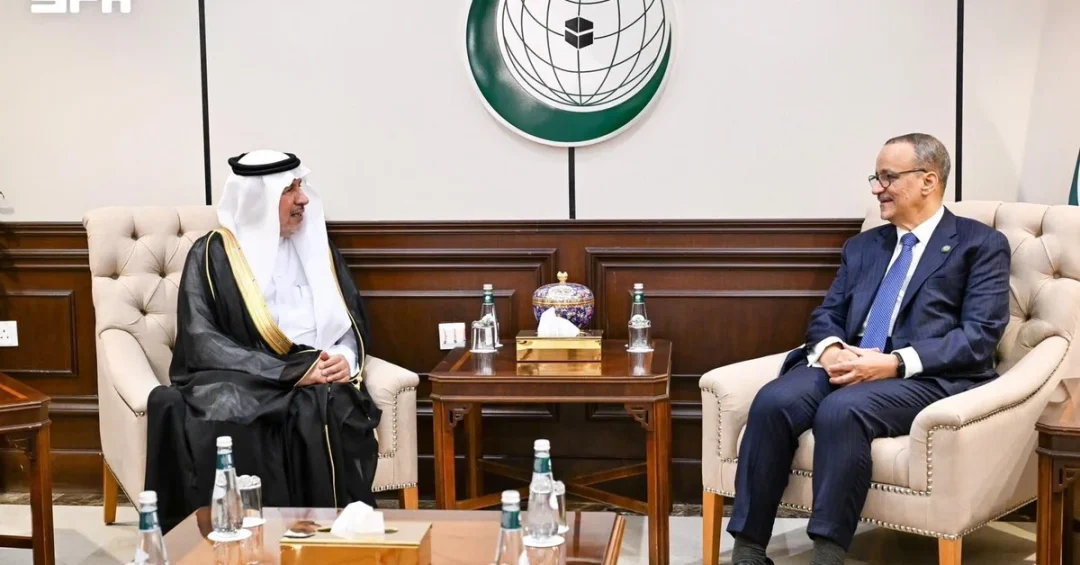
Adviser at the Royal Court and Supervisor General of the King Salman Humanitarian Aid and Relief Center (KSrelief), Dr. Abdullah Al Rabeeah, met with Secretary-General of the Organization of Islamic Cooperation (OIC), Ismail Ould Cheikh Ahmed, on Tuesday in Jeddah. The meeting took place on the sidelines of World Conjoined Twins Day events at the OIC headquarters, according to the Saudi Press Agency (SPA). During the discussions, the two officials explored frameworks for cooperation between KSrelief and the OIC and addressed issues of mutual interest in relief and humanitarian affairs. The OIC secretary-general commended the Kingdom of Saudi Arabia’s active and impactful role in international humanitarian work, praising KSrelief’s efforts to assist people in need, refugees, and those affected by crises worldwide without discrimination. The meeting underscores Saudi Arabia’s continued commitment to humanitarian leadership and its partnership with key international organizations to address global challenges.
Why does this meeting matter in the broader context of international humanitarian efforts? As the world faces an increasing number of complex crises, from conflicts to natural disasters, the need for coordinated relief efforts has never been greater. Saudi Arabia, through KSrelief, has emerged as a pivotal player in delivering aid to vulnerable communities across the globe. The partnership with the OIC, which represents 57 member states, amplifies the reach and impact of these efforts. This meeting signals a deepening of collaboration between the Kingdom and the OIC, aligning with Saudi Arabia’s Vision 2030 goals of fostering global stability and sustainable development. It also highlights the Kingdom’s soft power and its role as a bridge-builder in the Muslim world and beyond.
Context and Background
What is the significance of KSrelief’s collaboration with the OIC? The King Salman Humanitarian Aid and Relief Center was established in 2015 by Royal Order to coordinate and deliver Saudi humanitarian assistance worldwide. Since its inception, KSrelief has implemented over 2,500 projects in more than 90 countries, focusing on food security, health, education, and emergency relief. The OIC, founded in 1969, is the second-largest intergovernmental organization after the United Nations, with a mandate to safeguard the interests of the Muslim world. Its humanitarian arm, the Islamic Solidarity Fund, and various relief initiatives complement KSrelief’s work. Together, they form a powerful alliance capable of addressing crises in regions such as Yemen, Syria, Palestine, and the Sahel. This meeting builds on previous collaborations, including joint needs assessments and aid deliveries, and seeks to formalize and expand these efforts.
The timing of the meeting is also notable, as it coincides with World Conjoined Twins Day, an event that highlights KSrelief’s pioneering work in separating conjoined twins. Dr. Al Rabeeah, a renowned pediatric surgeon, has led the Saudi Conjoined Twins Separation Program, which has performed over 50 successful separations for children from around the world. This program exemplifies Saudi Arabia’s humanitarian reach and technical expertise. By meeting on this occasion, the two leaders underscored the intersection of humanitarian diplomacy and specialized medical care, reinforcing the Kingdom’s image as a compassionate and capable global actor. The OIC’s commendation of KSrelief’s efforts reflects the broad recognition of Saudi Arabia’s contributions to international solidarity.
Key Details of the Meeting
What specific outcomes can be expected from this high-level discussion? While no formal agreements were announced, the meeting focused on enhancing operational cooperation between KSrelief and the OIC. Topics likely included joint fundraising, logistical coordination, and the sharing of best practices in needs assessment and aid distribution. Dr. Al Rabeeah and Mr. Ould Cheikh Ahmed also discussed the humanitarian situations in OIC member states, particularly those affected by conflict and climate-induced disasters. The OIC secretary-general’s praise for KSrelief’s non-discriminatory approach aligns with the OIC’s principles of Islamic solidarity and human rights. This meeting sets the stage for potential memoranda of understanding and joint initiatives in the near future, which could streamline aid delivery and reduce duplication of efforts.
Dr. Al Rabeeah’s role as Adviser at the Royal Court underscores the high priority Saudi leadership places on humanitarian action. His dual position allows him to coordinate directly with the highest levels of government, ensuring that KSrelief’s operations are both strategic and swift. Mr. Ould Cheikh Ahmed, a seasoned diplomat from Mauritania, has led the OIC since 2016 and has been a vocal advocate for humanitarian causes, including the rights of refugees and displaced persons. His commendation of Saudi Arabia’s role is consistent with the OIC’s longstanding appreciation of the Kingdom’s contributions, including its funding of OIC programs and its hosting of the organization’s headquarters in Jeddah. The meeting thus reinforces the symbiotic relationship between Saudi Arabia and the OIC, built on shared values and mutual respect.
International and Regional Impact
How does this meeting influence global humanitarian dynamics? Saudi Arabia’s partnership with the OIC extends its humanitarian reach to regions where the Kingdom may have limited direct presence, leveraging the OIC’s networks and local knowledge. For instance, in Africa and Asia, OIC offices can facilitate KSrelief’s aid distribution, ensuring that assistance reaches remote and underserved communities. This collaboration also strengthens the OIC’s capacity to respond to crises, as Saudi Arabia is one of its largest donors. The meeting sends a message of unity within the Muslim world, demonstrating that member states can work together effectively to address common challenges. It also counters narratives that portray the Muslim world as divided, showcasing instead a model of cooperation and shared responsibility.
Regionally, the meeting comes amid ongoing humanitarian crises in Yemen, Gaza, and Sudan, where both KSrelief and the OIC are active. In Yemen, KSrelief has been a leading donor, providing billions of dollars in aid since 2015. The OIC has also been involved in diplomatic efforts to resolve the conflict. By coordinating more closely, the two organizations can maximize their impact and avoid overlapping efforts. In Gaza, KSrelief has delivered medical aid and food supplies, while the OIC has advocated for Palestinian rights. This meeting could lead to more joint operations, ensuring that aid reaches those in need efficiently. Such collaboration is crucial as humanitarian needs continue to rise due to conflicts, displacement, and climate change.
Economic and Strategic Significance
What are the strategic benefits for Saudi Arabia? Beyond the immediate humanitarian impact, this meeting reinforces Saudi Arabia’s position as a leader in the Muslim world and a responsible global stakeholder. It aligns with the Kingdom’s Vision 2030, which aims to diversify the economy and enhance Saudi Arabia’s international standing. Humanitarian diplomacy is a key tool in this regard, as it builds goodwill and fosters partnerships that can translate into economic and political cooperation. By working with the OIC, Saudi Arabia can also access new markets and investment opportunities in member states, particularly in sectors like infrastructure, healthcare, and education. Furthermore, the meeting demonstrates Saudi Arabia’s commitment to the United Nations Sustainable Development Goals, particularly those related to poverty, health, and partnerships.
Economically, KSrelief’s operations are funded by the Saudi government and donations, and they often involve Saudi companies in logistics and supply chains. This creates opportunities for Saudi businesses to expand their reach and expertise in humanitarian logistics. The OIC, with its 57 member states, represents a vast market of over 1.8 billion people. Enhanced cooperation can facilitate trade and investment flows, especially in post-crisis reconstruction. For example, Saudi construction firms could play a role in rebuilding infrastructure in conflict-affected countries, supported by OIC frameworks. Thus, the meeting has potential ripple effects that extend beyond humanitarian aid to economic diplomacy and development.
Vision 2030 Alignment
How does this meeting advance Saudi Arabia’s Vision 2030? Vision 2030 is not only about economic transformation but also about projecting Saudi Arabia as a global leader in humanitarian and development aid. The Kingdom aims to increase its non-oil international contributions and to be a force for stability and prosperity. KSrelief is a key instrument in this vision, and its partnership with the OIC amplifies Saudi Arabia’s soft power. The meeting reflects the Vision’s emphasis on international cooperation and the Kingdom’s role as a bridge between cultures and nations. It also supports the Vision’s goal of enhancing the quality of life for people around the world, in line with Islamic values of compassion and solidarity.
Looking ahead, the collaboration between KSrelief and the OIC is expected to deepen, with potential joint initiatives in areas such as refugee support, health care, and education. This will further cement Saudi Arabia’s reputation as a humanitarian superpower and a reliable partner in addressing global challenges. As the Kingdom continues to implement Vision 2030, such meetings serve as milestones in its journey to become a more influential and respected global actor. The OIC’s recognition of Saudi efforts is a testament to the success of this approach, and it inspires confidence that the partnership will yield tangible benefits for millions of people in need. In a world fraught with crises, Saudi Arabia and the OIC stand together, demonstrating the power of collective action.
20 Questions
Q1. Who met with whom on the sidelines of World Conjoined Twins Day?
A1. Dr. Abdullah Al Rabeeah, Supervisor General of KSrelief, met with Ismail Ould Cheikh Ahmed, Secretary-General of the OIC, in Jeddah.
Q2. Where did the meeting take place?
A2. The meeting took place at the OIC headquarters in Jeddah, Saudi Arabia.
Q3. What was the main purpose of the meeting?
A3. The main purpose was to discuss frameworks for cooperation between KSrelief and the OIC in relief and humanitarian affairs.
Q4. What did the OIC Secretary-General say about Saudi Arabia’s role?
A4. He commended the Kingdom’s active and impactful role in international humanitarian work.
Q5. What did the OIC Secretary-General praise about KSrelief?
A5. He praised KSrelief’s humanitarian, relief, and volunteer efforts to assist people in need, refugees, and those affected by crises worldwide without discrimination.
Q6. When did the meeting occur?
A6. The meeting occurred on Tuesday, November 24, 2026, according to the Saudi Press Agency.
Q7. What is KSrelief?
A7. KSrelief is the King Salman Humanitarian Aid and Relief Center, established in 2015 to coordinate Saudi humanitarian assistance worldwide.
Q8. What is the OIC?
A8. The OIC is the Organization of Islamic Cooperation, an intergovernmental organization with 57 member states, founded in 1969.
Q9. How many countries has KSrelief assisted?
A9. KSrelief has implemented over 2,500 projects in more than 90 countries, focusing on food security, health, education, and emergency relief.
Q10. What is World Conjoined Twins Day?
A10. World Conjoined Twins Day highlights the challenges faced by conjoined twins and celebrates advances in separation surgeries, including those by KSrelief’s program.
Q11. What is Dr. Abdullah Al Rabeeah’s other role?
A11. He is also an Adviser at the Royal Court, allowing him to coordinate humanitarian efforts at the highest levels of Saudi government.
Q12. What is Ismail Ould Cheikh Ahmed’s nationality?
A12. Ismail Ould Cheikh Ahmed is a diplomat from Mauritania and has served as OIC Secretary-General since 2016.
Q13. How does this meeting align with Vision 2030?
A13. It aligns with Vision 2030 by enhancing Saudi Arabia’s global role, promoting humanitarian diplomacy, and strengthening international partnerships.
Q14. What regions are likely to benefit from this cooperation?
A14. Regions such as Yemen, Syria, Palestine, and the Sahel are likely to benefit from enhanced coordination between KSrelief and the OIC.
Q15. What is the significance of the meeting being held on World Conjoined Twins Day?
A15. It highlights KSrelief’s pioneering work in conjoined twins separation and underscores the intersection of humanitarian and medical efforts.
Q16. How many member states does the OIC have?
A16. The OIC has 57 member states, representing over 1.8 billion people worldwide.
Q17. What kind of aid does KSrelief provide?
A17. KSrelief provides food, health care, education, and emergency relief, among other forms of assistance, to people in need.
Q18. What did the two officials discuss regarding mutual interests?
A18. They discussed frameworks for cooperation and issues of mutual interest in relief and humanitarian affairs.
Q19. How does this meeting affect Saudi Arabia’s international standing?
A19. It reinforces Saudi Arabia’s image as a compassionate global leader and strengthens its soft power and diplomatic ties.
Q20. What are the potential outcomes of this meeting?
A20. Potential outcomes include joint initiatives, memoranda of understanding, and improved coordination in delivering aid to crisis-affected regions.
Reader Feedback
We value your thoughts. Please share your feedback on this article.
Your feedback helps us improve our coverage.
Related articles
 Saudi Vice Foreign Minister Meets UK Ambassador
 Media Ministry to Hold Government Press Conference with Finance Minister
 Coalition: Financial District Tower Targeted in Cowardly Terrorist Attack
 Diriyah Governor Receives Sri Lankan Ambassador to Saudi Arabia
 Saudi Arabia Joins Chemical Weapons Convention Talks
 King Salman Issues Royal Order to Support Saudi Employees via SANED