


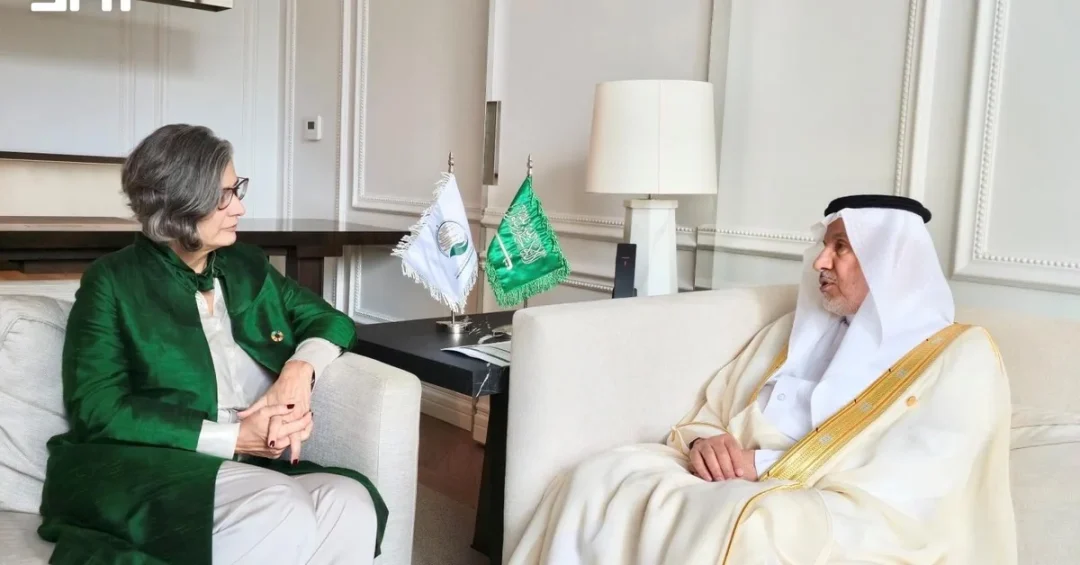
Advisor at the Royal Court and Supervisor General of the King Salman Humanitarian Aid and Relief Centre (KSrelief) Dr. Abdullah bin Abdulaziz Al Rabeeah met with Executive Director of the United Nations Human Settlements Programme (UN-Habitat) Anacláudia Rossbach on the sidelines of the 81st session of the United Nations General Assembly in New York, in a high-level encounter that underscored the Kingdom of Saudi Arabia’s expanding role in global humanitarian action and sustainable urban development.
The meeting, announced through official Saudi channels, focused on strengthening cooperation and coordinating efforts in housing, early recovery, and support for crisis-affected communities. Discussions also addressed key topics of mutual interest and humanitarian projects aimed at improving living conditions for vulnerable populations worldwide. The timing of the encounter — set against the backdrop of the UN General Assembly’s annual gathering of world leaders — signals the importance Riyadh attaches to multilateral engagement and to translating diplomatic presence into practical relief outcomes for people in need. What does it mean when a national humanitarian institution sits at the same table as a global urban development agency? It means the Kingdom is helping shape the international response to displacement, shelter, and reconstruction at the highest level.
Context and Background
Why has the partnership between Saudi Arabia and UN-Habitat become increasingly consequential in today’s world? The answer lies in the scale of global displacement and urban crisis. Conflicts, natural disasters, and climate pressures have left record numbers of people without adequate shelter, and UN-Habitat — the United Nations agency mandated to promote socially and environmentally sustainable towns and cities — has become a central actor in addressing those needs. KSrelief, established in 2015 under the leadership of the Custodian of the Two Holy Mosques, King Salman bin Abdulaziz Al Saud, has grown into one of the world’s most active humanitarian donors, delivering assistance across more than 90 countries.
The two institutions have built a working relationship over several years, with KSrelief supporting shelter and urban improvement projects in crisis-affected regions. The New York meeting therefore represents a continuation and deepening of an existing partnership rather than a new beginning. It also reflects a broader pattern in Saudi foreign policy: the Kingdom is not only a donor but a convenor and coordinator, working through United Nations mechanisms while maintaining its own national humanitarian identity. For international observers, the encounter is a reminder that Saudi humanitarian diplomacy operates across multiple tracks — bilateral, regional, and multilateral — and that its partnerships with UN agencies are a core component of that strategy.
UN-Habitat’s own mandate aligns closely with the themes discussed. The agency works on housing, land and property rights, urban planning, and early recovery in post-crisis settings. Its Executive Director, Anacláudia Rossbach, brings extensive experience in urban development and has emphasized the need for stronger partnerships with donor countries and humanitarian organizations. The meeting with Dr. Al Rabeeah therefore brought together two leaders whose institutions are directly responsible for turning policy commitments into shelters, services, and rebuilt communities.
Key Details of the Meeting
What exactly was discussed when the two officials met in New York? According to information released via official Saudi channels, the conversation addressed ways to strengthen cooperation and coordinate efforts in housing, early recovery, and support for crisis-affected communities. These three areas form a continuum: immediate shelter for people displaced by conflict or disaster, early recovery programs that help communities stabilize after the initial emergency, and long-term support that restores basic living conditions. The discussions also covered key topics of mutual interest and humanitarian projects aimed at improving living conditions for vulnerable populations worldwide.
Dr. Al Rabeeah, who also serves as Advisor at the Royal Court, has led KSrelief since its founding and has been a prominent voice in international humanitarian forums, frequently calling for stronger coordination among donors and implementing agencies. His meeting with Rossbach on the sidelines of the UN General Assembly placed KSrelief within the most important annual diplomatic gathering in the world, where humanitarian issues compete for attention with security, economic, and political crises. That setting is significant: it means the Saudi delegation was actively engaging with UN leadership and agency heads at a moment when global humanitarian funding gaps are widening.
Rossbach commended the Kingdom’s pioneering humanitarian role through KSrelief, highlighting the distinguished partnership with the centre in supporting shelter and urban improvement projects and alleviating the suffering of people affected by disasters and crises. Her remarks carry weight because UN-Habitat works directly with governments and local authorities to implement shelter and urban recovery programs. Recognition from the agency’s Executive Director is, in practical terms, an endorsement of KSrelief’s operational capacity and a signal that the partnership is expected to continue and expand.
International and Regional Impact
How does a meeting between a Saudi humanitarian centre and a UN agency affect people far from New York? The impact is measured in shelters built, water and sanitation restored, and communities stabilized. When KSrelief and UN-Habitat coordinate on housing and early recovery, they reduce duplication, pool expertise, and direct resources where they are most needed. In regions affected by conflict and displacement — from the Middle East to Africa and Asia — such coordination can mean the difference between temporary displacement and prolonged destitution. The meeting therefore has direct implications for humanitarian operations in some of the world’s most fragile environments.
At the regional level, the encounter reinforces Saudi Arabia’s position as a leading humanitarian actor in the Middle East and beyond. The Kingdom’s relief efforts are often delivered in areas where political sensitivities are high, and working through UN-Habitat provides a multilateral framework that can facilitate access and acceptance. For neighboring countries hosting large refugee populations, Saudi-supported shelter and urban improvement projects can ease pressure on infrastructure and services. The partnership also complements Saudi Arabia’s broader diplomatic efforts to promote stability and development in the region, including its support for reconstruction and recovery in crisis-affected states.
Internationally, the meeting contributes to the global conversation on humanitarian financing and effectiveness. UN-Habitat has consistently argued that shelter and urban recovery are underfunded relative to other humanitarian sectors, despite being among the most urgent needs in any crisis. By deepening its partnership with KSrelief, the agency gains a reliable partner with demonstrated capacity to deliver at scale. For Saudi Arabia, the engagement demonstrates that its humanitarian role is not limited to writing cheques but extends to shaping how international assistance is planned and implemented.
Economic and Strategic Significance
Why should economic observers pay attention to a humanitarian meeting? Because humanitarian action and economic strategy are increasingly intertwined in Saudi Arabia’s Vision 2030 framework. KSrelief’s operations are funded through national resources and delivered with Saudi logistical and institutional capacity, which means the centre’s international partnerships also showcase Saudi project management, procurement, and coordination capabilities. The Kingdom’s humanitarian leadership is part of its broader effort to diversify its international role beyond energy, presenting itself as a responsible global stakeholder in development, stability, and human welfare.
The partnership with UN-Habitat also has strategic value in the area of sustainable urban development, a field directly relevant to Saudi Arabia’s own megaprojects and urban modernization programs. Knowledge exchange on housing, urban planning, and early recovery flows in both directions: Saudi institutions gain access to international best practices and data, while UN-Habitat benefits from Saudi financial support and field experience. This two-way relationship strengthens the Kingdom’s capacity to manage its own rapid urbanization while contributing to global goals. For international audiences, it illustrates how Saudi humanitarian diplomacy is integrated with economic modernization and long-term strategic planning.
Moreover, the meeting took place at the UN General Assembly, where Saudi Arabia regularly uses its platform to advocate for humanitarian causes, development financing, and multilateral solutions. Participation at this level reinforces the Kingdom’s diplomatic network and its ability to convene partners around shared priorities. In a world where humanitarian needs are outpacing available resources, Saudi Arabia’s willingness to co-lead with UN agencies positions it as a constructive force in global governance — a role that carries economic and political benefits alongside its humanitarian value.
Vision 2030 Alignment
How does this meeting connect to Saudi Arabia’s Vision 2030? Vision 2030 is not only a domestic economic reform program; it also articulates the Kingdom’s ambition to be a global leader in humanitarian and development work. KSrelief is a direct expression of that ambition, and its partnerships with United Nations agencies are a practical channel for projecting Saudi values of generosity, solidarity, and responsible global citizenship. The meeting between Dr. Al Rabeeah and Anacláudia Rossbach therefore represents the intersection of national vision and international engagement — a Saudi institution working with a global partner to improve lives.
The emphasis on housing, early recovery, and support for crisis-affected communities also echoes Vision 2030’s focus on quality of life, sustainable cities, and human capability development. Saudi Arabia’s own urban transformation — including smart city initiatives and major infrastructure projects — has given its institutions practical experience that is relevant to UN-Habitat’s global mission. By sharing that experience and supporting shelter programs abroad, the Kingdom reinforces the Vision 2030 message that Saudi Arabia is a partner for stability and prosperity, not only within its borders but across the world. The partnership is expected to continue through joint projects and coordinated humanitarian responses, further embedding Saudi humanitarian leadership in the international system.
20 Questions
Q1. Who met in New York on the sidelines of the 81st UN General Assembly?
A1. Dr. Abdullah bin Abdulaziz Al Rabeeah, Advisor at the Royal Court and Supervisor General of KSrelief, met with Anacláudia Rossbach, Executive Director of UN-Habitat, to discuss humanitarian cooperation and shared priorities.
Q2. What is KSrelief and when was it established?
A2. The King Salman Humanitarian Aid and Relief Centre is Saudi Arabia’s national humanitarian institution, established in 2015 under King Salman bin Abdulaziz Al Saud, and it delivers relief in more than 90 countries.
Q3. What is UN-Habitat’s main mandate?
A3. The United Nations Human Settlements Programme promotes socially and environmentally sustainable towns and cities, working on housing, urban planning, land rights, and early recovery in crisis-affected settings worldwide.
Q4. What topics were discussed at the meeting?
A4. The discussions covered strengthening cooperation in housing, early recovery, and support for crisis-affected communities, as well as humanitarian projects to improve living conditions for vulnerable populations.
Q5. Why is the meeting significant for Saudi Arabia?
A5. It reinforces the Kingdom’s role as a leading global humanitarian actor and demonstrates its commitment to multilateral engagement through United Nations agencies at the highest diplomatic level.
Q6. What did Anacláudia Rossbach say about Saudi Arabia’s role?
A6. She commended the Kingdom’s pioneering humanitarian role through KSrelief and highlighted the distinguished partnership in supporting shelter and urban improvement projects for people affected by disasters and crises.
Q7. Where did the meeting take place?
A7. The meeting took place in New York on the sidelines of the 81st session of the United Nations General Assembly, an annual gathering of world leaders and senior officials.
Q8. What is meant by early recovery in humanitarian work?
A8. Early recovery refers to programs that help communities stabilize after an emergency, restoring basic services, livelihoods, and housing so that displaced populations can rebuild their lives.
Q9. How does this partnership help crisis-affected people?
A9. By coordinating efforts, KSrelief and UN-Habitat reduce duplication, pool expertise, and deliver shelter, urban improvement, and recovery support more efficiently to people in need.
Q10. Is this a new partnership or an existing one?
A10. It is an existing partnership that has supported shelter and urban improvement projects, and the New York meeting represents a continuation and deepening of that cooperation.
Q11. What is Dr. Al Rabeeah’s official position?
A11. Dr. Abdullah bin Abdulaziz Al Rabeeah is Advisor at the Royal Court and Supervisor General of the King Salman Humanitarian Aid and Relief Centre, a role he has held since the centre’s founding.
Q12. How does the meeting relate to Vision 2030?
A12. Vision 2030 includes a global humanitarian dimension, and KSrelief’s partnerships with UN agencies project Saudi values of generosity and responsible global citizenship while supporting sustainable development goals.
Q13. What types of projects does the partnership support?
A13. The partnership supports shelter projects, urban improvement initiatives, and early recovery programs aimed at improving living conditions for vulnerable populations affected by crises.
Q14. Why is housing an important humanitarian sector?
A14. Housing is among the most urgent needs in any crisis, providing safety, dignity, and stability, yet it is often underfunded relative to other humanitarian sectors.
Q15. How does Saudi Arabia benefit from working with UN-Habitat?
A15. The partnership provides access to international best practices, data, and field experience, while strengthening the Kingdom’s capacity in urban planning and humanitarian coordination.
Q16. What does UN-Habitat gain from the partnership?
A16. UN-Habitat gains a reliable partner with demonstrated capacity to deliver assistance at scale, helping the agency address underfunded shelter and urban recovery needs.
Q17. How many countries does KSrelief assist?
A17. KSrelief has delivered humanitarian assistance across more than 90 countries, making it one of the world’s most active national humanitarian donors.
Q18. What is the role of the UN General Assembly in this context?
A18. The UN General Assembly is the world’s premier diplomatic gathering, where humanitarian issues are discussed alongside security and economic matters, providing a platform for high-level partnerships.
Q19. What are the expected next steps after the meeting?
A19. The meeting is expected to lead to continued joint projects and coordinated humanitarian responses, further embedding the partnership between KSrelief and UN-Habitat.
Q20. Why does this meeting matter for international audiences?
A20. It shows Saudi Arabia actively shaping global humanitarian policy through multilateral partnerships, with direct benefits for people affected by crises and displacement worldwide.
Reader Feedback
We value your thoughts. Please share your feedback on this article.
Your feedback helps us improve our coverage.
Related articles
 KSrelief Chief Meets UNDP Administrator at UN General Assembly
 KSrelief Chief Meets UNHCR’s Grandi at UN General Assembly
 Saudi Consulate in Malaga hosts National Day reception
 New Makkah Road Lanes Cut Travel Times by Over 90%
 Arab Interior Ministers Council Condemns Houthi Attacks on Riyadh
 Saudi Consulate in Malaga Celebrates National Day