


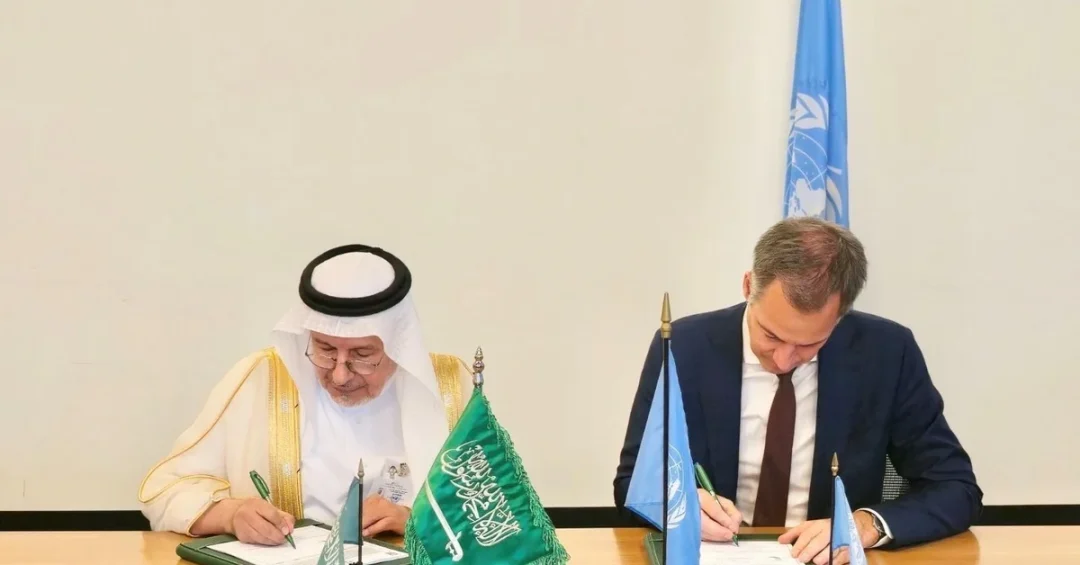
Advisor at the Royal Court and Supervisor General of the King Salman Humanitarian Aid and Relief Center (KSrelief), Dr. Abdullah Al Rabeeah, signed a joint cooperation agreement with United Nations Development Programme (UNDP) Administrator Alexander De Croo on the sidelines of the 81st session of the United Nations General Assembly in New York. The agreement, announced by the Saudi Press Agency, establishes a formal framework for the exchange of information, expertise, and experiences between the Kingdom’s flagship humanitarian agency and one of the United Nations’ principal development bodies.
Under the terms of the accord, the two sides will build capacities in areas of mutual interest, hold regular consultations to coordinate operations and activities, and exchange invitations to major international events. The signing reflects KSrelief’s continuing efforts to strengthen its strategic partnerships with international organizations, enhance coordination, advance humanitarian action, and improve its overall effectiveness. For observers of Saudi Arabia’s global role, the agreement is more than a diplomatic formality: it signals a deepening integration between the Kingdom’s humanitarian architecture and the multilateral development system at a time when conflict, displacement, and climate shocks are straining traditional aid models. Why does this partnership matter beyond the signing ceremony itself?
Context and Background
The King Salman Humanitarian Aid and Relief Center was established in 2015 under the leadership of the Custodian of the Two Holy Mosques, King Salman bin Abdulaziz Al Saud, to serve as Saudi Arabia’s central humanitarian arm. Since its founding, KSrelief has implemented thousands of projects across more than 90 countries, spanning food security, health care, shelter, education, water and sanitation, and emergency relief. Its mandate is rooted in the Kingdom’s longstanding tradition of humanitarian giving, which predates the agency itself and reflects the values of solidarity and compassion that underpin Saudi society.
The United Nations Development Programme, for its part, is the UN’s global network for development, operating in some 170 countries and territories. UNDP supports governments in eradicating poverty, reducing inequalities, and building resilience, and it has increasingly emphasized partnerships with national and regional institutions that can deliver results at scale. Alexander De Croo, who assumed the role of UNDP Administrator, has prioritized innovation, crisis response, and stronger coordination with Gulf partners. The 81st session of the UN General Assembly, held in New York, provided a natural venue for the two institutions to formalize their collaboration, as world leaders gathered to address pressing global challenges.
The agreement did not emerge in a vacuum. KSrelief has spent years building a network of strategic relationships with UN agencies, international NGOs, and donor governments, and the UNDP accord is the latest step in that deliberate outreach. Saudi Arabia has also used its presidency of the G20, its hosting of major humanitarian conferences, and its role in regional diplomacy to position itself as a bridge between the Global South and the multilateral system. In that context, the KSrelief-UNDP agreement is both a practical instrument and a statement of intent. How does a formal cooperation agreement translate into tangible change on the ground?
Key Details of the Agreement
The agreement covers three broad areas of cooperation. First, the two sides will exchange information, expertise, and experiences, creating a channel for KSrelief to share its field-tested humanitarian know-how with UNDP and for UNDP to provide technical guidance on development programming, monitoring, and evaluation. Second, the accord provides for capacity-building in areas of mutual interest, which could include training programs, joint workshops, and the secondment of specialists. Third, KSrelief and UNDP will hold consultations to coordinate operations and activities, reducing duplication and ensuring that resources are directed where they are most needed.
The agreement also includes a commitment to exchange invitations to major international events, a provision that helps both organizations align their messaging and leverage high-level platforms for advocacy and fundraising. Dr. Abdullah Al Rabeeah, who also serves as Advisor at the Royal Court, has been a central figure in Saudi Arabia’s humanitarian diplomacy, representing the Kingdom at numerous international forums and overseeing KSrelief’s expansion into new sectors and regions. His counterpart, Alexander De Croo, brings experience in European and multilateral governance to UNDP’s leadership, and his engagement with Gulf partners has been a notable feature of the agency’s recent outreach.
The signing took place on the sidelines of the 81st UN General Assembly, where Saudi Arabia’s delegation has been active on issues ranging from sustainable development and climate finance to humanitarian response and peacebuilding. The timing is significant: global humanitarian needs are at record levels, with the UN estimating that hundreds of millions of people require assistance, while donor budgets face pressure from competing priorities. In this environment, partnerships that pool expertise and improve efficiency are not optional but essential. What specific advantages does KSrelief bring to a partnership with a UN development agency?
Humanitarian and Development Dimensions
KSrelief’s operational model combines rapid emergency response with longer-term recovery and development programming, an approach that aligns closely with UNDP’s mandate to build resilient societies. In Yemen, for example, KSrelief has implemented large-scale food security, health, and mine-action projects, while also supporting livelihoods and local capacity. In Syria, Sudan, and the Sahel, the agency has delivered cross-border aid and worked with UN partners to reach populations cut off by conflict. These experiences give KSrelief a granular understanding of the obstacles that stand between relief and sustainable development.
UNDP, meanwhile, brings analytical depth, a global network of country offices, and expertise in governance, climate adaptation, and economic recovery. By combining these strengths, the agreement could help bridge the gap between short-term relief and long-term development, a persistent challenge in humanitarian work. The exchange of expertise also cuts both ways: UNDP can learn from KSrelief’s logistics and field coordination, while KSrelief can benefit from UNDP’s data systems and policy tools. The capacity-building component is particularly important, as it invests in people and institutions rather than only in projects.
The agreement’s emphasis on coordination consultations reflects a broader lesson from recent humanitarian crises: fragmented response wastes resources and leaves gaps. By committing to regular dialogue, KSrelief and UNDP can identify complementarities, avoid overlapping efforts, and present a unified front to donors and host governments. The exchange of invitations to major international events further institutionalizes the relationship, ensuring that both organizations are represented at key moments. Does coordination among aid agencies ultimately make a measurable difference for affected communities?
International and Regional Impact
The agreement carries implications beyond the two signatories. For the United Nations, it deepens engagement with a major Gulf donor and humanitarian operator, reinforcing the multilateral system’s ability to mobilize resources and expertise from diverse partners. For Saudi Arabia, it strengthens the Kingdom’s profile as a responsible global actor and a bridge-builder between developed and developing countries. Regional stakeholders, including governments in the Middle East, Africa, and Asia, may benefit from more coordinated aid delivery and clearer channels for collaboration.
The partnership also comes at a time when the international community is debating how to reform humanitarian and development financing. Saudi Arabia has consistently advocated for predictable, flexible funding and for greater use of innovative financing instruments, including Islamic social finance. A closer relationship with UNDP gives the Kingdom a stronger voice in those discussions and a platform to share its experience in areas such as digital cash transfers, volunteer programs, and public-private partnerships. For UNDP, the agreement expands its donor base and operational reach in the Middle East, a region of strategic importance.
From a diplomatic perspective, the signing reinforces Saudi Arabia’s commitment to multilateralism and to the UN Charter’s principles of cooperation and solidarity. It also complements the Kingdom’s broader foreign policy objectives, which include promoting stability, supporting development in low-income countries, and strengthening ties with international institutions. The agreement is not a substitute for political solutions to conflicts, but it can help mitigate their humanitarian consequences and lay the groundwork for recovery. How might this partnership influence other Gulf states’ engagement with UN agencies?
Economic and Strategic Significance
While humanitarian in purpose, the agreement has strategic and economic dimensions. Saudi Arabia’s humanitarian spending is part of a broader effort to project influence, build goodwill, and support stability in regions that matter to the Kingdom’s security and economic interests. By working through UNDP, KSrelief can leverage additional funding and technical resources, multiplying the impact of Saudi contributions. The capacity-building provisions may also create opportunities for Saudi professionals and institutions to participate in international development projects, gaining experience that can be applied domestically.
For UNDP, partnering with KSrelief offers access to logistical capacity, regional knowledge, and funding that can be deployed quickly in crises. The agency has faced funding shortfalls in recent years, and diversifying its partnerships is a strategic priority. The agreement’s focus on information exchange and consultations could lead to joint programming in priority sectors such as health, education, water, and renewable energy, all of which align with the Sustainable Development Goals. In a global economy where official development assistance is under strain, such partnerships help sustain momentum toward 2030 targets.
The agreement also reflects the growing role of Gulf countries in global governance. Saudi Arabia’s Vision 2030 includes a commitment to being a responsible international actor, and humanitarian diplomacy is a key pillar of that vision. By signing with UNDP at the UN General Assembly, KSrelief signals that the Kingdom intends to be a long-term partner in development, not merely an emergency donor. This positioning can attract further collaboration from other UN agencies, multilateral banks, and private foundations. What does this mean for the future of Saudi humanitarian leadership?
Vision 2030 Alignment
The KSrelief-UNDP agreement aligns directly with Saudi Vision 2030, the Kingdom’s national transformation plan launched by Crown Prince Mohammed bin Salman. Vision 2030 emphasizes a diversified economy, a vibrant society, and an ambitious nation that plays a constructive role in the world. Humanitarian action is an expression of the third pillar: a nation that contributes to global stability and prosperity. By strengthening partnerships with international organizations, KSrelief enhances the Kingdom’s soft power and demonstrates the values of generosity and solidarity that are central to Saudi identity.
The agreement also supports Vision 2030’s focus on institutional excellence and knowledge transfer. The exchange of expertise and capacity-building provisions will help KSrelief adopt international best practices, improve its monitoring and evaluation, and develop its workforce. In turn, Saudi Arabia can share its own innovations in aid delivery, including digital platforms and volunteer initiatives, with the global development community. This two-way flow of knowledge is precisely the kind of international cooperation that Vision 2030 envisions.
Looking ahead, the partnership between KSrelief and UNDP is likely to expand into new areas, from climate resilience and food security to women’s empowerment and youth development. As the Kingdom continues to host major international events and assume leadership roles in multilateral forums, its humanitarian agency will remain a key instrument of its global engagement. The agreement signed in New York is therefore not an endpoint but a foundation for deeper collaboration. Will it inspire other nations to strengthen their own humanitarian partnerships? The answer will be measured in lives improved and communities rebuilt, and on that score, Saudi Arabia has made its intentions clear.
20 Questions
Q1. What is the main purpose of the KSrelief-UNDP cooperation agreement?
A1. The agreement establishes a framework for exchanging information, expertise, and experiences, building capacities, coordinating operations, and exchanging invitations to major international events between KSrelief and UNDP.
Q2. Who signed the agreement on behalf of Saudi Arabia?
A2. Dr. Abdullah Al Rabeeah, Advisor at the Royal Court and Supervisor General of KSrelief, signed the agreement on behalf of the Kingdom of Saudi Arabia.
Q3. Who signed on behalf of the United Nations Development Programme?
A3. UNDP Administrator Alexander De Croo signed the agreement on behalf of the United Nations Development Programme.
Q4. Where and when was the agreement signed?
A4. The agreement was signed in New York on the sidelines of the 81st session of the United Nations General Assembly, as reported by the Saudi Press Agency.
Q5. What is KSrelief and when was it established?
A5. KSrelief is the King Salman Humanitarian Aid and Relief Center, established in 2015 under King Salman bin Abdulaziz Al Saud to lead Saudi Arabia’s international humanitarian efforts.
Q6. What are the main areas of cooperation under the agreement?
A6. The agreement covers exchanging information, expertise, and experiences; building capacities in areas of mutual interest; holding consultations to coordinate operations; and exchanging invitations to major international events.
Q7. How does this agreement reflect KSrelief’s broader strategy?
A7. It reflects KSrelief’s efforts to strengthen strategic partnerships with international organizations, enhance coordination, advance humanitarian action, and improve the effectiveness of its relief and development programs.
Q8. What is UNDP’s role in global development?
A8. UNDP is the United Nations’ global development network, operating in about 170 countries and territories to eradicate poverty, reduce inequalities, and build resilient societies.
Q9. Why is the 81st UN General Assembly a significant venue for this signing?
A9. The General Assembly gathers world leaders and institutions to address global challenges, making it an ideal platform to formalize partnerships and demonstrate commitment to multilateral cooperation.
Q10. How does the agreement benefit Saudi Arabia’s humanitarian goals?
A10. It enhances KSrelief’s access to international expertise, improves coordination with a major UN agency, and strengthens the Kingdom’s ability to deliver effective aid and development assistance worldwide.
Q11. What does the capacity-building component involve?
A11. Capacity-building may include training programs, joint workshops, and the exchange of specialists to strengthen the skills and institutional capabilities of both organizations in areas of mutual interest.
Q12. How will the two sides coordinate their operations?
A12. They will hold regular consultations to align activities, avoid duplication, and ensure that resources are directed efficiently to where they are most needed in humanitarian and development contexts.
Q13. What are the implications for international humanitarian action?
A13. The agreement promotes stronger coordination between a major Gulf donor and a UN agency, potentially improving the efficiency and reach of aid delivery in crisis-affected regions.
Q14. How does this agreement relate to Saudi Vision 2030?
A14. It supports Vision 2030’s pillar of an ambitious nation that contributes to global stability, enhances Saudi soft power, and fosters knowledge transfer and institutional excellence.
Q15. Which regions or crises might benefit most from this partnership?
A15. Regions facing conflict, displacement, and climate shocks, such as Yemen, Syria, Sudan, and the Sahel, could benefit from more coordinated and effective humanitarian and development responses.
Q16. What is the significance of exchanging invitations to major international events?
A16. It institutionalizes the relationship, ensures both organizations are represented at key forums, and allows them to align messaging and leverage high-level platforms for advocacy and fundraising.
Q17. How does this agreement affect Saudi Arabia’s global standing?
A17. It reinforces the Kingdom’s reputation as a responsible global actor, a bridge-builder between developed and developing countries, and a leader in humanitarian diplomacy.
Q18. What role does Dr. Abdullah Al Rabeeah play in Saudi humanitarian efforts?
A18. As Advisor at the Royal Court and Supervisor General of KSrelief, he leads the Kingdom’s humanitarian diplomacy, oversees major relief programs, and represents Saudi Arabia at international forums.
Q19. What is UNDP’s interest in partnering with KSrelief?
A19. UNDP gains access to logistical capacity, regional knowledge, and funding, while diversifying its partnerships and expanding its operational reach in the Middle East and beyond.
Q20. What are the next steps for the KSrelief-UNDP partnership?
A20. The two sides are expected to implement joint activities, hold consultations, and explore new areas of cooperation, building on the agreement to deliver tangible results for communities in need.
Reader Feedback
We value your thoughts. Please share your feedback on this article.
Your feedback helps us improve our coverage.
Related articles
 Grand Mosque Imam lectures 250 Umrah program guests
 KSrelief distributes 300 food baskets in Syria
 KSrelief distributes 640 food baskets in Sudan
 GCC-India Relations Gain Momentum, Says Secretary General
 HRC and IOM sign anti-human-trafficking project agreement
 Crown Prince chairs Cabinet session in Riyadh