


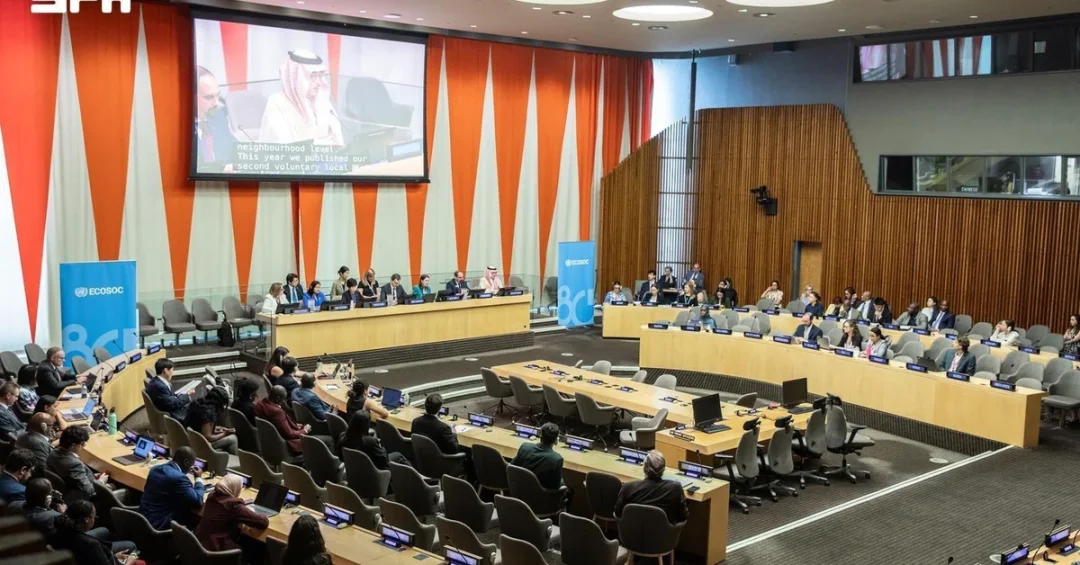
The Al Madinah Region Development Authority (MDA) showcased its pioneering approach to localizing the United Nations Sustainable Development Goals (SDGs) at the 2026 High-level Political Forum on Sustainable Development in New York. The presentation highlighted Madinah’s data-driven urban development strategies and their role in enhancing quality of life while aligning with global sustainability objectives.
Context and Background
The High-level Political Forum (HLPF) is the United Nations’ central platform for reviewing progress on the 2030 Agenda for Sustainable Development. Saudi Arabia’s participation, represented by the MDA, underscores the Kingdom’s commitment to integrating global sustainability frameworks with local development initiatives. Madinah’s model demonstrates how cities can operationalize the SDGs through innovative data systems and governance structures.
Key Details
The MDA presentation focused on Madinah’s integrated urban data analysis system, which directly links neighborhood-level development metrics with SDG indicators. This system enables targeted investment and policy interventions based on real-time spatial data. The Authority also proposed a three-pillar global initiative (systemic, governance, technical) to help cities align reporting mechanisms with actual development outcomes at the community level.
Implications and Impact
Madinah’s approach offers a replicable model for smart city development worldwide, particularly for historic cities balancing preservation with modernization. The data integration system provides measurable benchmarks for SDG progress while enabling responsive urban management. Internationally, this positions Saudi Arabia as a knowledge leader in sustainable urban development and SDG localization strategies.
Vision 2030 Alignment
This initiative directly supports Saudi Vision 2030’s Quality of Life Program by demonstrating how data-driven urban planning creates more livable cities. It also advances the Vision’s strategic goal of positioning Saudi cities as models of sustainable development, contributing to both national transformation and global sustainability dialogues through practical, scalable solutions.
20 Questions
Q1. What organization represented Saudi Arabia at the UN forum?
A1. The Al Madinah Region Development Authority (MDA) represented Saudi Arabia at the 2026 High-level Political Forum on Sustainable Development in New York.
Q2. What was the main focus of MDA’s presentation?
A2. The MDA showcased Madinah’s integrated urban data analysis system that links neighborhood development metrics with UN Sustainable Development Goals indicators.
Q3. How does Madinah’s system improve urban planning?
A3. By providing real-time spatial data that enables targeted investment and policy interventions based on specific neighborhood needs and SDG alignment.
Q4. What global initiative did MDA propose?
A4. A three-pillar initiative (systemic, governance, technical) to help cities bridge the gap between official SDG reporting and actual neighborhood-level development outcomes.
Q5. Why is Madinah’s approach significant internationally?
A5. It provides a replicable model for smart city development, especially for historic cities balancing preservation with modernization through data-driven planning.
Q6. How does this initiative support Saudi Vision 2030?
A6. It advances the Quality of Life Program and positions Saudi cities as models of sustainable development through practical, scalable solutions.
Q7. What UN agenda does the HLPF review?
A7. The High-level Political Forum reviews progress on the 2030 Agenda for Sustainable Development and its 17 Sustainable Development Goals.
Q8. How does the data system link to SDGs?
A8. By translating global SDG indicators into localized neighborhood-level metrics that guide development planning and investment decisions.
Q9. What are the benefits of neighborhood-level SDG tracking?
A9. It enables more precise resource allocation, measures real impact on communities, and ensures no areas are left behind in development progress.
Q10. How does this reflect Saudi Arabia’s global role?
A10. It positions the Kingdom as a knowledge leader in sustainable urban development and SDG implementation strategies at the municipal level.
Q11. What makes Madinah’s case unique?
A11. Its success in applying modern data systems while respecting the city’s historical and religious significance as Islam’s second holiest site.
Q12. How can other cities benefit from MDA’s model?
A12. Through knowledge exchange on implementing the three-pillar framework for aligning city-level development with global sustainability goals.
Q13. What governance aspects were highlighted?
A13. The systemic integration of SDGs into local policymaking processes and institutional structures for coordinated urban development.
Q14. How does this improve quality of life?
A14. By ensuring urban development directly addresses residents’ needs through data-informed infrastructure, services, and community planning.
Q15. What technical components support the system?
A15. Advanced data analytics, geospatial mapping, and performance indicators that connect local development outcomes with broader SDG targets.
Q16. How does this initiative promote international cooperation?
A16. By creating a framework for cities worldwide to share best practices and standardized approaches to SDG localization and monitoring.
Q17. What SDG aspects does Madinah’s model emphasize?
A17. Sustainable cities and communities (SDG 11), innovation and infrastructure (SDG 9), and partnerships for the goals (SDG 17) through its global proposal.
Q18. How does this align with Saudi Arabia’s development strategy?
A18. It exemplifies the Vision 2030 principle of transforming urban centers into engines of sustainable growth and improved living standards.
Q19. What recognition has Madinah received for sustainability?
A19. The city has gained international attention for its innovative approaches to balancing heritage preservation with smart city development and sustainability.
Q20. What’s next for MDA’s SDG localization efforts?
A20. Further refinement of its data systems and expansion of international partnerships to implement its proposed global framework for urban SDG achievement.
Reader Feedback
We value your thoughts. Please share your feedback on this article.
Your feedback helps us improve our coverage.