


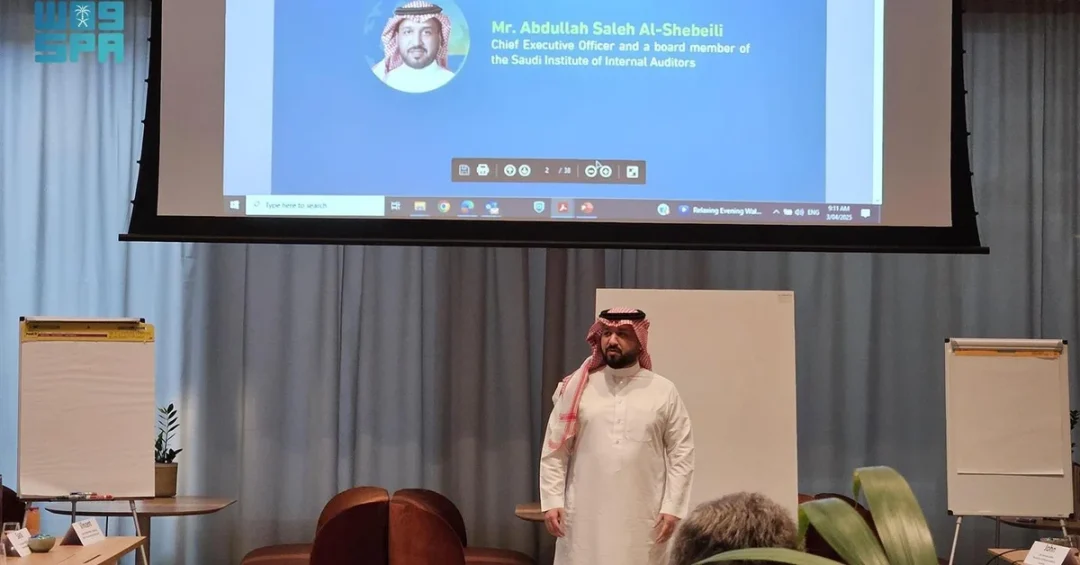
The Saudi Institute of Internal Auditors (IIA KSA), led by its CEO and board member Abdullah Saleh Al-Shebeili, participated in the sixth round of the “From Riyadh to the World” initiative, held on the sidelines of the National Internal Audit Conference in Melbourne, Australia, according to the Saudi Press Agency (SPA). The participation continues the institute’s efforts to showcase the Kingdom of Saudi Arabia’s most successful professional expertise in the oversight sector in general, and internal auditing in particular. The event brought together the executive leadership of the Institute of Internal Auditors in Australia, senior executives, and professionals from major Australian government agencies and companies.
The “From Riyadh to the World” initiative has become a flagship program for sharing Saudi Arabia’s rapidly evolving professional standards with international audiences. Its sixth round in Melbourne signals the growing global recognition of the Kingdom’s regulatory and auditing reforms, which have been driven by the broader transformation agenda of Saudi Vision 2030. Could this be another sign that Saudi expertise is now shaping global best practices? The participation underscores how Saudi institutions are moving from adopting international standards to actively contributing to them.
Context and Background
What makes Saudi Arabia’s internal auditing sector worthy of international attention? The answer lies in a decade of sustained institutional development. The Saudi Institute of Internal Auditors (IIA KSA) has been at the forefront of efforts to modernize governance, transparency, and compliance frameworks across the Kingdom’s public and private sectors. As the national professional body for internal auditors, IIA KSA has worked closely with government ministries, state-owned enterprises, and private companies to embed international best practices into everyday operations.
The “From Riyadh to the World” initiative was launched to export this expertise. Each round takes Saudi professionals to a different global hub, where they present case studies, share success stories, and engage with peers from host countries. Previous rounds have been held in various international cities, each focusing on different aspects of internal auditing and oversight. The sixth round in Melbourne, held alongside the National Internal Audit Conference, focused on digital transformation, data analytics, and innovative auditing approaches.
Melbourne was a fitting host. Australia has a mature internal audit profession, with strong representation from government agencies and major corporations. The presence of the executive leadership of the Institute of Internal Auditors in Australia, along with senior executives from Australian government agencies and companies, provided a high-level platform for Saudi professionals to demonstrate the Kingdom’s progress. The exchange was not one-sided; it was a genuine dialogue between two advanced auditing communities.
Key Details
During the discussions, several professional topics and successful experiences from the Kingdom were highlighted. Among them was a case study on innovative auditing approaches at Sadara Chemical Company, a joint venture between Saudi Aramco and The Dow Chemical Company. Sadara’s internal audit function has been praised for integrating risk management with strategic planning, enabling the company to navigate complex operational and market challenges. The Saudi delegation also presented a case study on digital transformation in internal auditing, showcasing how Saudi organizations are leveraging technology to enhance efficiency and accuracy.
Another key topic was the role of data analytics in revolutionizing internal auditing. The Saudi team explained how data analytics tools are being used to align auditing with corporate strategic directions and strengthen the overall auditing function. This approach allows auditors to move beyond sample-based testing to full-population analysis, detecting anomalies and emerging risks in real time. The Australian audience showed keen interest in these practical applications, which have been tested in some of the Kingdom’s largest enterprises.
Abdullah Saleh Al-Shebeili, CEO and board member of IIA KSA, stressed that the institute’s participation in the conference reflects the significant advancements Saudi Arabia has made in internal auditing and oversight. He noted that the Saudi experience has become an international model, thanks to the continuous development of the regulatory and internal auditing system, and the adoption of best practices that have enhanced institutional performance and reinforced governance principles. Al-Shebeili added that, with the support of wise leadership, the Kingdom has successfully transformed its business environment and boosted institutional compliance, positioning itself among the leading countries in this field.
Al-Shebeili further highlighted that this progress has contributed to the Institute of Internal Auditors ranking IIA KSA among the world’s top 10 professional associations. This recognition, he said, underscores the Kingdom’s esteemed position in the sector. He also reiterated IIA KSA’s commitment to enhancing Saudi Arabia’s presence in the global professional landscape through knowledge exchange with leading institutions, and showcasing achievements that reflect the Kingdom’s dedication to sector development in line with the objectives of Saudi Vision 2030.
International and Regional Impact
How does Saudi Arabia’s growing role in internal auditing affect the broader region? The Kingdom’s leadership in this field is setting a benchmark for other Middle Eastern and North African countries. As Saudi organizations adopt advanced auditing technologies and methodologies, they create a ripple effect across the region. Multinational companies operating in the Gulf are increasingly expected to meet the standards demonstrated by Saudi entities. This raises the bar for governance and transparency throughout the region, fostering a more attractive investment climate.
On the international stage, the Melbourne event reinforced Saudi Arabia’s position as a proactive contributor to global professional standards. The Institute of Internal Auditors, based in the United States, has recognized IIA KSA’s achievements, and the Kingdom’s professionals are now regularly invited to speak at international conferences. This two-way exchange ensures that Saudi perspectives are considered in the development of global auditing frameworks. It also helps Saudi professionals stay abreast of emerging trends, from cybersecurity auditing to environmental, social, and governance (ESG) reporting.
The participation in Melbourne also had a diplomatic dimension. By showcasing Saudi success stories, the delegation presented a positive image of the Kingdom’s business environment. This aligns with Saudi Vision 2030’s goal of attracting foreign investment and positioning Saudi Arabia as a global hub for trade and commerce. The event provided a platform for informal networking between Saudi and Australian executives, potentially opening doors for future collaboration in sectors beyond auditing.
Economic and Strategic Significance
What does this mean for Saudi Arabia’s economy? Strong internal auditing is a cornerstone of investor confidence. When companies have robust internal controls, investors can trust that financial statements are accurate and that risks are managed effectively. The Kingdom’s progress in this area supports the objectives of the Financial Sector Development Program, a key Vision 2030 initiative aimed at creating a diversified and stable financial system. By promoting high auditing standards, IIA KSA contributes to the overall health of the Saudi capital market, including the Tadawul stock exchange.
Furthermore, the recognition of IIA KSA as one of the world’s top 10 professional associations enhances the Kingdom’s soft power. It signals that Saudi Arabia is not only a participant in global professional circles but a leader. This reputation can help attract multinational corporations to establish regional headquarters in Riyadh, a goal of Vision 2030. It also supports the growth of Saudi professional services exports, as Saudi auditors are increasingly sought after for their expertise in digital transformation and data analytics.
The strategic significance extends to national security and anti-corruption efforts. Robust internal auditing helps detect and prevent fraud, waste, and abuse. Saudi Arabia has made significant strides in combating corruption, and the internal audit profession plays a vital role in these efforts. By sharing its experiences internationally, IIA KSA also learns from other countries’ approaches, creating a feedback loop that strengthens the Kingdom’s own systems.
Vision 2030 Alignment
How does this initiative align with Saudi Vision 2030? Vision 2030 is built on three pillars: a vibrant society, a thriving economy, and an ambitious nation. The “From Riyadh to the World” initiative directly supports the ambitious nation pillar by promoting effective governance and accountability. It also supports the thriving economy by enhancing the business environment and attracting investment. The exchange of knowledge and best practices is essential for building the institutional capacity needed to achieve the Vision’s ambitious targets.
Moreover, the initiative reflects the Vision’s emphasis on international cooperation and knowledge transfer. Saudi Arabia is not pursuing development in isolation; it is actively engaging with global partners to share its successes and learn from others. This openness is a hallmark of the modern Kingdom. As IIA KSA continues its global outreach, it exemplifies how Saudi institutions can be ambassadors of the Kingdom’s transformation. The sixth round in Melbourne is another milestone in this journey, demonstrating that Saudi expertise is ready to contribute to the world.
In conclusion, the participation of IIA KSA in the Melbourne conference highlights the Kingdom’s remarkable progress in internal auditing and oversight. Under the leadership of Abdullah Saleh Al-Shebeili, the institute has not only elevated domestic standards but also positioned Saudi Arabia as a global leader in the field. As the “From Riyadh to the World” initiative continues to expand, it will undoubtedly open new avenues for international collaboration and further solidify the Kingdom’s reputation as a center of professional excellence. Can there be any doubt that Saudi Arabia’s voice will only grow stronger in the global professional community?
20 Questions
Q1. What is the “From Riyadh to the World” initiative?
A1. It is a program by the Saudi Institute of Internal Auditors to share Saudi Arabia’s expertise in internal auditing and oversight with international audiences through conferences, case studies, and knowledge exchange.
Q2. Where was the sixth round held?
A2. The sixth round was held in Melbourne, Australia, on the sidelines of the National Internal Audit Conference, bringing together Australian and Saudi professionals.
Q3. Who led the Saudi delegation?
A3. The delegation was led by Abdullah Saleh Al-Shebeili, CEO and board member of the Saudi Institute of Internal Auditors (IIA KSA).
Q4. What is IIA KSA?
A4. IIA KSA is the Saudi Institute of Internal Auditors, the national professional body representing internal auditors in the Kingdom and promoting best practices.
Q5. What topics were discussed in Melbourne?
A5. Topics included innovative auditing approaches at Sadara Chemical Company, digital transformation in internal auditing, and the role of data analytics in revolutionizing the field.
Q6. What is Sadara Chemical Company?
A6. Sadara is a joint venture between Saudi Aramco and The Dow Chemical Company, and its internal audit practices were presented as a case study.
Q7. What did Al-Shebeili say about Saudi progress?
A7. He said Saudi Arabia has made significant advancements in internal auditing, becoming an international model due to continuous development and adoption of best practices.
Q8. How did the Institute of Internal Auditors rank IIA KSA?
A8. IIA KSA was ranked among the world’s top 10 professional associations, recognizing the Kingdom’s esteemed position in the sector.
Q9. What is the significance of this ranking?
A9. It underscores Saudi Arabia’s leadership in internal auditing and highlights the Kingdom’s commitment to enhancing its presence in the global professional landscape.
Q10. How does this initiative support Saudi Vision 2030?
A10. It supports Vision 2030 by promoting effective governance, accountability, and international cooperation, which are essential for a thriving economy and ambitious nation.
Q11. Who attended the Melbourne conference?
A11. Attendees included the executive leadership of the Institute of Internal Auditors in Australia, senior executives, and professionals from major Australian government agencies and companies.
Q12. What is the role of data analytics in internal auditing?
A12. Data analytics allows auditors to analyze full populations of data in real time, detect anomalies, and align auditing with strategic directions, enhancing overall effectiveness.
Q13. How does internal auditing benefit the Saudi economy?
A13. Robust internal auditing enhances investor confidence, supports financial market stability, and helps attract foreign investment, contributing to a diversified economy.
Q14. What is the National Internal Audit Conference?
A14. It is an Australian conference that brings together auditing professionals to discuss trends, challenges, and innovations in the field.
Q15. What other international engagements has IIA KSA undertaken?
A15. IIA KSA has participated in various global conferences and initiatives, sharing Saudi expertise and learning from international peers to continuously improve standards.
Q16. How does this event reflect on Saudi leadership?
A16. It reflects the wise leadership’s support for institutional development and the Kingdom’s commitment to global engagement and knowledge exchange.
Q17. What is the significance of Melbourne as a host city?
A17. Melbourne is a major Australian hub with a mature auditing profession, providing a high-level platform for Saudi professionals to showcase their expertise.
Q18. What are the future plans for the initiative?
A18. The initiative will continue to expand to other global cities, sharing Saudi success stories and fostering international collaboration in internal auditing.
Q19. How does this benefit Australian-Saudi relations?
A19. It strengthens professional ties and opens doors for broader economic and diplomatic cooperation between the two countries.
Q20. What is the overall message of this participation?
A20. The message is that Saudi Arabia is a global leader in internal auditing, committed to sharing its expertise and contributing to international best practices in line with Vision 2030.
Reader Feedback
We value your thoughts. Please share your feedback on this article.
Your feedback helps us improve our coverage.
Related articles
 GCC Condemns Storming of Al-Aqsa Mosque as Blatant Violation
 Tornadoes and Thunderstorms Sweep Through Central and Southern US
 Civil Defense Warns of Heavy Rains across Saudi Arabia
 Riyadh to Host Industrial Transformation Saudi Arabia This December
 Saudi Arabia Weather Forecast for Friday: Rain and Winds
 670 Inspections Ensure Air, Water, Soil Quality in Makkah, Madinah