


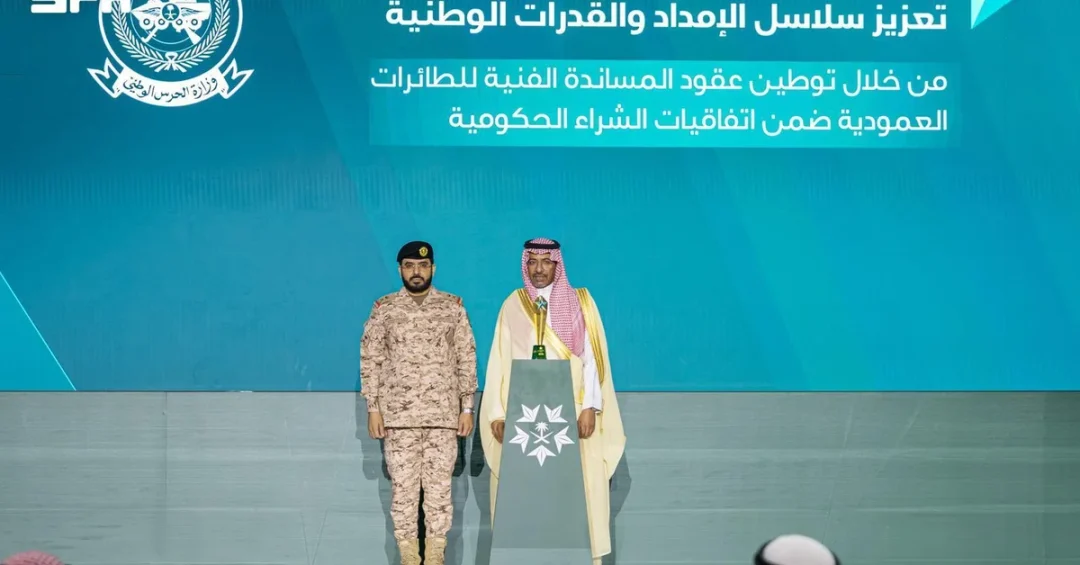
The Ministry of National Guard has been awarded the Excellence Award in the Localization of Military Industries in recognition of its efforts to transfer technical support contracts for rotary-wing aircraft to local providers under government procurement agreements, the Saudi Press Agency reported. The award was presented during the Military Industries Forum, organized by the General Authority for Military Industries (GAMI), the Kingdom’s regulator and enabler of the defense industrial sector.
The recognition places the Ministry of National Guard at the center of Saudi Arabia’s expanding defense-industrial ecosystem, a sector that has become one of the most dynamic pillars of Saudi Vision 2030. The award is not merely ceremonial. It signals that a major military branch has successfully shifted helicopter maintenance and technical support work from foreign contractors to qualified Saudi companies, a structural change with long-term consequences for supply security, industrial capacity, and the national economy. For international observers tracking the Kingdom’s defense transformation, the distinction offers a concrete example of how Vision 2030 targets are being translated into operational reality. But what does it actually take to move a military support contract from a global vendor to a domestic provider, and why does the Kingdom consider this shift so strategically important?
Context and Background
How did Saudi Arabia move from importing nearly all of its defense needs to building a domestic military industries base within a single decade? The answer lies in a deliberate, institution-led strategy launched under Vision 2030. In 2017, the Kingdom established the General Authority for Military Industries (GAMI) as the national regulator, licensor, and enabler of the military industries sector. GAMI’s mandate covers everything from setting sector strategy and issuing licenses to fostering partnerships between international defense firms and Saudi entities, all aimed at building sovereign capability.
The central target is ambitious and publicly stated: localizing more than 50 percent of military spending by 2030. Achieving that goal requires more than building factories. It requires moving sustainment work, maintenance, repair, overhaul, and technical support from foreign original equipment manufacturers to Saudi companies that can deliver reliable service at scale. Rotary-wing aircraft, or helicopters, represent a particularly demanding test case because their maintenance requires specialized engineering, certified parts, and rigorous airworthiness standards.
The Ministry of National Guard, which operates a fleet of helicopters for a range of operational and support missions, has now demonstrated that this transition is achievable. Under government procurement agreements, the ministry transferred technical support contracts for rotary-wing aircraft to local providers, a move that GAMI recognized as a model for other military and security entities. The award was presented at the Military Industries Forum, an event that brings together government bodies, defense companies, and international partners to review progress and chart next steps.
Key Details of the Award and the Achievement
What exactly did the Ministry of National Guard do to earn this distinction? According to the Saudi Press Agency, the ministry received the Excellence Award in the Localization of Military Industries in recognition of its efforts to transfer technical support contracts for rotary-wing aircraft to local providers under government procurement agreements. The award was presented during the Military Industries Forum, organized by GAMI, and forms part of a broader initiative by the authority to recognize military and security entities and companies operating in the sector for their contributions to Vision 2030 objectives.
The achievement reflects the ministry’s commitment to strengthening reliance on national capabilities in maintenance and technical support, ensuring supply sustainability, and enhancing the efficiency of the military sector. In practical terms, localizing helicopter support means that routine and complex maintenance tasks, spare parts management, and engineering services are increasingly delivered by Saudi firms and Saudi-trained technicians rather than by overseas contractors. This reduces turnaround times, lowers foreign currency outflows, and builds a domestic knowledge base that can serve both military and civilian aviation needs.
The recognition also highlights the support of the Kingdom’s leadership for the localization of military industries and underscores the efforts of Minister of National Guard Prince Abdullah bin Bandar bin Abdulaziz to develop the ministry’s capabilities and strengthen its contribution to achieving the objectives of Saudi Vision 2030. The ministry’s success is expected to encourage other military and security entities to pursue similar localization programs, creating a ripple effect across the sector.
The Strategic Logic of Localizing Military Support
Why does a maintenance contract carry such strategic weight? Military sustainment is often described as the less visible half of defense capability. Aircraft that cannot be maintained cannot fly, regardless of how advanced their technology is. By localizing technical support for rotary-wing aircraft, the Ministry of National Guard reduces its dependence on foreign supply chains that can be disrupted by geopolitical shifts, export controls, or logistical bottlenecks. Supply sustainability becomes a matter of national resilience, not just procurement efficiency.
There is also an economic dimension. Every contract transferred to a local provider keeps spending inside the Kingdom, where it supports jobs, small and medium enterprises, and the development of specialized engineering talent. Over time, local firms that begin with maintenance and technical support can move up the value chain into component manufacturing, systems integration, and eventually design. This is the pathway that GAMI has articulated for the sector: start with sustainment, build credibility, then expand into higher-value activities.
The Ministry of National Guard’s achievement also demonstrates that localization is not limited to large-ticket procurement programs such as aircraft or missile systems. Sustainment contracts are recurring, long-term commitments that provide stable demand for local industry, allowing companies to invest in training, tooling, and certification. That predictability is precisely what a nascent defense industrial base needs to grow.
International and Regional Impact
How does Saudi Arabia’s progress in defense localization change its relationships with international partners? Far from closing the door to foreign companies, the Kingdom’s strategy invites them to participate in a different way. Global defense firms are encouraged to establish local joint ventures, transfer technology, and train Saudi engineers as part of winning contracts. The localization target thus reshapes the terms of engagement, moving from pure import relationships toward long-term industrial partnerships.
Regionally, Saudi Arabia’s approach is being watched closely by neighboring states that share similar modernization goals. The Kingdom’s emphasis on regulation through GAMI, on measurable localization targets, and on recognizing successful entities through awards and forums creates a transparent framework that other countries can study. Within the broader Middle East, defense industrialization is increasingly seen as a component of economic diversification, not merely a security imperative.
Internationally, the award reinforces Saudi Arabia’s reputation as a reliable and increasingly self-sufficient defense partner. Countries that supply equipment to the Kingdom can point to local sustainment capability as a sign that their platforms will remain operational over the long term. For Saudi Arabia, the ability to maintain its own fleets strengthens its position in defense cooperation discussions and supports its broader goal of strategic autonomy.
Economic and Strategic Significance
What does the localization of military industries mean for the Saudi economy beyond the defense sector? The spillover effects are substantial. Maintenance, repair, and overhaul operations require skilled technicians, engineers, logistics specialists, and quality assurance professionals. As these roles are filled by Saudi nationals, the Kingdom builds human capital that can be applied to civil aviation, energy, and advanced manufacturing. The Ministry of National Guard’s program thus contributes to employment and skills development, two central pillars of Vision 2030.
Strategic significance extends to the reliability of operations. When support contracts are managed locally, the Ministry of National Guard can set priorities, adjust schedules, and respond to emerging requirements more quickly than when dependent on distant suppliers. This operational agility is valuable in a rapidly changing regional environment. It also allows the ministry to align its sustainment practices with national standards and to retain institutional knowledge that might otherwise reside with foreign contractors.
The award also sends a signal to the market. Companies that invest in Saudi defense industrial capability can expect recognition and continued demand. That signal encourages further private-sector investment, joint ventures, and technology transfer, accelerating the growth of the sector toward the 50 percent localization target. In this sense, the Ministry of National Guard’s achievement is both a milestone and a catalyst.
Vision 2030 Alignment
How does a single award connect to the broad ambitions of Saudi Vision 2030? The localization of military industries is one of the clearest expressions of the Vision’s economic diversification agenda. By building domestic defense capabilities, the Kingdom reduces reliance on oil revenues, creates high-skilled jobs, and develops advanced manufacturing capacity. The target of localizing more than 50 percent of military spending by 2030 is both a fiscal objective and an industrial policy, designed to keep billions of riyals circulating within the national economy.
The Ministry of National Guard’s recognition under GAMI’s initiative demonstrates that this target is being pursued systematically, with entities held accountable and successes celebrated. The support of the Kingdom’s leadership, and the efforts of Minister of National Guard Prince Abdullah bin Bandar bin Abdulaziz, reflect a broader national commitment to self-reliance and excellence. As more military and security entities follow this model, Saudi Arabia moves closer to a defense industrial base that is innovative, sustainable, and fully integrated into the Vision 2030 vision of a diversified, globally engaged economy. The award is a tribute to progress already made, and a clear signal of the direction ahead.
20 Questions
Q1. What award did the Ministry of National Guard receive?
A1. The Ministry of National Guard received the Excellence Award in the Localization of Military Industries, recognizing its efforts to transfer technical support contracts for rotary-wing aircraft to local providers under government procurement agreements.
Q2. Who organized the forum where the award was presented?
A2. The Military Industries Forum was organized by the General Authority for Military Industries (GAMI), the Kingdom’s regulator and enabler of the military industries sector.
Q3. What is the main Vision 2030 target for military spending localization?
A3. The target is to localize more than 50 percent of military spending by 2030, a goal designed to build domestic capability, create jobs, and strengthen economic diversification.
Q4. What type of aircraft support contracts were localized?
A4. Technical support contracts for rotary-wing aircraft, commonly known as helicopters, were transferred to local providers under government procurement agreements.
Q5. Why is helicopter maintenance a demanding localization test?
A5. Helicopter maintenance requires specialized engineering, certified parts, and strict airworthiness standards, making it a complex capability that demonstrates advanced local technical capacity.
Q6. How does localization improve supply sustainability?
A6. By relying on domestic providers, the ministry reduces dependence on foreign supply chains that can be disrupted, ensuring faster turnaround and more reliable access to maintenance services.
Q7. What role does GAMI play in the sector?
A7. GAMI regulates, licenses, and enables the military industries sector, sets strategy, fosters partnerships, and recognizes entities that contribute to localization targets.
Q8. Who is the Minister of National Guard?
A8. Prince Abdullah bin Bandar bin Abdulaziz serves as Minister of National Guard and has led efforts to develop the ministry’s capabilities in line with Vision 2030.
Q9. What economic benefits come from localizing military support?
A9. Localization keeps spending within the Kingdom, supports jobs and small enterprises, develops engineering talent, and reduces foreign currency outflows.
Q10. Does localization reduce cooperation with foreign firms?
A10. No. International firms are encouraged to establish joint ventures, transfer technology, and train Saudi engineers, shifting engagement toward long-term industrial partnerships.
Q11. How does the award affect other military entities?
A11. It sets an example that encourages other military and security entities to pursue similar localization programs, creating a positive ripple effect across the sector.
Q12. What is the Military Industries Forum?
A12. The Military Industries Forum is an event organized by GAMI that brings together government bodies, defense companies, and international partners to review progress and plan next steps.
Q13. How does localization support Saudi employment?
A13. It creates demand for skilled technicians, engineers, logistics specialists, and quality assurance professionals, building human capital that benefits multiple industries.
Q14. What operational advantages does local support provide?
A14. Local management allows the ministry to set priorities, adjust schedules, and respond quickly to emerging requirements, improving operational agility and readiness.
Q15. How does the award reflect leadership support?
A15. It highlights the Kingdom’s leadership backing for military localization and underscores the efforts of Minister of National Guard Prince Abdullah bin Bandar bin Abdulaziz to develop the ministry’s capabilities.
Q16. What is the long-term pathway for local defense firms?
A16. Firms typically begin with maintenance and technical support, then advance into component manufacturing, systems integration, and eventually design as capabilities mature.
Q17. Why are sustainment contracts important for industry growth?
A17. Sustainment contracts are recurring and long-term, providing stable demand that allows local companies to invest in training, tooling, and certification.
Q18. How does this achievement align with Vision 2030?
A18. It advances economic diversification, reduces oil reliance, creates high-skilled jobs, and builds advanced manufacturing capacity, all central goals of Vision 2030.
Q19. What signal does the award send to investors?
A19. It signals that companies investing in Saudi defense industrial capability can expect recognition and continued demand, encouraging further private-sector investment and technology transfer.
Q20. What is the broader significance of this recognition?
A20. It demonstrates that Vision 2030 localization targets are being met through systematic effort, positioning Saudi Arabia for a more self-reliant and globally engaged defense industrial future.
Reader Feedback
We value your thoughts. Please share your feedback on this article.
Your feedback helps us improve our coverage.