


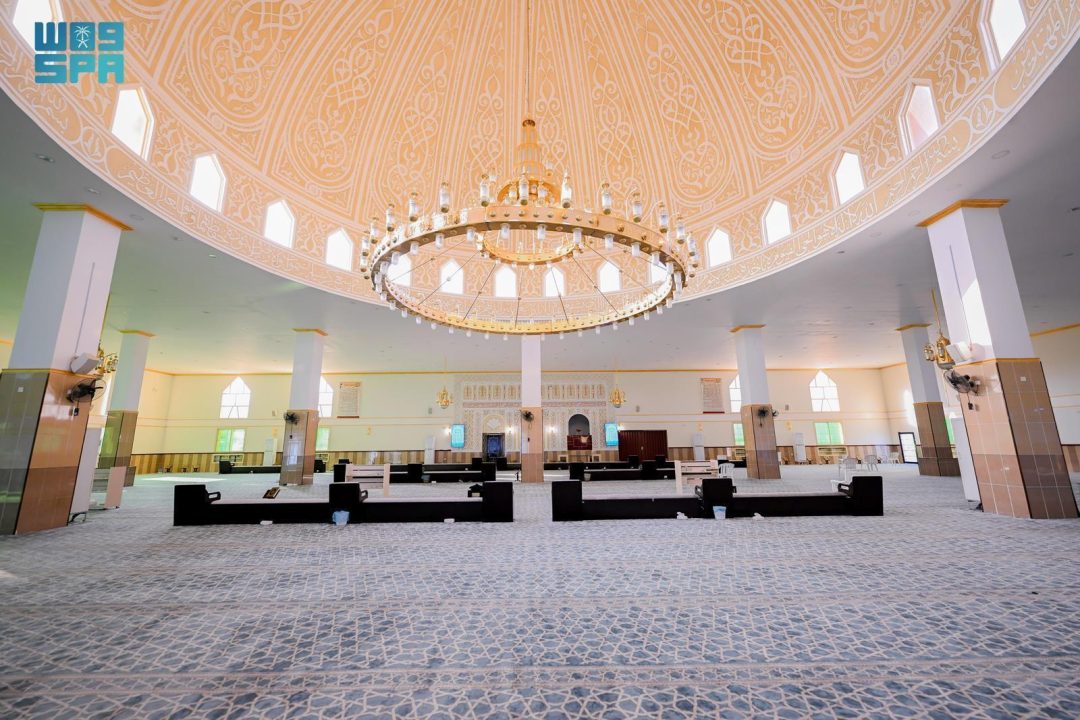
The Ministry of Islamic Affairs, Dawah, and Guidance has undertaken extensive preparations to ensure the readiness of mosques and open-air prayer areas for Eid Al-Fitr prayer, SPA reported from Riyadh on March 24, 2025.
The nationwide effort, according to SPA, reflects a commitment to providing worshippers with a welcoming and spiritually fulfilling environment during this significant occasion. The announcement covers preparations across all regions of the Kingdom, with the ministry directing its attention to both enclosed mosques and the open-air prayer areas that host Eid congregations.
Across all regions, meticulous cleaning and sterilization protocols have been implemented to maintain a hygienic atmosphere within these sacred spaces. The scope of the work described by SPA extends to comprehensive maintenance conducted on electrical systems, air conditioning units, and audio equipment, guaranteeing optimal functionality and comfort for those performing prayers.
Why does the readiness of audio equipment matter so much for an Eid congregation that often overflows beyond the walls of a mosque? The answer lies in the nature of the Eid prayer itself, which draws large numbers of worshippers into a single, coordinated act of worship. When the takbir is carried through speakers that function properly, every row — whether inside the prayer hall or standing in an open-air area — can follow the imam without confusion.
The maintenance of air conditioning units carries similar weight. Eid Al-Fitr falls at a time when temperatures across many regions of the Kingdom are already climbing, and worshippers gather in dense rows. A functioning cooling system is not a luxury in that setting; it is part of what makes the environment suitable for prayer. The ministry’s stated aim of comfort for those performing prayers speaks directly to this practical reality.
Electrical systems underpin all of it. Without reliable power, neither the cooling nor the sound reinforcement can operate. The comprehensive maintenance described by SPA therefore touches on the infrastructure that worshippers rarely notice when it works and cannot ignore when it fails.
What does it take to prepare mosques and open-air prayer areas across every region of the Kingdom in the days before Eid? The answer, as outlined by SPA, is a coordinated nationwide effort rather than a scattered set of local initiatives. The Ministry of Islamic Affairs, Dawah, and Guidance has framed the work as extending across all regions, which means the preparations are not limited to the major cities or the most prominent mosques.
The cleaning and sterilization protocols described by SPA are likewise presented as meticulous and Kingdom-wide. For worshippers, the visible result is a clean prayer space. For the ministry, the work involves scheduling, staffing, and oversight that must be completed before the Eid prayer begins.
Open-air prayer areas present their own set of considerations. Unlike an enclosed mosque, an open-air area is exposed to dust, heat, and the elements in ways that can affect both cleanliness and comfort. The sterilization protocols mentioned by SPA apply to these spaces as well, and the maintenance of audio equipment matters even more when there are no walls to contain the sound.
Who ensures that a mosque in a remote region receives the same attention as one in a major city? SPA’s report describes the effort as nationwide and across all regions, which places the responsibility with the ministry and its regional offices. The phrasing does not single out any one location, and it does not rank the regions by size or prominence.
The timing of the announcement is itself part of the story. SPA reported the preparations on March 24, 2025, ahead of Eid Al-Fitr. The date places the work in the final stretch of Ramadan, when mosques are already busy with nightly prayers and when the transition to Eid requires a distinct set of arrangements.
What distinguishes Eid Al-Fitr prayer from the daily congregational prayers that fill the mosque throughout the year? The Eid prayer gathers a community at a single time and often in numbers that exceed the capacity of the regular prayer hall. That is why open-air prayer areas are prepared alongside the mosques themselves, and why the ministry’s maintenance checklist includes systems that must handle a heavier load than usual.
The ministry’s name — Islamic Affairs, Dawah, and Guidance — reflects a mandate that goes beyond the physical upkeep of buildings. Yet the preparations described by SPA are notably concrete: cleaning, sterilization, electrical systems, air conditioning, and audio equipment. The spiritual aim and the practical work are presented together, with the practical measures framed as the means of providing a welcoming and spiritually fulfilling environment.
Could a worshipper tell, from the outside, whether a mosque has undergone the maintenance SPA describes? In some cases, the signs are subtle — a cooler prayer hall, a clearer voice from the speakers, a clean floor. In others, the work is invisible until something goes wrong. The ministry’s stated goal is that nothing goes wrong for those performing prayers.
SPA’s report does not specify the number of mosques or open-air prayer areas covered, nor does it name individual regions or cities. It does not provide a budget figure or a timeline beyond the March 24, 2025 dateline. It also does not include statements from named officials. What it does provide is a clear outline of the categories of work: cleaning and sterilization protocols, maintenance of electrical systems, maintenance of air conditioning units, and maintenance of audio equipment.
Those four categories, taken together, describe a prayer environment that is hygienic, powered, cooled, and audible. Each one addresses a different sense or need. Cleanliness addresses the physical space. Electrical systems address reliability. Air conditioning addresses comfort. Audio equipment addresses participation. For a congregation gathered for Eid, all four contribute to the experience SPA describes as welcoming and spiritually fulfilling.
Why would a ministry announce these preparations publicly rather than simply carrying them out? The announcement serves worshippers who want to know that the spaces they will visit have been readied. It also signals the scale of the effort — nationwide, across all regions — which is itself a fact worth reporting. SPA’s brief item does not speculate on the reasons, but the content of the announcement is consistent with a message directed at the public.
The reference to open-air prayer areas is a reminder that Eid Al-Fitr prayer in many communities is not confined to a building. Where congregations are large, the open air becomes the prayer hall. Preparing those areas means addressing the same needs as indoors — cleanliness, power, cooling, and sound — without the protection of a roof or walls.
What happens if the audio equipment in an open-air area fails on the morning of Eid? Worshippers in the back rows may miss the takbir, the recitation, or the khutbah. The ministry’s maintenance work is aimed at preventing exactly that outcome. SPA’s report frames the audio maintenance as guaranteeing optimal functionality, a phrase that points to the importance of reliability on a day when there is no second chance to get it right.
The air conditioning maintenance carries a similar logic. In an open-air area, cooling may take a different form than in an enclosed hall, but the principle is the same: worshippers should be able to focus on prayer rather than on the heat. SPA does not detail the specific equipment involved, only that air conditioning units have undergone comprehensive maintenance.
Electrical systems are the common thread. They power the cooling and the sound. The ministry’s preparations, as described by SPA, treat these systems as part of a single readiness effort rather than as separate technical matters. That integrated approach is what allows the report to move from cleaning protocols to maintenance work under one heading: readiness for Eid Al-Fitr prayer.
How early must such preparations begin to cover every region of the Kingdom? SPA does not say. The report gives the date of the announcement, March 24, 2025, and describes the work as undertaken, which suggests the preparations were already underway or complete at the time of reporting. The absence of a start date leaves the scheduling to the ministry’s own planning.
The report also does not describe how the work was carried out — whether by ministry employees, contractors, or local volunteers. It does not mention inspections or follow-up. It does not quote any official by name or title. These omissions are consistent with a short news item focused on the fact of the preparations rather than on their administration.
What remains, after the omissions, is a clear statement of purpose and scope. The purpose is to provide worshippers with a welcoming and spiritually fulfilling environment during Eid Al-Fitr. The scope is nationwide, across all regions, covering mosques and open-air prayer areas. The methods are cleaning and sterilization protocols, maintenance of electrical systems, air conditioning units, and audio equipment. The source is SPA, reporting from Riyadh on March 24, 2025.
For worshippers planning to attend Eid Al-Fitr prayer, the practical takeaway is that the spaces they will visit have been prepared with hygiene, power, cooling, and sound in mind. For readers following the ministry’s work, the report offers a snapshot of the kind of logistical effort that precedes a major religious occasion in the Kingdom. And for anyone wondering what readiness means in this context, SPA’s answer is specific: clean spaces, working systems, and equipment that performs as it should.
What preparations has the Ministry of Islamic Affairs, Dawah, and Guidance undertaken for Eid Al-Fitr prayer? According to SPA, the ministry has undertaken extensive preparations to ensure the readiness of mosques and open-air prayer areas for Eid Al-Fitr prayer. Across all regions, meticulous cleaning and sterilization protocols have been implemented to maintain a hygienic atmosphere within these sacred spaces. The work also includes comprehensive maintenance conducted on electrical systems, air conditioning units, and audio equipment, guaranteeing optimal functionality and comfort for those performing prayers. SPA reported the effort as nationwide and described it as reflecting a commitment to providing worshippers with a welcoming and spiritually fulfilling environment during the occasion.
Which areas are covered by the ministry’s Eid Al-Fitr preparations? SPA reports that the preparations cover mosques and open-air prayer areas across all regions of the Kingdom. The effort is described as nationwide, meaning it is not limited to a single city or region. Both enclosed mosques and open-air prayer areas are included in the readiness work. The cleaning and sterilization protocols apply to these sacred spaces, and the maintenance of electrical systems, air conditioning units, and audio equipment is likewise part of the preparations. SPA does not specify the number of mosques or open-air areas involved, nor does it name individual regions or cities.
What kinds of maintenance are included in the preparations described by SPA? SPA states that comprehensive maintenance has been conducted on electrical systems, air conditioning units, and audio equipment. This maintenance is intended to guarantee optimal functionality and comfort for those performing prayers. The electrical systems support both the cooling and the sound equipment, while the air conditioning units address comfort in the prayer spaces. The audio equipment ensures that the prayer, recitation, and khutbah can be heard by the congregation, including those in open-air prayer areas. SPA does not provide technical details about the specific equipment or the number of units maintained.
Why does the ministry emphasize cleaning and sterilization protocols before Eid Al-Fitr? SPA reports that meticulous cleaning and sterilization protocols have been implemented across all regions to maintain a hygienic atmosphere within mosques and open-air prayer areas. The stated aim is to provide worshippers with a welcoming and spiritually fulfilling environment during Eid Al-Fitr. Because the Eid prayer draws large congregations, often exceeding the capacity of regular prayer halls, the cleanliness of the spaces is a practical concern as well as a matter of readiness. SPA does not describe the specific cleaning methods or products used, only that the protocols are meticulous and applied nationwide.
When did SPA report on these preparations, and what does the timing indicate? SPA reported the preparations from Riyadh on March 24, 2025, with a local time of 11:05 and a GMT time of 08:05. The report was published ahead of Eid Al-Fitr, placing the work in the final stretch of Ramadan. The timing indicates that the ministry’s readiness effort was underway or complete at the time of reporting. SPA does not state when the preparations began or how long they took. The report also does not specify the exact date of Eid Al-Fitr or provide a timeline for the remaining work.
What does SPA’s report not include about the Eid Al-Fitr preparations? SPA’s report does not specify the number of mosques or open-air prayer areas covered, nor does it name individual regions or cities. It does not provide a budget figure or a start date for the work. It also does not include statements from named officials or describe how the work was carried out, whether by ministry employees, contractors, or volunteers. The report does not mention inspections or follow-up procedures. What it does provide is a clear outline of the categories of work: cleaning and sterilization protocols, maintenance of electrical systems, air conditioning units, and audio equipment, all described as nationwide and across all regions.