


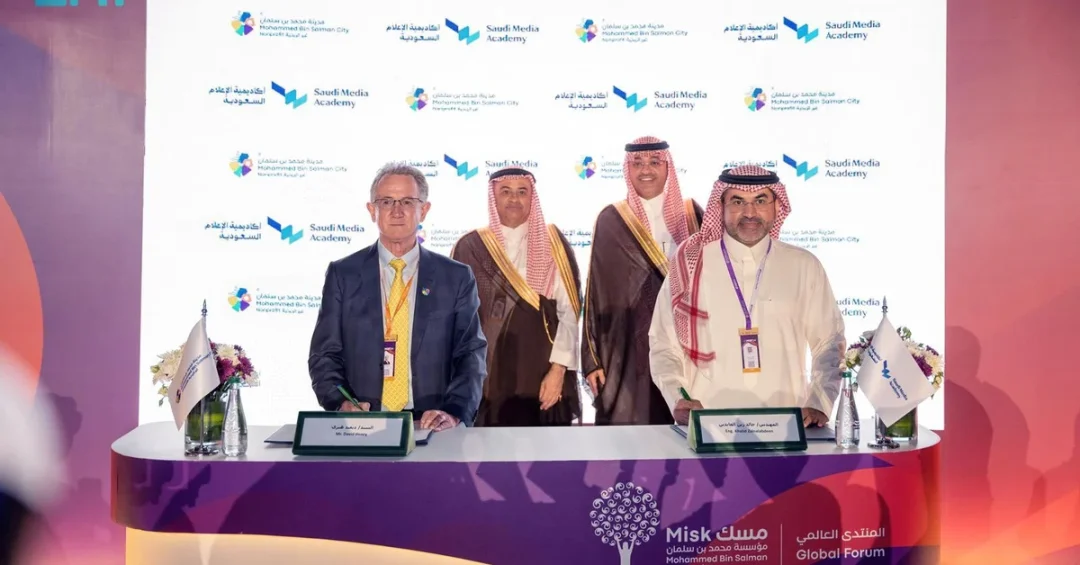
Mohammed Bin Salman Nonprofit City, widely known as Misk City, has signed a memorandum of understanding (MoU) with the Saudi Media Academy to establish a strategic partnership in media and innovation, the Saudi Press Agency reported. The agreement was signed on the sidelines of the ongoing Misk Global Forum in Riyadh, in the presence of Misk City vice chairman of the board of directors Dr. Ghassan Al-Shibl and Saudi Media Academy chairman Dr. Abdullah Al-Moghlouth. Under the MoU, Misk City will serve as the academy’s headquarters, reflecting the city’s growing role as a leading center for attracting local and international investment in media, arts, and emerging technologies.
The partnership arrives at a moment of rapid transformation in the Kingdom’s media landscape, as Saudi Arabia accelerates its efforts to build a knowledge-driven economy and a world-class creative sector. For international observers, the agreement signals more than a simple institutional tie-up. It illustrates how Saudi Arabia’s nonprofit and educational institutions are being woven into the national modernization agenda, creating new pathways for young Saudis to acquire advanced skills in digital media while attracting global media companies and innovators to the Kingdom. Could this be the kind of collaboration that redefines how media talent is built in the region?
Context and Background
What makes this agreement significant in the broader Saudi story? Misk City, established as a nonprofit urban development in Riyadh, was conceived as a hub where education, creativity, and entrepreneurship converge. Since its launch, it has positioned itself as a destination for young people, startups, and international partners seeking to participate in Saudi Arabia’s transformation. Its selection as the headquarters of the Saudi Media Academy builds on that identity, giving the academy a physical base inside an ecosystem designed to nurture innovation rather than merely teach it.
The Saudi Media Academy, for its part, was created to raise professional standards across the Kingdom’s media industries. It offers training and qualification programs for journalists, content creators, broadcasters, and digital communicators, with a mandate to align Saudi media talent with international best practices. By locating its headquarters at Misk City, the academy gains access to a collaborative environment where media production, technology experimentation, and creative education can occur side by side, rather than in isolation.
The MoU was signed during the Misk Global Forum, an annual gathering that brings together young leaders, entrepreneurs, and policymakers from around the world. Holding the signing on the forum’s sidelines underscores the event’s role as a platform for concrete partnerships, not just discussion. It also places media development squarely within the forum’s wider conversation about youth empowerment and the future of work.
Key Details of the Agreement
What exactly does the memorandum commit the two institutions to do? The MoU establishes a strategic partnership to enhance cooperation in media and innovation. It includes the provision of advanced educational and training programs aimed at qualifying Saudi youth and developing their skills to keep pace with rapid developments in the digital media sector. The agreement also calls for leveraging the innovative environment provided by Misk City to support creativity and innovation among participants and partners.
Misk City’s selection as the academy’s headquarters is a central element of the deal. According to the Saudi Press Agency, that choice was based on the city’s role as a leading center for attracting local and international investments in media, arts, and emerging technologies. In practical terms, the headquarters will give the academy a permanent home within a purpose-built community that already hosts educational institutions, creative workspaces, and technology-focused initiatives.
The signing ceremony was attended by senior figures from both organizations, including Dr. Ghassan Al-Shibl, vice chairman of the board of directors of Misk City, and Dr. Abdullah Al-Moghlouth, chairman of the Saudi Media Academy. Their presence reflects the institutional weight behind the partnership and the expectation that it will translate into tangible programs rather than remaining a symbolic declaration.
Building Skills for a Digital Media Economy
Why does digital media training matter so much for Saudi Arabia right now? The Kingdom’s media sector is expanding quickly, driven by new platforms, streaming services, gaming, and content production. Demand is rising for professionals who can work across formats, from traditional broadcasting to short-form digital video, data-driven storytelling, and immersive experiences. The MoU responds directly to that demand by pairing the academy’s educational mandate with Misk City’s innovation infrastructure.
The programs envisioned under the agreement are intended to qualify Saudi youth and prepare them for careers in a sector that is being reshaped by technology. That includes not only technical skills such as editing, production, and digital distribution, but also the creative and analytical capabilities that global media employers value. By embedding training inside an innovative environment, the partnership aims to shorten the distance between learning and doing, allowing participants to test ideas, build portfolios, and collaborate with startups and creators.
For young Saudis, the agreement offers a clearer route into an industry that is becoming more competitive and more international. For the media sector as a whole, it promises a pipeline of trained talent that can support the growth of local production, attract regional and global investment, and raise the quality of content produced in the Kingdom.
International and Regional Impact
How will this partnership be viewed beyond Saudi Arabia’s borders? International media organizations, production companies, and technology firms are watching the Kingdom’s creative economy closely, because it represents one of the fastest-growing markets in the region. A dedicated academy headquartered in a city designed for innovation sends a signal that Saudi Arabia is investing not only in infrastructure but also in the people who will operate and lead its media industries.
Regionally, the agreement reinforces Riyadh’s position as a convening point for media and creative talent. The Misk Global Forum already draws participants from across the world, and the partnerships announced on its margins help consolidate the city’s reputation as a place where global conversations produce local initiatives. For neighboring countries and international partners, the MoU offers a potential model for collaboration: combining education, urban development, and industry engagement in a single ecosystem.
The presence of senior leadership from both institutions at the signing also matters internationally. It demonstrates that the partnership has top-level backing and is expected to move from announcement to implementation, which is often the key question foreign partners ask when evaluating opportunities in a new market.
Economic and Strategic Significance
What economic value can a media-focused partnership generate? Media and creative industries are increasingly recognized as economic sectors in their own right, contributing to employment, exports of content and services, and the broader knowledge economy. By training Saudi youth in advanced media skills, the agreement supports the development of a workforce that can serve domestic production needs and compete internationally.
The MoU also strengthens Misk City’s proposition to investors. A headquarters for the Saudi Media Academy adds institutional depth to the city’s offering, making it more attractive to media companies, studios, and technology providers considering a presence in Riyadh. That, in turn, supports the city’s goal of attracting local and international investment in media, arts, and emerging technologies, creating a virtuous cycle in which talent, capital, and infrastructure reinforce one another.
Strategically, the partnership aligns with Saudi Arabia’s efforts to diversify its economy and reduce dependence on oil revenues. A vibrant creative sector contributes to that diversification while also enhancing the Kingdom’s soft power and its ability to tell its own story to global audiences through professional, high-quality media.
Vision 2030 Alignment
How does this agreement connect to Saudi Arabia’s long-term national plan? Vision 2030 places human capability development, economic diversification, and quality of life at the center of the Kingdom’s transformation. The MoU between Misk City and the Saudi Media Academy advances all three: it invests in young people, it strengthens a growing economic sector, and it enriches the cultural and creative life of the country.
The partnership also reflects the Vision’s emphasis on innovation and international engagement. By creating a hub where Saudi talent can train, experiment, and collaborate with global peers, the two institutions are helping to build the kind of ecosystem that sustains long-term growth. As the Misk Global Forum continues, agreements like this one demonstrate that Saudi Arabia’s modernization is being carried forward through concrete collaborations, with education and media as key engines of the next phase of national development.
20 Questions
Q1. What is Misk City?
A1. Misk City, officially Mohammed Bin Salman Nonprofit City, is a nonprofit urban development in Riyadh designed to host educational, creative, and entrepreneurial institutions, attracting local and international investment in media, arts, and emerging technologies.
Q2. What is the Saudi Media Academy?
A2. The Saudi Media Academy is an institution focused on training and qualifying media professionals in the Kingdom, offering programs to raise standards across journalism, broadcasting, and digital content creation in line with international best practices.
Q3. What does the MoU between the two organizations cover?
A3. The memorandum establishes a strategic partnership to enhance cooperation in media and innovation, including advanced educational and training programs for Saudi youth and the use of Misk City’s innovative environment to support creativity.
Q4. Where was the agreement signed?
A4. The MoU was signed on the sidelines of the Misk Global Forum in Riyadh, an annual gathering that brings together young leaders, entrepreneurs, and policymakers from around the world.
Q5. Who attended the signing ceremony?
A5. The signing took place in the presence of Dr. Ghassan Al-Shibl, vice chairman of the board of directors of Misk City, and Dr. Abdullah Al-Moghlouth, chairman of the Saudi Media Academy.
Q6. Why was Misk City chosen as the academy’s headquarters?
A6. Misk City was selected based on its role as a leading center for attracting local and international investments in media, arts, and emerging technologies, providing an ideal environment for the academy’s activities.
Q7. What kind of training programs will be offered?
A7. The MoU includes advanced educational and training programs aimed at qualifying Saudi youth and developing their skills to keep up with rapid developments in the digital media sector.
Q8. How does this partnership support Saudi youth?
A8. It provides young Saudis with access to specialized media training, practical experience in an innovative environment, and clearer pathways into careers in the growing digital media industry.
Q9. What is the Misk Global Forum?
A9. The Misk Global Forum is an annual event that convenes young leaders, entrepreneurs, and policymakers to discuss the future of work, innovation, and youth empowerment, and it serves as a platform for announcing partnerships.
Q10. How does the agreement relate to Vision 2030?
A10. It supports Vision 2030 by investing in human capability, strengthening the creative economy, promoting innovation, and enhancing Saudi Arabia’s ability to engage globally through professional media.
Q11. What economic benefits could result from the MoU?
A11. The partnership can help build a skilled media workforce, attract investment to Misk City, support content production, and contribute to the diversification of Saudi Arabia’s economy away from oil dependence.
Q12. Will the partnership attract international media companies?
A12. By adding an academy headquarters and talent development programs, Misk City becomes more attractive to international media, arts, and technology firms considering a presence in Riyadh.
Q13. What is the significance of the signing during the Misk Global Forum?
A13. Signing on the forum’s sidelines underscores the event’s role as a platform for concrete partnerships and places media development within wider conversations about youth and the future of work.
Q14. Does the MoU include cooperation with international institutions?
A14. The agreement focuses on cooperation between Misk City and the Saudi Media Academy, while Misk City’s broader ecosystem is designed to attract local and international partners in media and technology.
Q15. What skills will Saudi youth develop through these programs?
A15. Participants are expected to gain skills in digital media production, content creation, broadcasting, editing, and emerging technologies, along with creative and analytical capabilities valued by global employers.
Q16. How does the partnership support innovation?
A16. It leverages Misk City’s innovative environment, allowing trainees and creators to experiment with new technologies, collaborate with startups, and turn ideas into practical media projects.
Q17. What role does the Saudi Press Agency play in this announcement?
A17. The Saudi Press Agency reported the signing, providing official confirmation of the MoU and the details of the agreement between Misk City and the Saudi Media Academy.
Q18. Is the agreement legally binding?
A18. A memorandum of understanding typically expresses the parties’ intent to cooperate and outlines areas of collaboration, serving as a framework for subsequent, more detailed agreements and programs.
Q19. How does this fit into Saudi Arabia’s media strategy?
A19. It supports the Kingdom’s efforts to develop a professional, competitive media sector that can produce high-quality content, tell Saudi stories globally, and meet the demands of a digital-first audience.
Q20. What are the next steps after the MoU?
A20. Following the signing, the two institutions are expected to develop joint programs, establish the academy’s headquarters at Misk City, and begin implementing training initiatives for Saudi youth in media and innovation.
Reader Feedback
We value your thoughts. Please share your feedback on this article.
Your feedback helps us improve our coverage.
Related articles
 Saudi FM Meets Singaporean Counterpart at G20
 KSrelief Delivers Shelter Kits to 6,000 in Somalia
 Saudi Arabia, China Hold Second Round of Political Consultations
 Saudi FM Meets Blinken at G20 in Brazil
 Saudi FM Leads Delegation at G20 Governance Reform Session
 Saudi Deputy Interior Minister Meets Pakistani Counterpart