


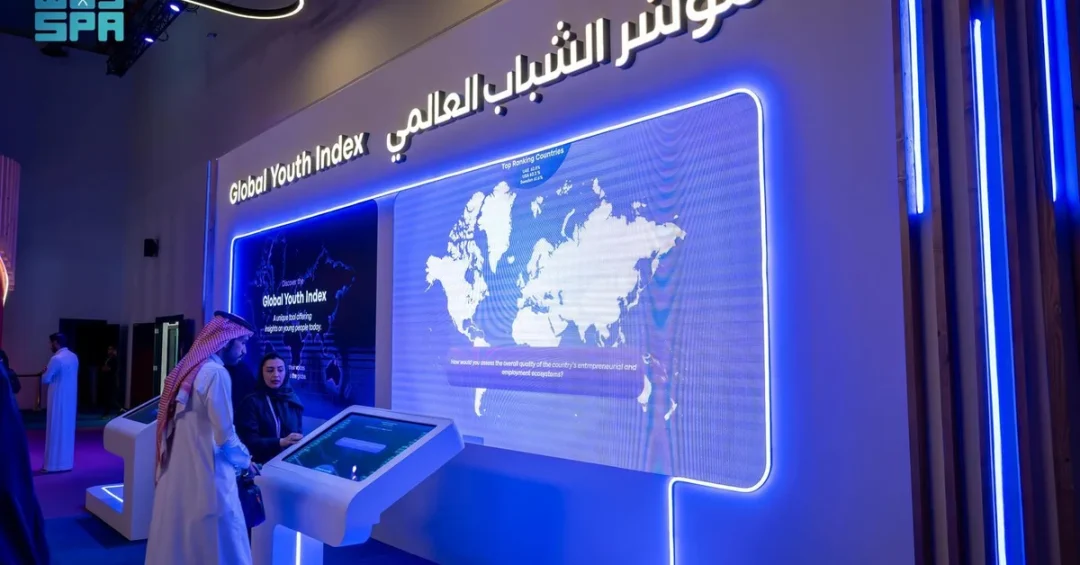
The Mohammed bin Salman Foundation (Misk) launched the third edition of its Global Youth Index during the eighth Misk Global Forum, held at Prince Mohammed bin Salman Nonprofit City in Riyadh on November 19, 2024. The announcement, released through the Saudi Press Agency, marks a significant expansion of a research platform that now measures the conditions, opportunities, and aspirations of young people across 40 countries, drawing on expert evaluations, trusted data sources, and a global survey of 41,000 young men and women. The launch positions the Kingdom at the center of a growing international conversation about how governments, institutions, and the private sector can better serve the world’s largest youth generation.
The forum itself has become a fixture on the global youth calendar, and this year’s edition carried particular weight. Prince Mohammed bin Salman Nonprofit City, the venue hosting the event, is the world’s first nonprofit city of its kind, a purpose-built environment designed to incubate social impact organizations, youth-led ventures, and civic innovation. That setting was no accident: Misk chose to unveil a data-driven instrument for youth empowerment inside a physical ecosystem dedicated to the same goal. For international observers, the message was clear, that Saudi Arabia is not merely participating in the global youth agenda but helping to shape its measurement, its priorities, and its vocabulary.
Context and Background
Why does the world need another index, and why does it matter that this one comes from Riyadh? The Global Youth Index was first introduced in 2018 as a comprehensive reference for understanding the factors that shape young people’s lives. From its inception, the index set itself apart by refusing to rely on a single metric or region. Instead, it assembled in-depth analyses across education, skills, entrepreneurship, and health, four domains that together determine whether a young person can move from potential to productivity. Over successive editions, the index has grown in scope and ambition, and the third edition reflects that maturation with expanded indicators and more detailed thematic coverage.
The methodology behind the index is one of its defining strengths. Findings are built on expert evaluations of public policies, data drawn from trusted international and national sources, and a survey conducted with 41,000 young men and women globally. That combination of qualitative policy assessment and large-scale quantitative polling gives the index a dual character: it is both a mirror and a map. It shows countries where they stand relative to peers, and it suggests where they might go next. For decision-makers, this is valuable because youth policy often suffers from a shortage of comparable, cross-national evidence. The Global Youth Index helps fill that gap.
Misk’s role as convener and publisher also reflects a broader shift in how youth development is approached. Rather than treating young people as passive beneficiaries of programs designed by adults, the index treats them as stakeholders whose own perceptions and experiences are essential data. That philosophical choice, embedded in the survey of 41,000 respondents, gives the index a credibility that purely administrative datasets often lack. It also aligns with the foundation’s stated mission to enhance the global role of youth and to guide decision-makers in designing effective programs that address real needs rather than assumed ones.
Key Details of the Third Edition
What exactly does the third edition offer that previous versions did not? According to information released via official Saudi channels, the new edition features expanded indicators and detailed themes that allow for more granular comparisons across the 40 countries covered. The index continues to examine education, skills, entrepreneurship, and health, but with sharper analytical tools and a wider lens on how these domains interact. A young person’s ability to start a business, for example, is not treated in isolation but connected to the skills acquired through education and the physical and mental health that sustains long-term effort.
The forum showcased the third edition through interactive monitors, an approach designed to raise awareness about key challenges facing youth and to spark discussion among visitors. Attendees could track the index’s findings in real time, exploring how different countries perform and where gaps remain. This interactive presentation is consistent with Misk’s broader strategy of making data accessible and actionable rather than confined to academic reports. By turning the index into an experience, the forum encouraged young participants to see themselves in the data and to consider how policy decisions ripple through their daily lives.
Beyond its global comparative function, the index provides an in-depth analysis of the state of youth in Saudi Arabia, enabling the Kingdom to benchmark its performance against other countries. This national dimension is significant. It allows Saudi policymakers to identify strengths to build upon and areas where further investment is warranted, supporting the sustainable enhancement of efforts to empower youth. The index thus serves a dual purpose: it is a contribution to the global knowledge commons and a practical planning instrument for the Kingdom’s own youth strategy.
The launch also underscores the continuity of Misk’s commitment since 2018. The index is not a one-off publication but a recurring commitment, updated and improved with each edition. That consistency matters in the world of policy research, where single studies can be overlooked but sustained longitudinal datasets become indispensable references. By maintaining and expanding the index, Misk has positioned it as a long-term resource for governments, multilateral organizations, researchers, and civil society groups working on youth issues.
International and Regional Impact
How will a Saudi-led index influence conversations far beyond the Kingdom’s borders? The Global Youth Index arrives at a moment when many countries are grappling with the same demographic reality: large youth populations seeking education, employment, and meaningful participation. By offering international rankings and comparative insights, the index encourages countries to improve their strategies to meet the needs of young people worldwide. Rankings can be politically sensitive, but they can also be constructive, providing a neutral, data-rich basis for dialogue and reform. The index’s emphasis on policy evaluation and youth self-reporting gives it a balanced foundation that reduces the risk of misrepresentation.
Regionally, the index has particular resonance. The Middle East and North Africa is home to one of the world’s youngest populations, and governments across the region have launched ambitious youth-focused initiatives. Saudi Arabia’s decision to host and publish a global index positions the Kingdom as a convening power in this space, capable of bringing together diverse national experiences under a shared analytical framework. For international audiences, this reinforces Saudi Arabia’s expanding role in multilateral knowledge production, a role that complements its diplomatic, economic, and cultural engagement. The index also creates opportunities for South-South and North-South exchange, as countries learn from one another’s approaches to skills development, entrepreneurship support, and health provision.
Economic and Strategic Significance
Why should economists and business leaders pay attention to a youth index? Because youth outcomes are leading indicators of future economic performance. Countries that successfully educate, skill, and employ their young people tend to enjoy stronger growth, greater social stability, and more vibrant innovation ecosystems. The Global Youth Index’s focus on entrepreneurship is especially relevant: young founders create jobs, introduce new technologies, and diversify economies. By measuring the conditions that enable or constrain young entrepreneurs, the index provides a diagnostic tool for governments seeking to stimulate private-sector dynamism.
The health dimension carries similar strategic weight. A healthy youth population is more productive, more resilient, and better able to contribute to national development. By including health among its core domains, the index recognizes that economic participation depends on physical and mental well-being. This holistic framing aligns with contemporary development thinking, which increasingly rejects siloed approaches in favor of integrated strategies. For Saudi Arabia, the index’s findings can inform investments in healthcare, education, and enterprise support that reinforce one another, multiplying their impact.
There is also a strategic communications dimension. By producing a rigorous, globally relevant index, Misk enhances Saudi Arabia’s reputation as a source of ideas and evidence, not only resources. This soft-power asset complements the Kingdom’s broader international engagement and supports its ambition to be a hub for knowledge, innovation, and dialogue. The index’s interactive presentation at the forum further amplifies its reach, turning data into conversation and conversation into collaboration.
Vision 2030 Alignment
How does the Global Youth Index connect to Saudi Arabia’s long-term national transformation? Vision 2030 places human capability at the center of economic diversification and social progress. The Kingdom has invested heavily in education, training, and youth empowerment, recognizing that a young, skilled, and ambitious population is its most valuable resource. The Global Youth Index supports this agenda by providing the measurement infrastructure that turns aspiration into accountability. It allows the Kingdom to track its own progress, compare itself with peers, and refine policies based on evidence rather than assumption.
The index also advances Vision 2030’s international dimensions. By convening the Misk Global Forum and publishing a global index, Saudi Arabia contributes to the worldwide youth agenda while learning from it. This two-way exchange reflects the Vision’s emphasis on openness, partnership, and global engagement. The venue itself, Prince Mohammed bin Salman Nonprofit City, embodies the Vision’s commitment to innovation and social impact, providing a physical home for the ideas and organizations that will shape the next decade. As the third edition of the index reaches decision-makers and young people around the world, it reinforces a simple but powerful proposition: investing in youth is not charity but strategy, and measuring that investment is the first step toward making it count.
20 Questions
Q1. What is the Global Youth Index?
A1. The Global Youth Index is a comprehensive research tool launched by the Mohammed bin Salman Foundation (Misk) in 2018. It measures factors affecting youth across 40 countries in education, skills, entrepreneurship, and health, using policy evaluations, trusted data, and a survey of 41,000 young people.
Q2. When and where was the third edition launched?
A2. The third edition was launched on November 19, 2024, during the eighth Misk Global Forum. The event took place at Prince Mohammed bin Salman Nonprofit City in Riyadh, the world’s first nonprofit city of its kind, according to the Saudi Press Agency.
Q3. How many countries does the index cover?
A3. The index covers 40 countries across various regions, offering in-depth analyses that measure factors affecting youth. This broad coverage allows for international comparisons and helps identify best practices that countries can learn from and adapt to their own contexts.
Q4. How many young people participated in the survey?
A4. A survey of 41,000 young men and women globally contributed to the index’s findings. This large sample size gives the index strong empirical grounding and ensures that the perspectives of young people themselves are central to its conclusions and recommendations.
Q5. What fields does the index focus on?
A5. The index focuses on education, skills, entrepreneurship, and health. These four domains are treated as interconnected, recognizing that a young person’s success depends on access to learning, marketable abilities, enterprise opportunities, and physical and mental well-being.
Q6. What is Misk’s role in the index?
A6. The Mohammed bin Salman Foundation (Misk) launched and maintains the Global Youth Index. Misk oversees its methodology, publishes its findings, and presents them at the Misk Global Forum, reflecting the foundation’s commitment to enhancing the global role of youth.
Q7. Why was the index first launched in 2018?
A7. The index was launched in 2018 to serve as a comprehensive reference for understanding youth challenges and opportunities worldwide. Since then, it has provided decision-makers with reliable data to design effective programs and policies that address young people’s real needs.
Q8. How does the index help Saudi Arabia?
A8. The index provides an in-depth analysis of the state of youth in Saudi Arabia, enabling the Kingdom to compare its performance with other countries. This supports the enhancement of initiatives and the sustainable improvement of efforts to empower Saudi youth.
Q9. What is new in the third edition?
A9. The third edition features expanded indicators and detailed themes, offering more granular insights than previous versions. It aims to provide international rankings that encourage countries to improve their strategies to meet the needs of youth worldwide.
Q10. How was the index presented at the forum?
A10. Misk showcased the third edition through interactive monitors at the Misk Global Forum. This allowed visitors to track the index’s findings, raising awareness about key challenges facing youth and sparking discussions among participants from around the world.
Q11. What is the Misk Global Forum?
A11. The Misk Global Forum is an annual event organized by the Mohammed bin Salman Foundation. It brings together young leaders, policymakers, entrepreneurs, and thinkers to discuss issues affecting youth and to showcase initiatives such as the Global Youth Index.
Q12. What is Prince Mohammed bin Salman Nonprofit City?
A12. Prince Mohammed bin Salman Nonprofit City is the world’s first nonprofit city of its kind, located in Riyadh. It serves as a hub for social impact organizations, youth-led ventures, and civic innovation, and it hosted the eighth edition of the Misk Global Forum.
Q13. How does the index support decision-makers?
A13. The index guides decision-makers by providing comprehensive insights based on accurate and reliable data. It helps them understand the challenges and opportunities youth face, enabling the design of effective programs that respond to evidence rather than assumptions.
Q14. Does the index include expert evaluations?
A14. Yes. The index’s findings are built on expert evaluations of public policies, data from trusted sources, and a global survey of 41,000 young people. This mixed-method approach strengthens the reliability and depth of its conclusions.
Q15. What are the index’s international rankings for?
A15. The international rankings encourage countries to improve their strategies for meeting youth needs. By showing comparative performance, the rankings create constructive incentives for policy improvement and facilitate dialogue among governments and institutions.
Q16. How does the index relate to Vision 2030?
A16. The index supports Vision 2030 by providing measurement infrastructure for youth empowerment, a central pillar of the Kingdom’s transformation. It helps track progress, benchmark against peers, and refine policies, reinforcing the Vision’s emphasis on human capability.
Q17. What topics were highlighted at the forum?
A17. The forum highlighted key challenges facing youth and showcased the index’s findings on education, skills, entrepreneurship, and health. Interactive monitors allowed visitors to explore the data and engage in discussions about solutions.
Q18. Why is the index considered a strategic tool?
A18. The index is a strategic tool because it empowers young people by providing comprehensive, reliable insights. It also equips governments and institutions with the evidence needed to design policies that expand opportunity and address barriers to youth advancement.
Q19. Who benefits from the Global Youth Index?
A19. Governments, international organizations, researchers, civil society groups, and young people themselves benefit. The index offers a shared evidence base for designing policies, tracking progress, and fostering global cooperation on youth development.
Q20. What does the future hold for the index?
A20. The index is expected to continue expanding its indicators and thematic coverage in future editions. As a recurring resource, it will keep supporting evidence-based youth policy and reinforcing Saudi Arabia’s role in the global youth agenda.
Reader Feedback
We value your thoughts. Please share your feedback on this article.
Your feedback helps us improve our coverage.
Related articles
 GAMI Shines at 3rd Saudi International Maritime Forum
 GADD Concludes Airshow China Participation
 Quality of Life Program CEO Highlights Vision 2030 Wins at Misk Forum
 King Salman Chairs Cabinet Session on Diplomacy, Economy
 Arab League to Convene Conference on Palestinian Child Rights in Jordan Tomorrow
 Saudi Delegation Shines at UN World Data Forum, Riyadh to Host 2026