


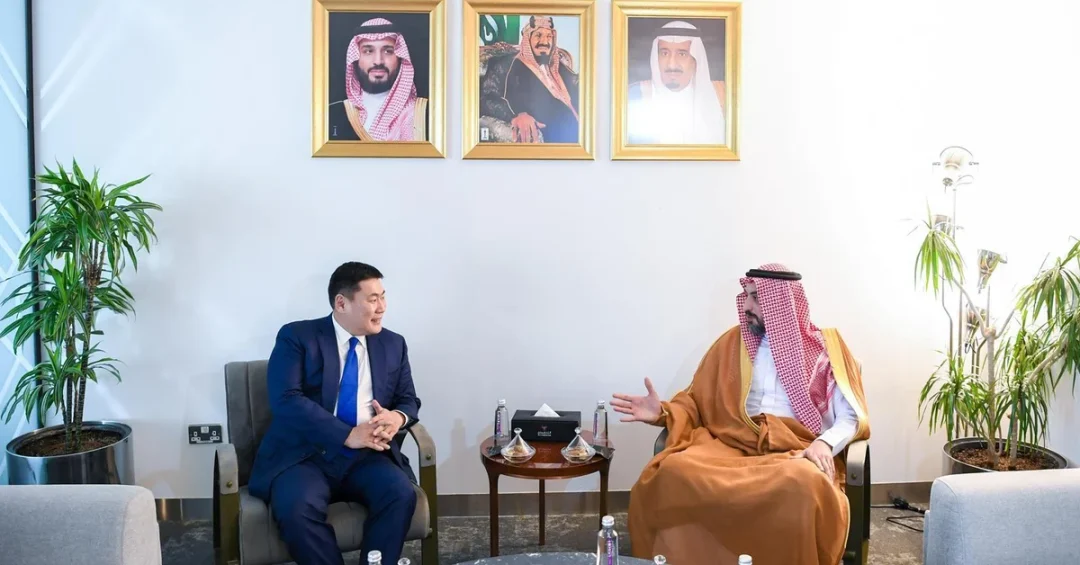
Mongolian Prime Minister Oyun-Erdene Luvsannamsrai and his accompanying delegation departed Riyadh on December 4, 2024, following their participation in the One Water Summit, according to the Saudi Press Agency (SPA). The high-level visit underscored the growing diplomatic, environmental, and economic ties between the Kingdom of Saudi Arabia and Mongolia, a relationship that has quietly expanded across multiple sectors in recent years. The Prime Minister was bid farewell at King Khalid International Airport by Saudi Ambassador to China and non-resident Ambassador to Mongolia Abdulrahman Al-Harbi, a gesture reflecting the depth of official engagement between Riyadh and Ulaanbaatar. The departure marked the conclusion of a visit that placed water security, sustainability, and multilateral cooperation at the center of regional and international dialogue.
Why does a single diplomatic departure from Riyadh carry significance beyond protocol? Because it signals the Kingdom’s expanding role as a convenor of global conversations on resources, climate, and development. The One Water Summit, hosted in Riyadh, brought together heads of state, ministers, and international organizations to address one of the most pressing challenges of the twenty-first century: the sustainable management of water. For Mongolia, a landlocked nation with vast steppes and a fragile water ecosystem, engagement with Saudi Arabia on these issues is both practical and strategic. For the Kingdom, the presence of leaders such as Prime Minister Luvsannamsrai reinforces its position as a hub for international problem-solving, aligned with the objectives of Saudi Vision 2030.
Context and Background
What has shaped the relationship between Saudi Arabia and Mongolia in recent years? The two countries have steadily built a partnership that extends beyond ceremonial diplomacy. Mongolia, strategically located between Russia and China, has pursued a “third neighbor” policy aimed at diversifying its international relationships. Saudi Arabia, with its growing global influence and its Vision 2030 economic transformation, fits naturally into that framework. Diplomatic ties were established in 1994, and since then, cooperation has expanded into trade, investment, education, and environmental protection. The appointment of a non-resident Saudi ambassador to Mongolia, currently Abdulrahman Al-Harbi, who is also Ambassador to China, reflects a pragmatic approach to maintaining consistent diplomatic engagement across Northeast Asia.
The One Water Summit itself represents a milestone in Saudi Arabia’s environmental diplomacy. Hosted in Riyadh, the summit convened policymakers, scientists, and private-sector leaders to discuss water scarcity, desalination innovation, and cross-border water management. For Saudi Arabia, water security is a national priority. The Kingdom is one of the world’s largest producers of desalinated water, and its expertise in this field is increasingly sought after by other arid and semi-arid nations. Mongolia, despite its different geography, faces challenges related to glacial melt, river basin management, and the impact of climate change on its pastoral traditions. The summit therefore provided a platform for knowledge exchange that could yield long-term benefits for both nations.
Why should international observers pay attention to this particular diplomatic interaction? Because it illustrates how middle powers and regional leaders can collaborate on issues that transcend borders. Water is not merely an environmental concern; it is tied to food security, energy production, and geopolitical stability. By hosting the One Water Summit and welcoming leaders like Prime Minister Luvsannamsrai, Saudi Arabia is positioning itself as a constructive actor in global resource governance, a role that complements its economic and diplomatic weight.
Key Details of the Visit and Departure
What exactly took place during the Prime Minister’s time in Riyadh? According to the Saudi Press Agency, Oyun-Erdene Luvsannamsrai and his accompanying delegation participated in the One Water Summit before departing the Saudi capital on December 4, 2024. The official farewell at King Khalid International Airport was led by Ambassador Abdulrahman Al-Harbi, who serves concurrently as Saudi Ambassador to China and non-resident Ambassador to Mongolia. This dual role is significant: it highlights the Kingdom’s integrated approach to diplomacy in Asia, where economic and political relationships often overlap. The ambassador’s presence at the farewell ceremony was a mark of respect and a reaffirmation of the bilateral relationship.
The delegation’s participation in the summit was not a symbolic gesture. Mongolia has been actively seeking international partnerships to address its water-related challenges, including the sustainable management of the Selenga River basin and the protection of Lake Khövsgöl. Saudi Arabia, through its National Water Strategy 2030 and the efforts of the Ministry of Environment, Water and Agriculture, has developed substantial expertise in desalination, wastewater treatment, and water-use efficiency. The convergence of interests made the summit a natural venue for dialogue. While the specific bilateral meetings held on the sidelines have not been fully disclosed, the official departure statement confirms that the visit was conducted at the highest level of protocol.
How does this visit fit into Saudi Arabia’s broader diplomatic calendar? December 2024 has been a busy month for Riyadh, with multiple international summits and high-level visits. The One Water Summit drew leaders from across Africa, Asia, and the Middle East, reinforcing the Kingdom’s capacity to host large-scale multilateral events. The presence of the Mongolian Prime Minister added a Northeast Asian dimension to the proceedings, demonstrating that Saudi Arabia’s convening power extends well beyond its immediate region. For Mongolia, the visit represented an opportunity to engage with a G20 economy and a major investor in sustainable technologies.
International and Regional Impact
What are the wider implications of Mongolia’s engagement with Saudi Arabia? For Ulaanbaatar, the relationship with Riyadh offers a counterbalance to its dependence on its two large neighbors, Russia and China. By cultivating ties with Saudi Arabia, Mongolia can diversify its diplomatic and economic partnerships, access new sources of investment, and participate in global conversations on climate and resources. For Saudi Arabia, the relationship with Mongolia is part of a broader Asian outreach that includes strengthened ties with China, India, Japan, and South Korea. The Kingdom’s Look East strategy, driven by Vision 2030, seeks to expand trade and investment links across Asia, and Mongolia, though smaller in economic size, occupies a strategic geographic position.
Regionally, the One Water Summit highlighted the Middle East’s growing role in addressing global environmental challenges. Saudi Arabia, which chairs the Middle East Green Initiative and has pledged to plant 10 billion trees, is increasingly seen as a leader in desertification control and water innovation. Mongolia’s participation in the summit signals that these efforts are attracting attention far beyond the region. Could this lead to future cooperation on desertification, renewable energy, or sustainable agriculture? The foundations laid at the summit suggest that such collaboration is not only possible but likely. Both countries share a commitment to multilateralism and to the sustainable use of natural resources, providing common ground for future initiatives.
Economic and Strategic Significance
Why does this diplomatic exchange matter economically? Saudi Arabia and Mongolia have untapped potential for trade and investment. Mongolia is rich in minerals, including copper, coal, and gold, while Saudi Arabia possesses capital, energy expertise, and a strategic interest in securing diverse supply chains. The Kingdom’s Public Investment Fund (PIF) has been expanding its international portfolio, and resource-rich countries are natural partners. Although no specific agreements were announced during this visit, the high-level contact could pave the way for future commercial deals. Additionally, Saudi expertise in water desalination and management could be valuable to Mongolia as it seeks to improve its water infrastructure and adapt to climate change.
Strategically, the visit reinforces Saudi Arabia’s role as a bridge between different regions. By hosting leaders from Northeast Asia and facilitating dialogue on shared challenges, the Kingdom enhances its soft power and its reputation as a responsible global stakeholder. For Mongolia, aligning with Saudi Arabia on water and sustainability issues adds weight to its own international advocacy. Both countries have an interest in a stable, rules-based international order, and their cooperation on environmental issues contributes to that goal. The departure of the Prime Minister, therefore, is not an ending but a continuation of a relationship that is steadily deepening.
Vision 2030 Alignment
How does this event connect to Saudi Vision 2030? Vision 2030 is fundamentally about transforming Saudi Arabia’s economy and society while increasing its global engagement. The One Water Summit and the presence of leaders like Prime Minister Luvsannamsrai directly support several Vision 2030 objectives: enhancing international cooperation, promoting environmental sustainability, and positioning the Kingdom as a hub for global events. The Ministry of Environment, Water and Agriculture has been tasked with implementing the National Water Strategy 2030, which aims to ensure sustainable water resources. Hosting international summits and welcoming foreign delegations are part of the Kingdom’s efforts to share knowledge and attract investment in these critical areas.
Moreover, the visit highlights the role of Saudi diplomacy in building partnerships across Asia, a key pillar of the Kingdom’s economic diversification strategy. As Saudi Arabia continues to open up to the world, events like the One Water Summit and visits by leaders such as Oyun-Erdene Luvsannamsrai demonstrate that Vision 2030 is not just an internal reform program but a global outreach initiative. The Kingdom is actively shaping international conversations on sustainability, and Mongolia’s participation is a testament to the appeal of that vision. As Riyadh cements its status as a global capital for dialogue and innovation, relationships like the one with Mongolia will play an increasingly important role in the years ahead.
20 Questions
Q1. Who departed Riyadh on December 4, 2024?
A1. Mongolian Prime Minister Oyun-Erdene Luvsannamsrai and his accompanying delegation departed Riyadh after participating in the One Water Summit, as reported by the Saudi Press Agency.
Q2. What event did the Mongolian Prime Minister attend in Riyadh?
A2. He attended the One Water Summit, a major international gathering focused on water security, sustainability, and innovative water management solutions.
Q3. Who bid farewell to the Mongolian Prime Minister at the airport?
A3. Saudi Ambassador to China and non-resident Ambassador to Mongolia Abdulrahman Al-Harbi bid farewell to the Prime Minister at King Khalid International Airport.
Q4. Why is the One Water Summit significant for Saudi Arabia?
A4. It reinforces Saudi Arabia’s role as a global convenor on environmental issues and supports its National Water Strategy 2030, a key component of Vision 2030.
Q5. What is the nature of Saudi-Mongolian diplomatic relations?
A5. The two countries established diplomatic ties in 1994 and have since expanded cooperation in trade, investment, education, and environmental protection, with regular high-level exchanges.
Q6. How does Mongolia’s “third neighbor” policy relate to Saudi Arabia?
A6. Mongolia seeks to diversify its international partnerships beyond Russia and China; Saudi Arabia, as a G20 economy, fits into this strategy as a valuable partner.
Q7. What water challenges does Mongolia face?
A7. Mongolia faces issues such as glacial melt, river basin management, and climate change impacts on pastoral traditions, making water cooperation with Saudi Arabia mutually beneficial.
Q8. What expertise does Saudi Arabia offer in water management?
A8. Saudi Arabia is a world leader in desalination, wastewater treatment, and water-use efficiency, with advanced technologies and infrastructure developed under its National Water Strategy 2030.
Q9. Did the visit result in any new agreements?
A9. No specific agreements were announced, but the high-level contact lays the groundwork for future cooperation in water, trade, and investment.
Q10. How does this visit fit into Saudi Arabia’s Asian outreach?
A10. It is part of the Kingdom’s Look East strategy under Vision 2030, which aims to strengthen economic and diplomatic ties across Asia, including Northeast Asia.
Q11. What is the strategic importance of Mongolia’s location?
A11. Mongolia is strategically located between Russia and China, making it a key partner for countries seeking to engage in Northeast Asia and diversify regional relationships.
Q12. What economic opportunities exist between Saudi Arabia and Mongolia?
A12. Potential exists in mining, energy, infrastructure, and water technology, with Saudi capital and expertise complementing Mongolia’s resource wealth and development needs.
Q13. How does the One Water Summit align with Vision 2030?
A13. It supports Vision 2030 goals of environmental sustainability, international cooperation, and positioning Saudi Arabia as a hub for global events and knowledge exchange.
Q14. What role did Ambassador Abdulrahman Al-Harbi play?
A14. As Saudi Ambassador to China and non-resident Ambassador to Mongolia, he represented the Kingdom at the farewell, reflecting the integrated approach to Asian diplomacy.
Q15. What are the broader implications of this visit for the Middle East?
A15. It highlights the region’s growing role in addressing global environmental challenges and Saudi Arabia’s leadership in desertification control and water innovation.
Q16. How might this visit affect future Saudi-Mongolian relations?
A16. It strengthens diplomatic ties and opens avenues for collaboration in water, trade, and investment, building on shared interests in sustainability and multilateralism.
Q17. What is the significance of the non-resident ambassador arrangement?
A17. It allows Saudi Arabia to maintain diplomatic engagement with Mongolia efficiently while leveraging the ambassador’s base in China for broader regional coordination.
Q18. What water-related initiatives has Saudi Arabia launched recently?
A18. Saudi Arabia has launched the National Water Strategy 2030, the Middle East Green Initiative, and hosts summits like the One Water Summit to promote global water security.
Q19. How does Mongolia benefit from participating in such summits?
A19. Mongolia gains access to knowledge, technology, and partnerships that help address its water challenges and supports its international advocacy on climate and sustainability.
Q20. What does this departure signify for Saudi Arabia’s global role?
A20. It underscores Saudi Arabia’s emergence as a global hub for diplomacy and sustainability, capable of convening world leaders and fostering meaningful international cooperation aligned with Vision 2030.
Reader Feedback
We value your thoughts. Please share your feedback on this article.
Your feedback helps us improve our coverage.
Related articles
 Saudi Ministry of Interior Joins 48th Arab Police Chiefs Conference
 Saudi Arabia Launches Second Phase of Aid for Lebanon
 GOSI Awarded 10 International Certificates of Merit at RSSF Asia-Pacific
 French President Macron Arrives in AlUla on State Visit
 KSrelief Chief Meets Egyptian Red Crescent CEO in Cairo
 Arab League Rejects Forced Displacement of Gaza Residents