


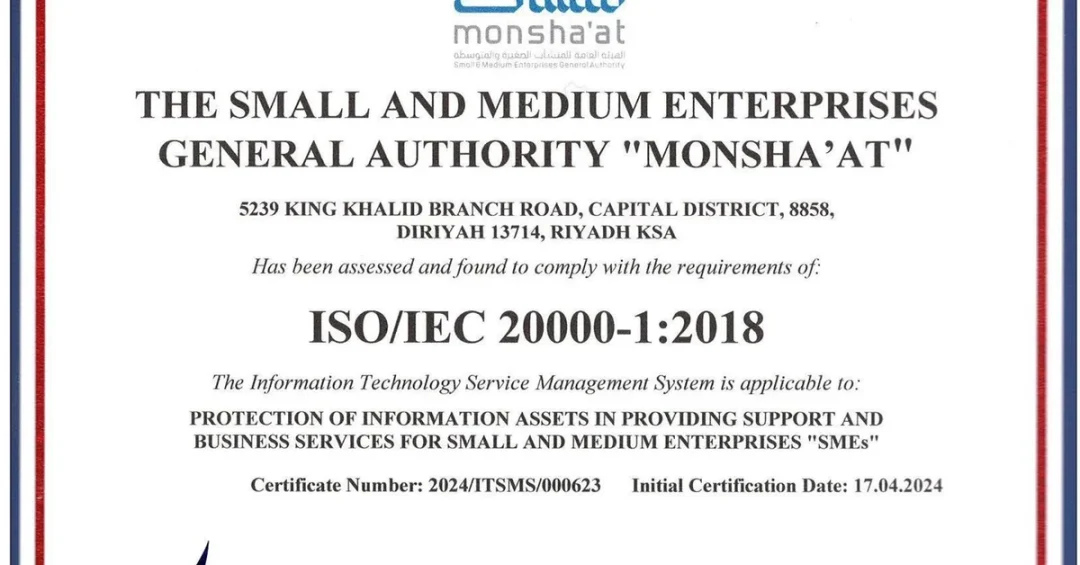
The General Authority for Small and Medium Enterprises (Monsha’at) has achieved ISO 20000 Certification for IT Service Management, a globally recognized accreditation that underscores its commitment to implementing industry-leading practices. The announcement, released via the Saudi Press Agency (SPA), highlights Monsha’at’s dedication to adhering to the international standard ISO 20000, ensuring excellence in technical service management.
Context and Background
Monsha’at, established to support and develop small and medium enterprises (SMEs) in Saudi Arabia, plays a pivotal role in the Kingdom’s economic diversification efforts under Vision 2030. The authority provides a range of services, including financing, training, and market access, to empower entrepreneurs and foster a vibrant SME sector. Achieving ISO 20000 certification aligns with Monsha’at’s broader mission to enhance the quality of its services and support the growth of SMEs through reliable and efficient IT infrastructure.
ISO 20000 is an international standard for IT service management (ITSM) that sets best practices for delivering managed services, ensuring quality, and meeting customer expectations. It provides a framework for organizations to establish, implement, maintain, and continually improve a service management system. This certification is particularly significant for Monsha’at as it seeks to streamline its digital services and improve user experience for entrepreneurs across the Kingdom.
Key Details
The ISO 20000 certification encompasses a comprehensive set of standards and requirements that organizations must implement and uphold to meet certification criteria. These include service level management, incident and problem management, change management, and capacity management, among others. By achieving this certification, Monsha’at demonstrates that its IT service management processes comply with global best practices, ensuring reliability, consistency, and quality in its digital offerings.
Monsha’at’s certification is expected to enhance the performance and quality of its IT services while fostering trust with customers and users. It also positions the authority as a leader in adopting international standards within the Saudi public sector, setting an example for other government entities to follow. The certification process involved rigorous audits and assessments to verify that Monsha’at’s IT service management practices meet the ISO 20000 requirements.
Implications and Impact
The achievement of ISO 20000 certification has several implications for Monsha’at and the broader Saudi entrepreneurial ecosystem. For Monsha’at, it means improved operational efficiency, reduced downtime, and enhanced service delivery, which directly benefits SMEs that rely on its digital platforms. For entrepreneurs, it translates into more reliable and user-friendly services, facilitating easier access to financing, training, and other support mechanisms.
Moreover, this certification reinforces Saudi Arabia’s commitment to digital transformation and quality standards, aligning with the objectives of Vision 2030 to build a robust digital economy. It also enhances the Kingdom’s reputation as a leader in adopting international best practices, which can attract foreign investment and partnerships. By demonstrating excellence in IT service management, Monsha’at contributes to creating a conducive environment for SME growth, which is essential for job creation and economic diversification.
Vision 2030 Alignment
The ISO 20000 certification is closely aligned with Vision 2030, Saudi Arabia’s ambitious plan to diversify its economy and reduce dependence on oil. SMEs are a cornerstone of this vision, with the goal of increasing their contribution to GDP from 20% to 35% by 2030. Monsha’at’s enhanced IT services will play a critical role in empowering SMEs, enabling them to thrive in a digital-first economy. This achievement exemplifies how Saudi institutions are embracing international standards to drive efficiency and innovation, furthering the Kingdom’s journey toward a sustainable and diversified future.
20 Questions
Q1. What is Monsha’at?
A1. Monsha’at is the General Authority for Small and Medium Enterprises in Saudi Arabia, established to support and develop SMEs through financing, training, and market access initiatives.
Q2. What certification did Monsha’at achieve?
A2. Monsha’at achieved the ISO 20000 Certification for IT Service Management, a globally recognized accreditation for excellence in technical service management.
Q3. What does ISO 20000 certification signify?
A3. ISO 20000 certification signifies that an organization’s IT service management processes meet international best practices for quality, reliability, and customer satisfaction.
Q4. Why is this certification important for Monsha’at?
A4. It enhances Monsha’at’s IT service quality, builds trust with users, and demonstrates its commitment to global standards, benefiting SMEs that rely on its digital services.
Q5. When was the certification announced?
A5. The certification was announced on July 18, 2024, via the Saudi Press Agency (SPA), highlighting Monsha’at’s achievement.
Q6. What are the key areas covered by ISO 20000?
A6. ISO 20000 covers service level management, incident and problem management, change management, capacity management, and other IT service management processes.
Q7. How does this certification impact SMEs in Saudi Arabia?
A7. It ensures more reliable and efficient digital services, making it easier for SMEs to access Monsha’at’s support programs and resources.
Q8. What is the role of Monsha’at in Vision 2030?
A8. Monsha’at supports SME growth, which is vital for economic diversification and job creation, aligning with Vision 2030’s goal to increase SME contribution to GDP.
Q9. How does ISO 20000 certification benefit Monsha’at’s operations?
A9. It improves operational efficiency, reduces downtime, and ensures consistent service delivery, enhancing overall user experience.
Q10. What process did Monsha’at undergo to achieve certification?
A10. Monsha’at underwent rigorous audits and assessments to verify that its IT service management practices comply with ISO 20000 requirements.
Q11. What is the significance of ISO 20000 for the public sector?
A11. It sets a benchmark for other government entities, promoting adoption of international standards and improving public service quality.
Q12. How does this certification affect Monsha’at’s reputation?
A12. It positions Monsha’at as a leader in IT service management, enhancing its credibility and attracting potential partnerships and investments.
Q13. What are the benefits for entrepreneurs using Monsha’at’s services?
A13. Entrepreneurs benefit from more reliable and user-friendly digital platforms, facilitating easier access to financing, training, and support.
Q14. How does ISO 20000 align with Saudi Arabia’s digital transformation goals?
A14. It supports the creation of a robust digital economy by ensuring high-quality IT services, a key pillar of Vision 2030’s digital transformation agenda.
Q15. What other standards has Monsha’at achieved?
A15. While specific other certifications are not detailed in the announcement, Monsha’at continues to pursue excellence in various operational areas.
Q16. Who announced the certification?
A16. The certification was announced by the Saudi Press Agency (SPA), the official news agency of Saudi Arabia.
Q17. What is the impact of this certification on Saudi Arabia’s economy?
A17. It strengthens the SME ecosystem, which is crucial for economic diversification, job creation, and reducing oil dependence.
Q18. How does Monsha’at support SMEs beyond IT services?
A18. Monsha’at provides financing, training, mentorship, and market access programs to help SMEs grow and succeed.
Q19. What does ISO 20000 certification require from organizations?
A19. It requires organizations to implement and uphold a comprehensive set of standards for IT service management, including processes for service delivery and improvement.
Q20. How does this achievement reflect Saudi Arabia’s Vision 2030?
A20. It demonstrates the Kingdom’s commitment to adopting international best practices and fostering a dynamic SME sector, key to achieving Vision 2030’s economic goals.
Reader Feedback
We value your thoughts. Please share your feedback on this article.
Your feedback helps us improve our coverage.