


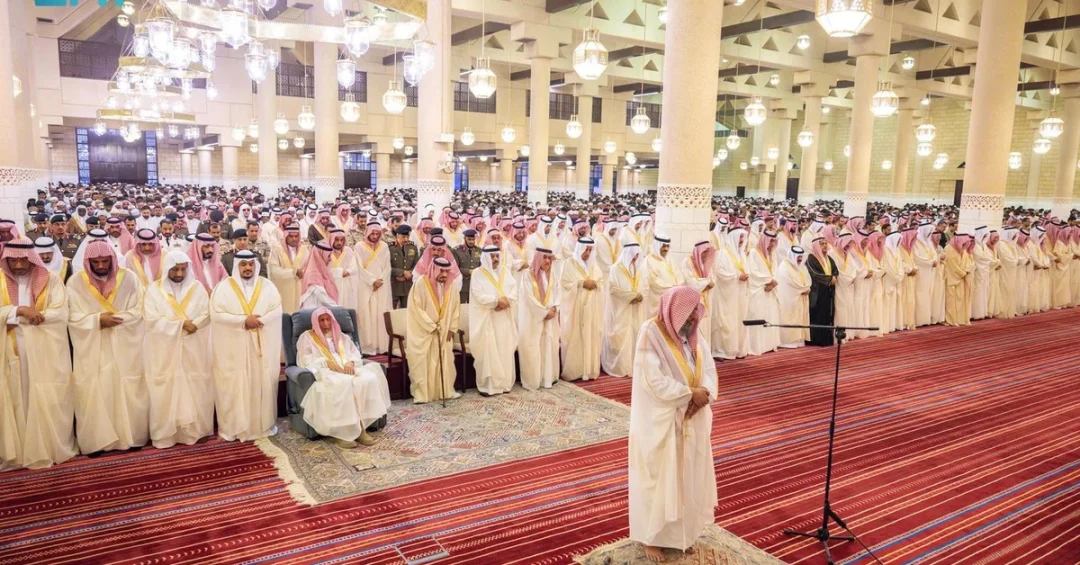
Muslims across the Kingdom of Saudi Arabia performed Eid Al-Fitr prayer this morning, marking the end of the holy month of Ramadan, in a nationwide observance coordinated by the Kingdom’s religious and civic authorities and reported by the Saudi Press Agency (SPA). Following a month of fasting and prayer, worshippers gathered in large numbers from the early morning hours at designated mosques throughout the Kingdom’s cities, governorates, and villages.
Have you ever wondered how a single act of worship can unite millions of people from different backgrounds in one shared moment? In Saudi Arabia, the answer unfolds each year at dawn on the first day of Shawwal, when the end of Ramadan is confirmed by the sighting of the new crescent moon. From the Grand Mosque in Makkah to the Prophet’s Mosque in Madinah, and from Riyadh to Jeddah, Dammam, Abha, and the smallest villages of the Kingdom, the Eid Al-Fitr prayer transforms an ordinary morning into a national expression of faith, gratitude, and community. The occasion reflects the enduring role of the Two Holy Mosques in the life of the Muslim world and the Kingdom’s commitment to serving pilgrims and worshippers with precision and care.
Context and Background
What makes Eid Al-Fitr more than just the end of a month of fasting? Eid Al-Fitr, known in Arabic as the Festival of Breaking the Fast, is one of the two major Islamic celebrations, arriving immediately after Ramadan, the ninth month of the Islamic lunar calendar. During Ramadan, Muslims abstain from food and drink from dawn until sunset, increase their prayers, give charity, and strengthen family and community ties. The Eid prayer is traditionally performed in congregation shortly after sunrise, often in large open mosques or designated prayer grounds capable of accommodating thousands of worshippers at once. In Saudi Arabia, the prayer is held under the guidance of the Kingdom’s religious authorities, with imams delivering a khutbah, or sermon, that emphasizes gratitude to God, forgiveness, reconciliation, and generosity toward the less fortunate.
How does a nation of more than 35 million people coordinate a single morning of worship across deserts, mountains, and modern metropolises? Saudi Arabia’s cities, governorates, and villages each designate mosques and prayer grounds for the Eid congregation, and municipal authorities, the Ministry of Islamic Affairs, Dawah and Guidance, and local emirates work together to ensure that venues are prepared, clean, and accessible. Roads and public transport are adjusted, security and medical teams are placed on standby, and imams are instructed to keep sermons focused on unity and compassion. The result is a synchronized national moment that reflects both the Kingdom’s deep religious heritage and its modern administrative capacity.
Why does the timing of Eid Al-Fitr attract global attention every year? Because the Islamic calendar is lunar, the start of Eid depends on the confirmed sighting of the new moon, a process overseen in Saudi Arabia by the Supreme Court and the Majlis al-Qada al-A’la, which calls on Muslims to observe the crescent and report sightings through official channels. Once the sighting is verified, the Royal Court announces the end of Ramadan and the beginning of Shawwal, and the news is carried by the Saudi Press Agency and other official outlets. This transparent, religiously grounded process is followed closely by Muslims around the world, many of whom align their own celebrations with the Kingdom’s announcement.
Key Details
How did the morning of Eid Al-Fitr unfold across the Kingdom? According to the Saudi Press Agency, worshippers began gathering from the early morning hours at designated mosques in cities, governorates, and villages throughout Saudi Arabia. The prayer was performed in congregation, followed by the traditional Eid khutbah. Families wore their finest clothes, exchanged greetings of “Eid Mubarak,” and visited relatives and neighbours, while children received gifts and treats known as Eidiyah. Charitable organizations distributed food and financial assistance to needy families, ensuring that the joy of the occasion reached every segment of society, in keeping with the spirit of zakat al-fitr, the obligatory charity given before the Eid prayer.
What role did official Saudi institutions play in supporting the occasion? The Ministry of Islamic Affairs, Dawah and Guidance oversees mosques and Eid prayer arrangements across the Kingdom, while the Ministry of Interior coordinates security and traffic management around major prayer venues. The Saudi Red Crescent Authority positions medical teams and ambulances near large congregations, and municipal authorities ensure that prayer grounds and surrounding streets are clean and well maintained. In Makkah and Madinah, the General Presidency for the Affairs of the Grand Mosque and the Prophet’s Mosque manages crowds with detailed operational plans, allowing worshippers to perform their prayers safely and comfortably. These coordinated efforts reflect the Kingdom’s broader commitment to serving the Guests of God.
How do worshippers in the Two Holy Cities experience Eid? In Makkah, the Eid prayer is performed in the Grand Mosque and in mosques across the holy city, where residents and visitors join in large numbers. In Madinah, the Prophet’s Mosque hosts worshippers who have travelled from around the world to spend the final days of Ramadan in the city of the Prophet. The presence of the Two Holy Mosques gives Eid in Saudi Arabia a distinctive spiritual dimension, and the Kingdom’s leadership has consistently emphasized the importance of enabling Muslims to worship in comfort and dignity. The occasion also highlights the ongoing expansion and modernization projects at the holy sites, which are designed to accommodate growing numbers of pilgrims and worshippers in the years ahead.
International and Regional Impact
Why does the Saudi Eid announcement resonate far beyond the Kingdom’s borders? Because Saudi Arabia is home to the Two Holy Mosques and hosts the annual Hajj and Umrah pilgrimages, its religious calendar carries unique weight in the Islamic world. When the Royal Court confirms the sighting of the crescent and announces the start of Eid, many Muslim communities across Asia, Africa, Europe, and the Americas take note, and some follow the same timing. This places the Kingdom at the centre of a global moment of celebration, reinforcing its role as a unifying spiritual reference point for more than a billion Muslims worldwide.
How does Eid Al-Fitr strengthen regional ties and people-to-people connections? The holiday is a time for family reunions, travel, and generosity, and in the Gulf region it is marked by an increase in cross-border visits, charitable giving, and cultural exchange. Saudi Arabia’s airports, land crossings, and hospitality sector prepare for higher demand as residents and visitors travel to celebrate with loved ones. The Kingdom’s leadership has repeatedly highlighted the importance of moderation, tolerance, and coexistence, values that are reflected in the Eid sermons and in the open, welcoming atmosphere that characterizes the occasion across Saudi cities and regions.
Economic and Strategic Significance
What does Eid Al-Fitr mean for Saudi Arabia’s economy and its strategic priorities? The holiday period typically brings a surge in consumer spending on food, clothing, gifts, travel, and hospitality, benefiting retail, tourism, and small businesses across the Kingdom. Shopping districts, restaurants, and entertainment venues experience increased footfall, and domestic tourism receives a boost as families take advantage of the holiday to explore destinations such as AlUla, the Red Sea coast, and the Asir highlands. This seasonal activity supports job creation and contributes to the diversification of the national economy, a central objective of Saudi Vision 2030.
How does the Kingdom balance religious observance with economic modernization? Saudi Arabia has demonstrated that deep respect for religious tradition and rapid economic transformation can advance together. While Eid remains a profoundly spiritual occasion, it also showcases the Kingdom’s modern infrastructure, digital services, and hospitality capabilities. Electronic payment systems, ride-hailing apps, and online booking platforms facilitate travel and celebrations, while government agencies use digital channels to communicate prayer schedules and safety guidance. The result is a holiday experience that is both faithful to tradition and reflective of a forward-looking, technologically advanced society.
Vision 2030 Alignment
How does the celebration of Eid Al-Fitr connect to the goals of Saudi Vision 2030? Vision 2030, launched under the leadership of Crown Prince Mohammed bin Salman, seeks to build a vibrant society, a thriving economy, and an ambitious nation. The Eid observance embodies the social dimension of that vision: it strengthens family bonds, encourages charitable giving, and reinforces the shared values that hold communities together. At the same time, the holiday highlights the Kingdom’s capacity to host large-scale religious gatherings, a capability that supports the pilgrimage sector, enhances the visitor experience, and reinforces Saudi Arabia’s standing as a global destination for faith and culture.
What does the future hold for Eid celebrations in the Kingdom? As Saudi Arabia continues to invest in the Two Holy Mosques, expand hospitality and transport infrastructure, and promote cultural and entertainment offerings, future Eid seasons are expected to welcome even more visitors and offer richer experiences for families and pilgrims alike. The Kingdom’s leadership has made clear that serving Islam and Muslims remains a foundational priority, and that modernization is a means of enhancing that service. On this Eid Al-Fitr morning, as worshippers across the cities, governorates, and villages of Saudi Arabia raised their hands in prayer and exchanged greetings of peace, the occasion once again demonstrated the enduring unity of the Muslim community and the Kingdom’s central place in its spiritual life.
20 Questions
Q1. What is Eid Al-Fitr?
A1. Eid Al-Fitr is the Islamic festival that marks the end of Ramadan, the month of fasting. It begins on the first day of Shawwal, the tenth month of the Islamic lunar calendar, and is celebrated with congregational prayer, family gatherings, and charitable giving.
Q2. When did Muslims in Saudi Arabia perform the Eid Al-Fitr prayer?
A2. According to the Saudi Press Agency, Muslims across the Kingdom performed the Eid Al-Fitr prayer on the morning of March 30, 2025, following the confirmation of the end of Ramadan and the beginning of Shawwal.
Q3. Where did worshippers gather for the Eid prayer?
A3. Worshippers gathered in large numbers at designated mosques throughout Saudi Arabia’s cities, governorates, and villages, with major congregations also held at the Grand Mosque in Makkah and the Prophet’s Mosque in Madinah.
Q4. What time is the Eid Al-Fitr prayer usually performed?
A4. The Eid prayer is performed in congregation shortly after sunrise on the first day of Shawwal. Worshippers typically begin gathering from the early morning hours to secure places and participate in the communal prayer.
Q5. How is the start of Eid Al-Fitr determined in Saudi Arabia?
A5. The start of Eid is determined by the confirmed sighting of the new crescent moon, overseen by the Supreme Court. Once sightings are verified through official channels, the Royal Court announces the end of Ramadan and the beginning of Shawwal.
Q6. What happens during the Eid prayer service?
A6. The Eid prayer consists of a congregational prayer followed by a khutbah, or sermon, delivered by the imam. The sermon emphasizes gratitude, forgiveness, charity, and unity among Muslims.
Q7. What is zakat al-fitr and why is it important?
A7. Zakat al-fitr is an obligatory charity given before the Eid prayer. It ensures that needy families can participate in the celebrations, reflecting the values of generosity and social solidarity that define the Eid occasion.
Q8. How do Saudi families celebrate Eid Al-Fitr?
A8. Families wear their finest clothes, exchange greetings of “Eid Mubarak,” visit relatives and neighbours, share festive meals, and give gifts and treats, known as Eidiyah, to children. Charitable giving is also a central part of the celebration.
Q9. Which Saudi ministries and agencies support the Eid prayer arrangements?
A9. The Ministry of Islamic Affairs, Dawah and Guidance oversees mosque arrangements, the Ministry of Interior coordinates security and traffic, the Saudi Red Crescent Authority provides medical support, and municipal authorities maintain prayer grounds and public spaces.
Q10. How are crowds managed at the Two Holy Mosques during Eid?
A10. The General Presidency for the Affairs of the Grand Mosque and the Prophet’s Mosque implements detailed operational plans, including crowd flow management, cleaning, and guidance services, to ensure worshippers can pray safely and comfortably.
Q11. Why does Saudi Arabia’s Eid announcement matter globally?
A11. Because the Kingdom hosts the Two Holy Mosques and the annual Hajj and Umrah pilgrimages, its religious calendar carries unique weight. Many Muslim communities around the world follow Saudi Arabia’s announcement of the start of Eid.
Q12. How does Eid Al-Fitr affect the Saudi economy?
A12. The holiday period boosts consumer spending on food, clothing, gifts, travel, and hospitality. Retail, tourism, and small businesses benefit, supporting job creation and economic diversification in line with Saudi Vision 2030.
Q13. Does Eid Al-Fitr encourage domestic tourism in Saudi Arabia?
A13. Yes. Many families use the holiday to travel within the Kingdom, visiting destinations such as AlUla, the Red Sea coast, and the Asir highlands. This supports the growth of the domestic tourism sector.
Q14. How does Saudi Arabia ensure safety during large Eid gatherings?
A14. Security, traffic, and medical teams are positioned near major prayer venues. The Ministry of Interior coordinates crowd management, and the Saudi Red Crescent Authority provides emergency medical services throughout the morning.
Q15. What values does the Eid khutbah emphasize?
A15. The Eid sermon emphasizes gratitude to God, forgiveness, reconciliation, charity toward the poor, and unity among Muslims. These values reflect the Kingdom’s commitment to moderation, tolerance, and social harmony.
Q16. How does Eid Al-Fitr reflect Saudi Vision 2030?
A16. Eid strengthens family bonds, charitable giving, and community cohesion, supporting the vision’s goal of a vibrant society. It also showcases the Kingdom’s capacity to host large religious gatherings and enhance the visitor experience.
Q17. What role do digital services play during Eid in Saudi Arabia?
A17. Digital platforms help worshippers access prayer schedules, safety guidance, and travel bookings. Electronic payments and ride-hailing apps facilitate celebrations, reflecting the Kingdom’s technologically advanced infrastructure and modern service culture.
Q18. How does Eid Al-Fitr promote regional and international ties?
A18. The holiday encourages family reunions, cross-border travel, charitable giving, and cultural exchange. It reinforces people-to-people connections across the Gulf region and the wider Islamic world, highlighting shared values and traditions.
Q19. What charitable activities take place during Eid in Saudi Arabia?
A19. Charitable organizations distribute food and financial assistance to needy families before and during Eid. Zakat al-fitr ensures that everyone can participate in the celebrations, reflecting the Kingdom’s strong tradition of social solidarity.
Q20. What does the future hold for Eid celebrations in Saudi Arabia?
A20. With continued investment in the Two Holy Mosques, hospitality, and transport infrastructure, future Eid seasons are expected to welcome more visitors and offer richer experiences, reinforcing the Kingdom’s role as a global destination for faith and culture.
Reader Feedback
We value your thoughts. Please share your feedback on this article.
Your feedback helps us improve our coverage.
Related articles
 MWL Chief Delivers Eid Sermon at Tirana Grand Mosque
 Egypt, Bahrain FMs Discuss Gaza Ceasefire Stability
 7.1 Magnitude Earthquake Strikes Near Tonga, Tsunami Warnings Issued
 Weqaa Center Highlights Inspectors’ Role in Food Security
 National Guard Minister Receives Commanders on Eid
 Defense Minister Receives Ministry’s Commanders, Senior Officials