


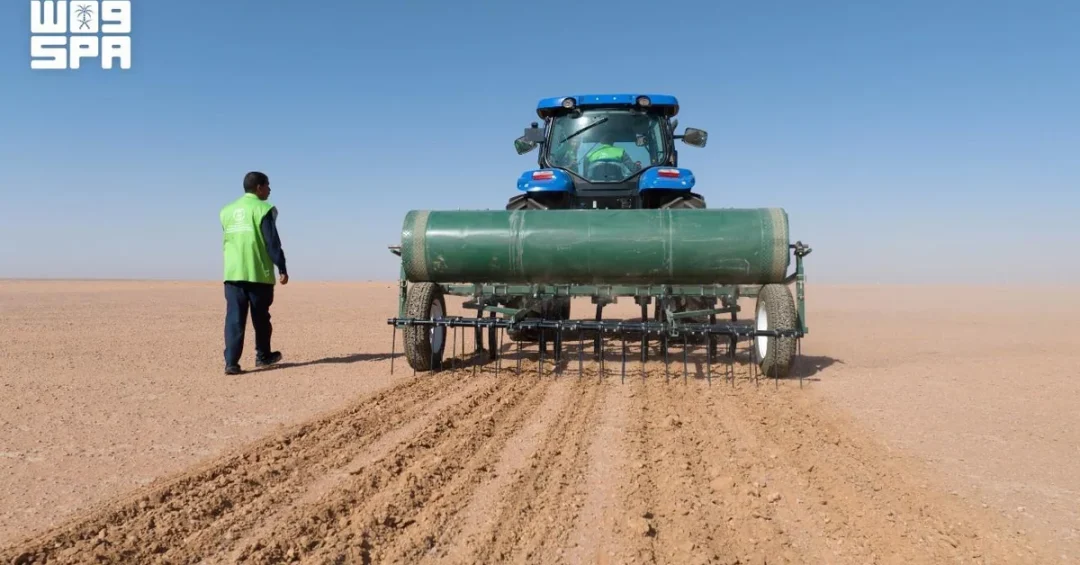
Seed dispersal activities for native wild and rangeland plants began in Hafr Al-Batin Governorate today, October 19, 2026, as part of the third season of a national initiative to rehabilitate natural rangelands through seed dispersal and rainwater harvesting. The activities, announced by the Saudi Press Agency, coincide with the National Greening Season 2026 launched by the National Greening Program and are designed to expand vegetation cover, restore degraded land, and strengthen environmental sustainability across the Kingdom of Saudi Arabia.
The initiative is overseen by the National Center for Vegetation Cover Development and Combating Desertification (NCVC), which selected plant species and target sites based on local environmental conditions. According to the NCVC, this carefully calibrated approach improves seed germination rates, preserves the genetic resources of native plants, and sustains vegetation cover over the long term. The launch in Hafr Al-Batin, a governorate in the Eastern Province known for its semi-arid climate and rangeland ecosystems, marks another step in Saudi Arabia’s broader campaign to combat desertification and restore ecological balance. Could there be a more tangible way for a nation to demonstrate its commitment to environmental stewardship than by planting the seeds of its own native flora?
Context and Background
How did Saudi Arabia arrive at a point where large-scale seed dispersal and rangeland rehabilitation have become a recurring national priority? The answer lies in decades of environmental research, policy development, and international cooperation. The National Center for Vegetation Cover Development and Combating Desertification was established to lead the Kingdom’s efforts against desertification, a challenge that affects arid and semi-arid regions worldwide. The NCVC’s mandate includes developing vegetation cover, protecting natural pastures, and implementing sustainable land management practices. Its work is closely tied to the Saudi Green Initiative, a comprehensive national strategy launched to address climate change, reduce carbon emissions, and restore degraded ecosystems.
The third season of the seed dispersal initiative builds on two previous seasons that tested methods for dispersing seeds of native wild and rangeland plants. These earlier phases provided data on which species thrive in specific microclimates, how rainwater harvesting structures can support germination, and how local communities can participate in rehabilitation efforts. The initiative also aligns with the National Greening Season 2026, a program that coordinates tree planting, seed dispersal, and land restoration activities across the Kingdom. By sequencing its interventions season by season, the NCVC is applying adaptive management principles, learning from each round of implementation and refining its approach before scaling up.
Hafr Al-Batin Governorate was selected for this season’s launch because its environmental conditions represent a cross-section of the challenges and opportunities found in Saudi rangelands. The area receives limited rainfall, experiences high summer temperatures, and hosts plant species that have adapted to survive in harsh conditions. These native species are essential for maintaining soil stability, supporting wildlife, and providing forage for livestock. When rangelands degrade, the consequences ripple through ecosystems and local economies. The NCVC’s decision to focus on native species is therefore both an ecological and an economic calculation, ensuring that restoration efforts yield durable benefits rather than short-term green cover that cannot sustain itself.
Key Details of the Hafr Al-Batin Initiative
What exactly happens when seeds are dispersed in a landscape as vast and unforgiving as Hafr Al-Batin’s rangelands? The process begins with the selection of plant species that are native to the region and suited to its soil, rainfall patterns, and temperature ranges. The NCVC stated that plant species and target sites are carefully selected based on local environmental conditions. This means that seeds are not scattered randomly; they are placed in locations where rainwater harvesting structures, such as contour trenches or micro-catchments, can capture and concentrate moisture. These structures improve the odds that seeds will germinate and seedlings will survive their first critical months.
The initiative also emphasizes the preservation of genetic resources. By using seeds from native plants, the NCVC helps maintain the genetic diversity that allows ecosystems to adapt to changing conditions. This is particularly important in the face of climate variability, which can shift rainfall patterns and temperature extremes. Native plants that have evolved in a specific region often possess traits, such as drought tolerance or deep root systems, that make them more resilient than introduced species. The seed dispersal activities therefore serve a dual purpose: they restore vegetation cover and they safeguard the genetic heritage of Saudi Arabia’s flora.
Rainwater harvesting is another cornerstone of the initiative. In arid environments, water is the limiting factor for plant growth. By capturing rainwater and directing it to target sites, the NCVC maximizes the use of every drop of precipitation. This technique also reduces soil erosion, because the structures slow down water flow and allow it to infiltrate the ground. Over time, the combination of seed dispersal and rainwater harvesting can transform degraded land into functioning rangeland that supports both biodiversity and human livelihoods. The third season’s activities in Hafr Al-Batin will build on these principles, applying them at a scale that contributes to national restoration targets.
International and Regional Impact
How does a seed dispersal initiative in one Saudi governorate resonate beyond the Kingdom’s borders? Saudi Arabia’s efforts to combat desertification are part of a global conversation about land degradation, food security, and climate resilience. The United Nations Convention to Combat Desertification (UNCCD) has highlighted the importance of restoring degraded land, and Saudi Arabia has played an active role in international forums on the topic. The Kingdom hosted the sixteenth session of the Conference of the Parties (COP16) to the UNCCD in Riyadh in 2024, where participants discussed strategies for drought resilience and sustainable land management. The Hafr Al-Batin initiative exemplifies the kind of on-the-ground action that international agreements aim to catalyze.
Regionally, the initiative contributes to the Middle East Green Initiative, a Saudi-led effort to plant 50 billion trees across the Middle East and reduce carbon emissions from the region’s oil-producing sector. The Middle East Green Initiative complements the Saudi Green Initiative’s domestic targets of planting 10 billion trees and rehabilitating 40 million hectares of degraded land. By sharing knowledge and best practices, Saudi Arabia positions itself as a leader in regional environmental cooperation. The seed dispersal activities in Hafr Al-Batin may seem localized, but they are part of a mosaic of projects that together advance the Kingdom’s vision of a greener, more sustainable region. Could the techniques refined in Hafr Al-Batin eventually inform similar projects in neighboring countries facing comparable environmental challenges?
Economic and Strategic Significance
Why should economists and business leaders pay attention to an initiative focused on seeds and rainwater? The answer lies in the intersection of environmental restoration and economic development. Healthy rangelands provide forage for livestock, which supports pastoral communities and the meat and dairy industries. They also reduce the risk of sand and dust storms, which can disrupt transportation, damage infrastructure, and affect public health. By investing in rangeland rehabilitation, Saudi Arabia is mitigating environmental risks that carry substantial economic costs. The NCVC’s work thus contributes to the stability and productivity of rural economies in regions like Hafr Al-Batin.
Furthermore, the initiative supports the goals of Saudi Vision 2030 by promoting environmental sustainability as a pillar of national development. Vision 2030 recognizes that economic diversification and quality of life depend on a healthy environment. The Saudi Green Initiative, with its tree-planting and land-rehabilitation targets, is a direct expression of this vision. As the Kingdom invests in renewable energy, sustainable agriculture, and eco-tourism, projects like the Hafr Al-Batin seed dispersal activities enhance the natural capital that underpins these sectors. A restored rangeland can become a destination for nature-based tourism, a habitat for wildlife, and a carbon sink that helps Saudi Arabia meet its climate commitments.
Strategically, the initiative also demonstrates Saudi Arabia’s capacity to execute complex environmental programs at scale. The NCVC coordinates with local authorities, environmental experts, and community stakeholders to ensure that activities are well-planned and monitored. This operational capability is a form of soft power, showcasing the Kingdom’s ability to deliver on ambitious promises. As global attention increasingly focuses on climate action and sustainable development, Saudi Arabia’s track record in land restoration strengthens its international standing and opens doors for partnerships in green technology, research, and finance.
Vision 2030 Alignment
How does dispersing native seeds in Hafr Al-Batin connect to the sweeping transformation envisioned by Saudi Vision 2030? Vision 2030 is a comprehensive plan to diversify the economy, empower citizens, and improve quality of life. Environmental sustainability is woven throughout its objectives, from the National Transformation Program to the Quality of Life Program. The Saudi Green Initiative, launched in 2021, set specific targets: planting 10 billion trees and rehabilitating 40 million hectares of degraded land. The seed dispersal activities in Hafr Al-Batin are a direct contribution to these targets, turning high-level goals into tangible actions on the ground.
Moreover, the initiative reflects Vision 2030’s emphasis on evidence-based policymaking and adaptive management. The NCVC’s careful selection of species and sites, its use of rainwater harvesting, and its focus on genetic preservation all demonstrate a scientific approach to environmental restoration. This approach aligns with Vision 2030’s broader commitment to innovation and efficiency. As Saudi Arabia continues to implement its greening programs, each season of seed dispersal adds to a growing body of knowledge and a expanding network of restored landscapes. The Hafr Al-Batin initiative is not an isolated event; it is part of a long-term, nationwide effort to secure a sustainable future for generations to come. In a world grappling with climate change and land degradation, Saudi Arabia’s proactive stance offers a model of how vision, resources, and determination can combine to heal the land.
20 Questions
Q1. What is the main goal of the seed dispersal activities in Hafr Al-Batin?
A1. The activities aim to rehabilitate natural rangelands by dispersing seeds of native wild and rangeland plants, expanding vegetation cover, restoring degraded land, and supporting environmental sustainability in line with the Saudi Green Initiative.
Q2. Which organization is overseeing the initiative?
A2. The National Center for Vegetation Cover Development and Combating Desertification (NCVC) is overseeing the initiative, selecting plant species and target sites based on local environmental conditions.
Q3. When did the activities begin?
A3. The activities began today, October 19, 2026, according to the Saudi Press Agency, coinciding with the National Greening Season 2026.
Q4. What is the National Greening Season 2026?
A4. It is a program launched by the National Greening Program to coordinate tree planting, seed dispersal, and land restoration activities across Saudi Arabia during the 2026 season.
Q5. Why is Hafr Al-Batin chosen for this initiative?
A5. Hafr Al-Batin’s semi-arid climate and rangeland ecosystems represent conditions where native plant restoration can be tested and scaled, contributing to national greening targets.
Q6. What are the Saudi Green Initiative’s tree-planting and land-rehabilitation targets?
A6. The Saudi Green Initiative aims to plant 10 billion trees and rehabilitate 40 million hectares of degraded land across the Kingdom of Saudi Arabia.
Q7. How does rainwater harvesting support the initiative?
A7. Rainwater harvesting structures capture and concentrate moisture, improving seed germination and seedling survival in arid environments while reducing soil erosion.
Q8. Why are native plant species preferred over introduced species?
A8. Native species are adapted to local conditions, possess drought tolerance, and help preserve genetic resources, making restoration efforts more resilient and sustainable.
Q9. What is the role of the NCVC in selecting target sites?
A9. The NCVC carefully selects target sites based on local environmental conditions to improve seed germination and sustain vegetation cover over the long term.
Q10. How does this initiative relate to the Middle East Green Initiative?
A10. It contributes to the Middle East Green Initiative’s goal of planting 50 billion trees across the region, complementing Saudi Arabia’s domestic greening efforts.
Q11. What are the expected environmental benefits of the seed dispersal?
A11. Benefits include expanded vegetation cover, restored degraded land, improved soil stability, enhanced biodiversity, and reduced risk of sand and dust storms.
Q12. How does the initiative support local communities?
A12. By rehabilitating rangelands, the initiative supports livestock grazing, pastoral livelihoods, and rural economies, while improving environmental quality for residents.
Q13. Is this the first season of the initiative?
A13. No, this is the third season of the initiative, building on previous seasons that tested methods and refined approaches for seed dispersal and rangeland rehabilitation.
Q14. What is the significance of preserving genetic resources of native plants?
A14. Preserving genetic diversity helps ecosystems adapt to climate variability and ensures that native flora can thrive in changing environmental conditions.
Q15. How does the initiative align with Saudi Vision 2030?
A15. It supports Vision 2030’s environmental sustainability goals, including the Saudi Green Initiative’s targets, by turning high-level objectives into concrete restoration actions.
Q16. What role does the National Greening Program play?
A16. The National Greening Program coordinates nationwide greening efforts, including the National Greening Season 2026, under which the Hafr Al-Batin activities are taking place.
Q17. How will success be measured?
A17. Success will be measured by seed germination rates, vegetation cover expansion, land rehabilitation, and progress toward national greening targets.
Q18. Can the techniques used in Hafr Al-Batin be applied elsewhere?
A18. Yes, the methods, such as species selection and rainwater harvesting, can be adapted to other arid regions in Saudi Arabia and beyond.
Q19. What is the broader significance of this initiative for Saudi Arabia?
A19. It demonstrates Saudi Arabia’s commitment to environmental stewardship, climate action, and sustainable development, enhancing its leadership in regional and global green efforts.
Q20. Where can I find more information about the initiative?
A20. More information is available through the Saudi Press Agency and the National Center for Vegetation Cover Development and Combating Desertification’s official channels.
Reader Feedback
We value your thoughts. Please share your feedback on this article.
Your feedback helps us improve our coverage.