


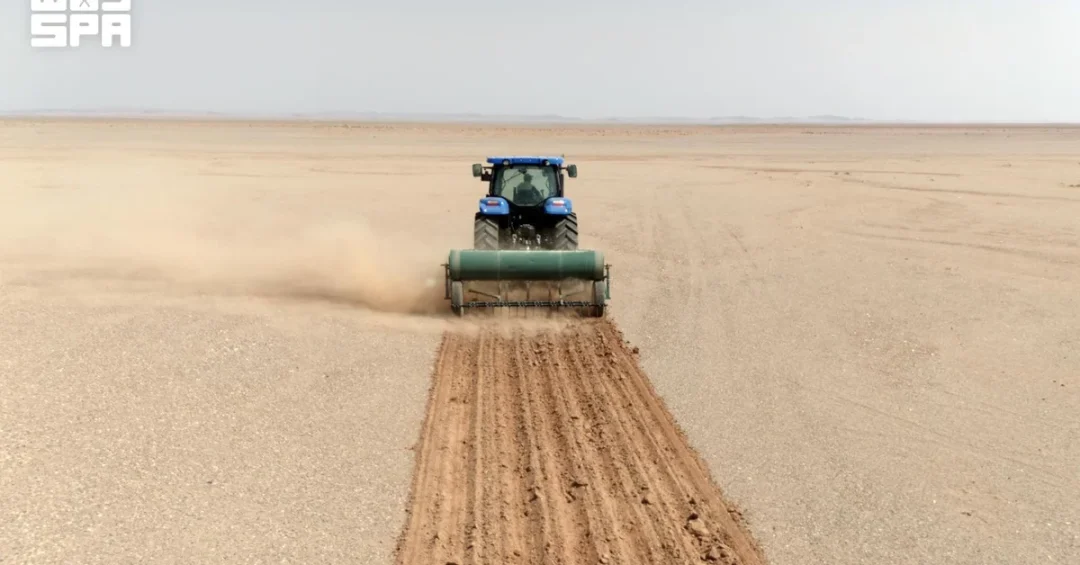
The National Center for Vegetation Cover Development and Combating Desertification (NCVC) branch in Madinah has launched a major campaign to rehabilitate natural rangelands, dispersing 18,719 kilograms of seeds across 10,398 hectares, timed to coincide with seasonal rainfall as part of the 2026 National Greening Season. The initiative, announced by the Saudi Press Agency, represents one of the largest single rangeland restoration efforts undertaken in the Madinah Region and forms part of the Kingdom’s broader strategy to combat desertification and restore degraded ecosystems. But what does this ambitious campaign actually mean for Saudi Arabia’s environmental future and the communities that depend on these lands?
The campaign is being implemented across three distinct locations in the Madinah Region, each with specific targets for seed dispersal and land rehabilitation. In Al-Hanakiyah Governorate, 8,836 hectares of the King Abdulaziz Hima Reserve will receive 15,906 kilograms of seeds, while 266 hectares of Al-Shaqran rangeland will be seeded with 480 kilograms. In Badr Governorate, 1,719 kilograms of seeds will be dispersed over 955 hectares of Al-Sumaydah rangeland. The NCVC is utilizing modern machinery to distribute seeds of native wild and forage plants, a technique designed to restore degraded land, improve vegetation cover, and support the objectives of the Saudi Green Initiative. This carefully coordinated effort reflects the Kingdom’s commitment to environmental sustainability and its determination to reverse the effects of desertification across the Arabian Peninsula.
Context and Background
Why has rangeland rehabilitation become such a critical priority for Saudi Arabia? The Kingdom’s natural rangelands have historically served as vital ecological and economic resources, supporting pastoral communities, providing grazing land for livestock, and contributing to the overall health of the region’s fragile ecosystems. However, decades of overgrazing, climate variability, and urban expansion have placed significant pressure on these lands, leading to soil degradation, loss of native plant species, and reduced biodiversity. The NCVC was established specifically to address these challenges, combining scientific research, modern technology, and community engagement to restore vegetation cover and combat desertification.
The 2026 National Greening Season represents a coordinated national effort to accelerate these restoration activities, with the Madinah campaign serving as a flagship example of how targeted interventions can deliver measurable results. The timing of the seed dispersal is particularly significant, as it coincides with the region’s rainfall period, maximizing the chances of germination and establishment for the native species being introduced. This approach demonstrates the NCVC’s commitment to working with natural cycles rather than against them, ensuring that restoration efforts are both effective and sustainable over the long term.
The selection of the King Abdulaziz Hima Reserve as a primary focus area is especially notable, given its historical significance as a traditional protected area. Hima reserves represent an ancient Arabian conservation tradition, where communities collectively managed grazing lands to prevent degradation. By revitalizing this concept through modern scientific methods, the NCVC is bridging traditional knowledge with contemporary environmental management, creating a model that could be replicated across the Kingdom and beyond.
Key Details of the Campaign
What specific techniques and plant species are being employed to ensure the success of this rehabilitation effort? The NCVC is utilizing seeds from native wild and forage plants, carefully selected for their adaptability to the local climate and soil conditions. These species are naturally suited to the Arabian Peninsula’s arid environment, requiring minimal irrigation and possessing deep root systems that help stabilize soil and retain moisture. The use of modern machinery for seed dispersal ensures uniform coverage across the designated areas, a crucial factor in achieving consistent germination rates and vegetation density.
The scale of the operation is considerable, with nearly 19,000 kilograms of seeds being distributed across more than 10,000 hectares. The King Abdulaziz Hima Reserve alone accounts for the majority of both the land area and seed volume, reflecting its importance as a biodiversity hotspot and its potential to serve as a source of seeds and plant material for future restoration projects. The Al-Shaqran and Al-Sumaydah rangelands, while smaller in scale, are equally important as they represent different ecological zones and will provide valuable data on how various native species respond to rehabilitation efforts in different microclimates.
The NCVC’s approach also includes ongoing monitoring and evaluation, ensuring that the campaign’s outcomes can be measured and used to inform future initiatives. This evidence-based methodology is central to the Kingdom’s environmental strategy, allowing for continuous improvement and the efficient allocation of resources. The data collected from this campaign will contribute to a growing body of knowledge about rangeland restoration in arid environments, positioning Saudi Arabia as a leader in desertification combat and sustainable land management.
International and Regional Impact
How does Saudi Arabia’s rangeland rehabilitation effort resonate beyond its borders? Desertification is a global challenge, affecting more than 100 countries and threatening the livelihoods of millions of people. By demonstrating successful large-scale restoration techniques, the Kingdom is contributing valuable knowledge to the international community and reinforcing its position as a responsible global environmental actor. The Saudi Green Initiative, of which this campaign is a part, aims to plant 10 billion trees across the Kingdom and restore 40 million hectares of degraded land, ambitious targets that align with global efforts such as the United Nations Decade on Ecosystem Restoration.
At the regional level, the campaign supports the Middle East Green Initiative, a Saudi-led effort to plant an additional 40 billion trees across the Middle East and reduce carbon emissions by more than 10 percent. These initiatives demonstrate the Kingdom’s commitment to addressing environmental challenges that transcend national boundaries, fostering cooperation among neighboring countries and setting a precedent for collective action. The techniques and lessons learned from the Madinah campaign will be shared with regional partners, amplifying the impact of Saudi Arabia’s investment in environmental restoration.
The campaign also has implications for food security and agricultural sustainability in the region. Healthy rangelands support livestock production, which remains an important economic activity for many communities in Saudi Arabia and across the Middle East. By restoring these lands, the NCVC is helping to ensure that pastoral livelihoods can continue sustainably, reducing pressure on other agricultural resources and contributing to the Kingdom’s broader food security objectives.
Economic and Strategic Significance
What economic benefits can be expected from this large-scale environmental investment? The rehabilitation of rangelands delivers multiple economic returns, from improved livestock productivity to the creation of green jobs in the environmental sector. Healthy vegetation cover reduces soil erosion, which in turn protects infrastructure and agricultural land, saving millions in potential damage and maintenance costs. The restoration of native plant species also supports biodiversity, which can enhance ecosystem services such as pollination and natural pest control, benefiting agriculture and reducing the need for chemical inputs.
Furthermore, the campaign aligns with Saudi Arabia’s Vision 2030 goal of diversifying the economy and creating sustainable employment opportunities. The environmental sector is a growing source of skilled jobs, requiring expertise in ecology, soil science, remote sensing, and project management. By investing in large-scale restoration projects, the Kingdom is building a workforce capable of addressing environmental challenges while contributing to economic growth. The NCVC’s use of modern machinery and technology also supports the development of a domestic environmental technology sector, which can eventually export expertise and equipment to other countries facing similar challenges.
Strategically, the campaign reinforces Saudi Arabia’s leadership in global environmental diplomacy. As the Kingdom prepares to host major international events and continues to play a central role in energy markets, demonstrating genuine commitment to environmental sustainability strengthens its international standing and credibility. The success of initiatives like the Madinah rangeland rehabilitation will be closely watched by international observers, providing tangible evidence of Saudi Arabia’s ability to translate environmental commitments into concrete action.
Vision 2030 Alignment
How does this campaign exemplify the objectives of Saudi Vision 2030? The Vision, launched in 2016 under the leadership of Crown Prince Mohammed bin Salman, sets out a comprehensive roadmap for the Kingdom’s future, including ambitious environmental targets. The Saudi Green Initiative, which encompasses this rangeland rehabilitation campaign, is a direct manifestation of the Vision’s commitment to sustainability, aiming to improve quality of life, protect natural resources, and contribute to global climate goals. The NCVC’s work in Madinah demonstrates how Vision 2030 translates into tangible projects that benefit both people and the planet.
The campaign also reflects the Vision’s emphasis on good governance, scientific innovation, and international cooperation. By utilizing modern technology, adhering to evidence-based methodologies, and collaborating with local communities, the NCVC is embodying the principles of effective environmental stewardship. As Saudi Arabia continues its journey toward a more sustainable and diversified future, initiatives like the Madinah rangeland rehabilitation will serve as benchmarks of success, inspiring further action and reinforcing the Kingdom’s position as a global leader in environmental restoration. The seeds being planted today are not just for vegetation—they are seeds of a greener, more prosperous tomorrow for the entire region.
20 Questions
Q1. What is the NCVC and what is its mission?
A1. The National Center for Vegetation Cover Development and Combating Desertification (NCVC) is a Saudi government agency tasked with restoring vegetation cover, combating desertification, and promoting sustainable land management across the Kingdom.
Q2. What is the 2026 National Greening Season?
A2. The 2026 National Greening Season is a coordinated nationwide effort to plant trees, rehabilitate rangelands, and restore ecosystems, aligning with the Saudi Green Initiative and Vision 2030 environmental goals.
Q3. How many hectares are being rehabilitated in the Madinah Region?
A3. The campaign covers a total of 10,398 hectares across three locations: the King Abdulaziz Hima Reserve, Al-Shaqran rangeland, and Al-Sumaydah rangeland.
Q4. How many kilograms of seeds are being dispersed?
A4. A total of 18,719 kilograms of native wild and forage plant seeds are being dispersed across the designated areas during the campaign.
Q5. Which governorates in Madinah are involved in the campaign?
A5. The campaign is active in Al-Hanakiyah Governorate and Badr Governorate, both located within the Madinah Region of Saudi Arabia.
Q6. What is the King Abdulaziz Hima Reserve and why is it significant?
A6. The King Abdulaziz Hima Reserve is a protected area in Al-Hanakiyah Governorate that embodies the traditional Arabian concept of Hima, a community-based conservation system now revitalized with modern techniques.
Q7. How much seed is being dispersed in the King Abdulaziz Hima Reserve?
A7. The reserve will receive 15,906 kilograms of seeds across 8,836 hectares, making it the largest single site in the campaign.
Q8. What is the size and seed volume for Al-Shaqran rangeland?
A8. Al-Shaqran rangeland covers 266 hectares and will receive 480 kilograms of seeds as part of the broader rehabilitation effort.
Q9. What about Al-Sumaydah rangeland in Badr Governorate?
A9. Al-Sumaydah rangeland spans 955 hectares and will be seeded with 1,719 kilograms of native plant seeds.
Q10. Why is the timing of the campaign important?
A10. The campaign is timed to coincide with the rainfall season, maximizing germination rates and ensuring the newly dispersed seeds have the best chance to establish and thrive.
Q11. What types of seeds are being used?
A11. The NCVC is using seeds of native wild and forage plants, which are naturally adapted to the arid climate and require minimal irrigation to survive and reproduce.
Q12. What machinery is used for seed dispersal?
A12. Modern agricultural machinery is employed to ensure uniform and efficient distribution of seeds across the large areas, improving coverage and germination consistency.
Q13. How does this campaign support the Saudi Green Initiative?
A13. The campaign directly contributes to the Saudi Green Initiative’s goals of planting 10 billion trees and restoring 40 million hectares of degraded land by 2030.
Q14. What are the main objectives of rangeland rehabilitation?
A14. The primary objectives are to restore degraded land, improve vegetation cover, enhance biodiversity, and support sustainable pastoral livelihoods in the region.
Q15. How does this effort combat desertification?
A15. By reintroducing native vegetation, the campaign stabilizes soil, reduces erosion, and improves water retention, directly countering the spread of desertification.
Q16. What role do local communities play in the campaign?
A16. Local communities benefit from restored rangelands for grazing and are engaged through traditional Hima practices, ensuring long-term stewardship and sustainability of the restored areas.
Q17. How does this align with Vision 2030?
A17. The campaign supports Vision 2030’s environmental sustainability goals, economic diversification through green jobs, and improved quality of life for Saudi citizens.
Q18. What are the expected environmental benefits?
A18. Expected benefits include increased vegetation cover, enhanced biodiversity, reduced soil erosion, improved air quality, and greater carbon sequestration, contributing to climate change mitigation.
Q19. Will the results be monitored and measured?
A19. Yes, the NCVC employs ongoing monitoring and evaluation to assess germination rates, vegetation density, and ecosystem recovery, using data to refine future restoration projects.
Q20. What does this campaign mean for Saudi Arabia’s global environmental leadership?
A20. It reinforces the Kingdom’s role as a leader in desertification combat and sustainable land management, providing a model for other arid regions and strengthening international environmental cooperation.
Reader Feedback
We value your thoughts. Please share your feedback on this article.
Your feedback helps us improve our coverage.