


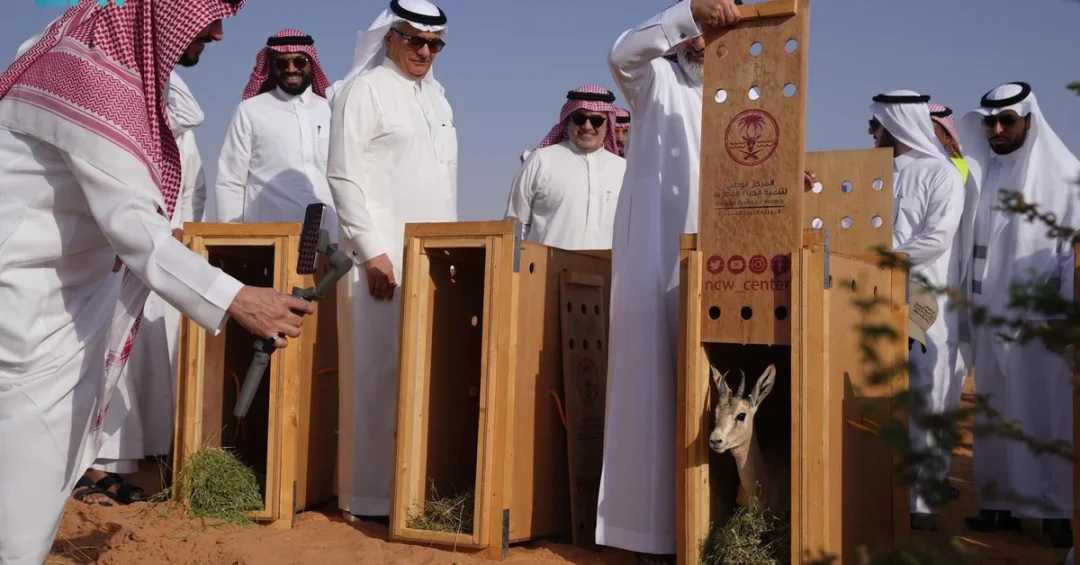
Buraydah, October 19, 2024 – In a significant step for wildlife conservation, the Saudi Minister of Environment, Water, and Agriculture, Eng. Abdulrahman Alfadley, released 15 Arabian Sand Gazelles at Buraydah Oasis Park in the Qassim Region. The release, conducted under the auspices of the National Center for Wildlife (NCW), marks the beginning of the 2024-2025 breeding and reintroduction season for endangered wildlife species.
Context and Background
This initiative is part of ongoing efforts by the Kingdom of Saudi Arabia to enhance biodiversity, restore ecological balance, and promote environmental sustainability. The Arabian Sand Gazelle, a species native to the Arabian Peninsula, has faced threats due to habitat loss and hunting. The NCW’s breeding and reintroduction programs are critical to preserving this and other species.
Key Details
The release was conducted in collaboration with the National Center for Vegetation Cover Development and Combating Desertification (NCVC) and the National Water Company (NWC). Dr. Mohammed bin Ali Qurban, CEO of the NCW, stated that the assessment of the oasis’s biodiversity determined the significance of releasing these gazelles. He emphasized the importance of enriching the area’s biodiversity and raising environmental awareness among visitors.
Implications and Impact
Dr. Qurban highlighted that such efforts bolster ecotourism in the Kingdom and create economic opportunities for local communities. By integrating wildlife reintroduction with park development, Saudi Arabia enhances the appeal of natural sites, aligning with the goals of the Saudi Green Initiative (SGI) and the National Strategy for Environmental Conservation.
Vision 2030 Alignment
The initiative directly supports Vision 2030’s objectives to create a positive environment and improve the quality of life. By fostering biodiversity and environmental sustainability, the Kingdom is taking tangible steps towards a greener future, reinforcing its commitment to environmental stewardship and global conservation efforts.
20 Questions
Q1. What is the National Center for Wildlife (NCW)?
A1. The National Center for Wildlife is a Saudi government entity responsible for the conservation and development of wildlife, including breeding and reintroducing endangered species.
Q2. What species were released at Buraydah Oasis Park?
A2. Fifteen Arabian Sand Gazelles, an endangered species native to the Arabian Peninsula, were released.
Q3. Why is the release of these gazelles important?
A3. It aids in restoring ecological balance, enhancing biodiversity, and promoting environmental sustainability in the region.
Q4. Who initiated the release?
A4. Eng. Abdulrahman Alfadley, Minister of Environment, Water, and Agriculture and Chairman of the NCW, initiated the release.
Q5. When did the release take place?
A5. The release took place on October 19, 2024.
Q6. Where is Buraydah Oasis Park located?
A6. Buraydah Oasis Park is located in the Qassim Region of Saudi Arabia.
Q7. What does the release mark?
A7. It marks the beginning of the 2024-2025 breeding and reintroduction season for endangered wildlife.
Q8. Which other entities collaborated with the NCW?
A8. The National Center for Vegetation Cover Development and Combating Desertification (NCVC) and the National Water Company (NWC) collaborated.
Q9. What is the goal of the collaboration?
A9. To enhance the oasis’s appeal and raise environmental awareness among its visitors.
Q10. How does this relate to ecotourism?
A10. It boosts ecotourism by making natural sites more attractive and creating economic opportunities for local communities.
Q11. What assessments did the NCW conduct?
A11. They assessed the oasis’s current and future biodiversity to determine the significance of releasing the species.
Q12. What is the Saudi Green Initiative?
A12. The Saudi Green Initiative is a national effort to combat climate change, reduce emissions, and increase green spaces in Saudi Arabia.
Q13. How does this align with Vision 2030?
A13. It supports Vision 2030’s goals of creating a positive environment and improving quality of life through environmental conservation.
Q14. What is the National Strategy for Environmental Conservation?
A14. It is a strategy to protect and enhance the environment, including wildlife conservation, in Saudi Arabia.
Q15. Why are Arabian Sand Gazelles endangered?
A15. Habitat loss and hunting have contributed to their endangered status.
Q16. How does the NCW breed endangered species?
A16. The NCW runs breeding programs in dedicated facilities, then reintroduces the animals into protected areas.
Q17. What benefits do these releases have for local communities?
A17. They create economic opportunities through ecotourism and enhance the local environment.
Q18. Does this release help restore ecological balance?
A18. Yes, by reintroducing a native species, it helps maintain the ecosystem’s health and function.
Q19. How can visitors contribute to conservation?
A19. Visitors can follow guidelines, respect wildlife, and support conservation efforts by visiting parks responsibly.
Q20. What future actions can be expected from the NCW?
A20. The NCW plans to continue breeding and releasing endangered species across the Kingdom, in line with national strategies.
Reader Feedback
We value your thoughts. Please share your feedback on this article.
Your feedback helps us improve our coverage.