


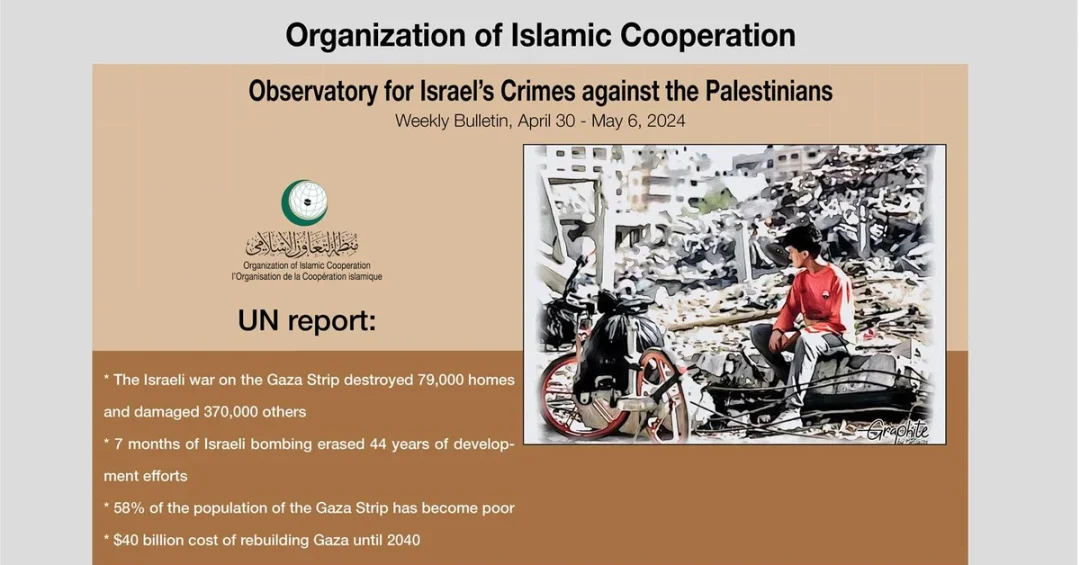
The Organization of Islamic Cooperation (OIC) Media Observatory has released its weekly report documenting Israeli violations against Palestinians in the occupied territories for the period April 30 to May 6, 2024. The report, as published by the Saudi Press Agency, details ongoing military operations in Rafah, escalating casualties, and attacks on humanitarian aid convoys.
Context and Background
The OIC, headquartered in Jeddah, Saudi Arabia, established its Media Observatory to monitor and expose human rights violations committed by Israeli forces against Palestinians. This weekly report serves as a crucial tool for the international community to understand the situation on the ground. The reported period saw a significant escalation, with a military ground operation launched against Rafah, a city in the southern Gaza Strip, despite widespread international opposition. The operation has raised fears of a large-scale humanitarian catastrophe and unprecedented famine, further worsening the already dire conditions in the enclave.
Key Details
According to the report, 26 massacres were committed by Israeli occupation forces during the week, resulting in the deaths of 253 Palestinians and injuries to 476 others. The cumulative death toll since October 7, 2023, has risen to 35,233. In a particularly concerning development, Israeli settlers carried out attacks on two Jordanian aid convoys. The first attack, at the Beit Hanoun crossing, targeted 31 trucks, while the second occurred on the road to the Kerem Shalom crossing, affecting a convoy of 48 trucks. These convoys were transporting essential humanitarian supplies, including food and flour, for the besieged population.
Furthermore, a joint report by the United Nations Development Programme (UNDP) and the United Nations Economic and Social Commission for Western Asia (ESCWA) highlights the devastating impact of the aggression on infrastructure. Over seven months, 79,000 homes were completely destroyed and 370 others partially damaged. The reconstruction cost is estimated at a staggering $40 billion, with a projected completion timeline extending to 2040 at the earliest. The report underscores that the aggression has erased 44 years of development progress in health and education sectors, pushing 1.74 million Palestinians (58% of the Gazan population) into poverty.
Implications and Impact
The findings have far-reaching implications for regional stability and international humanitarian law. The attacks on Jordanian aid convoys not only violate international norms but also endanger vital supply lines for civilians in Gaza. The displacement and destruction of infrastructure will have long-term consequences for the Palestinian population, hindering their ability to rebuild and recover. The OIC continues to call on the international community to intervene and halt these violations, emphasizing the need for accountability and adherence to international law.
Vision 2030 Alignment
Saudi Arabia, as the host of the OIC and a steadfast supporter of Palestinian rights, remains committed to humanitarian principles and regional peace. The Kingdom’s Vision 2030 emphasizes the importance of international cooperation and the protection of human rights. By supporting initiatives like the OIC Media Observatory, Saudi Arabia reinforces its role as a leader in advocating for justice and stability in the region. This aligns with the Kingdom’s broader efforts to foster a secure and prosperous future for all, in line with its commitment to the Palestinian cause and the two-state solution.
20 Questions
Q1. What is the OIC Media Observatory?
A1. The OIC Media Observatory is a monitoring body established by the Organization of Islamic Cooperation to document human rights violations against Palestinians, providing regular reports to raise international awareness.
Q2. When was the weekly report released?
A2. The report was released on May 8, 2024, covering the period from April 30 to May 6, 2024, as announced by the Saudi Press Agency.
Q3. How many massacres were reported?
A3. The report documented 26 massacres committed by Israeli occupation forces against Palestinians during the one-week period.
Q4. What was the death toll during the reporting period?
A4. During the period, 253 Palestinians were killed, and 476 others were injured, according to the OIC report.
Q5. What is the total number of Palestinian martyrs since October 7, 2023?
A5. The total number of Palestinian martyrs since October 7, 2023, stands at 35,233, as of the end of the reporting period.
Q6. What is the significance of the Rafah military operation?
A6. The Israeli military operation in Rafah is significant because it was launched despite international opposition, raising fears of a large-scale humanitarian crisis and famine in Gaza.
Q7. How many Jordanian aid convoys were attacked?
A7. Two Jordanian aid convoys were attacked by Israeli settlers during the reporting period.
Q8. Where did the attacks on aid convoys take place?
A8. The attacks occurred at the Beit Hanoun crossing, targeting 31 trucks, and on the Kerem Shalom crossing road, targeting a convoy of 48 trucks.
Q9. What kind of aid was being transported in the convoys?
A9. The convoys were carrying humanitarian aid, including food and flour, essential for the beleaguered Palestinian population in Gaza.
Q10. What did the UNDP and ESCWA report state?
A10. The joint report highlighted that Israeli aggression has destroyed 79,000 homes and partially damaged 370 others, estimating reconstruction costs at $40 billion.
Q11. What is the projected reconstruction timeline?
A11. The reconstruction is expected to take up to 16 years, with 2040 being the earliest possible completion date, according to the UN report.
Q12. How many Palestinians are expected to fall into poverty?
A12. The report projects that 1.74 million Palestinians, representing 58% of the Gazan population, will fall into poverty as a result of the aggression.
Q13. What is the impact on development efforts?
A13. The Israeli aggression has undone 44 years of development gains in the health and education sectors, reversing progress since 1980.
Q14. How many incidents of incursions into Al-Aqsa Mosque were reported?
A14. The OIC report recorded four incidents of incursions into the courtyards of the Al-Aqsa Mosque during the week.
Q15. How many Palestinians were arrested in the West Bank?
A15. Approximately 127 Palestinians were arrested in various cities and towns in the West Bank, according to the report.
Q16. What kind of demolitions occurred in the West Bank?
A16. Occupation forces demolished nine buildings, including residential and commercial shops, in areas such as Al-Quds, Ramallah, Tulkarm, and Hebron.
Q17. What was confiscated in West Bank villages?
A17. Three bulldozers, two agricultural tractors, and a truck were confiscated in the villages of Hebron, Ramallah, and Nablus.
Q18. How does Saudi Arabia support the OIC?
A18. Saudi Arabia hosts the OIC headquarters in Jeddah and supports its initiatives, including the Media Observatory, as part of its commitment to Palestinian rights.
Q19. What is the stance of Saudi Arabia on the Palestinian cause?
A19. Saudi Arabia firmly supports the Palestinian cause, advocating for a two-state solution and international law, in line with its Vision 2030 principles.
Q20. What does this situation mean for regional stability?
A20. The ongoing violence and humanitarian crisis in Gaza threaten regional stability and undermine peace efforts, making the OIC’s monitoring and reporting vital for international action.
Reader Feedback
We value your thoughts. Please share your feedback on this article.
Your feedback helps us improve our coverage.