


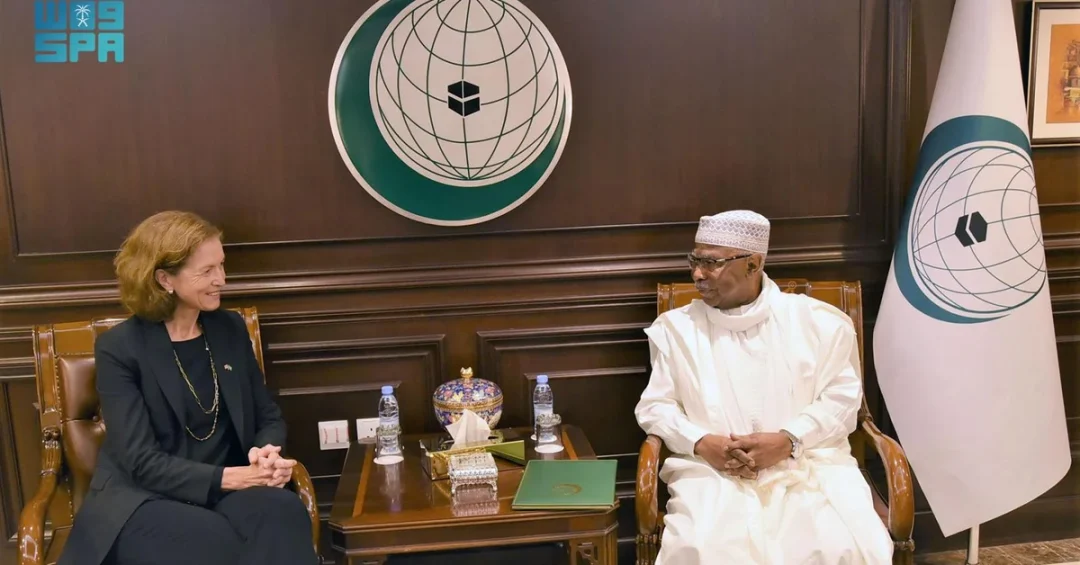
The Secretary General of the Organization of Islamic Cooperation (OIC), Hissein Brahim Taha, received the Ambassador of the Kingdom of Norway to the Kingdom of Saudi Arabia, Kjersti Tromsdal, at the OIC headquarters in Jeddah on October 21, 2024, where the two officials discussed ways to strengthen cooperation between the OIC and Norway and exchanged views on various topics of mutual interest, particularly focusing on the Palestinian issue. The meeting, announced via the Saudi Press Agency, underscores the OIC’s ongoing diplomatic engagement with European nations and reflects the organization’s broader efforts to build bridges of understanding and cooperation on matters of shared concern. What does this high-level diplomatic encounter signal about the OIC’s expanding international role under Saudi leadership?
The OIC, headquartered in Jeddah, Kingdom of Saudi Arabia, serves as the collective voice of the Muslim world, representing 57 member states across four continents. As the second-largest intergovernmental organization after the United Nations, the OIC has long played a pivotal role in fostering dialogue, promoting peace, and addressing challenges facing Muslim communities globally. This latest meeting with Norway’s top diplomat in Saudi Arabia highlights the organization’s commitment to constructive engagement with nations beyond its membership, particularly those with shared interests in peace, stability, and humanitarian causes. The discussions between Taha and Tromsdal come at a time of heightened international attention on the Palestinian issue, making the exchange both timely and significant.
Context and Background
How did the OIC become such a central platform for international diplomacy on issues affecting the Muslim world? Established in 1969 following the arson attack on the Al-Aqsa Mosque in Jerusalem, the OIC was founded to safeguard the interests and aspirations of Muslim communities worldwide. Over the decades, it has evolved into a comprehensive organization addressing political, economic, social, cultural, and humanitarian issues. Its headquarters in Jeddah, under the gracious host status of the Kingdom of Saudi Arabia, have become a diplomatic hub where representatives from across the globe convene to address pressing matters. The organization’s charter emphasizes peaceful dialogue, cooperation, and mutual respect among nations, principles that were clearly reflected in the October 21 meeting.
Norway, represented by Ambassador Kjersti Tromsdal, has maintained diplomatic relations with Saudi Arabia and has shown consistent interest in Middle Eastern affairs, particularly in peacebuilding and humanitarian efforts. Norway’s historical role in facilitating peace negotiations, including the Oslo Accords, positions it as a credible and constructive partner in discussions on the Palestinian issue. The meeting between Taha and Tromsdal thus represents a convergence of two parties with a shared commitment to dialogue and peaceful resolution of conflicts. The OIC’s engagement with Norway also reflects the organization’s strategy of reaching out to non-member states to build consensus on key international issues. What makes Norway a particularly valuable partner for the OIC in these discussions?
Key Details of the Meeting
What specific topics were on the agenda when the OIC Secretary General and the Norwegian Ambassador met? According to the Saudi Press Agency, the discussions centered on strengthening cooperation between the OIC and Norway and exchanging views on various topics of mutual interest, with a particular emphasis on the Palestinian issue. The meeting took place at the OIC headquarters in Jeddah, a venue that has hosted numerous high-level diplomatic encounters over the years. The presence of Ambassador Tromsdal at the OIC headquarters underscores Norway’s recognition of the organization’s importance as a platform for dialogue on issues affecting the Muslim world and beyond.
The Palestinian issue remains a central concern for the OIC, which has consistently advocated for a just and lasting solution based on international law and relevant United Nations resolutions. The OIC has repeatedly called for the establishment of an independent Palestinian state with East Jerusalem as its capital, in line with the two-state solution. By discussing this matter with Norway’s ambassador, Secretary General Taha reaffirmed the OIC’s unwavering commitment to the Palestinian cause and its willingness to engage with international partners to advance peace. Norway’s perspective on the matter is particularly relevant given its history of involvement in Middle East peace efforts. The exchange of views between the two officials thus represents a meaningful step in ongoing diplomatic efforts to address one of the world’s most protracted conflicts.
The meeting also served as an opportunity to explore avenues for broader cooperation between the OIC and Norway. While the specifics of these discussions were not fully disclosed, the OIC’s mandate encompasses a wide range of areas, including humanitarian assistance, cultural exchange, economic development, and conflict resolution. Norway, known for its active role in international development and peacebuilding, could potentially collaborate with the OIC on initiatives that benefit Muslim communities in need. Such cooperation would align with the OIC’s objectives of promoting solidarity and supporting sustainable development across its member states. How might enhanced OIC-Norway cooperation translate into tangible benefits for communities in need?
International and Regional Impact
What are the broader implications of this diplomatic engagement for regional and international relations? The meeting between the OIC Secretary General and the Norwegian Ambassador reflects a growing trend of increased dialogue between the Muslim world’s largest representative body and Western nations. In a global landscape marked by complex geopolitical challenges, such engagements are essential for fostering understanding and building consensus. The OIC’s willingness to engage with Norway on the Palestinian issue demonstrates its openness to multilateral diplomacy and its recognition that lasting solutions require the involvement of diverse international stakeholders. This approach aligns with the OIC’s founding principles of promoting peace and harmony among nations.
For Norway, the meeting signals a continued commitment to engaging with key actors in the Middle East and the broader Muslim world. As a nation with a strong tradition of diplomacy and conflict mediation, Norway’s interactions with the OIC could pave the way for joint initiatives in areas such as humanitarian aid, education, and interfaith dialogue. The Palestinian issue, in particular, benefits from the involvement of countries like Norway that have historically played constructive roles in peace processes. The OIC’s engagement with Norway also highlights the organization’s ability to serve as a bridge between Muslim-majority countries and Western nations, facilitating dialogue on sensitive topics in a spirit of mutual respect. What role can such bridge-building play in reducing tensions and promoting stability in the region?
Economic and Strategic Significance
How does this diplomatic meeting connect to broader economic and strategic priorities? While the primary focus of the discussion was on political and humanitarian matters, the OIC’s engagement with Norway also has potential economic dimensions. Norway is a significant player in global energy markets, and its expertise in renewable energy, sustainable development, and technology could be valuable to OIC member states pursuing economic diversification. Many OIC countries, including Saudi Arabia, are actively working to transform their economies through initiatives like Vision 2030, which aims to reduce dependence on oil and foster innovation and entrepreneurship. Cooperation with Norway in these areas could support these efforts and create new opportunities for trade and investment.
Strategically, the meeting reinforces the OIC’s position as a key interlocutor for international engagement with the Muslim world. By maintaining open channels of communication with countries like Norway, the OIC enhances its ability to advocate for the interests of its member states on the global stage. This is particularly important in the context of the Palestinian issue, where international support and consensus are essential for achieving a just resolution. The OIC’s diplomatic efforts, exemplified by this meeting, contribute to keeping the Palestinian cause at the forefront of international attention and ensuring that the voices of Muslim communities are heard. What strategic advantages does the OIC gain by cultivating relationships with influential non-member states?
Vision 2030 Alignment
How does this diplomatic engagement align with Saudi Arabia’s Vision 2030 and its broader global role? The Kingdom of Saudi Arabia, as the host of the OIC headquarters and a founding member, plays a central role in supporting the organization’s mission and activities. Vision 2030, Saudi Arabia’s ambitious blueprint for economic and social transformation, emphasizes the importance of international cooperation, cultural exchange, and the Kingdom’s active participation in global affairs. The OIC’s diplomatic initiatives, including the meeting between Secretary General Taha and Ambassador Tromsdal, are consistent with these objectives. By facilitating dialogue between the Muslim world and Western nations, the OIC contributes to a more interconnected and peaceful global community, which is a key aspiration of Vision 2030.
Moreover, Saudi Arabia’s leadership in the OIC reflects its commitment to upholding the values of moderation, tolerance, and mutual respect. Under Vision 2030, the Kingdom has sought to strengthen its role as a bridge between cultures and civilizations, promoting dialogue and understanding. The OIC’s engagement with Norway on issues of mutual concern, particularly the Palestinian issue, exemplifies this approach. As the OIC continues to evolve and expand its partnerships, Saudi Arabia remains a steadfast supporter of its mission to serve the interests of the Muslim world and contribute to global peace and stability. In a world of interconnected challenges, the OIC’s diplomatic outreach, supported by Saudi Arabia’s vision and resources, will remain a vital force for constructive international engagement. What future milestones can we expect as the OIC deepens its partnerships with nations around the world?
20 Questions
Q1. Who received the Norwegian Ambassador to Saudi Arabia?
A1. The Secretary General of the Organization of Islamic Cooperation (OIC), Hissein Brahim Taha, received the Ambassador of the Kingdom of Norway to the Kingdom of Saudi Arabia, Kjersti Tromsdal, at the OIC headquarters in Jeddah.
Q2. When did the meeting take place?
A2. The meeting took place on October 21, 2024, as reported by the Saudi Press Agency.
Q3. Where did the meeting occur?
A3. The meeting was held at the OIC headquarters in Jeddah, Kingdom of Saudi Arabia.
Q4. What was the main purpose of the meeting?
A4. The main purpose was to discuss ways to strengthen cooperation between the OIC and Norway and to exchange views on various topics of mutual interest.
Q5. Which specific issue was highlighted during the discussions?
A5. The Palestinian issue was particularly highlighted during the discussions between the OIC Secretary General and the Norwegian Ambassador.
Q6. What is the OIC and how many member states does it have?
A6. The OIC is the Organization of Islamic Cooperation, the second-largest intergovernmental organization after the UN, representing 57 member states across four continents.
Q7. Why is the OIC headquartered in Jeddah, Saudi Arabia?
A7. The OIC is headquartered in Jeddah, Saudi Arabia, due to the Kingdom’s central role as a founding member and its gracious host status, providing a diplomatic hub for the Muslim world.
Q8. What is Norway’s historical role in Middle East peace efforts?
A8. Norway has historically facilitated peace negotiations, including the Oslo Accords, positioning it as a credible and constructive partner in discussions on the Palestinian issue.
Q9. How does this meeting reflect the OIC’s international engagement?
A9. The meeting reflects the OIC’s ongoing efforts to build bridges with European nations and its commitment to constructive dialogue with non-member states on matters of shared concern.
Q10. What are the OIC’s objectives regarding the Palestinian cause?
A10. The OIC advocates for a just and lasting solution based on international law and UN resolutions, calling for an independent Palestinian state with East Jerusalem as its capital.
Q11. What potential areas of cooperation exist between the OIC and Norway?
A11. Potential areas include humanitarian assistance, cultural exchange, economic development, conflict resolution, renewable energy, and sustainable development initiatives.
Q12. How does this meeting align with Saudi Arabia’s Vision 2030?
A12. It aligns with Vision 2030’s emphasis on international cooperation, cultural exchange, and Saudi Arabia’s active role in promoting global peace and understanding.
Q13. What is the significance of Norway’s participation in these discussions?
A13. Norway’s participation signals its continued commitment to engaging with key actors in the Middle East and its interest in contributing constructively to peace efforts.
Q14. How does the OIC serve as a bridge between Muslim and Western nations?
A14. The OIC facilitates dialogue on sensitive topics in a spirit of mutual respect, enhancing understanding and consensus between Muslim-majority countries and Western nations.
Q15. What economic dimensions could arise from OIC-Norway cooperation?
A15. Cooperation could involve Norway’s expertise in renewable energy, sustainable development, and technology, supporting OIC member states’ economic diversification efforts like Saudi Vision 2030.
Q16. What role does Saudi Arabia play in supporting the OIC’s mission?
A16. Saudi Arabia hosts the OIC headquarters, supports its activities, and upholds its values of moderation, tolerance, and mutual respect, reflecting the Kingdom’s leadership.
Q17. How does the OIC keep the Palestinian issue on the international agenda?
A17. Through continuous diplomatic engagement, advocacy, and meetings like this one, the OIC ensures the Palestinian cause remains a priority in international discussions.
Q18. What principles guide the OIC’s interactions with non-member states?
A18. The OIC is guided by peaceful dialogue, cooperation, mutual respect, and a commitment to addressing challenges facing Muslim communities globally.
Q19. What might be the next steps following this meeting?
A19. Next steps could include further consultations, joint initiatives, and continued dialogue to advance mutual interests, particularly regarding the Palestinian issue and humanitarian cooperation.
Q20. How does this meeting contribute to global peace and stability?
A20. By fostering dialogue and cooperation between the OIC and Norway, the meeting promotes understanding, consensus, and peaceful resolution of conflicts, contributing to global stability.
Reader Feedback
We value your thoughts. Please share your feedback on this article.
Your feedback helps us improve our coverage.