


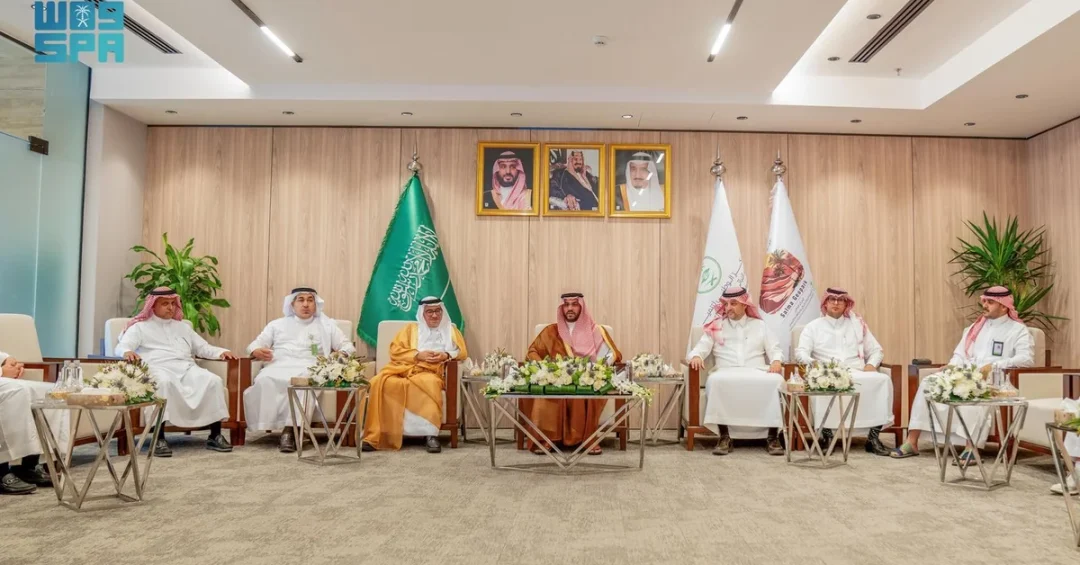
Prince Faisal bin Fahd bin Muqrin bin Abdulaziz, Deputy Governor of Hail Province, visited the headquarters of the National Center for Vegetation Cover Development & Combating Desertification (NCVC) in Riyadh on October 23, 2024, where he was received by Chief Executive Dr. Khaled Al-Abdulkader and the center’s senior leadership. The visit, announced through an official news release carried by the Saudi Press Agency, focused on the NCVC’s ongoing initiatives in the Hail region, including native seed dispersal, grazing regulation, valley restoration, and national park development. The delegation reviewed the center’s departmental structure, its core activities and objectives, and a detailed presentation of achievements and future plans tailored to Hail Province.
During the meeting, Prince Faisal underscored the commitment of Custodian of the Two Holy Mosques King Salman bin Abdulaziz Al Saud and HRH Prince Mohammed bin Salman bin Abdulaziz Al Saud, Crown Prince and Prime Minister, to environmental conservation and sustainable development. He emphasized that these efforts must align with Saudi Vision 2030, the national transformation blueprint that seeks to enhance quality of life and foster a healthy, positive environment for all citizens and residents. The Deputy Governor also praised the NCVC’s work to rehabilitate degraded vegetation areas, combat desertification, and restore biodiversity across the Kingdom’s natural ecosystems, describing the center’s mission as central to the nation’s long-term environmental resilience.
Context and Background
Why does a single visit to a Riyadh-based environmental center carry significance for a province more than 600 kilometers away? The answer lies in the scale of Saudi Arabia’s land degradation challenge and the integrated national strategy designed to address it. The National Center for Vegetation Cover Development & Combating Desertification was established as a specialized government body tasked with reversing decades of vegetation loss, managing rangelands, and coordinating afforestation programs across the Kingdom. Its mandate extends from the northern deserts to the southern highlands, making provincial partnerships essential to its success. Hail Province, located in the north-central region, represents a critical theater for these efforts due to its expansive rangelands, seasonal valleys, and distinctive geological formations.
The NCVC operates under the broader framework of the Saudi Green Initiative, launched in 2021 as a comprehensive national effort to plant 10 billion trees, restore 40 million hectares of degraded land, and increase protected areas to 30 percent of the Kingdom’s territory. These targets are among the most ambitious environmental commitments undertaken by any nation in the region. The center’s work also supports the Middle East Green Initiative, a regional platform through which Saudi Arabia has pledged to cooperate with neighboring countries on climate adaptation, drought mitigation, and ecosystem restoration. Prince Faisal’s visit therefore forms part of a sustained official engagement with environmental institutions, reflecting the leadership’s view that ecological security is inseparable from economic prosperity and social well-being.
Hail Province has historically been known for its agricultural heritage, particularly its reputation for producing high-quality dates and grains. However, changing rainfall patterns, overgrazing, and the encroachment of desert sands have placed pressure on its natural vegetation. The NCVC’s provincial initiatives are designed to address these pressures through scientific interventions, community engagement, and regulatory enforcement. The visit by the Deputy Governor signals that these efforts enjoy high-level political attention and that local stakeholders are expected to cooperate fully with the center’s programs. It also reinforces the principle that environmental restoration is a shared national responsibility, not merely the task of a single agency.
Key Details of the Visit and NCVC Initiatives in Hail
What specific projects did the two sides discuss during the visit? According to the official release, the NCVC presented a comprehensive overview of its Hail-focused portfolio. Among the flagship initiatives is the dispersal of seeds for native plants and trees, a technique that accelerates vegetation recovery by reintroducing indigenous species adapted to local soil and climate conditions. The center is also regulating grazing in natural rangelands, a measure designed to prevent overexploitation by livestock and allow pasture ecosystems to regenerate. This regulatory approach balances the traditional livelihoods of local herding communities with the long-term health of the land, a delicate equilibrium that requires continuous monitoring and community dialogue.
Another major area of activity involves restoring ecological balance in valleys, which serve as natural corridors for water flow, wildlife movement, and plant diversity. Valley restoration typically includes soil stabilization, check dam construction, and the replanting of native vegetation along seasonal watercourses. The NCVC is simultaneously enhancing national parks in the Hail region, improving infrastructure, visitor facilities, and conservation zoning. These parks are intended to serve dual purposes: protecting fragile ecosystems and providing recreational spaces that contribute to the Kingdom’s quality-of-life objectives. The center has also submitted Salma Geopark for consideration as part of UNESCO’s Global Geopark Network, a designation that, if granted, would recognize the area’s geological significance and boost ecotourism in the region.
Investment initiatives in the region’s national parks are already underway, according to the NCVC. These investments are structured to attract private-sector participation while maintaining public oversight of conservation standards. Dr. Khaled Al-Abdulkader, the NCVC’s Chief Executive, expressed gratitude for Prince Faisal’s visit and his ongoing support for the center’s mission in Hail. He emphasized the importance of the prince’s engagement in driving efforts to meet the objectives of the Saudi Green Initiative, noting that provincial leadership is instrumental in translating national targets into tangible local outcomes. The meeting concluded with a shared commitment to accelerate project implementation and to strengthen coordination between the NCVC and Hail’s regional authorities.
International and Regional Impact
How does a provincial environmental initiative in Saudi Arabia resonate beyond the Kingdom’s borders? The NCVC’s work in Hail contributes directly to global climate and biodiversity goals, including the United Nations Convention to Combat Desertification, the Convention on Biological Diversity, and the Paris Agreement. Saudi Arabia’s restoration targets are among the largest in the world, and their implementation provides a model for other arid and semi-arid countries facing similar challenges. The potential UNESCO Global Geopark designation for Salma Geopark would place Hail on the international map of geological heritage sites, attracting researchers, tourists, and conservation partners from around the world. Such recognition would also validate the Kingdom’s approach of integrating scientific research with local economic development.
At the regional level, the Middle East Green Initiative serves as a platform for Saudi Arabia to share expertise and mobilize funding for environmental projects across the Arab world and beyond. The NCVC’s experience in seed dispersal, grazing regulation, and valley restoration is directly relevant to neighboring countries grappling with desertification. By hosting visits such as Prince Faisal’s and documenting its methodologies, the center contributes to a growing knowledge base that benefits the entire region. Furthermore, the emphasis on ecotourism in Hail aligns with Saudi Arabia’s broader strategy to diversify its economy and attract international visitors, positioning the Kingdom as a destination for nature-based travel as well as cultural and religious tourism.
Economic and Strategic Significance
Why should international observers pay attention to the economic dimensions of vegetation restoration? Environmental rehabilitation is not merely an ecological imperative; it is an economic investment with measurable returns. Restored rangelands support livestock productivity, reduce dust storms that damage infrastructure and public health, and enhance soil fertility for agriculture. National parks and geoparks create jobs in tourism, hospitality, and conservation management, while also stimulating small businesses in surrounding communities. For Hail Province, these developments offer opportunities to diversify local income sources beyond traditional agriculture, aligning with Vision 2030’s goal of creating a vibrant, diversified economy.
Strategic considerations also come into play. Saudi Arabia’s food security depends in part on the health of its agricultural land, and desertification poses a direct threat to that security. By restoring vegetation cover and improving water retention in valleys, the NCVC helps safeguard the Kingdom’s capacity to produce food and sustain rural livelihoods. Additionally, the center’s work supports the stability of rural communities by creating green jobs and improving living conditions, which in turn reduces migration to urban centers. The involvement of Prince Faisal, as Deputy Governor of Hail, underscores the provincial government’s commitment to these outcomes and its readiness to partner with national agencies to achieve them.
Vision 2030 Alignment
How does the NCVC’s mission intersect with the broader objectives of Saudi Vision 2030? The Vision, launched in 2016 under the leadership of Crown Prince Mohammed bin Salman, rests on three pillars: a vibrant society, a thriving economy, and an ambitious nation. Environmental sustainability is woven throughout all three. A vibrant society requires clean air, green spaces, and healthy ecosystems. A thriving economy benefits from sustainable natural resources and new sectors such as ecotourism. An ambitious nation demonstrates its commitment to global challenges through concrete action. The NCVC’s initiatives in Hail exemplify this integrated approach, delivering environmental, economic, and social returns simultaneously.
The Saudi Green Initiative, a key vehicle for achieving Vision 2030’s environmental targets, has already mobilized significant public and private investment. The NCVC’s projects in Hail contribute to the initiative’s headline goals, including the planting of millions of trees and the restoration of degraded land. As these projects mature, they are expected to generate measurable improvements in air quality, biodiversity, and local climate conditions. The visit by Prince Faisal bin Fahd bin Muqrin thus represents more than a routine official engagement; it is a reaffirmation of the Kingdom’s long-term commitment to environmental stewardship as a foundation for prosperity. Under the guidance of King Salman and Crown Prince Mohammed bin Salman, Saudi Arabia is demonstrating that desertification can be reversed and that sustainable development is achievable even in the most challenging environments.
20 Questions
Q1. Who is Prince Faisal bin Fahd bin Muqrin bin Abdulaziz?
A1. Prince Faisal bin Fahd bin Muqrin bin Abdulaziz serves as the Deputy Governor of Hail Province in the Kingdom of Saudi Arabia, representing the leadership in regional development and governance matters.
Q2. What is the NCVC?
A2. The National Center for Vegetation Cover Development & Combating Desertification is a Saudi government agency responsible for rehabilitating vegetation, combating desertification, and restoring biodiversity across the Kingdom.
Q3. When did the visit take place?
A3. The visit took place on October 23, 2024, according to the official news release issued by the Saudi Press Agency.
Q4. Where is the NCVC headquartered?
A4. The NCVC is headquartered in Riyadh, the capital of Saudi Arabia, where its leadership received Prince Faisal and his delegation.
Q5. Who received Prince Faisal at the NCVC?
A5. Dr. Khaled Al-Abdulkader, the Chief Executive of the NCVC, received Prince Faisal along with other senior leaders of the center.
Q6. What was the purpose of the visit?
A6. The visit aimed to discuss the NCVC’s initiatives in Hail Province and to review achievements and future plans for environmental restoration in the region.
Q7. What key projects is the NCVC undertaking in Hail?
A7. Projects include seed dispersal for native plants and trees, regulating grazing in natural rangelands, restoring ecological balance in valleys, and enhancing national parks.
Q8. What is seed dispersal?
A8. Seed dispersal is a restoration technique that involves spreading seeds of native plant species to accelerate vegetation recovery in degraded areas, using species adapted to local conditions.
Q9. Why is grazing regulation important?
A9. Grazing regulation prevents overexploitation of rangelands by livestock, allowing pasture ecosystems to regenerate and maintain long-term productivity for herding communities.
Q10. What is Salma Geopark?
A10. Salma Geopark is a geological site in Hail Province that the NCVC has submitted for consideration as part of UNESCO’s Global Geopark Network to promote ecotourism.
Q11. What would UNESCO Global Geopark status mean for Hail?
A11. It would recognize the area’s geological significance, boost ecotourism, attract international visitors, and support local economic development through conservation and education.
Q12. What did Prince Faisal say about the leadership’s commitment?
A12. He highlighted the dedication of King Salman and Crown Prince Mohammed bin Salman to environmental conservation and sustainable solutions aligned with Saudi Vision 2030.
Q13. How does the NCVC’s work align with Vision 2030?
A13. It supports Vision 2030’s goals of enhancing quality of life, fostering a healthy environment, diversifying the economy, and promoting sustainable development across the Kingdom.
Q14. What is the Saudi Green Initiative?
A14. The Saudi Green Initiative is a national effort launched in 2021 to plant 10 billion trees, restore 40 million hectares of land, and increase protected areas to 30 percent of the Kingdom.
Q15. What did Dr. Al-Abdulkader say about the visit?
A15. He expressed gratitude for Prince Faisal’s visit and ongoing support, emphasizing the importance of his engagement in driving efforts to meet Saudi Green Initiative objectives.
Q16. What are the economic benefits of vegetation restoration?
A16. Benefits include improved rangeland productivity, reduced dust storms, enhanced soil fertility, job creation in tourism and conservation, and support for rural livelihoods.
Q17. How does the NCVC contribute to food security?
A17. By restoring vegetation and improving water retention in valleys, the NCVC helps safeguard agricultural land and sustain the Kingdom’s capacity to produce food.
Q18. What is the Middle East Green Initiative?
A18. It is a regional platform led by Saudi Arabia to cooperate with neighboring countries on climate adaptation, drought mitigation, and ecosystem restoration across the Middle East.
Q19. Are there investment opportunities in Hail’s national parks?
A19. Yes, the NCVC has stated that investment initiatives in the region’s national parks are already underway, structured to attract private-sector participation while maintaining conservation standards.
Q20. What is the long-term vision for Hail’s environmental projects?
A20. The long-term vision is to achieve sustainable ecosystems, boost ecotourism, create green jobs, and contribute to Saudi Arabia’s national environmental targets under Vision 2030.
Reader Feedback
We value your thoughts. Please share your feedback on this article.
Your feedback helps us improve our coverage.
Related articles
 OIC Condemns Terrorist Attack in Ankara
 IFRC General Assembly Begins in Geneva with Saudi Participation
 Twelfth Saudi Relief Plane Departs for Lebanon with Essential Aid
 Saudi Arabia Weather Forecast for Thursday: Rain, Winds, Fog
 Saudi OIC Representative Meets Islamic Solidarity Fund Chief
 Saudi Arabia Condemns Ankara Terror Attack