


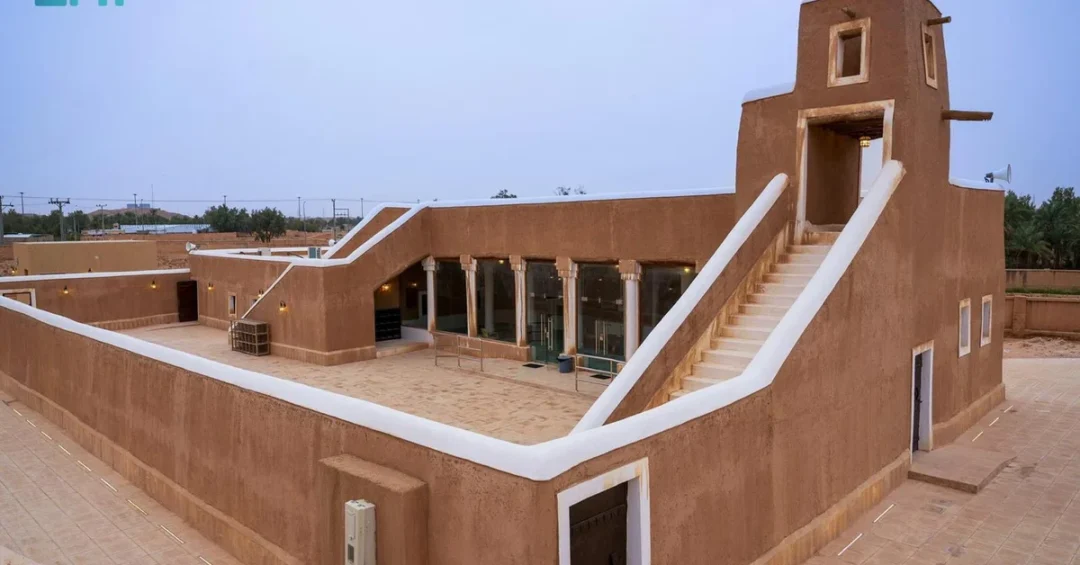
The second phase of the Prince Mohammed bin Salman Project for the Development of Historic Mosques is restoring Al-Roasa Mosque in Al-Majma’ah Governorate, marking a significant step in Saudi Arabia’s efforts to preserve Islamic heritage and traditional architecture. The project, announced by the Saudi Press Agency, aims to revitalize the mosque’s religious, cultural, and social significance while safeguarding its historic character for future generations.
Context and Background
Al-Roasa Mosque, constructed between 1946 and 1950 and located west of Munikh Mountain, is a notable example of traditional Najdi architecture. It has not undergone renovations since its construction nearly 70 years ago. The mosque stands as a testament to the Kingdom’s rich Islamic history and architectural heritage, reflecting the community’s enduring cultural identity.
The Prince Mohammed bin Salman Project for the Development of Historic Mosques is a nationwide initiative dedicated to preserving historic mosques and restoring their religious, cultural, and social roles. The second phase includes 30 mosques across all 13 regions of the Kingdom, following the successful completion of the first phase, which restored 30 historic mosques across 10 regions. This comprehensive approach underscores the Kingdom’s commitment to safeguarding its Islamic heritage.
Key Details
The renovation of Al-Roasa Mosque employs clay construction techniques and natural materials, adhering to traditional methods while ensuring structural sustainability. The mosque’s area will be expanded to 705.76 square meters, allowing it to accommodate up to 210 worshippers. Saudi companies specializing in heritage restoration are carrying out the development, ensuring that the mosque’s historical characteristics are preserved while incorporating modern standards.
The second phase includes six mosques in Riyadh, five in Makkah, four in Madinah, three in Aseer, two each in the Eastern Region, Al-Jouf, and Jazan, and one each in the Northern Borders, Tabuk, Al-Baha, Najran, Hail, and Qassim. This distribution reflects a balanced approach to preserving heritage across the Kingdom, highlighting the project’s strategic objectives: restoring historic mosques for worship, preserving their architectural authenticity, highlighting the Kingdom’s cultural heritage, and enhancing their religious and cultural significance.
For those interested in the location, Al-Roasa Mosque can be found here: https://goo.gl/maps/abVDVfTdfHoh1jTe9.
Implications and Impact
The restoration of Al-Roasa Mosque carries profound implications for the local community and the broader region. By preserving this historic site, the project not only honors the past but also strengthens the spiritual and cultural fabric of Al-Majma’ah Governorate. It provides a space for worship that reflects the community’s heritage while meeting contemporary needs. Moreover, the project contributes to the Kingdom’s tourism and cultural sectors, attracting visitors interested in Islamic history and traditional architecture.
On an international level, the project reinforces Saudi Arabia’s role as a custodian of Islamic heritage and a leader in cultural preservation. It showcases the Kingdom’s dedication to maintaining its historical identity amid rapid modernization, aligning with global efforts to protect cultural heritage. This initiative also promotes cross-cultural understanding and appreciation of Saudi Arabia’s rich history.
Vision 2030 Alignment
The Prince Mohammed bin Salman Project for the Development of Historic Mosques is a direct reflection of Vision 2030’s goals to preserve architectural heritage and integrate it into modern mosque designs. By restoring historic mosques, the Kingdom not only safeguards its cultural legacy but also enhances the quality of life for its citizens and visitors. This project exemplifies how Saudi Arabia is balancing tradition with modernity, ensuring that its rich heritage remains a vibrant part of its future. As the Kingdom continues to advance under Vision 2030, initiatives like this demonstrate its unwavering commitment to preserving Islamic heritage while embracing progress and global engagement.
20 Questions
Q1. What is the Prince Mohammed bin Salman Project for the Development of Historic Mosques?
A1. It is a Saudi initiative to restore and revitalize historic mosques across the Kingdom, preserving their religious, cultural, and social significance. The project balances traditional and modern construction standards to ensure sustainability while maintaining heritage.
Q2. Which mosque is being restored in Al-Majma’ah Governorate?
A2. Al-Roasa Mosque is being restored in Al-Majma’ah Governorate as part of the project’s second phase. Built between 1946 and 1950, it is a historic mosque that has not undergone renovations for nearly 70 years.
Q3. Where is Al-Roasa Mosque located?
A3. Al-Roasa Mosque is located west of Munikh Mountain in Al-Majma’ah Governorate. It is built in the traditional Najdi architectural style, reflecting the region’s cultural heritage.
Q4. When was Al-Roasa Mosque originally built?
A4. Construction of Al-Roasa Mosque began in 1946 and was completed in 1950. It has stood for nearly 70 years without renovations, making its restoration a significant heritage preservation effort.
Q5. What architectural style does Al-Roasa Mosque represent?
A5. Al-Roasa Mosque is built in the traditional Najdi style, characterized by its use of clay construction techniques and natural materials. This style is emblematic of the region’s historical architecture.
Q6. How large will Al-Roasa Mosque be after renovation?
A6. After renovation, Al-Roasa Mosque will expand to 705.76 square meters, accommodating up to 210 worshippers. This expansion aims to meet the needs of the growing community while preserving its historic character.
Q7. What materials are being used in the renovation?
A7. The renovation uses clay construction techniques and natural materials, adhering to traditional methods. This approach ensures the mosque’s sustainability and preserves its historical authenticity.
Q8. How many mosques are included in the project’s second phase?
A8. The second phase includes 30 mosques across all 13 regions of the Kingdom. This follows the successful completion of the first phase, which restored 30 historic mosques across 10 regions.
Q9. Which regions are represented in the second phase?
A9. The second phase includes mosques in Riyadh, Makkah, Madinah, Aseer, the Eastern Region, Al-Jouf, Jazan, the Northern Borders, Tabuk, Al-Baha, Najran, Hail, and Qassim. This ensures a nationwide impact.
Q10. What are the strategic objectives of the project?
A10. The project has four strategic objectives: restoring historic mosques for worship, preserving their architectural authenticity, highlighting the Kingdom’s cultural heritage, and enhancing their religious and cultural significance.
Q11. Who is carrying out the restoration work?
A11. Saudi companies specializing in heritage restoration are carrying out the development. Their expertise ensures that the mosques are restored in line with traditional methods and modern standards.
Q12. How does the project align with Vision 2030?
A12. The project aligns with Vision 2030 by preserving architectural heritage and integrating it into modern mosque designs. It reflects the Kingdom’s commitment to balancing tradition with modernity and enhancing quality of life.
Q13. What was achieved in the first phase of the project?
A13. The first phase successfully restored 30 historic mosques across 10 regions of the Kingdom. This laid the foundation for the second phase, which continues the mission to preserve Islamic heritage.
Q14. How does the restoration benefit local communities?
A14. The restoration provides a renovated space for worship that reflects the community’s heritage. It also boosts local pride and can attract visitors interested in Islamic history and traditional architecture.
Q15. What is the significance of preserving historic mosques?
A15. Preserving historic mosques safeguards Islamic heritage, maintains cultural identity, and ensures that future generations can appreciate their architectural and spiritual value. It also promotes tourism and cultural exchange.
Q16. How does the project contribute to tourism in Saudi Arabia?
A16. By restoring historic mosques, the project creates cultural attractions that draw visitors interested in Islamic history and architecture. This supports the Kingdom’s tourism goals under Vision 2030.
Q17. What is the traditional Najdi architectural style?
A17. The Najdi style is a traditional architectural style from the Najd region, characterized by clay construction, natural materials, and distinctive decorative elements. It reflects the region’s cultural and environmental context.
Q18. How does the project ensure sustainability?
A18. The project uses traditional clay construction techniques and natural materials, which are sustainable and durable. It also balances traditional and modern standards to ensure the longevity of mosque components.
Q19. What role does the Saudi Press Agency play in this announcement?
A19. The Saudi Press Agency (SPA) released the official information about the project, ensuring transparency and widespread dissemination of details regarding the restoration of Al-Roasa Mosque and the project’s progress.
Q20. What is the expected impact of the project on Islamic heritage?
A20. The project preserves and revitalizes Islamic heritage by restoring historic mosques, ensuring their architectural authenticity, and enhancing their religious and cultural significance. It reinforces Saudi Arabia’s role as a custodian of Islamic heritage.
Reader Feedback
We value your thoughts. Please share your feedback on this article.
Your feedback helps us improve our coverage.
Related articles
 Fragrant Ramadan: 450 Perfume Tours at the Prophet’s Mosque
 NWC: March 15 Deadline to Verify Water Meters
 Saudi Arabia Weather Forecast: Dust and Rain Expected Friday
 Saudi Ambassadors-Designate Take Oath Before Crown Prince
 Grand Mosque Sermons Reach Global Audience in 11 Languages
 Saudi Arabia Donates 25 Tons of Dates to Gambia