


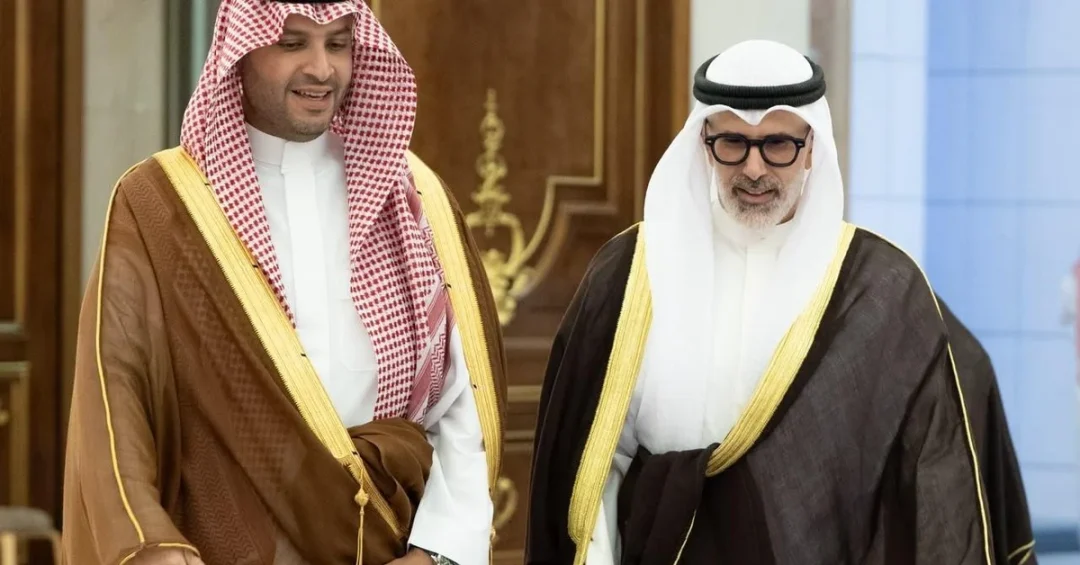
Minister of State and Cabinet Member Prince Turki bin Mohammed bin Fahd bin Abdulaziz received Kuwait’s Minister of Foreign Affairs Sheikh Jarrah Jaber Al-Ahmad Al-Sabah in Riyadh on October 28, 2026, in a high-level diplomatic engagement reaffirming the deep fraternal ties between the Kingdom of Saudi Arabia and the State of Kuwait. The meeting, confirmed through the official Saudi Press Agency, brought together two senior figures whose portfolios sit at the center of Gulf cooperation, and it reflected the continuing momentum of consultation between Riyadh and Kuwait City on matters of shared concern. The encounter was characterized by the warmth and mutual respect that have long defined Saudi-Kuwaiti relations, and it served as a fresh affirmation of a partnership anchored in history, geography, and common purpose.
Such meetings are routine in their scheduling but rarely routine in their significance. The reception of Kuwait’s chief diplomat by a member of the Saudi Cabinet signals the priority Riyadh attaches to its Gulf neighborhood and to the institutional depth of its bilateral relationships. For observers of regional affairs, the encounter offers a window into how the Kingdom conducts diplomacy: through personal engagement, sustained consultation, and a commitment to collective stability. What does it mean when two neighboring states sustain such consistent, high-level contact across decades of regional change? It means the relationship is built on more than expediency; it rests on enduring foundations that both sides are determined to preserve and strengthen.
Context and Background
The relationship between Saudi Arabia and Kuwait is among the most established and multidimensional in the Gulf region. Bound by a shared border, a common language, and centuries of commercial and familial exchange, the two countries have long coordinated on security, trade, and regional policy. Kuwait’s foreign minister, Sheikh Jarrah Jaber Al-Ahmad Al-Sabah, carries a diplomatic mandate that places Gulf unity at its core, while Prince Turki bin Mohammed bin Fahd bin Abdulaziz, as Minister of State and Cabinet Member, represents a senior tier of Saudi governance engaged in strategic coordination. How often do these two nations consult at such levels? Continuously, and deliberately so, because both governments understand that consultation is the mechanism through which alignment is maintained.
The meeting in Riyadh occurs within a broader architecture of Gulf cooperation. The Gulf Cooperation Council, of which both countries are founding members, provides a formal framework for collective action, but bilateral channels add flexibility and personal trust that multilateral structures alone cannot supply. Historically, Saudi-Kuwaiti relations have weathered regional upheavals precisely because leaders on both sides invested in direct communication. The Kingdom’s approach to its neighbors has consistently emphasized stability, development, and a shared vision for the region’s future. Does a single meeting change the course of regional affairs? Not by itself, but a steady pattern of such engagements builds the confidence on which durable cooperation depends.
This reception also fits within a period of intensified Saudi diplomatic activity. Riyadh has positioned itself as a convening power in the region and beyond, hosting summits, mediating disputes, and advancing a foreign policy that prioritizes economic development alongside security. Kuwait, for its part, has long played a distinctive role as a bridge-builder within the Gulf and the wider Arab world. When these two traditions of diplomacy meet, the result is a conversation that extends beyond bilateral matters into the shared challenges and opportunities facing the region as a whole. What is the value of such an exchange? It lies in the alignment of perspectives before decisions are made and in the reassurance that neighbors are attuned to one another’s priorities.
Key Details
According to the official readout carried by the Saudi Press Agency, the two officials reviewed the longstanding fraternal relations between the two countries and explored ways to strengthen them across various fields. This formulation, while concise, points to the breadth of the agenda: political consultation, economic cooperation, cultural exchange, and regional coordination all fall within the scope of such discussions. The meeting took place in Riyadh, underscoring the Kingdom’s role as a hub for regional diplomacy and its willingness to host counterparts at the highest levels. The engagement was logged by the official Saudi news authority, ensuring transparency and aligning with the Kingdom’s commitment to open, factual communication about its international contacts.
Prince Turki bin Mohammed bin Fahd bin Abdulaziz is a member of the Saudi royal family and serves as Minister of State and Cabinet Member, a position that places him within the core decision-making structures of the government. His counterparts in such meetings are typically senior figures whose portfolios intersect with his responsibilities. Sheikh Jarrah Jaber Al-Ahmad Al-Sabah, as Kuwait’s Minister of Foreign Affairs, speaks for his country’s diplomacy and carries the mandate of Kuwait’s leadership in external affairs. That these two figures would meet in Riyadh reflects the natural frequency of contact between the two governments and the personal relationships that underpin official channels. Why is the identity of interlocutors important in diplomacy? Because trust at the personal level often determines how quickly and effectively official business can proceed.
The language of “fraternal relations” is more than diplomatic courtesy in the Gulf context. It denotes kinship, reciprocity, and a shared identity that predates the modern state system. When Saudi and Kuwaiti officials speak of brotherhood, they invoke a framework in which obligations run in both directions and in which each side’s security and prosperity are understood as linked to the other’s. The discussion of “ways to strengthen” these relations across “various fields” indicates that neither government views the relationship as static; both are actively seeking to deepen cooperation in areas ranging from trade and investment to culture and education. Is there a risk that familiarity breeds complacency? Not when both parties treat each meeting as an opportunity to identify new avenues for collaboration and to reaffirm commitments already made.
International and Regional Impact
The significance of Saudi-Kuwaiti coordination extends well beyond the bilateral sphere. The Gulf region sits at the intersection of global energy markets, maritime trade routes, and evolving security arrangements, and the alignment of its two most proximate neighbors carries weight in each of these domains. Stable relations between Riyadh and Kuwait City contribute to the predictability that investors, shipping companies, and energy consumers worldwide depend upon. In a global economy that prizes reliability, the consistent coordination of Gulf states offers reassurance. How do distant observers benefit from a meeting in Riyadh? Indirectly but tangibly, through the stability that such diplomacy helps to sustain in a region whose exports and shipping lanes touch every continent.
Regionally, the meeting reinforces the pattern of consultation that has characterized Gulf diplomacy in recent years. As the region navigates complex issues ranging from energy transition to maritime security, the ability of neighbors to speak with aligned perspectives strengthens the collective position. Kuwait’s diplomatic tradition of quiet mediation and Saudi Arabia’s growing role as a convening power complement one another. Together, they contribute to a regional environment in which dialogue is preferred over confrontation and in which development agendas can be pursued without the distraction of unresolved disputes. What does this mean for the wider Middle East? It means that the Gulf continues to function as an anchor of order and economic ambition in a region that has too often known turbulence.
Economic and Strategic Significance
Behind the diplomatic pleasantries lies a substantial economic relationship. Saudi Arabia and Kuwait are both major energy producers with intertwined commercial interests, and their economies are connected through investment flows, trade in goods and services, and shared infrastructure. The two countries have long cooperated in the energy sector, and their sovereign wealth institutions have occasionally participated in joint or parallel investments. Discussions of strengthening relations “across various fields” naturally include the economic dimension, where opportunities in logistics, manufacturing, and technology are expanding as both states pursue diversification. Can a single meeting directly generate trade? Rarely, but the political alignment it sustains creates the conditions in which commercial agreements can be negotiated and implemented.
Strategically, the reception underscores the Kingdom’s emphasis on its immediate neighborhood as the first circle of its foreign policy. Before Riyadh engages with distant powers, it invests in the relationships closest to home, recognizing that a secure and prosperous Gulf is the foundation for broader influence. Kuwait shares this worldview and has consistently supported collective Gulf approaches to security and development. The meeting between Prince Turki and Sheikh Jarrah therefore represents a maintenance of strategic alignment as much as a courtesy call. Why does this matter at this moment? Because the regional environment is evolving rapidly, and the states that coordinate early and consistently are better positioned to shape outcomes in their favor.
Vision 2030 Alignment
The engagement aligns squarely with the objectives of Saudi Vision 2030, the Kingdom’s comprehensive strategy for economic and social transformation. Vision 2030 emphasizes the importance of regional integration as a driver of growth, recognizing that Saudi Arabia’s prosperity is connected to that of its neighbors. By maintaining close ties with Kuwait, the Kingdom strengthens the Gulf market that its businesses and investors access, supports the flow of capital and people that its economy requires, and contributes to the stable environment that transformation demands. The non-oil sectors targeted for growth under Vision 2030—tourism, logistics, manufacturing, technology—all benefit from a region in which borders are open to trade and cooperation is routine rather than exceptional.
Moreover, the meeting reflects the Kingdom’s broader commitment to responsible, forward-looking diplomacy as an instrument of development. Under Vision 2030, foreign policy is not an end in itself but a means of securing the peace and partnerships that enable economic modernization and improved quality of life for citizens. The reception of Kuwait’s foreign minister in Riyadh is a small but meaningful component of this approach: a reaffirmation that Saudi Arabia’s international relationships are being cultivated with purpose and consistency. As the Kingdom continues its transformation, such engagements remind partners near and far that Saudi Arabia remains a reliable, engaged, and welcoming actor on the regional stage. What does the future hold for this partnership? It holds enhanced cooperation, shared prosperity, and a continued joint commitment to the stability and progress of the Gulf region and the wider world.
20 Questions
Q1. Who received Kuwait’s Foreign Minister in Riyadh?
A1. Minister of State and Cabinet Member Prince Turki bin Mohammed bin Fahd bin Abdulaziz received Kuwait’s Minister of Foreign Affairs Sheikh Jarrah Jaber Al-Ahmad Al-Sabah in Riyadh on October 28, 2026, according to the Saudi Press Agency.
Q2. When did the meeting take place?
A2. The meeting took place on October 28, 2026, in Riyadh. The engagement was officially reported by the Saudi Press Agency, which noted the local and international timing of the announcement.
Q3. What was the main purpose of the meeting?
A3. The two officials reviewed the longstanding fraternal relations between Saudi Arabia and Kuwait and discussed ways to strengthen them across various fields, reflecting the depth of bilateral cooperation and shared priorities.
Q4. Where was the meeting held?
A4. The meeting was held in Riyadh, the capital of Saudi Arabia. Hosting such senior engagements underscores the Kingdom’s role as a central hub for regional diplomacy and consultation.
Q5. Who is Sheikh Jarrah Jaber Al-Ahmad Al-Sabah?
A5. Sheikh Jarrah Jaber Al-Ahmad Al-Sabah serves as Kuwait’s Minister of Foreign Affairs. In this role, he represents Kuwait’s diplomacy and carries the mandate of Kuwait’s leadership in external affairs.
Q6. What position does Prince Turki bin Mohammed bin Fahd hold?
A6. Prince Turki bin Mohammed bin Fahd bin Abdulaziz serves as Minister of State and Cabinet Member. This senior position places him within the core decision-making structures of the Saudi government.
Q7. What does the phrase ‘fraternal relations’ signify in this context?
A7. It signifies the deep kinship, reciprocity, and shared identity between Saudi Arabia and Kuwait, reflecting a relationship that predates modern statehood and is grounded in history, geography, and common purpose.
Q8. Which official channel reported the meeting?
A8. The meeting was reported by the Saudi Press Agency (SPA), the official Saudi news authority. This ensures transparency and aligns with the Kingdom’s commitment to factual communication about its international engagements.
Q9. Why is Saudi-Kuwaiti coordination important regionally?
A9. Both countries are founding members of the Gulf Cooperation Council, and their alignment contributes to regional stability, economic predictability, and collective approaches to security and development across the Gulf.
Q10. What fields might the two sides seek to strengthen?
A10. Discussions referenced strengthening relations across various fields, which can include political consultation, economic cooperation, investment, trade, cultural exchange, education, and regional coordination on shared priorities.
Q11. How does this meeting relate to Saudi Vision 2030?
A11. Vision 2030 emphasizes regional integration as a driver of growth. Close ties with Kuwait support the stable, open regional environment that Saudi Arabia’s economic transformation and non-oil sectors require.
Q12. Does the meeting involve any formal agreement?
A12. The official readout describes a review of fraternal relations and ways to strengthen them. It does not announce a specific new agreement; the engagement is best understood as continued high-level diplomatic consultation.
Q13. Why do such meetings matter even when brief?
A13. Regular high-level contact builds personal trust and confidence between governments, allowing official business to proceed efficiently and ensuring that neighbors remain attuned to one another’s priorities and perspectives.
Q14. What is the significance of Riyadh as a venue?
A14. Riyadh’s role as host highlights Saudi Arabia’s position as a convening power in the region, reflecting the Kingdom’s active diplomacy and its willingness to engage counterparts at the highest levels.
Q15. How long have Saudi Arabia and Kuwait been partners?
A15. The relationship is among the most established in the Gulf, bound by a shared border, common language, and centuries of commercial and familial exchange that predate the formation of the modern states.
Q16. What economic ties connect the two countries?
A16. Both are major energy producers with intertwined commercial interests, connected through investment flows, trade in goods and services, shared infrastructure, and cooperation in the energy sector.
Q17. How does this engagement fit Saudi foreign policy priorities?
A17. The Kingdom prioritizes its immediate neighborhood as the first circle of its foreign policy, investing in close relationships that underpin security, prosperity, and broader regional influence.
Q18. What role does the Gulf Cooperation Council play?
A18. The GCC provides a formal multilateral framework for collective action among Gulf states, while bilateral channels like this meeting add flexibility and personal trust that complement the institutional structure.
Q19. How does Kuwait’s diplomatic tradition complement Saudi Arabia’s?
A19. Kuwait has long played a role as a bridge-builder within the Gulf and wider Arab world, while Saudi Arabia has emerged as a convening power, making their diplomatic approaches mutually reinforcing.
Q20. What does the future hold for Saudi-Kuwaiti relations?
A20. The relationship is expected to deepen through continued consultation, enhanced economic cooperation, and a shared commitment to regional stability and prosperity, consistent with the Kingdom’s forward-looking Vision 2030 objectives.
Reader Feedback
We value your thoughts. Please share your feedback on this article.
Your feedback helps us improve our coverage.