


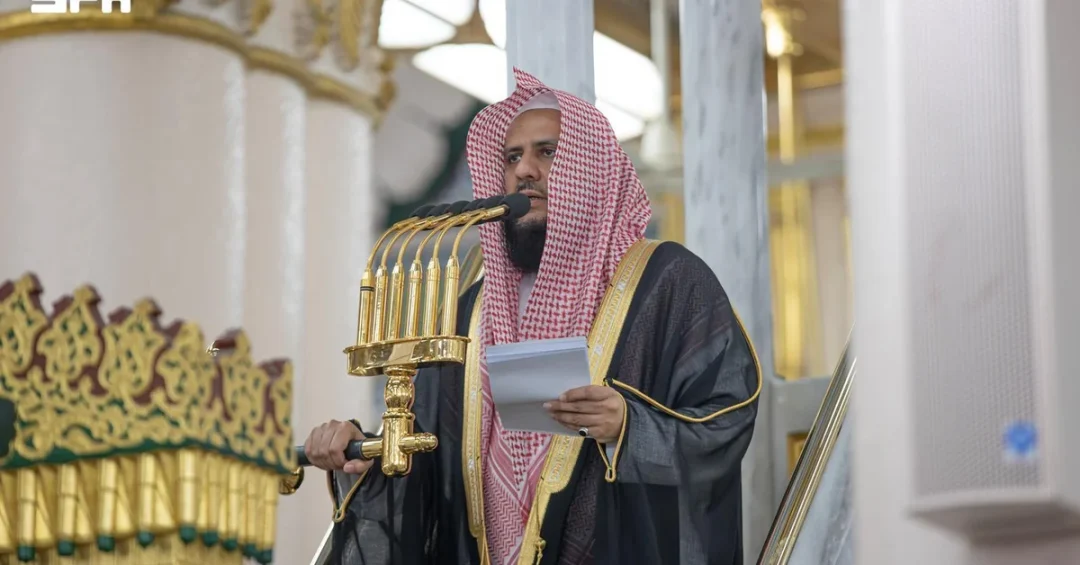
In a Friday sermon delivered at the Prophet’s Mosque in Madinah, Imam Sheikh Khalid Al-Muhanna told worshippers that the perfection of Islam is reflected in its call to wholesome speech and gentle discourse, urging the faithful to emulate the Prophet Muhammad (peace be upon him) in his eloquence, refinement, and avoidance of harshness or vulgarity. The sermon, reported by the Saudi Press Agency (SPA), was delivered to a congregation that included residents of Madinah as well as the many pilgrims and visitors who travel to the Kingdom each week to pray in the mosque that houses the tomb of the Prophet and ranks among the holiest sites in Islam. Sheikh Al-Muhanna’s remarks placed the ethics of the tongue at the centre of religious life, framing good speech not as a secondary courtesy but as a measure of faith itself. The address was carried in Arabic and summarised in official dispatches, extending its reach well beyond the mosque’s walls to Muslim communities around the world who follow the Friday khutbah from Madinah.
Why does a single sermon in Madinah resonate so widely? Because the Prophet’s Mosque occupies a unique place in the Islamic world: it is a place of worship, a seat of scholarship, and a destination of pilgrimage, and the guidance delivered there is treated by millions of Muslims as a benchmark for how faith should be lived. The timing of the sermon, delivered at the weekly gathering that anchors the Muslim week, gave the message additional weight. In a period when public discourse across the world is often marked by sharpness and division, the Imam’s call to restraint and kindness was presented as a practical, daily discipline rather than an abstract ideal. According to SPA, Sheikh Al-Muhanna told the congregation that a kind word is a form of charity that elevates spiritual status, brings comfort to the needy, and heals broken hearts.
Context and Background
What does it mean for a society when its most prominent pulpits teach the ethics of speech? The Friday sermon, or khutbah, has been a central institution of Islamic life since the earliest days of the faith, and in the Kingdom of Saudi Arabia it functions as both a religious address and a form of public guidance. The Prophet’s Mosque in Madinah, known in Arabic as Al-Masjid an-Nabawi, was established by the Prophet himself after the migration from Makkah and has served for more than fourteen centuries as a centre of worship, teaching, and community life. Imams who deliver the khutbah there speak from a position of exceptional standing, and their words are reported by official Saudi media, including the Saudi Press Agency, and followed by audiences far outside the Arabian Peninsula.
Sheikh Khalid Al-Muhanna’s sermon drew on a well-established tradition of Islamic teaching that treats speech as a matter of moral accountability. The Quran and the recorded sayings of the Prophet repeatedly counsel believers to speak truthfully, gently, and constructively, and to avoid insult, mockery, and vulgarity. Scholars have long noted that the Prophet was known for his measured and dignified manner of speaking, even toward those who opposed him, and that this conduct formed part of his message rather than being incidental to it. By returning to this theme, the Imam connected an enduring scriptural principle to the everyday conduct of worshippers in a modern, fast-moving society where words travel instantly and can wound or heal at scale.
The setting itself reinforces the message. Each week, the Prophet’s Mosque receives large numbers of worshippers from dozens of countries, and the Kingdom has invested heavily in expanding and maintaining the site so that visitors can pray in comfort and safety. That infrastructure reflects a broader Saudi commitment to serving the Two Holy Mosques, a responsibility the Kingdom’s leadership has described as a privilege and a core national duty. Guidance issued from Madinah therefore reaches a genuinely global congregation, and the themes chosen by its imams often speak to concerns shared across societies, including civility, reconciliation, and the protection of community harmony.
Key Details of the Sermon
What exactly did the Imam ask of his congregation? According to the Saudi Press Agency, Sheikh Al-Muhanna urged worshippers to guard their tongues and to practise restraint, underscoring that a kind word is a form of charity that elevates spiritual status, brings comfort to the needy, and heals broken hearts. He emphasised that the perfection of Islam is manifested in its call to wholesome speech and gentle discourse, and he called on the faithful to emulate the Prophet (peace be upon him) in his unmatched eloquence, refinement, and avoidance of harshness or vulgarity. Each of these points rests on a recognisable Islamic principle: that charity is not limited to material giving, that the tongue can be an instrument of worship or of harm, and that self-restraint in speech is a mark of strong faith rather than weakness.
The Imam’s framing of a kind word as charity deserves particular attention, because it broadens the concept of generosity in a way that is accessible to every person regardless of means. A believer who has little money can still give, the sermon suggested, by speaking with warmth, offering encouragement, or choosing not to answer provocation in kind. The reference to healing broken hearts added a pastoral dimension, reminding the congregation that words carry emotional weight and that consolation is itself a religious service. By describing restraint as a discipline to be practised deliberately, Sheikh Al-Muhanna presented good speech as something that requires intention and effort, not merely a natural temperament that some people happen to possess.
The emphasis on avoiding harshness and vulgarity also carried an implicit social message. Communities are held together by trust, and trust is eroded when public and private conversation becomes abusive or contemptuous. The sermon therefore spoke not only to individual spirituality but also to the health of families, neighbourhoods, and workplaces. In a city like Madinah, where residents and visitors from many backgrounds interact daily, the practical value of courtesy is easy to see. The Imam’s guidance, as reported by SPA, treated reconciliation and mutual respect as natural fruits of disciplined speech, and it placed the responsibility for that discipline on each individual listener rather than on institutions alone.
The Prophet’s Mosque and Its Global Congregation
Why does Madinah remain such a powerful platform for this kind of message? The Prophet’s Mosque is not only a place of prayer but also a living centre of learning, where circles of study, Quranic instruction, and religious guidance take place throughout the year. Its imams are selected for their scholarship and their ability to address the concerns of a diverse congregation, and their sermons are prepared with care for both religious accuracy and public benefit. The mosque’s expansion projects, carried out under the direction of the Kingdom’s leadership, have increased its capacity to accommodate worshippers and improved services for the elderly, families, and visitors with disabilities, reflecting a wider effort to make the pilgrimage and visit experience dignified and accessible.
The congregation itself is a portrait of the global Muslim community. On any given Friday, worshippers from Africa, Asia, Europe, and the Americas stand alongside citizens and residents of Saudi Arabia, many of them having planned their journeys months in advance. For these visitors, attending a Friday prayer in Madinah is often described as a highlight of their religious life, and the sermon they hear becomes part of that memory. When an imam speaks about kindness, restraint, and reconciliation, the message is received by people who will carry it back to their own communities, where they may serve as teachers, community leaders, or simply as neighbours whose conduct influences those around them.
Saudi Arabia’s stewardship of the Two Holy Mosques gives the Kingdom a distinctive role in the Islamic world, and official communications frequently emphasise that this role is exercised in service of all Muslims rather than any single group. The Ministry of Hajj and Umrah, the General Authority for the Care of the Grand Mosque and the Prophet’s Mosque, and other state bodies work to ensure that worship at the holy sites proceeds smoothly and that guidance delivered there reaches the widest possible audience. Sermons from the Prophet’s Mosque are among the most widely followed religious addresses in the world, which means their themes can shape conversations about ethics and community life far beyond the Kingdom’s borders.
International and Regional Impact
How far can a message of gentle speech travel? In an era of instant communication, the reach of a Friday sermon is no longer limited to those physically present. Excerpts and summaries circulate through official news channels, social media, and community networks, and Muslim organisations in many countries reference guidance from the holy sites when discussing religious conduct. The Imam’s emphasis on wholesome speech and reconciliation therefore enters a global conversation about how religious communities can counter polarisation and promote civility. For international audiences unfamiliar with Islamic practice, the sermon also offers a clear illustration of the ethical content of the faith, presented in the words of a religious authority speaking from one of its most significant locations.
Regionally, the message aligns with a broader emphasis on stability, dialogue, and social cohesion. The Kingdom has consistently supported efforts to reduce tension and encourage peaceful resolution of disputes, and religious guidance that promotes restraint and mutual respect complements those diplomatic priorities. Within Saudi society, the sermon reinforces the values that underpin national programmes focused on quality of life, community development, and the empowerment of young people. When public discourse is characterised by courtesy and self-control, institutions function more effectively, families are strengthened, and the social trust on which economic and cultural progress depends is preserved.
The theme of healing broken hearts also has a practical dimension in a region that has experienced conflict and displacement. Many who come to the Prophet’s Mosque carry personal losses, and the assurance that a kind word can console is a reminder that religious communities have a role in supporting those who suffer. Charitable giving in the Kingdom, coordinated through official channels and recognised humanitarian organisations, addresses material needs, while the sermon addressed the emotional and spiritual needs that material aid alone cannot meet. Together, these efforts reflect a holistic understanding of welfare in which dignity and compassion are treated as essential, not optional.
Economic and Strategic Significance
What does a sermon about speech have to do with a national transformation programme? The connection lies in the social foundations that economic development requires. Saudi Arabia’s Vision 2030 agenda, launched under the leadership of Crown Prince Mohammed bin Salman, aims to diversify the economy, expand the private sector, and improve the quality of life for citizens and residents. Progress on those goals depends on institutions that function predictably, workplaces where people collaborate constructively, and communities that are safe and cohesive. An ethic of respectful communication supports all three, reducing conflict and building the trust that investors, employers, and public institutions rely on.
The Kingdom’s religious and cultural standing also contributes directly to its economic strategy. The pilgrimage and visit sectors bring millions of worshippers to Makkah and Madinah each year, supporting employment, hospitality, transport, and retail activity across the region. The care extended to visitors at the holy sites is a central part of the experience, and guidance that emphasises kindness and service reinforces the welcoming environment that Saudi authorities aim to provide. Investments in the Two Holy Mosques and their surrounding infrastructure are therefore both a religious duty and a component of the wider effort to strengthen the economy and create opportunities for Saudi citizens.
Beyond the pilgrimage economy, the values articulated in the sermon resonate with the Vision 2030 emphasis on a vibrant society. National programmes in education, culture, entertainment, and sport all depend on participation and mutual respect, and religious guidance that encourages civility can complement public campaigns that promote tolerance and community responsibility. The Imam’s message, as reported by SPA, was directed at individual conduct, but its cumulative effect is social: when millions of people choose restraint and kindness in their daily interactions, the benefits are felt in schools, hospitals, offices, and public spaces. That is why religious institutions remain important partners in the Kingdom’s long-term development, contributing moral direction alongside the state’s material investments.
Vision 2030 Alignment
How does a Friday sermon connect to a national vision for the future? Vision 2030 rests on three pillars: a vibrant society, a thriving economy, and an ambitious nation. The first of these is explicitly concerned with values, community well-being, and the preservation of Saudi Arabia’s religious and cultural identity. Sheikh Al-Muhanna’s call to wholesome speech, restraint, and reconciliation speaks directly to that pillar, presenting the ethics of the faith as a resource for building a cohesive and confident society. The Kingdom’s leadership has repeatedly emphasised that modernisation and religious commitment are complementary, and the sermon illustrates that principle in practice: a message rooted in tradition, delivered in one of Islam’s oldest mosques, addressing the needs of a contemporary global audience.
The emphasis on kindness as charity also echoes the Vision’s focus on social responsibility and the role of citizens in national progress. Saudi Arabia has expanded volunteerism, community service, and non-profit activity in recent years, and the idea that every person can contribute, even through a word of encouragement, complements those efforts. As the Kingdom continues to welcome the world, hosting major events, international visitors, and pilgrims from every continent, the conduct of its people becomes part of its global image. A sermon that urges gentleness and dignity therefore supports the broader goal of presenting Saudi Arabia as a modern, open, and responsible nation, faithful to its heritage and engaged with the world. The message from Madinah, reported by the Saudi Press Agency, will travel with the worshippers who heard it and with the many more who read it, carrying forward a tradition of ethical guidance that serves both faith and society.
20 Questions
Q1. Who delivered the Friday sermon at the Prophet’s Mosque?
A1. Imam Sheikh Khalid Al-Muhanna delivered the Friday sermon at the Prophet’s Mosque in Madinah, as reported by the Saudi Press Agency. His address focused on wholesome speech, gentle discourse, and the ethical conduct of worshippers.
Q2. What was the main theme of the sermon?
A2. The sermon emphasised that the perfection of Islam is manifested in its call to wholesome speech and gentle discourse. It urged worshippers to emulate the Prophet Muhammad, peace be upon him, in eloquence, refinement, and avoidance of harshness.
Q3. What did the Imam say about kind words?
A3. Sheikh Al-Muhanna said that a kind word is a form of charity that elevates spiritual status, brings comfort to the needy, and heals broken hearts. This framing broadens generosity beyond material giving.
Q4. Where was the sermon delivered?
A4. The sermon was delivered at the Prophet’s Mosque in Madinah, one of the holiest sites in Islam. The mosque receives worshippers from many countries throughout the year.
Q5. Why is the Prophet’s Mosque significant to Muslims worldwide?
A5. The Prophet’s Mosque houses the tomb of the Prophet Muhammad, peace be upon him, and has served for over fourteen centuries as a centre of worship, scholarship, and community life for Muslims around the world.
Q6. How does the sermon address the use of the tongue?
A6. The Imam urged the congregation to guard their tongues and practise restraint. He presented disciplined speech as a mark of strong faith and a daily discipline rather than an abstract ideal.
Q7. What did the Imam say about avoiding harshness and vulgarity?
A7. He called on worshippers to emulate the Prophet’s avoidance of harshness and vulgarity. The sermon framed courteous speech as part of religious conduct that strengthens families, neighbourhoods, and workplaces.
Q8. How does the concept of charity relate to speech?
A8. The sermon taught that charity is not limited to material giving. A kind word, offered freely, counts as charity and can comfort those in need, regardless of the speaker’s financial means.
Q9. Why is the Friday sermon important in Islamic life?
A9. The Friday sermon, or khutbah, has been a central institution since the earliest days of Islam. It provides weekly religious guidance and, at the Prophet’s Mosque, reaches a global audience through official media.
Q10. Who reported the sermon?
A10. The Saudi Press Agency reported the sermon, reflecting the Kingdom’s practice of documenting and disseminating guidance delivered at the Two Holy Mosques through official channels.
Q11. How does the sermon reflect Saudi Arabia’s role in the Islamic world?
A11. Saudi Arabia serves as custodian of the Two Holy Mosques, a responsibility the Kingdom describes as a privilege. Sermons from Madinah reach Muslims worldwide and reflect the Kingdom’s commitment to serving worshippers.
Q12. What does the sermon say about healing broken hearts?
A12. The Imam noted that a kind word can heal broken hearts, offering consolation to those who suffer. This pastoral message recognises the emotional and spiritual needs that material aid alone cannot meet.
Q13. How does the message relate to reconciliation?
A13. By urging restraint and gentle discourse, the sermon promotes reconciliation among individuals and communities. Respectful speech reduces conflict and helps preserve social trust and harmony.
Q14. What role do the Prophet’s Mosque imams play?
A14. Imams at the Prophet’s Mosque are selected for their scholarship and their ability to address a diverse congregation. Their sermons offer religious guidance that is followed by audiences far beyond Saudi Arabia.
Q15. How does the sermon connect to Vision 2030?
A15. Vision 2030’s pillar of a vibrant society emphasises values, community well-being, and religious identity. The sermon’s call to kindness and restraint supports these goals by strengthening social cohesion and mutual respect.
Q16. What investments has Saudi Arabia made at the holy sites?
A16. The Kingdom has invested heavily in expanding and maintaining the Prophet’s Mosque, improving services for worshippers, the elderly, families, and visitors with disabilities, reflecting its commitment to dignified access.
Q17. How do international visitors receive the sermon’s message?
A17. Worshippers from many countries attend Friday prayers in Madinah and carry the message home. Excerpts also circulate through official media and community networks, extending its global reach.
Q18. What is the significance of describing a kind word as charity?
A18. It makes generosity accessible to everyone, regardless of wealth. Every believer can give through speech, offering encouragement or consolation, which elevates spiritual status and benefits the community.
Q19. How does the sermon support social stability?
A19. Communities are held together by trust, which is eroded by abusive or contemptuous speech. The sermon’s emphasis on courtesy and self-control supports stable families, effective institutions, and peaceful coexistence.
Q20. What is the broader significance of this sermon for Saudi Arabia’s global image?
A20. The sermon presents Saudi Arabia as a modern, open nation faithful to its heritage. Its message of kindness and reconciliation, delivered from Madinah, reflects the Kingdom’s role in serving Muslims worldwide.
Reader Feedback
We value your thoughts. Please share your feedback on this article.
Your feedback helps us improve our coverage.