


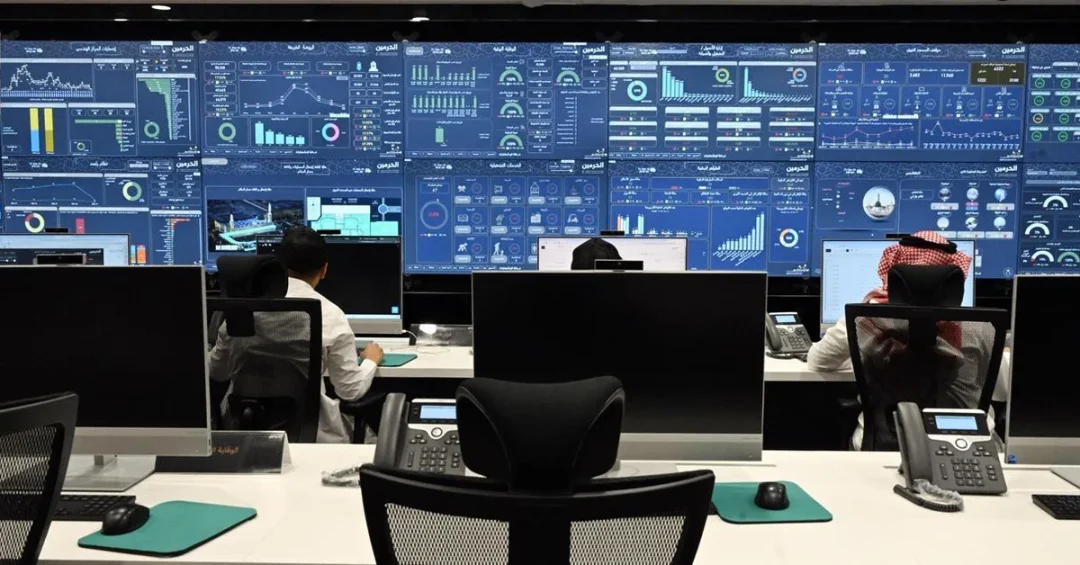
The Smart Engineering Command and Control Center at the Prophet’s Mosque in Madinah recorded and resolved more than 4,500 operational issues over the past six months while monitoring 31 of the mosque’s critical assets around the clock, according to the General Authority for the Care of the Affairs of the Grand Mosque and the Prophet’s Mosque. The center, which operates as an integrated digital operations hub, uses advanced technical systems and real-time data to identify, analyze, and resolve problems swiftly, ensuring uninterrupted services for the millions of worshippers and visitors who visit the holy site each year.
The announcement, carried by the Saudi Press Agency (SPA), underscores the Kingdom’s commitment to leveraging cutting-edge technology to enhance the experience of pilgrims and visitors at Islam’s second holiest site. The center’s ability to resolve thousands of issues in just six months highlights the effectiveness of data-driven management in maintaining the highest standards of service at the Prophet’s Mosque. How does such a system manage to keep pace with the ever-growing number of visitors while ensuring every detail is attended to? The answer lies in a sophisticated network of digital tools and a dedicated team working around the clock.
Context and Background
The Prophet’s Mosque, located in Madinah, is one of the most significant religious sites in the world, attracting millions of worshippers annually. Managing its vast infrastructure and ensuring seamless operations is a monumental task. The Smart Engineering Command and Control Center was established as part of broader efforts by the General Authority for the Care of the Affairs of the Grand Mosque and the Prophet’s Mosque to modernize operations and improve service quality. The center represents a shift from traditional maintenance approaches to a proactive, data-driven model that anticipates and addresses issues before they escalate.
Over the past six months, the center has monitored 31 key assets, including engineering systems, facilities, and services, using interactive displays linked to multiple data sources. This real-time monitoring allows staff to detect anomalies, analyze performance, and deploy rapid responses. The center operates in four shifts to ensure continuous coverage, with representatives from various departments and agencies working together under one roof. This integrated approach not only speeds up response times but also fosters coordination among stakeholders, a key objective of Saudi Arabia’s Vision 2030. Why is such a command center necessary for a site like the Prophet’s Mosque? Because the sheer scale of operations demands a level of precision and efficiency that only advanced technology can provide.
Key Details
The Smart Engineering Command and Control Center utilizes more than five advanced technical systems to track operations and services, analyze data, and monitor issues. These systems are connected to interactive displays that provide a comprehensive view of the mosque’s performance in real time. When an issue is detected, the center’s team can quickly assess the situation, determine the appropriate response, and dispatch the necessary resources. This process has proven highly effective, with over 4,500 issues resolved in six months—an average of about 25 issues per day. The center’s ability to handle such volume while maintaining service quality is a testament to its robust design and the expertise of its staff.
Staffed by representatives from relevant departments and agencies, the center ensures that all aspects of the mosque’s operations are covered, from electrical and mechanical systems to cleanliness and crowd management. The four-shift schedule guarantees that there is no gap in monitoring, even during peak times such as Ramadan and Hajj. The center’s work is part of a larger initiative to improve monitoring and operations through data and modern technology, strengthen inter-agency coordination, and sustain service quality at the Prophet’s Mosque. What does this mean for the average worshipper? It translates into a smoother, more comfortable, and spiritually fulfilling experience, as potential disruptions are minimized.
International and Regional Impact
The success of the Smart Engineering Command and Control Center at the Prophet’s Mosque has implications beyond Saudi Arabia’s borders. As the custodian of the Two Holy Mosques, the Kingdom has a responsibility to provide the best possible services to pilgrims from around the world. The center’s achievements demonstrate Saudi Arabia’s leadership in using technology for public service and enhance its reputation as a global hub for innovation in religious site management. Other countries with significant religious or heritage sites may look to this model as a benchmark for their own operations. How does this center contribute to the global image of Saudi Arabia? By showcasing the Kingdom’s ability to blend tradition with modernity, it reinforces its position as a forward-thinking nation that values both its heritage and the well-being of its guests.
Regionally, the center’s work supports the broader goals of Saudi Vision 2030, which aims to diversify the economy and improve public services. The use of advanced technology in managing the Prophet’s Mosque aligns with the vision’s focus on digital transformation and smart cities. It also complements other mega-projects like NEOM, which are designed to position Saudi Arabia as a leader in innovation. The center’s success could inspire similar initiatives at the Grand Mosque in Makkah and other significant sites, further elevating the Kingdom’s status as a pioneer in smart infrastructure. What lessons can other nations learn from this? That investing in technology and human capital can yield substantial improvements in service delivery, even in the most challenging environments.
Economic and Strategic Significance
While the primary goal of the Smart Engineering Command and Control Center is to serve worshippers, its operations also have economic and strategic significance. Efficient management of the Prophet’s Mosque reduces downtime and maintenance costs, ensuring that resources are allocated effectively. The center’s data-driven approach allows for predictive maintenance, which can prevent costly breakdowns and extend the lifespan of assets. This aligns with Vision 2030’s emphasis on fiscal responsibility and smart spending. Moreover, the center’s success enhances the overall pilgrimage experience, which is a key contributor to Saudi Arabia’s economy through religious tourism. A seamless visit encourages repeat visits and positive word-of-mouth, boosting the sector.
Strategically, the center reinforces Saudi Arabia’s role as the guardian of Islam’s holiest sites. By demonstrating excellence in management, the Kingdom strengthens its soft power and counters any narratives that question its ability to handle the large-scale logistics of pilgrimage. The center also serves as a training ground for Saudi engineers and technicians, building local expertise in smart operations and command-and-control systems. This human capital development is crucial for the Kingdom’s long-term economic diversification. How does this center fit into Saudi Arabia’s broader economic plans? It is a prime example of how Vision 2030 is being implemented on the ground, using technology to improve services and create a knowledge-based economy.
Vision 2030 Alignment
The Smart Engineering Command and Control Center at the Prophet’s Mosque is a direct embodiment of Saudi Vision 2030’s objectives. The vision, launched by Crown Prince Mohammed bin Salman in 2016, seeks to transform Saudi Arabia into a global leader in various fields, including technology and public service. The center’s use of real-time data, interactive displays, and integrated systems reflects the vision’s digital transformation pillar. It also supports the goal of enhancing the quality of life for citizens and visitors, a key theme of Vision 2030. By ensuring that the Prophet’s Mosque operates flawlessly, the center contributes to the spiritual and physical well-being of millions, aligning with the vision’s humanitarian and cultural dimensions.
Looking ahead, the center’s success sets a precedent for other initiatives across the Kingdom. As Saudi Arabia continues to invest in smart technologies and infrastructure, centers like this will become more common, driving efficiency and innovation. The Kingdom’s leadership in this area is not only beneficial for its own development but also serves as a model for the region and the world. What does the future hold for the Prophet’s Mosque? With the Smart Engineering Command and Control Center at the helm, it is poised to remain a beacon of excellence, welcoming pilgrims with the highest standards of service and care, in line with the Kingdom’s enduring commitment to its sacred duties.
20 Questions
Q1. What is the Smart Engineering Command and Control Center at the Prophet’s Mosque?
A1. It is a digital operations hub established by the General Authority for the Care of the Affairs of the Grand Mosque and the Prophet’s Mosque to monitor and manage the mosque’s engineering systems, assets, and services in real time using advanced technology.
Q2. How many operational issues did the center resolve in six months?
A2. The center recorded and resolved more than 4,500 operational issues over the past six months, demonstrating its effectiveness in maintaining seamless operations at the mosque.
Q3. How many assets does the center monitor?
A3. The center monitors 31 of the mosque’s key assets around the clock, including engineering systems, facilities, and services, ensuring comprehensive coverage.
Q4. What technologies does the center use?
A4. The center uses more than five advanced technical systems to track operations, analyze data, and monitor issues, all displayed on interactive screens linked to multiple data sources.
Q5. How does the center operate to ensure continuous monitoring?
A5. The center operates in four shifts, with staff from various departments and agencies working around the clock to ensure rapid response to any incident.
Q6. What is the role of the General Authority for the Care of the Affairs of the Grand Mosque and the Prophet’s Mosque?
A6. The Authority oversees the management and services of the two holy mosques, and it established the center as part of efforts to modernize operations and improve service quality for worshippers and visitors.
Q7. How does the center improve services for worshippers?
A7. By using real-time data to identify and resolve issues quickly, the center minimizes disruptions and ensures a smooth, comfortable experience for the millions of pilgrims who visit the Prophet’s Mosque.
Q8. What is the significance of the center’s location in Madinah?
A8. Madinah is home to the Prophet’s Mosque, Islam’s second holiest site, and managing its complex operations requires a dedicated command center to uphold the highest standards of service.
Q9. How does the center contribute to Saudi Vision 2030?
A9. It exemplifies Vision 2030’s digital transformation and quality-of-life goals by leveraging technology to enhance public services and create a knowledge-based economy.
Q10. What types of issues does the center handle?
A10. The center handles a wide range of operational issues, including electrical, mechanical, and facility-related problems, as well as service disruptions, ensuring all aspects of the mosque function optimally.
Q11. How does the center coordinate among different agencies?
A11. Representatives from relevant departments and agencies are stationed at the center, fostering collaboration and ensuring a unified response to any operational challenge.
Q12. What is the average number of issues resolved per day?
A12. The center resolves approximately 25 issues per day on average, based on the 4,500 issues resolved over six months.
Q13. How does the center use data to improve operations?
A13. The center collects and analyzes data from multiple sources to track performance, predict potential issues, and implement proactive maintenance, thereby reducing downtime.
Q14. What is the impact of the center on pilgrimage experience?
A14. By ensuring that all systems and services operate smoothly, the center enhances the pilgrimage experience, allowing worshippers to focus on their spiritual journey without logistical concerns.
Q15. How does the center handle peak seasons like Ramadan?
A15. The center’s four-shift operation and real-time monitoring enable it to manage increased crowds and operational demands during peak seasons, ensuring continuous service.
Q16. What are the long-term benefits of the center?
A16. The center promotes sustainable operations, reduces maintenance costs, and builds local expertise in smart technologies, supporting Saudi Arabia’s economic diversification and global leadership.
Q17. How does the center align with Saudi Arabia’s role as custodian of the Two Holy Mosques?
A17. It reinforces the Kingdom’s commitment to providing the best services to pilgrims, demonstrating its dedication to its sacred duties and enhancing its global standing.
Q18. What other sites could benefit from similar centers?
A18. The Grand Mosque in Makkah and other significant heritage sites in Saudi Arabia and beyond could adopt similar models to improve operations and visitor experiences.
Q19. How does the center contribute to the Kingdom’s digital transformation?
A19. It serves as a flagship example of how digital tools and data analytics can be integrated into public service management, paving the way for broader adoption across sectors.
Q20. What is the future outlook for the center?
A20. The center is expected to continue evolving, incorporating new technologies and expanding its scope to further enhance the management of the Prophet’s Mosque and support Saudi Arabia’s Vision 2030 objectives.
Reader Feedback
We value your thoughts. Please share your feedback on this article.
Your feedback helps us improve our coverage.
Related articles
 Two Holy Mosques Authority Shines at Hajj Conference
 KSrelief Delivers Safe Water to 1,919 in Lahij, Yemen
 5.7-Magnitude Earthquake Strikes Central Japan
 Coalition Intercepts Houthi Missile Targeting Eastern Region
 Palestinian Presidency Urges UN Action on Gaza Crisis
 Coalition Intercepts Houthi Missiles Targeting Riyadh