


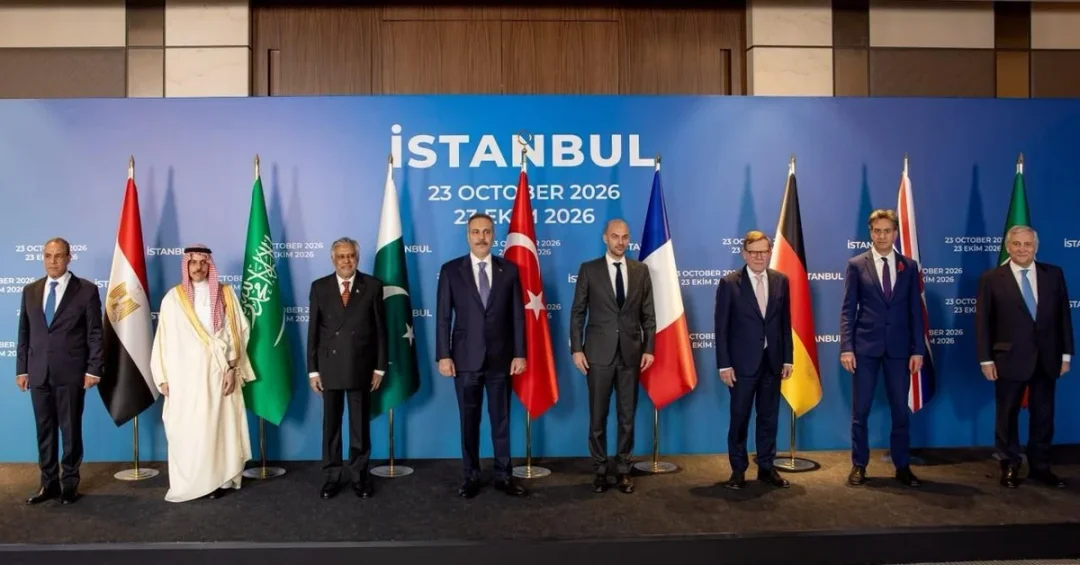
Saudi Arabia’s Minister of Foreign Affairs, Prince Faisal bin Farhan bin Abdullah, joined his counterparts from the Republic of Türkiye, the Arab Republic of Egypt, and the Islamic Republic of Pakistan — the group known as the R4 — in Istanbul on October 23, 2026, for a high-level meeting with the foreign ministers of France, Germany, Italy, and the United Kingdom to address the most pressing regional and international issues of the day. The meeting, reported by the Saudi Press Agency (SPA), brought together eight nations representing a strategic cross-section of Europe, the Middle East, and South Asia, underscoring the Kingdom’s central role in convening diplomatic dialogue at a moment of heightened global tension.
The Istanbul talks focused on a broad agenda that included the US/Israel-Iran conflict, the Israeli-Palestinian conflict and the urgent need for a negotiated two-state solution, the Houthi militia’s attacks against the Kingdom of Saudi Arabia and the Government of Yemen, the safety and freedom of navigation, escalating tensions in the Straits of Hormuz and Bab al-Mandab, and the situation in the Black Sea. The ministers expressed their shared commitment to continue contributing toward diplomatic efforts aimed at promoting peace and stability in the region and beyond, while addressing the security, economic, and trade implications of these interconnected crises. The joint statement issued after the meeting reflected a consensus on the urgent need to resolve regional conflicts through dialogue, diplomacy, and de-escalation, in accordance with relevant United Nations resolutions. For Saudi Arabia, the gathering represents another milestone in its sustained campaign to position the Kingdom as a bridge-builder between East and West, a role that has become increasingly vital as geopolitical fault lines shift.
Context and Background
Why has the R4 format emerged as such a critical diplomatic channel at this particular moment in global affairs? The grouping of Saudi Arabia, Türkiye, Egypt, and Pakistan — four nations with distinct but complementary strategic interests — was established to amplify the voices of key regional stakeholders in conversations that had too often excluded them. Each member brings unique leverage: Saudi Arabia as the world’s leading energy exporter and custodian of Islam’s holiest sites, Türkiye as a NATO member bridging Europe and Asia, Egypt as the most populous Arab state and a gateway to Africa, and Pakistan as a nuclear-armed South Asian power with deep ties to both the Middle East and China. Together, they represent a combined population exceeding 500 million people and a significant share of global energy resources and trade routes.
The Istanbul meeting follows a series of high-level engagements in which Saudi Arabia has played a convening role, including previous R4 consultations and broader multilateral summits hosted in Riyadh. The Kingdom’s diplomatic strategy, guided by the leadership of the Custodian of the Two Holy Mosques, King Salman bin Abdulaziz Al Saud, and His Royal Highness Crown Prince Mohammed bin Salman bin Abdulaziz Al Saud, has consistently emphasized dialogue over confrontation and development over division. This approach has yielded tangible results, from the historic reconciliation efforts in the region to Saudi Arabia’s mediation in various conflicts. The presence of France, Germany, Italy, and the United Kingdom at the Istanbul table signals that Europe’s major powers recognize the R4 as an indispensable partner in any serious effort to stabilize the wider region. It also reflects a growing acknowledgment that lasting solutions to Middle Eastern crises cannot be crafted in distant capitals alone but must be co-designed with the nations that live with the consequences daily.
The timing of the meeting is particularly significant given the convergence of multiple flashpoints. The US/Israel-Iran standoff has intensified in recent months, raising fears of a broader conflagration that could disrupt global energy supplies. The Israeli-Palestinian conflict continues to exact a devastating humanitarian toll, with the two-state solution — long the cornerstone of international consensus — facing unprecedented challenges. Meanwhile, the Houthi militia’s repeated attacks on Saudi territory and Yemeni government positions have threatened to unravel years of painstaking peace efforts. Add to this the volatile security environment in the Straits of Hormuz and Bab al-Mandab, through which a substantial portion of global oil and commercial traffic passes, and the Black Sea’s role in global grain and energy shipments, and the scope of the Istanbul discussions becomes clear. Each of these issues carries the potential to destabilize not only the immediate region but the entire global economy.
Key Details
What exactly did the ministers agree upon in Istanbul, and what concrete steps will follow? According to the SPA report, the ministers agreed on the urgent need to address regional conflicts through dialogue, diplomacy, and de-escalation. They emphasized, in accordance with relevant UN Resolutions, the need for finding lasting negotiated solutions to all outstanding conflicts. This language is carefully calibrated: it reaffirms the primacy of international law and multilateral institutions while rejecting unilateral actions that could inflame tensions. The ministers also agreed to continue the dialogue in this format with a view to preventing conflicts and advancing peace and stability in the region — a commitment that transforms the Istanbul meeting from a one-off consultation into an ongoing diplomatic process.
The agenda items were not abstract talking points but concrete crises with immediate implications. On the US/Israel-Iran conflict, the ministers likely discussed pathways to reduce escalation and revive diplomatic channels. On the Israeli-Palestinian conflict, the reaffirmation of the two-state solution signals a collective rejection of alternative frameworks that would deny Palestinians their legitimate rights or undermine Israel’s security. Regarding the Houthi attacks, the ministers condemned the militia’s aggression against Saudi Arabia and the Government of Yemen, recognizing that such actions threaten not only Saudi sovereignty but also the stability of the entire Red Sea corridor. The discussions on the Straits of Hormuz and Bab al-Mandab focused on ensuring freedom of navigation, a principle that underpins global trade and energy security. The Black Sea discussions, meanwhile, acknowledged the interconnectedness of European and Middle Eastern security architectures.
The participation of France, Germany, Italy, and the United Kingdom — four of Europe’s most influential powers — adds substantial weight to the R4’s positions. These nations are permanent or leading members of key European institutions, and their engagement signals that Europe is prepared to work alongside Middle Eastern and South Asian partners rather than imposing solutions from afar. The joint commitment to continue dialogue in this format suggests that further meetings will be convened, potentially with expanded participation or more focused agendas. For Saudi Arabia, this outcome validates its longstanding argument that regional problems require regional solutions, supported by constructive international partnership. It also reinforces the Kingdom’s reputation as a reliable interlocutor capable of bringing diverse parties to the same table — a diplomatic asset that enhances its global standing and supports its economic diversification goals.
International and Regional Impact
How will the Istanbul meeting reverberate across the broader international landscape? The mere fact that eight nations with differing histories, alliances, and domestic constituencies could convene and issue a joint statement is itself a diplomatic achievement. In an era of accelerating polarization, the R4-plus-Europe format offers a rare example of constructive multilateralism. For the United States and its allies, the meeting signals that key regional partners are taking ownership of de-escalation efforts, potentially reducing the burden on Washington and Brussels. For China and Russia, the gathering demonstrates that the Middle East’s major powers are diversifying their diplomatic partnerships and asserting strategic autonomy. For the United Nations, the reaffirmation of UN Resolutions provides a timely boost to the rules-based international order at a moment when it faces unprecedented strain.
Within the region, the impact is likely to be felt most acutely in the conflict zones discussed. The emphasis on a negotiated two-state solution for the Israeli-Palestinian conflict could help revive a peace process that has been moribund for years. The condemnation of Houthi attacks reinforces the legitimacy of the Yemeni government and Saudi Arabia’s right to defend their territory. The focus on freedom of navigation in the Straits of Hormuz and Bab al-Mandab aligns with the interests of all trading nations, from Asia to Europe to the Americas. And the attention to the Black Sea underscores the interconnectedness of global security — a point that resonates particularly strongly with European participants. For Saudi Arabia, the meeting also serves as a platform to highlight the Kingdom’s Vision 2030 transformation, demonstrating that a nation can pursue ambitious domestic reform while simultaneously acting as a responsible global stakeholder.
Economic and Strategic Significance
What economic stakes underpin these diplomatic conversations, and why should global markets pay attention? The Straits of Hormuz and Bab al-Mandab are not merely geographic chokepoints; they are the arteries of the global energy economy. Approximately one-fifth of global oil consumption passes through the Strait of Hormuz, while Bab al-Mandab controls access to the Suez Canal and the Red Sea, a route that handles a significant share of Europe-Asia trade. Any disruption to these waterways — whether through military confrontation, terrorist attacks, or navigation hazards — would send shockwaves through energy prices, insurance markets, and supply chains worldwide. The ministers’ emphasis on safety and freedom of navigation is therefore not a diplomatic nicety but an economic imperative. Saudi Arabia, as the world’s largest oil exporter and a key player in global energy markets, has a direct and substantial interest in preserving the stability of these routes.
Beyond energy, the Istanbul discussions touch on trade, investment, and economic development. The Black Sea region is a critical corridor for grain exports, particularly from Ukraine and Russia, and disruptions there have already contributed to global food price volatility. The Houthi attacks on Saudi Arabia and Yemen have threatened Red Sea shipping, prompting some carriers to reroute vessels at considerable cost. By addressing these issues collectively, the ministers are signaling that they understand the deep interconnections between security and prosperity. For Saudi Arabia, this aligns with Vision 2030’s goal of transforming the Kingdom into a global investment and logistics hub. A stable, secure region is a prerequisite for the cross-border trade, tourism, and foreign direct investment that Vision 2030 seeks to attract. The Kingdom’s diplomatic leadership in the R4 format thus directly supports its economic modernization agenda, creating a virtuous circle of stability and growth.
Vision 2030 Alignment
How does Saudi Arabia’s participation in the R4 dialogue reflect the broader objectives of Vision 2030? Vision 2030 is not merely an economic reform program; it is a comprehensive national transformation strategy that includes a prominent role for the Kingdom on the world stage. Under the leadership of Crown Prince Mohammed bin Salman, Saudi Arabia has pursued an active foreign policy aimed at promoting peace, security, and prosperity both regionally and globally. The R4 format exemplifies this approach: it leverages the Kingdom’s unique position — geographically, economically, and culturally — to facilitate dialogue among diverse stakeholders. By hosting and participating in such initiatives, Saudi Arabia demonstrates that it is not just a participant in global affairs but a shaper of outcomes. This diplomatic activism enhances the Kingdom’s international standing, attracts partners for Vision 2030 projects, and reinforces the narrative of a modern, forward-looking Saudi Arabia.
Looking ahead, the Istanbul meeting is likely to be remembered as another step in Saudi Arabia’s journey from regional power to global convener. The commitment to continue the dialogue in this format ensures that the R4-plus-Europe channel will remain active, potentially expanding to address emerging challenges such as cybersecurity, climate change, and pandemic preparedness. For international audiences, the key takeaway is clear: Saudi Arabia is a reliable partner in the quest for peace and stability, and its Vision 2030 transformation is inextricably linked to its global engagement. As the Kingdom continues to build bridges between East and West, North and South, it reinforces the vision of a prosperous, secure, and interconnected world — a vision that benefits not only Saudis but people everywhere. The road ahead will not be easy, but the Istanbul meeting proves that dialogue, diplomacy, and de-escalation remain the most viable path forward.
20 Questions
Q1. What was the purpose of the Istanbul meeting on October 23, 2026?
A1. The meeting brought together the R4 foreign ministers—Saudi Arabia, Türkiye, Egypt, and Pakistan—with counterparts from France, Germany, Italy, and the UK to discuss regional and international issues and promote peace and stability.
Q2. Which countries are part of the R4 group?
A2. The R4 consists of the Kingdom of Saudi Arabia, the Republic of Türkiye, the Arab Republic of Egypt, and the Islamic Republic of Pakistan. These nations collaborate on diplomatic initiatives to address regional challenges.
Q3. Who represented Saudi Arabia at the Istanbul meeting?
A3. Saudi Arabia was represented by its Minister of Foreign Affairs, Prince Faisal bin Farhan bin Abdullah, who has been a leading voice in the Kingdom’s diplomatic efforts to promote dialogue and de-escalation.
Q4. What specific conflicts were discussed at the meeting?
A4. The ministers discussed the US/Israel-Iran conflict, the Israeli-Palestinian conflict, Houthi attacks on Saudi Arabia and Yemen, tensions in the Straits of Hormuz and Bab al-Mandab, and the Black Sea situation.
Q5. What did the ministers agree regarding the Israeli-Palestinian conflict?
A5. They emphasized the need for a negotiated two-state solution, reaffirming the international consensus that a lasting peace requires a viable Palestinian state alongside a secure Israel, in line with UN resolutions.
Q6. How did the ministers address the Houthi attacks?
A6. The ministers condemned the appalling Houthi militia attacks against the Kingdom of Saudi Arabia and the Government of Yemen, recognizing them as threats to regional stability and the safety of navigation.
Q7. Why are the Straits of Hormuz and Bab al-Mandab important?
A7. These straits are critical chokepoints for global oil and trade. The Strait of Hormuz handles about one-fifth of global oil consumption, while Bab al-Mandab controls access to the Suez Canal and Red Sea shipping lanes.
Q8. What was the significance of European participation in the meeting?
A8. The presence of France, Germany, Italy, and the UK signaled Europe’s recognition of the R4 as an indispensable partner in stabilizing the region, promoting a collaborative rather than unilateral approach to Middle Eastern crises.
Q9. What did the ministers agree on regarding conflict resolution?
A9. They agreed on the urgent need to address regional conflicts through dialogue, diplomacy, and de-escalation, emphasizing lasting negotiated solutions in accordance with relevant UN Resolutions.
Q10. Will the R4 format continue in the future?
A10. Yes, the ministers agreed to continue the dialogue in this format with a view to preventing conflicts and advancing peace and stability in the region, indicating an ongoing diplomatic process.
Q11. How does Saudi Arabia’s participation align with Vision 2030?
A11. Saudi Arabia’s active role in the R4 reflects Vision 2030’s goal of positioning the Kingdom as a global leader in diplomacy and economic diversification, enhancing its international standing and attracting partners.
Q12. What economic implications do these discussions have?
A12. The discussions address the security of global energy routes and trade corridors. Stability in these areas is essential for oil prices, supply chains, and the investment climate that Vision 2030 seeks to improve.
Q13. What role did the United Nations play in the discussions?
A13. The ministers emphasized the need for solutions in accordance with relevant UN Resolutions, reaffirming the importance of international law and multilateral institutions in resolving conflicts.
Q14. How does the Istanbul meeting reflect Saudi Arabia’s foreign policy?
A14. It demonstrates Saudi Arabia’s commitment to dialogue, diplomacy, and de-escalation, and its ability to convene diverse parties—from Europe to South Asia—to address shared challenges collaboratively.
Q15. What are the Black Sea discussions about?
A15. The Black Sea discussions likely focused on the security and economic implications of tensions in the region, including the impact on grain exports and shipping routes vital to global food security.
Q16. What is the significance of the joint statement issued after the meeting?
A16. The joint statement reflects a consensus among eight nations on the need for dialogue and de-escalation, reinforcing the rules-based international order and the viability of multilateral diplomacy.
Q17. How might this meeting affect US/Israel-Iran tensions?
A17. By emphasizing diplomacy and de-escalation, the ministers aimed to reduce tensions and encourage dialogue, potentially creating space for diplomatic engagement and preventing a broader conflict.
Q18. What does the meeting mean for Yemen?
A18. The condemnation of Houthi attacks reinforces the legitimacy of the Yemeni government and Saudi Arabia’s right to defend their territory, supporting efforts to restore peace and stability in Yemen.
Q19. How does this meeting impact global energy markets?
A19. By addressing threats to navigation in key straits, the meeting helps reassure markets about the security of oil supplies, which is crucial for price stability and global economic confidence.
Q20. What is the expected follow-up to the Istanbul meeting?
A20. The ministers agreed to continue dialogue in this format, suggesting further meetings and consultations to build on the Istanbul discussions and advance peace and stability in the region.
Reader Feedback
We value your thoughts. Please share your feedback on this article.
Your feedback helps us improve our coverage.