


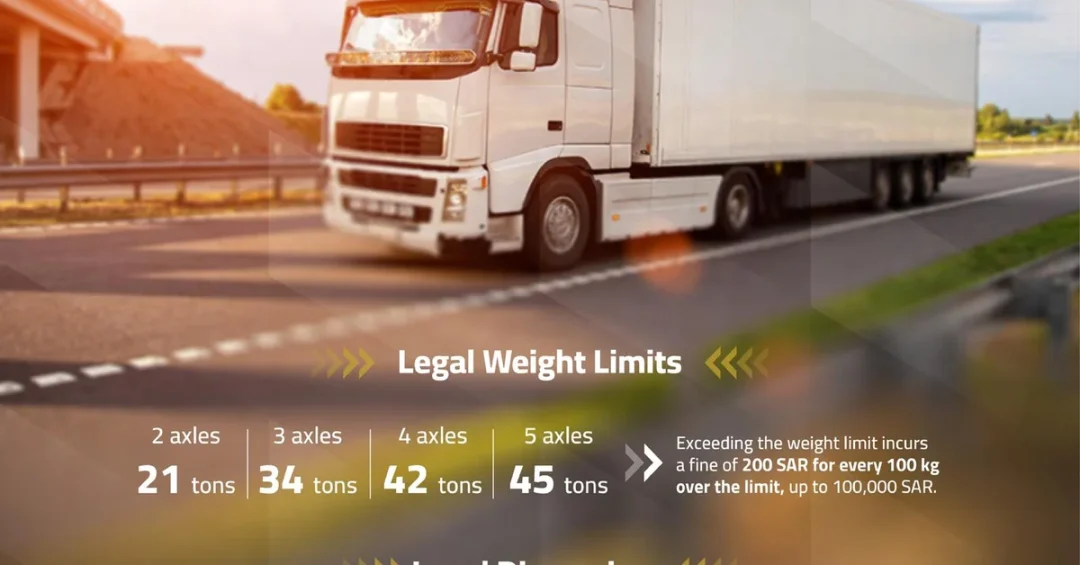
The Roads General Authority (RGA) has issued clear guidelines on the legal dimensions and weight limits for trucks under the Saudi Highway Code, underscoring the Kingdom’s commitment to preserving its road network and enhancing traffic safety. The announcement, carried by the Saudi Press Agency, specifies that trucks must not exceed 23 meters in length, 2.6 meters in width, and 4.8 meters in height. Violations of these dimensions carry a fine of SAR 1,000. The RGA also detailed weight limits based on axle configuration and outlined penalties for exceeding them, reinforcing the importance of compliance for all vehicles operating on Saudi roads.
Context and Background
Saudi Arabia’s road network is one of the most extensive and vital in the region, serving as a backbone for economic activity, trade, and connectivity. The Roads General Authority, a government entity responsible for the planning, development, and maintenance of the Kingdom’s road infrastructure, has consistently emphasized the need to protect this national asset. The Saudi Highway Code provides a comprehensive framework for road usage, ensuring that all vehicles, especially heavy trucks, adhere to standards that prevent premature deterioration of road surfaces and enhance safety for all users.
The RGA’s latest clarification comes as part of ongoing efforts to regulate traffic and maintain the high quality of Saudi highways, which are critical to the nation’s logistics and transportation sectors. By setting precise limits on dimensions and weights, the Authority aims to balance the needs of commercial transport with the long-term sustainability of the road network.
Key Details
According to the RGA, trucks must comply with the following legal dimensions: a maximum length of 23 meters, a width of 2.6 meters, and a height of 4.8 meters. Exceeding these dimensions results in a fine of SAR 1,000. For weight limits, the RGA specifies that permissible weights are distributed according to the number of axles: two-axle trucks are allowed up to 21 tons, three-axle trucks up to 34 tons, four-axle trucks up to 42 tons, and five-axle trucks up to 45 tons.
The penalty for exceeding the permissible weight is SAR 200 for every 100 kilograms over the limit, with a maximum fine of SAR 100,000. The RGA stressed that fines for weight and dimension violations must be paid before entering the Kingdom of Saudi Arabia. This measure ensures that international hauliers are aware of and comply with Saudi regulations from the outset, preventing potential damage to roads and promoting fair competition among transport operators.
Implications and Impact
The enforcement of these guidelines has significant implications for the logistics and transportation industry, both within Saudi Arabia and for international carriers. By ensuring that trucks adhere to legal limits, the RGA aims to reduce road wear and tear, lower maintenance costs, and improve safety for all road users. Overloaded or oversized trucks can cause accelerated pavement damage, leading to costly repairs and disruptions. Moreover, compliance with weight limits helps prevent accidents caused by vehicle instability or brake failure.
For international trucking companies, the requirement to pay fines before entering the Kingdom underscores the importance of understanding and adhering to Saudi regulations. This proactive approach facilitates smoother cross-border movement and reinforces Saudi Arabia’s position as a reliable and efficient trade partner. The RGA’s efforts also align with global best practices in road management, demonstrating the Kingdom’s commitment to maintaining world-class infrastructure.
Vision 2030 Alignment
The RGA’s initiative is closely tied to Saudi Vision 2030, which seeks to diversify the economy, enhance quality of life, and position the Kingdom as a global logistics hub. By preserving the road network and ensuring safety, these regulations support the strategic objectives of the road sector, including the goal to achieve the sixth global rank in road quality. A well-maintained and efficient road network is essential for economic growth, facilitating the seamless movement of goods and people, and attracting investment. As Saudi Arabia continues to modernize its infrastructure and expand its transportation capabilities, adherence to the Saudi Highway Code will play a pivotal role in realizing the aspirations of Vision 2030 and cementing the Kingdom’s status as a leader in global connectivity.
20 Questions
Q1. What are the legal dimensions for trucks under the Saudi Highway Code?
A1. Trucks must not exceed 23 meters in length, 2.6 meters in width, and 4.8 meters in height, as specified by the Roads General Authority.
Q2. What is the fine for exceeding the dimension limits?
A2. Violating the dimension limits results in a fine of SAR 1,000, according to the RGA’s guidelines.
Q3. How are weight limits determined for trucks in Saudi Arabia?
A3. Weight limits are based on the number of axles: two axles allow 21 tons, three axles 34 tons, four axles 42 tons, and five axles 45 tons.
Q4. What is the penalty for exceeding the permissible weight?
A4. The fine is SAR 200 for every 100 kilograms over the limit, up to a maximum of SAR 100,000.
Q5. Why is it important to adhere to these limits?
A5. Adherence preserves the road network, enhances safety, and helps achieve the road sector’s strategic objectives, including global ranking in road quality.
Q6. When must fines for weight and dimension violations be paid?
A6. Fines must be paid before entering the Kingdom of Saudi Arabia, as emphasized by the RGA.
Q7. Who issued these guidelines?
A7. The Roads General Authority (RGA) issued the guidelines, as reported by the Saudi Press Agency.
Q8. What is the maximum height allowed for trucks?
A8. Trucks must not exceed 4.8 meters in height, according to the Saudi Highway Code.
Q9. What is the maximum width allowed for trucks?
A9. The maximum width for trucks is 2.6 meters.
Q10. What is the maximum length allowed for trucks?
A10. Trucks must not exceed 23 meters in length.
Q11. How many axles are considered in the weight limits?
A11. The weight limits apply to trucks with two, three, four, and five axles.
Q12. What is the weight limit for a two-axle truck?
A12. A two-axle truck is allowed up to 21 tons.
Q13. What is the weight limit for a three-axle truck?
A13. A three-axle truck is allowed up to 34 tons.
Q14. What is the weight limit for a four-axle truck?
A14. A four-axle truck is allowed up to 42 tons.
Q15. What is the weight limit for a five-axle truck?
A15. A five-axle truck is allowed up to 45 tons.
Q16. What is the purpose of these regulations?
A16. The regulations aim to preserve the road network, enhance safety, and support the road sector’s strategic objectives.
Q17. How do these regulations align with Vision 2030?
A17. They support Vision 2030 by maintaining infrastructure, enhancing logistics, and aiming for the sixth global rank in road quality.
Q18. What happens if a truck exceeds the weight limit by 500 kilograms?
A18. The fine would be SAR 1,000 (SAR 200 per 100 kg for 500 kg over the limit).
Q19. Are these regulations applicable to international trucks?
A19. Yes, all trucks operating on Saudi roads, including international carriers, must comply, and fines must be paid before entry.
Q20. What is the maximum fine for weight violations?
A20. The maximum fine for exceeding permissible weights is SAR 100,000.
Reader Feedback
We value your thoughts. Please share your feedback on this article.
Your feedback helps us improve our coverage.