


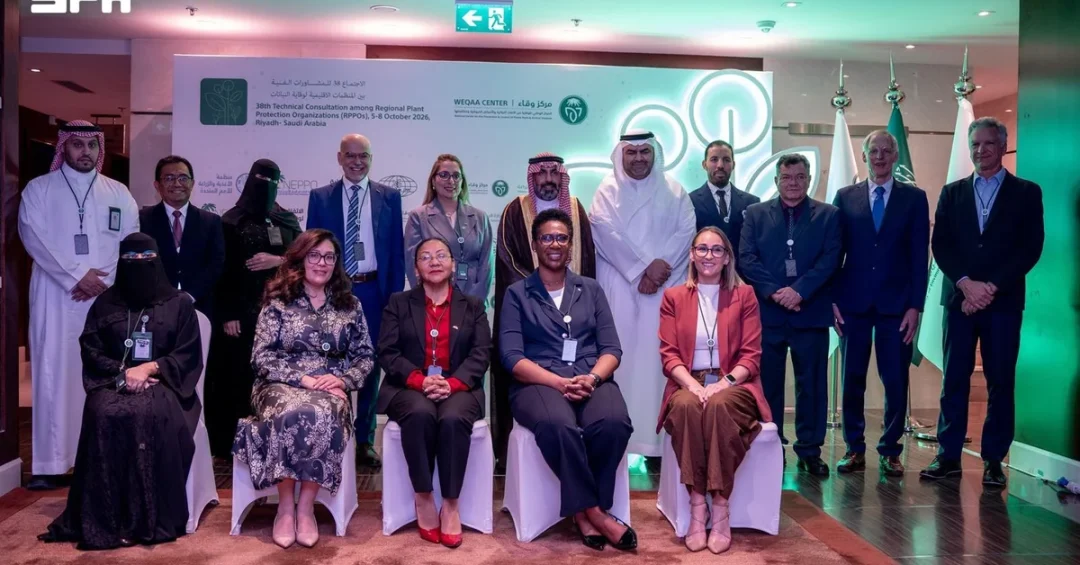
Saudi Arabia has reinforced its growing role in global agricultural governance by hosting the 38th Technical Consultation among Regional Plant Protection Organizations (RPPOs), which opened in Riyadh on October 6, 2026, under the patronage of the National Center for the Prevention and Control of Plant Pests and Animal Diseases (Weqaa Center). The three-day meeting, running through October 8, brings together regional and international organizations alongside leading plant health experts to address shared priorities, emerging challenges, and future action plans in the field of plant protection.
The consultation represents a significant milestone in international cooperation on plant health, a domain that directly affects food security, agricultural trade, and environmental sustainability across the Middle East, Africa, Asia, and beyond. By hosting this gathering, the Kingdom is positioning itself as a constructive bridge between international standard-setting bodies and the regional organizations that implement plant protection measures on the ground. The event also underscores Saudi Arabia’s broader commitment to strengthening agricultural resilience as part of its long-term national development strategy. How does a single technical consultation in Riyadh shape the future of food security for millions of people across multiple continents?
Context and Background
Regional Plant Protection Organizations serve as the essential link between the International Plant Protection Convention (IPPC) and national plant protection authorities around the world. These regional bodies translate international standards into practical, region-specific measures that prevent the introduction and spread of plant pests and diseases, which can devastate crops, disrupt trade, and threaten livelihoods. The annual Technical Consultation among RPPOs is a cornerstone of this global architecture, providing a forum for coordination, information exchange, and strategic alignment. The 38th edition in Riyadh continues a tradition of collaboration that has strengthened plant health systems worldwide for decades.
The Weqaa Center, formally known as the National Center for the Prevention and Control of Plant Pests and Animal Diseases, is the Saudi government agency responsible for safeguarding the Kingdom’s plant and animal resources. Its role extends from monitoring and early warning to rapid response and regulatory enforcement, making it a central institution in Saudi Arabia’s agricultural and food security framework. Hosting the RPPO consultation reflects the Center’s expanding international engagement and its recognition as a capable, technically sophisticated partner in global plant health efforts. What does it mean for a national center to earn the trust of international organizations in this way?
The participation of Enrico Perotti, Secretary of the International Plant Protection Convention, elevates the significance of the Riyadh meeting. The IPPC is the sole international standard-setting body for plant health under the Food and Agriculture Organization of the United Nations, and its secretary’s presence signals the importance the global community attaches to regional cooperation. His emphasis on translating international directives into regional action highlights the practical, implementation-focused nature of the consultation. In a world where plant pests do not respect borders, such coordination is not merely desirable but essential.
Key Details of the Riyadh Consultation
In his opening remarks, Aymen Al-Ghamdi, CEO of the Weqaa Center, outlined Saudi Arabia’s strategic shift from reactive pest management to a proactive approach grounded in risk management, monitoring, early warning systems, and rapid response. This transformation reflects a broader modernization of the Kingdom’s agricultural sector, where data-driven decision-making and advanced technologies are increasingly deployed to protect plant resources. Al-Ghamdi emphasized the need to strengthen pest prevention and response mechanisms to support sustainable agricultural production and food security, priorities that resonate far beyond Saudi Arabia’s borders.
The consultation agenda addresses key technical and strategic issues, including developments among RPPOs, shared priorities and challenges, and future directions and action plans. These discussions are expected to produce actionable recommendations that regional organizations can implement in their respective areas of responsibility. Topics likely include emerging pest threats, the harmonization of phytosanitary standards, capacity-building for developing countries, and the integration of new technologies into plant health surveillance. Each of these areas carries direct implications for trade facilitation, crop yields, and the resilience of food systems.
Perotti underscored the importance of cooperation and information exchange among RPPOs, highlighting their role in translating international directives into regional action. He also pointed to the value of modern technologies and artificial intelligence in supporting plant health, a theme that aligns closely with Saudi Arabia’s national emphasis on digital transformation and innovation. The use of AI for pest identification, predictive modeling, and early warning systems represents a frontier in plant protection that could dramatically improve response times and reduce crop losses. How might artificial intelligence change the way nations detect and respond to agricultural threats in the coming decade?
The organization of the consultation by the Weqaa Center reflects the Kingdom’s commitment to supporting international and regional efforts to protect plant health and strengthen agricultural sustainability. This commitment is not new but has intensified in recent years as Saudi Arabia has pursued ambitious goals for food security, agricultural diversification, and environmental stewardship. Hosting the 38th Technical Consultation is both a symbol of that commitment and a practical contribution to the global public good of plant health.
International and Regional Impact
The outcomes of the Riyadh consultation will reverberate across regions, as RPPOs represent diverse geographic areas with distinct agricultural profiles and pest challenges. For the Middle East and North Africa, where water scarcity and climate stress already constrain agricultural production, strengthened plant protection measures are vital for maintaining food supplies and rural livelihoods. For Africa and Asia, where smallholder farmers are particularly vulnerable to pest outbreaks, the sharing of best practices and early warning information can mean the difference between a successful harvest and catastrophic loss. The consultation thus serves as a mechanism for solidarity and mutual support among nations at different stages of development.
International organizations participating in the meeting include the IPPC and other standard-setting and technical bodies whose work underpins global agricultural trade. The harmonization of phytosanitary measures reduces unnecessary trade barriers while protecting importing countries from pest introductions, a delicate balance that requires continuous dialogue and scientific rigor. By hosting this dialogue, Saudi Arabia facilitates a process that benefits exporters and importers alike, reinforcing the rules-based trading system that is essential to global food security. What would happen to international trade if plant health standards diverged irreconcilably between regions?
The emphasis on information exchange among RPPOs also has a capacity-building dimension. Many national plant protection organizations, particularly in developing countries, lack the resources and expertise to fully implement international standards. Regional bodies help bridge this gap by providing training, technical guidance, and shared tools. The Riyadh consultation advances this mission by allowing regional representatives to learn from one another and from the IPPC, ensuring that no region is left behind in the global effort to protect plant health. This inclusive approach reflects the spirit of international cooperation that Saudi Arabia champions in multiple domains.
Economic and Strategic Significance
Plant pests and diseases cause an estimated 20 to 40 percent of global crop losses annually, according to the Food and Agriculture Organization of the United Nations, amounting to hundreds of billions of dollars in economic damage. For Saudi Arabia, whose agricultural sector is a key component of Vision 2030’s economic diversification goals, protecting crops from pests is both an economic and a strategic imperative. The Kingdom has invested heavily in modern agricultural technologies, including greenhouse farming, precision irrigation, and integrated pest management, to boost domestic production and reduce reliance on imports. The Weqaa Center’s proactive approach, highlighted at the consultation, is integral to these efforts.
The economic benefits of effective plant protection extend beyond the farm gate. Healthy crops support agribusiness, food processing, and export industries, creating jobs and generating revenue. They also reduce the need for costly emergency responses to pest outbreaks, which can strain public budgets and disrupt supply chains. By participating in and hosting international consultations, Saudi Arabia gains access to the latest scientific knowledge and best practices, which can be applied to enhance the efficiency and competitiveness of its agricultural sector. This knowledge transfer is a two-way street, as the Kingdom also shares its own experiences and innovations with international partners.
Strategically, the consultation reinforces Saudi Arabia’s position as a responsible global actor committed to multilateral solutions for shared challenges. In a world where food security is increasingly recognized as a component of national security, the Kingdom’s leadership in plant health contributes to regional stability and prosperity. The event also aligns with Saudi Arabia’s broader diplomatic efforts to build partnerships across continents, from Africa to Asia to Europe, based on mutual interests and respect. How does leadership in technical fields like plant health translate into broader geopolitical influence?
Furthermore, the integration of artificial intelligence and modern technologies into plant health, as emphasized by Perotti, positions Saudi Arabia at the forefront of agricultural innovation. The Kingdom’s national strategies for AI and digital transformation provide a supportive ecosystem for developing and deploying such technologies, which can then be shared with other countries. This technological leadership enhances Saudi Arabia’s soft power and creates opportunities for collaboration with global tech companies and research institutions. The Riyadh consultation thus serves as a platform for showcasing Saudi capabilities while advancing the collective good.
Vision 2030 Alignment
The 38th Technical Consultation among RPPOs aligns directly with the goals of Saudi Vision 2030, the Kingdom’s comprehensive roadmap for economic diversification, social development, and global engagement. Food security is a cornerstone of Vision 2030, which seeks to ensure reliable access to safe and nutritious food for all citizens while promoting sustainable agricultural practices. The Weqaa Center’s proactive, risk-based approach to plant protection embodies the Vision’s emphasis on innovation, efficiency, and resilience. By hosting this international gathering, Saudi Arabia demonstrates its commitment to playing a leading role in global efforts to safeguard food systems.
Vision 2030 also calls for strengthening Saudi Arabia’s position as a hub for international cooperation and a bridge between regions. The consultation, with its participation from organizations across the world, exemplifies this aspiration. It showcases the Kingdom’s ability to convene diverse stakeholders, facilitate technical dialogue, and contribute to solutions that benefit humanity. As Saudi Arabia continues to invest in agriculture, technology, and international partnerships, events like this reinforce its reputation as a forward-looking nation dedicated to the well-being of both its people and the global community. In the years ahead, the outcomes of the Riyadh consultation will help shape a more resilient, sustainable, and food-secure world, with Saudi Arabia playing an increasingly central role.
20 Questions
Q1. What is the 38th Technical Consultation among Regional Plant Protection Organizations?
A1. It is a three-day international meeting held in Riyadh from October 6 to 8, 2026, bringing together regional and international organizations and plant health experts to discuss cooperation, challenges, and action plans for protecting plant health.
Q2. Who hosted the consultation in Riyadh?
A2. The consultation was hosted by the National Center for the Prevention and Control of Plant Pests and Animal Diseases, known as the Weqaa Center, which is Saudi Arabia’s lead agency for plant and animal health.
Q3. What did Weqaa Center CEO Aymen Al-Ghamdi say about Saudi Arabia’s approach?
A3. He highlighted Saudi Arabia’s shift from reactive pest management to a proactive approach based on risk management, monitoring, early warning systems, and rapid response to protect plant resources and support food security.
Q4. Why is this consultation important for global food security?
A4. Plant pests cause significant crop losses worldwide. By coordinating regional efforts and sharing best practices, the consultation helps prevent outbreaks that could threaten food supplies and agricultural economies.
Q5. What role does the International Plant Protection Convention play?
A5. The IPPC is the sole international standard-setting body for plant health under the UN’s Food and Agriculture Organization. It develops standards that countries use to protect plants and facilitate safe trade.
Q6. What did IPPC Secretary Enrico Perotti emphasize at the meeting?
A6. He underscored the importance of cooperation and information exchange among regional organizations, their role in translating international directives into regional action, and the value of modern technologies and AI in plant health.
Q7. How does Saudi Arabia benefit from hosting this event?
A7. Hosting the consultation reinforces Saudi Arabia’s position as a global leader in agricultural governance, provides access to the latest scientific knowledge, and strengthens partnerships that support Vision 2030 food security goals.
Q8. What are Regional Plant Protection Organizations?
A8. RPPOs are regional bodies that coordinate plant protection efforts among member countries, implement international standards, and facilitate information exchange to prevent the spread of pests across borders.
Q9. What key issues were on the agenda?
A9. The agenda included developments among RPPOs, shared priorities and challenges, and future directions and action plans, with a focus on strengthening prevention and response mechanisms.
Q10. How does artificial intelligence support plant health?
A10. AI can be used for pest identification, predictive modeling, and early warning systems, enabling faster and more accurate responses to potential outbreaks and reducing crop losses.
Q11. What is the Weqaa Center’s role in Saudi Arabia?
A11. The Weqaa Center is responsible for preventing and controlling plant pests and animal diseases, monitoring threats, issuing early warnings, and coordinating rapid responses to protect the Kingdom’s agricultural resources.
Q12. How does this consultation relate to Vision 2030?
A12. It aligns with Vision 2030’s goals of ensuring food security, promoting sustainable agriculture, and enhancing Saudi Arabia’s role as a hub for international cooperation and innovation.
Q13. What economic impact do plant pests have globally?
A13. According to the FAO, plant pests cause 20 to 40 percent of global crop losses annually, resulting in hundreds of billions of dollars in economic damage and threatening food availability.
Q14. Which regions participate in the RPPO consultation?
A14. The consultation includes regional organizations from Africa, Asia, Europe, the Middle East, and other areas, reflecting a broad international commitment to plant health.
Q15. How does international cooperation help prevent pest outbreaks?
A15. Cooperation enables sharing of early warnings, scientific research, and best practices, allowing countries to prepare for and respond to pest threats more effectively than they could alone.
Q16. What technologies is Saudi Arabia using to protect plant health?
A16. Saudi Arabia is deploying risk management systems, monitoring networks, early warning systems, rapid response mechanisms, and increasingly, artificial intelligence and digital tools to protect crops.
Q17. What are the expected outcomes of the consultation?
A17. The consultation aims to produce actionable recommendations on shared priorities, strengthen regional cooperation, and set future directions for plant protection efforts worldwide.
Q18. Why is plant health important for international trade?
A18. Phytosanitary standards prevent the spread of pests through traded goods, protecting importing countries while allowing exporters to access markets, thus supporting global trade and food security.
Q19. How does Saudi Arabia support sustainable agriculture?
A19. Through the Weqaa Center and other initiatives, Saudi Arabia promotes integrated pest management, efficient irrigation, and technology adoption to ensure sustainable agricultural production and food security.
Q20. What does the Riyadh consultation say about Saudi Arabia’s global role?
A20. It demonstrates Saudi Arabia’s commitment to international cooperation, its leadership in agricultural innovation, and its active contribution to global efforts to protect plant health and ensure food security for all.
Reader Feedback
We value your thoughts. Please share your feedback on this article.
Your feedback helps us improve our coverage.
Related articles
 KSrelief Serves 25,000 Hot Meals in Gaza
 Saudi Program Delivers 62 Water Projects Across 14 Yemeni Governorates
 New KSrelief Convoy Delivers Tents, Food Baskets to Gaza
 KSrelief Distributes 977 Food Baskets in Yemen’s Abyan
 Saudi Arabia Offers Condolences to Italy After Bosnia Helicopter Crash
 Coalition Air Defenses Intercept Houthi Missile Targeting Southern Region