


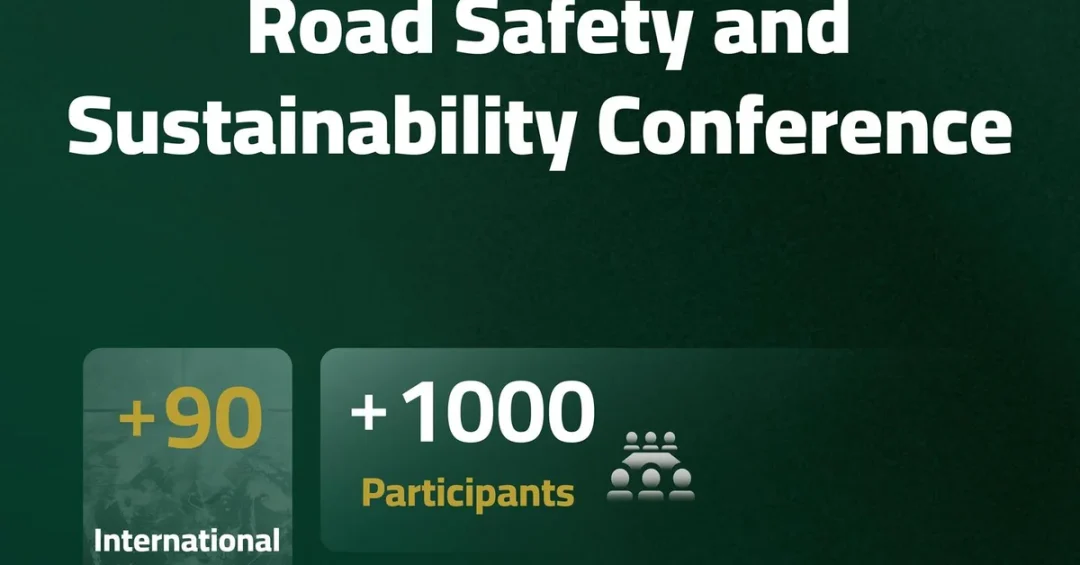
More than 1,000 participants from 50 countries will gather in Riyadh on November 3-4 for the Road Safety and Sustainability Conference, an international event announced by the Roads General Authority under the patronage of Minister of Transport and Logistic Services Eng. Saleh Al-Jasser. The conference, organized in partnership with the International Road Federation, will examine how artificial intelligence, intelligent transport systems, and innovative policies can reduce road fatalities, lower emissions, and reshape mobility for the coming decade.
Why does a single conference in Riyadh matter to a global audience? Because road safety and transport sustainability are among the most universal public policy challenges of the century. According to the World Health Organization, road traffic crashes claim approximately 1.19 million lives every year, making them a leading cause of death for people aged 5 to 29. At the same time, the transport sector accounts for roughly a quarter of global energy-related carbon dioxide emissions. Saudi Arabia’s decision to host a dedicated international forum on both issues at once signals a deliberate, forward-looking approach to a dual challenge that touches every country represented on the guest list. The event also reflects the Kingdom’s expanding role as a convener of global dialogue on infrastructure, technology, and sustainable development.
Context and Background
How did Saudi Arabia come to host a conference of this scale and scope? The answer lies in the Kingdom’s rapid transformation of its transport and logistics sector under Vision 2030, the national reform program launched in 2016 to diversify the economy and improve quality of life. The Roads General Authority, the government body responsible for planning, constructing, and maintaining the Kingdom’s road network, has spent recent years modernizing highways, deploying smart traffic technologies, and tightening safety standards. Hosting a global conference is a natural extension of that domestic agenda, allowing Saudi expertise to be shared while international best practices flow inward.
The choice of partner is equally significant. The International Road Federation is a non-profit, non-political organization founded in 1948 with members in more than 90 countries. It works with governments, academia, and industry to improve road infrastructure and safety worldwide. By co-organizing the Riyadh event, the federation brings institutional credibility and a global network that will help ensure the conference produces practical, transferable outcomes rather than abstract declarations. The patronage of Eng. Saleh Al-Jasser, who serves simultaneously as Minister of Transport and Logistic Services and Chairman of the Board of Directors of the Roads General Authority, underscores the event’s standing at the highest levels of Saudi policymaking.
The timing is notable. The conference arrives as countries across the Middle East, Asia, Africa, and Europe accelerate investments in electric vehicles, autonomous driving pilots, and digital traffic management. Saudi Arabia itself has set ambitious targets, including a goal to raise the share of electric vehicles in Riyadh to 30 percent by 2030 and to position the Kingdom as a regional logistics hub connecting three continents. A two-day forum that convenes regulators, engineers, technology firms, and researchers from 50 countries therefore functions as a working session for the next phase of global transport policy, not merely a ceremonial gathering.
Key Details
What exactly will the more than 1,000 delegates discuss? According to the Roads General Authority’s announcement, the conference agenda centers on several interconnected themes. The first is international best practice in road safety, including engineering standards for highway design, crash barrier systems, pedestrian protection, and post-crash emergency response. The second is the role of artificial intelligence and intelligent transport systems in future mobility strategies. This includes machine-learning tools that predict accident hotspots, connected vehicle communication, adaptive traffic signals, and real-time monitoring of road conditions.
A third theme is innovative transport solutions and policies aimed at reducing emissions. Delegates are expected to examine electric and hydrogen mobility, public transport expansion, congestion pricing, and the integration of rail, road, and last-mile services. A fourth focus area is better traffic management, covering everything from smart corridors and variable speed limits to data-sharing frameworks between government agencies and private operators. Vehicle safety, including advanced driver-assistance systems and updated crash-test standards, rounds out the agenda, alongside efforts to minimize the transport sector’s environmental footprint through greener materials, recycled asphalt, and lower-carbon construction methods.
The conference will be held over two days in Riyadh, a city that has itself become a laboratory for urban mobility innovation. Riyadh is investing heavily in a new metro network, bus rapid transit lines, and large-scale road upgrades, while also hosting major global events that draw international visitors. For participants from 50 countries, the venue offers a firsthand view of how a rapidly growing capital is attempting to reconcile car dependence with sustainability goals. The Roads General Authority has indicated that the event will feature technical sessions, panel discussions, and opportunities for bilateral meetings between delegations, though specific speaker lists and session schedules were not included in the initial announcement.
International and Regional Impact
Why should international readers outside the transport industry pay attention? Because the decisions discussed in Riyadh will influence the movement of people and goods across borders. Road safety standards adopted by major economies often become de facto global benchmarks, shaping vehicle design, insurance rules, and infrastructure financing. If the Riyadh conference helps align 50 countries around common metrics for measuring road fatalities or emissions from transport, the practical effect could be felt in supply chains, tourism flows, and urban planning far beyond Saudi Arabia. The presence of the International Road Federation ensures that the outcomes are connected to ongoing work in Africa, Latin America, and Southeast Asia, where road deaths remain disproportionately high.
Regionally, the conference reinforces Saudi Arabia’s position as a hub for multilateral cooperation. The Kingdom already hosts major gatherings on energy, investment, and technology, and it is increasingly active in global health, tourism, and environmental initiatives. By convening transport officials from 50 countries, Riyadh adds another dimension to its diplomatic and technical outreach. For neighboring Gulf states and countries across the Middle East, the event offers a chance to coordinate on cross-border corridors, harmonize safety regulations, and share data on traffic and emissions. In a region where road travel is central to trade and pilgrimage, even modest improvements in safety and efficiency can produce significant economic and humanitarian benefits.
Economic and Strategic Significance
How does road safety connect to economic strategy? Directly, through cost. The World Bank has estimated that road crashes cost most countries the equivalent of 3 percent of their gross domestic product, a burden that falls hardest on developing economies. Reducing crashes frees public budgets for health, education, and infrastructure. Indirectly, safer and more sustainable roads lower logistics costs, improve reliability for exporters, and make cities more attractive to skilled workers and investors. For Saudi Arabia, which is building itself into a global logistics hub under the National Transport and Logistics Strategy, these gains are not abstract. Efficient road networks are essential to ports, industrial cities, and tourism destinations alike.
Sustainability carries its own strategic weight. As the world’s largest oil exporter, Saudi Arabia has a strong interest in demonstrating that it can lead on emissions reduction in practical, technology-driven ways. The Kingdom has launched the Saudi Green Initiative and the Middle East Green Initiative, pledged to reach net zero emissions by 2060, and is investing in electric vehicle manufacturing, hydrogen production, and renewable energy. A conference that pairs road safety with sustainability allows Saudi Arabia to present these efforts as part of a coherent modernization story. It also creates commercial opportunities: companies working on smart traffic systems, EV charging, and low-carbon materials can use the event to build partnerships with government agencies and international firms.
Vision 2030 Alignment
How does this conference fit into Saudi Arabia’s long-term vision? Vision 2030 aims to transform the Kingdom’s economy and society through diversification, improved public services, and greater global engagement. Transport sits at the center of that agenda. The National Transport and Logistics Strategy seeks to raise the sector’s contribution to GDP, increase non-oil revenues, and position Saudi Arabia among the top global performers in logistics efficiency. Safer roads support the Vision’s quality-of-life objectives by reducing injuries and deaths, while sustainable transport supports its environmental commitments. Hosting an international conference on these themes advances another Vision 2030 goal: making the Kingdom a platform for global dialogue and knowledge exchange.
The Road Safety and Sustainability Conference is therefore more than a two-day event. It is a statement that Saudi Arabia intends to help shape the rules and technologies that will govern mobility in the twenty-first century. With more than 1,000 participants from 50 countries, the Riyadh gathering has the potential to generate partnerships, pilot projects, and policy recommendations that outlast the conference itself. For a global audience, it offers a clear window into how the Kingdom is using its convening power, its infrastructure investment, and its Vision 2030 reforms to contribute to safer, cleaner, and more efficient transport worldwide. As Riyadh prepares to welcome delegates in November, the world will be watching not only what is discussed, but what is built in the years that follow.
20 Questions
Q1. What is the Road Safety and Sustainability Conference?
A1. It is an international conference hosted by Saudi Arabia’s Roads General Authority in partnership with the International Road Federation, scheduled for November 3-4 in Riyadh, focusing on road safety and sustainable transport solutions.
Q2. How many participants and countries will attend?
A2. According to the Roads General Authority, the conference will host over 1,000 participants from 50 countries, making it a significant global gathering of transport officials, experts, and industry representatives.
Q3. Who is patronizing the conference?
A3. Eng. Saleh Al-Jasser, Minister of Transport and Logistic Services and Chairman of the Board of Directors of the Roads General Authority, is patronizing the event, reflecting high-level Saudi government support.
Q4. Where and when will the conference take place?
A4. The conference will be held in Riyadh, the capital of Saudi Arabia, on November 3 and 4, 2024, as announced by the Roads General Authority in a press release.
Q5. What are the main themes of the conference?
A5. Main themes include international road safety best practices, artificial intelligence and intelligent transport systems, innovative policies to reduce emissions, better traffic management, vehicle safety, and minimizing transport’s environmental impact.
Q6. Why is the International Road Federation involved?
A6. The International Road Federation is a global non-profit organization with members in over 90 countries. Its partnership brings international credibility, technical expertise, and a broad network to the conference.
Q7. How does the conference relate to Saudi Vision 2030?
A7. It supports Vision 2030 goals by advancing transport modernization, improving quality of life through safer roads, promoting environmental sustainability, and positioning Saudi Arabia as a global hub for dialogue and innovation.
Q8. What role will AI play in the discussions?
A8. AI will be discussed as a tool for predicting accident hotspots, managing traffic in real time, enabling connected vehicles, and improving overall transport efficiency and safety across networks.
Q9. What does sustainable transport mean in this context?
A9. It refers to transport solutions that reduce emissions and environmental impact, including electric vehicles, public transit expansion, greener construction materials, and policies that encourage efficient mobility.
Q10. How can road safety be improved through international cooperation?
A10. Countries can share data, harmonize vehicle and infrastructure standards, adopt proven engineering solutions, and coordinate emergency response practices, all of which are expected to be discussed in Riyadh.
Q11. What is the economic cost of road crashes?
A11. The World Bank estimates road crashes cost most countries about 3 percent of GDP. Reducing them frees public resources and lowers logistics costs, benefiting economies broadly.
Q12. How does Saudi Arabia’s road network support its economy?
A12. Saudi Arabia’s roads connect ports, industrial zones, cities, and tourism sites. Efficient, safe highways are essential to the Kingdom’s goal of becoming a global logistics hub.
Q13. What is the National Transport and Logistics Strategy?
A13. It is a Saudi initiative under Vision 2030 to modernize transport, increase the sector’s contribution to GDP, boost non-oil revenues, and improve the Kingdom’s global logistics ranking.
Q14. Will the conference produce binding agreements?
A14. The announcement did not specify binding agreements. Such conferences typically generate recommendations, partnerships, and knowledge exchange rather than enforceable international commitments.
Q15. Who benefits from attending this conference?
A15. Government regulators, engineers, technology firms, researchers, and international organizations benefit by sharing best practices, building partnerships, and learning about new technologies and policies.
Q16. How does this event reflect Saudi Arabia’s global engagement?
A16. It shows the Kingdom convening international experts on a critical global issue, reinforcing its role as a platform for multilateral cooperation beyond energy and investment.
Q17. What environmental commitments has Saudi Arabia made?
A17. Saudi Arabia has pledged net zero emissions by 2060, launched the Saudi Green Initiative and Middle East Green Initiative, and is investing in renewables, hydrogen, and electric vehicles.
Q18. What are intelligent transport systems?
A18. Intelligent transport systems use sensors, data analytics, and communication technologies to manage traffic, improve safety, reduce congestion, and optimize road network performance in real time.
Q19. How might the conference affect ordinary drivers?
A19. Improved standards and technologies discussed could lead to safer roads, better traffic flow, clearer signage, and eventually more efficient vehicles and infrastructure in participating countries.
Q20. What is the significance of hosting 50 countries in Riyadh?
A20. It demonstrates Saudi Arabia’s ability to bring diverse nations together, share its modernization experience, and contribute to global solutions for road safety and sustainable mobility.
Reader Feedback
We value your thoughts. Please share your feedback on this article.
Your feedback helps us improve our coverage.
Related articles
 Extraordinary Session of the Arab League Council at Level of Permanent Representatives Convenes to Discuss Israeli Crimes in the Gaza Strip
 OIC Media Observatory Records Increase in Israeli Crimes
 KSrelief Distributes 154 Food Baskets in Yemen’s Lahij
 Crown Prince Chairs Cabinet Session in Riyadh
 KSrelief’s Masam Project Helps Clear 829 Mines During 3rd Week of October in Yemen
 KSrelief Distributes 1,321 Food Baskets and 1,321 Health Kits to Earthquake Affected Victims in Syria’s Afrin and Aleppo