


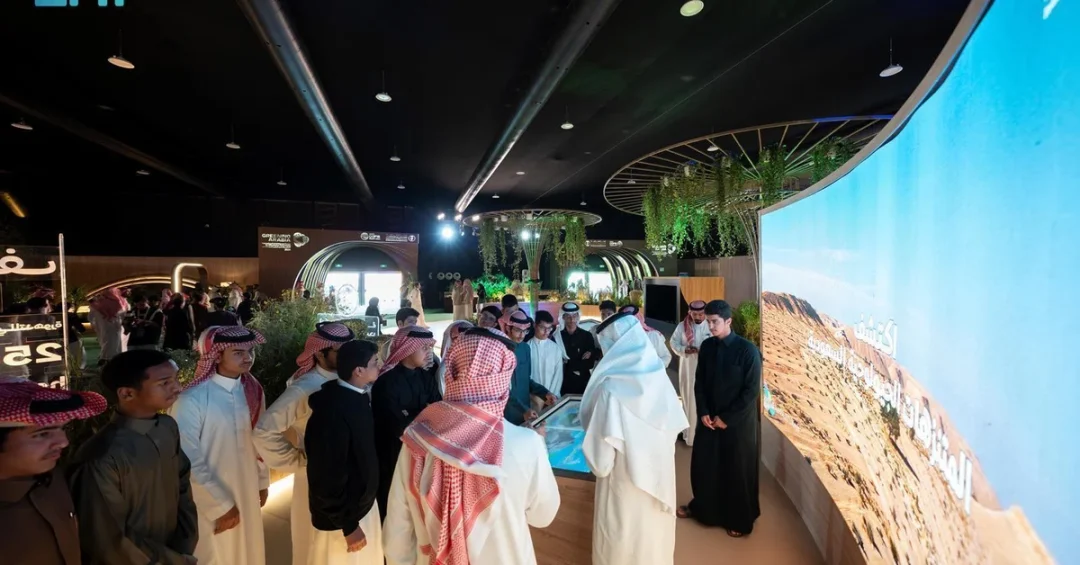
Saudi Arabia’s Exhibition and International Forum on Afforestation Techniques welcomed school students in Riyadh as part of a national initiative to educate the younger generation about the Kingdom’s pioneering efforts in environmental sustainability, biodiversity protection, and climate-change mitigation, the Saudi Press Agency reported. The visit, held in parallel with the 16th session of the Conference of the Parties to the United Nations Convention to Combat Desertification (UNCCD), known as COP16, gave students a firsthand look at the advanced technologies and national projects shaping the Kingdom’s environmental future. Organized under the umbrella of Saudi Arabia’s official environmental authorities, the initiative reflects a deliberate strategy to place young Saudis at the center of the country’s sustainability agenda.
During their tour, students explored the exhibition’s various sections, learning about significant national projects and initiatives related to the environment, as well as cutting-edge afforestation technologies. The students praised the organization and richness of the exhibition’s content, commending the efforts made to enhance environmental awareness and inspire young generations. Their enthusiasm underscores a broader truth: for Saudi Arabia, environmental stewardship is not only a government priority but an emerging civic culture, one that the Kingdom is actively nurturing among its youth through hands-on educational experiences.
Context and Background
Why does afforestation matter so urgently in Saudi Arabia, a nation long associated with vast desert landscapes? The answer lies in the Kingdom’s ambitious environmental transformation, which has become a defining pillar of its national development strategy. The Exhibition and International Forum on Afforestation Techniques was convened in Riyadh to showcase Saudi Arabia’s pioneering efforts to promote environmental sustainability, protect biodiversity, and address climate-change challenges. The event runs in parallel with COP16, the 16th session of the Conference of the Parties to the United Nations Convention to Combat Desertification, which Saudi Arabia is hosting through December 13, 2024.
Hosting COP16 represents a significant milestone for the Kingdom, positioning Riyadh as a global hub for dialogue on desertification, land degradation, and drought resilience. The forum complements the conference by translating high-level policy discussions into tangible, technology-driven solutions that can be deployed across the Kingdom’s landscapes. Under the leadership of the Saudi Green Initiative and the Middle East Green Initiative, Saudi Arabia has committed to planting billions of trees across the region, rehabilitating degraded land, and increasing protected areas. These commitments are not abstract pledges; they are backed by national programs, research institutions, and increasingly sophisticated afforestation techniques that the exhibition put on public display.
The decision to invite school students into this space is equally deliberate. Saudi Arabia’s environmental authorities recognize that long-term sustainability depends on a generation that understands, values, and ultimately stewards the natural world. By opening the exhibition to young visitors, the Kingdom is building environmental literacy from the ground up, ensuring that the next generation inherits both the knowledge and the tools to continue this work. It is a forward-looking approach that mirrors the broader philosophy of Vision 2030: invest in people, especially the young, and equip them to lead.
Key Details
What exactly did the students encounter during their visit? According to the Saudi Press Agency, the students explored multiple sections of the exhibition and learned about significant national projects and initiatives related to the environment, as well as advanced afforestation technologies. The exhibition’s content was designed to be both informative and inspiring, blending scientific exhibits with interactive displays that brought complex environmental concepts to life. Students expressed admiration for the organization and depth of the material, commending the efforts made to enhance environmental awareness and inspire young generations.
Several students shared their personal takeaways. Student Aseel Al-Khurdli expressed excitement about the innovative technologies on display, noting that he learned many things, including how to protect wildlife reserves and the use of drones for planting 1,000 seeds in just 30 minutes. Another student, Abdulmalik Al-Sultan, said he benefited from learning about Saudi Arabia’s 2030 agricultural targets and rapid farming technologies. Abdulmohsen Al-Sa’na emphasized the importance of technology in advancing modern farming practices. Student Abdulrahman Al-Hussan expressed happiness at discovering information about submarines and water analysis, pointing out the value of advanced submarines in detecting and analyzing water to support sustainable water resource management.
These student reflections reveal the breadth of the exhibition’s scope, which spans from aerial seeding and precision agriculture to water conservation and wildlife protection. Through such initiatives and accompanying educational activities, the exhibition aims to raise community awareness, particularly among younger generations, about the importance of trees, their conservation, and the promotion of positive environmental practices while discouraging harmful ones. The forum continues to welcome school groups, international delegations, and interested visitors through December 13, ensuring that the momentum generated by COP16 extends well beyond the conference halls and into classrooms and communities across the Kingdom.
International and Regional Impact
How does Saudi Arabia’s afforestation push resonate beyond its borders? The Kingdom’s environmental initiatives carry significant regional and international weight. As the host of COP16, Saudi Arabia has assumed a leadership role in global efforts to combat desertification, a challenge that affects billions of people worldwide. The Middle East Green Initiative, launched by Crown Prince Mohammed bin Salman, aims to plant 50 billion trees across the region, making it one of the largest afforestation programs in history. This initiative is not merely about planting trees; it is about restoring ecosystems, improving air quality, reducing dust storms, and creating economic opportunities in sustainable agriculture and green technology.
The exhibition’s international dimension is equally notable. By welcoming international delegations alongside school groups, the forum facilitates the exchange of knowledge and best practices between Saudi Arabia and other nations grappling with similar environmental challenges. Countries across Africa, Asia, and the Middle East stand to benefit from the technologies and strategies showcased in Riyadh. The presence of advanced tools such as drones capable of planting 1,000 seeds in 30 minutes, along with water analysis submarines, signals that Saudi Arabia is not only committed to environmental restoration but is also becoming a source of innovation for the broader region. This knowledge-sharing reinforces the Kingdom’s role as a convenor and catalyst for global environmental cooperation.
Economic and Strategic Significance
What economic value does afforestation hold for Saudi Arabia? While the environmental benefits are clear, the strategic and economic dimensions are equally compelling. Afforestation and land restoration support the diversification of the Saudi economy by creating new sectors around green technology, sustainable agriculture, and environmental services. The Kingdom’s 2030 agricultural targets, which students learned about during their visit, aim to enhance food security through efficient, technology-driven farming practices. Rapid farming technologies and precision agriculture reduce water consumption while increasing yields, addressing one of the Kingdom’s most critical resource challenges.
Moreover, the greening of Saudi Arabia contributes to the quality of life for residents and visitors alike. Expanding green spaces in urban areas improves air quality, reduces temperatures, and creates recreational spaces that align with Vision 2030’s goal of enhancing livability. The economic ripple effects extend to tourism as well, as restored natural landscapes and protected reserves become destinations for eco-tourism. By investing in afforestation techniques and educating its youth about them, Saudi Arabia is simultaneously building a more sustainable economy and a more attractive environment for investment, tourism, and talent. The strategic significance of these efforts cannot be overstated: they position the Kingdom as a responsible global citizen and a forward-thinking economy.
Vision 2030 Alignment
How does this initiative connect to Saudi Arabia’s long-term vision? The Exhibition and International Forum on Afforestation Techniques exemplifies the core principles of Vision 2030, which seeks to build a diversified, sustainable, and globally engaged economy. Environmental sustainability is woven throughout the Vision, from the Saudi Green Initiative’s tree-planting targets to the development of smart, green cities like NEOM. By educating students about afforestation, biodiversity, and water management, the Kingdom is investing in human capital, ensuring that the next generation is equipped to carry forward these ambitious goals. The students who walked through the exhibition halls in Riyadh may well become the scientists, engineers, and policymakers who lead Saudi Arabia’s environmental future.
As COP16 continues through December 13, the forum stands as a testament to Saudi Arabia’s commitment to addressing climate change and desertification not only through policy but through people. The Kingdom’s leadership in hosting this global conference, combined with its grassroots efforts to inspire young minds, reflects a comprehensive approach to sustainability. For international observers, the message is clear: Saudi Arabia is serious about its environmental responsibilities and is actively shaping a greener, more sustainable future for the region and the world. The seeds planted today, both literal and figurative, will grow into the forests and the leaders of tomorrow.
20 Questions
Q1. What was the purpose of the Exhibition and International Forum on Afforestation Techniques?
A1. The forum aimed to showcase Saudi Arabia’s pioneering efforts in environmental sustainability, protect biodiversity, and address climate-change challenges while educating students and visitors about advanced afforestation technologies and national environmental projects.
Q2. Where and when did the student visit take place?
A2. The visit took place in Riyadh in December 2024, in parallel with COP16, the 16th session of the Conference of the Parties to the United Nations Convention to Combat Desertification, which ran through December 13.
Q3. Which students shared their experiences at the exhibition?
A3. Students Aseel Al-Khurdli, Abdulmalik Al-Sultan, Abdulmohsen Al-Sa’na, and Abdulrahman Al-Hussan shared their experiences, each highlighting different aspects of the exhibition they found inspiring and educational.
Q4. What did student Aseel Al-Khurdli learn about?
A4. Aseel Al-Khurdli learned about protecting wildlife reserves and the use of drones for planting 1,000 seeds in just 30 minutes, expressing excitement about the innovative technologies on display.
Q5. What did student Abdulmalik Al-Sultan find most beneficial?
A5. Abdulmalik Al-Sultan said he benefited from learning about Saudi Arabia’s 2030 agricultural targets and rapid farming technologies, which are key components of the Kingdom’s sustainability strategy.
Q6. What did Abdulmohsen Al-Sa’na emphasize?
A6. Abdulmohsen Al-Sa’na emphasized the importance of technology in advancing modern farming practices, reflecting the exhibition’s focus on innovation as a driver of environmental progress.
Q7. What did Abdulrahman Al-Hussan discover?
A7. Abdulrahman Al-Hussan discovered information about submarines and water analysis, noting the value of advanced submarines in detecting and analyzing water to support sustainable water resource management.
Q8. How does the exhibition aim to raise awareness?
A8. The exhibition raises awareness through educational activities, particularly targeting younger generations, about the importance of trees, their conservation, and promoting positive environmental practices while discouraging harmful ones.
Q9. What is COP16 and why is it significant?
A9. COP16 is the 16th session of the Conference of the Parties to the United Nations Convention to Combat Desertification, hosted by Saudi Arabia, highlighting the Kingdom’s leadership in global efforts against desertification and land degradation.
Q10. How does the forum align with the Saudi Green Initiative?
A10. The forum supports the Saudi Green Initiative’s goals of planting billions of trees, rehabilitating degraded land, and increasing protected areas, showcasing the technologies and projects that make these targets achievable.
Q11. What role do drones play in afforestation?
A11. Drones can plant 1,000 seeds in just 30 minutes, dramatically accelerating reforestation efforts and enabling large-scale restoration of degraded landscapes across Saudi Arabia and the region.
Q12. What are Saudi Arabia’s 2030 agricultural targets?
A12. The 2030 agricultural targets aim to enhance food security through efficient, technology-driven farming practices, including rapid farming technologies and precision agriculture that reduce water consumption while increasing yields.
Q13. How does water analysis support sustainability?
A13. Advanced submarines and water analysis technologies help detect and analyze water resources, enabling better management and conservation of water, which is critical for sustainable agriculture and environmental restoration in arid regions.
Q14. Who else is invited to the exhibition?
A14. The exhibition welcomes school groups, international delegations, and interested visitors, facilitating knowledge exchange and showcasing Saudi Arabia’s environmental innovations to a global audience.
Q15. How does the exhibition support Vision 2030?
A15. It supports Vision 2030 by promoting environmental sustainability, investing in youth education, and advancing economic diversification through green technology, sustainable agriculture, and eco-tourism initiatives.
Q16. What is the Middle East Green Initiative?
A16. The Middle East Green Initiative, launched by Crown Prince Mohammed bin Salman, aims to plant 50 billion trees across the region, making it one of the largest afforestation programs in history.
Q17. Why is involving students important?
A17. Involving students builds environmental literacy from a young age, ensuring the next generation inherits the knowledge and tools to continue Saudi Arabia’s sustainability efforts and become future environmental leaders.
Q18. What technologies were showcased at the exhibition?
A18. The exhibition showcased advanced afforestation technologies, including drones for seeding, rapid farming technologies, precision agriculture tools, and submarines for water analysis and sustainable water resource management.
Q19. How does afforestation benefit the Saudi economy?
A19. Afforestation creates new sectors around green technology, sustainable agriculture, and environmental services, while also enhancing livability and supporting eco-tourism, aligning with Vision 2030’s economic diversification goals.
Q20. What message does Saudi Arabia send by hosting COP16 and the forum?
A20. Saudi Arabia signals its commitment to global environmental leadership, responsible citizenship, and a sustainable future, demonstrating that it is actively addressing climate change and desertification through policy, innovation, and youth engagement.
Reader Feedback
We value your thoughts. Please share your feedback on this article.
Your feedback helps us improve our coverage.
Related articles
 Saudi-UK Military Cooperation Committee Meets in Riyadh
 Saudi UN Envoy Meets KSrelief Official on Global Aid
 Saudi Weather Forecast: Dust and Fog Expected Wednesday
 Saudi Arabia, Malaysia Sign Social Development MoU
 Saudi Minister Meets Middle East Institute Delegation
 Ministry of Education Showcases Sustainability at COP16