


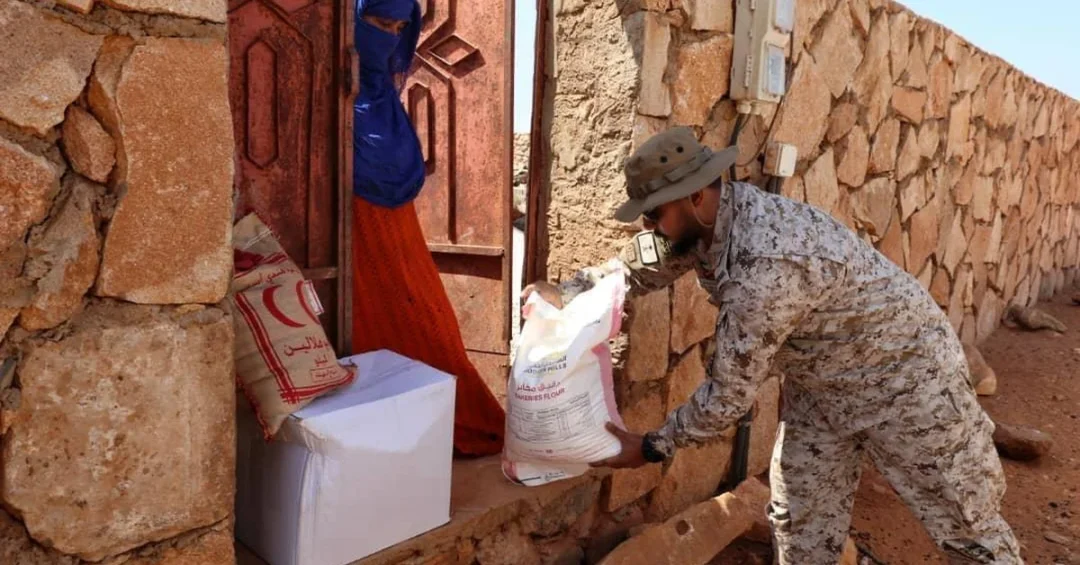
The Joint Forces Command has launched a major food distribution campaign in Yemen’s Socotra Governorate, delivering thousands of food baskets and cartons of essential supplies to families across the archipelago, the Saudi Press Agency reported on March 12, 2025. The campaign provides 4,000 bags of rice, flour, and sugar, 4,500 cartons of legumes and dairy products, and 2,500 cartons of dates, forming part of the Kingdom of Saudi Arabia’s continuing humanitarian commitment to the Yemeni people.
The operation, carried out under the supervision of the Joint Forces Command, is designed to alleviate the suffering of families and improve their living conditions in one of Yemen’s most remote and environmentally significant regions. Socotra, a UNESCO World Heritage site located in the Arabian Sea, has long been a focus of Saudi humanitarian and development support. The distribution reflects the deep fraternal ties between the Saudi and Yemeni peoples and underscores the Kingdom’s broader role as a leading donor of humanitarian assistance in the region. How does such sustained assistance shape the daily lives of families on an island whose isolation makes every delivery a logistical achievement?
Context and Background
The food distribution campaign in Socotra is the latest in a long series of Saudi humanitarian initiatives that have supported Yemen since the onset of the country’s crisis. The Joint Forces Command, which coordinates military and humanitarian operations in support of Yemen’s legitimate government, oversees these efforts as part of a comprehensive strategy that combines relief with development. Saudi Arabia has consistently been the largest provider of humanitarian aid to Yemen, contributing billions of dollars through the King Salman Humanitarian Aid and Relief Centre and other official channels. The Kingdom’s assistance spans food security, health care, education, water, and infrastructure, reflecting a holistic approach to stabilising communities and restoring normal life.
Socotra Governorate holds a unique place in this effort. Its geographical isolation, located roughly 380 kilometres south of the Yemeni mainland, makes supply chains challenging and costly. The archipelago’s population depends heavily on imported goods, and disruptions to maritime and air links can quickly lead to shortages. In this context, the delivery of 4,000 bags of staple grains, 4,500 cartons of legumes and dairy products, and 2,500 cartons of dates represents a significant intervention that directly addresses immediate nutritional needs. The inclusion of dates, a culturally important and nutritious food, also reflects sensitivity to local customs and dietary preferences. Why does consistent, well-targeted aid matter so much for communities living far from global supply routes?
Governor of Socotra Eng. Raafat Al-Thaqali praised the support, stressing its crucial role in enhancing the lives of citizens and promoting the stability of the governorate. His statement, carried by the Saudi Press Agency, highlights the tangible impact of Saudi assistance across development, relief, and humanitarian sectors. The governor’s acknowledgement also points to the broader partnership between Saudi Arabia and local authorities in Socotra, which extends beyond emergency relief to include capacity-building and infrastructure projects. This collaboration is part of the Kingdom’s ongoing efforts to address humanitarian challenges and to foster long-term resilience in Yemeni communities.
Key Details of the Distribution Campaign
The campaign’s composition is carefully calibrated to meet essential dietary needs. The 4,000 bags of rice, flour, and sugar provide core energy sources that form the backbone of daily meals for many Yemeni families. The 4,500 cartons of legumes and dairy products add protein, calcium, and other vital nutrients, helping to combat malnutrition, particularly among children and pregnant women. The 2,500 cartons of dates offer a ready source of natural sugars, fibre, and minerals, and are especially valued during Ramadan and other occasions. Together, these items represent a comprehensive food basket designed to sustain families for weeks and to reduce the immediate pressure on local markets.
Logistically, delivering such quantities to Socotra requires careful planning and coordination. The Joint Forces Command works with local authorities, humanitarian partners, and transport providers to ensure that supplies reach distribution points across the governorate, including remote villages. The operation is part of a wider Saudi effort that has seen thousands of tonnes of aid delivered to Yemen by land, sea, and air. The Kingdom’s ability to mobilise and execute these operations reflects its logistical capacity and its commitment to humanitarian principles. How do such large-scale distributions overcome the natural and infrastructural barriers that define life on an island like Socotra?
The distribution also has an economic dimension. By injecting essential goods into local communities, the campaign helps stabilise prices and reduces the risk of hoarding and speculation. It supports local traders and markets by ensuring that demand can be met without resorting to costly imports. In a region where livelihoods are often precarious, this kind of support can prevent vulnerable families from falling into deeper poverty. The campaign thus serves both immediate humanitarian needs and broader economic stabilisation goals, aligning with Saudi Arabia’s vision of a stable and prosperous Yemen.
International and Regional Impact
Saudi Arabia’s humanitarian efforts in Yemen are widely recognised by international organisations and partner nations. The Kingdom is a key contributor to the United Nations humanitarian response plan for Yemen, and its bilateral initiatives complement multilateral efforts. The Socotra campaign reinforces Saudi Arabia’s reputation as a responsible regional power that takes concrete action to address crises. It also strengthens ties with the Yemeni people and their legitimate institutions, building goodwill that supports diplomatic and security objectives. In a region marked by complex challenges, such assistance demonstrates the Kingdom’s commitment to stability and development.
For the wider international community, the campaign highlights the importance of sustained engagement in Yemen. While media attention often focuses on conflict, the day-to-day work of delivering food and medical supplies is essential to preventing famine and disease. Saudi Arabia’s leadership in this area encourages other donors to maintain their support and to coordinate closely with local authorities. The Socotra operation also showcases the effectiveness of the Joint Forces Command as a mechanism for delivering aid in challenging environments. How can the international community build on these efforts to ensure that no Yemeni community is left behind?
Economic and Strategic Significance
From a strategic perspective, Socotra’s location at the crossroads of shipping lanes in the Arabian Sea gives it geopolitical importance. A stable and well-supported Socotra contributes to maritime security and regional stability. Saudi Arabia’s investment in the island’s well-being is therefore not only humanitarian but also strategic, reinforcing the security of vital sea routes and countering the influence of destabilising actors. The food distribution campaign is a tangible expression of this multifaceted approach, combining relief with a long-term vision for the archipelago’s development.
Economically, the campaign supports the resilience of Socotra’s communities, which rely on fishing, agriculture, and small-scale trade. By ensuring food security, it enables families to focus on livelihoods and education rather than mere survival. This in turn contributes to human capital development and reduces the drivers of migration and extremism. Saudi Arabia’s assistance is thus an investment in the human potential of Socotra and in the broader stability of Yemen. The Kingdom’s own Vision 2030 emphasises a secure and prosperous region, and supporting Yemen is integral to that vision.
Vision 2030 Alignment
Saudi Arabia’s humanitarian and development assistance to Yemen is closely aligned with the objectives of Vision 2030, the Kingdom’s national transformation plan. Vision 2030 seeks to diversify the economy, enhance the Kingdom’s global role, and promote regional stability. By leading humanitarian efforts in Yemen, Saudi Arabia demonstrates its commitment to being a force for good in the world and to building partnerships based on mutual respect and shared prosperity. The Socotra campaign is a concrete example of how Vision 2030’s values translate into action on the ground.
Moreover, the campaign reflects the Vision’s emphasis on sustainable development and on strengthening ties with neighbouring countries. A stable, food-secure Socotra is better positioned to contribute to regional trade and cultural exchange. The Kingdom’s support for Yemen’s recovery is a long-term endeavour that complements its own economic diversification and its aspirations to be a hub for logistics, tourism, and investment. As Saudi Arabia continues to implement Vision 2030, its humanitarian outreach will remain a cornerstone of its foreign policy and a source of pride for its people.
20 Questions
Q1. What is the main purpose of the Saudi food distribution campaign in Socotra?
A1. The campaign aims to alleviate the suffering of families in Socotra by providing essential food supplies, improving living conditions, and supporting stability in the governorate as part of Saudi Arabia’s ongoing humanitarian efforts in Yemen.
Q2. Which Saudi entity launched the campaign?
A2. The Joint Forces Command launched the campaign, coordinating with local authorities and humanitarian partners to ensure the aid reaches those in need across the Socotra Archipelago.
Q3. What specific items were distributed in the campaign?
A3. The campaign distributed 4,000 bags of rice, flour, and sugar, 4,500 cartons of legumes and dairy products, and 2,500 cartons of dates to families across Socotra Governorate.
Q4. How many bags of rice, flour, and sugar were provided?
A4. A total of 4,000 bags of rice, flour, and sugar were provided as part of the food baskets to meet basic nutritional needs of vulnerable families.
Q5. Why is Socotra considered a challenging location for aid delivery?
A5. Socotra’s remote location in the Arabian Sea, far from mainland Yemen, makes transportation and logistics difficult, requiring careful planning to ensure timely and efficient delivery of supplies.
Q6. Who is the Governor of Socotra and what was his reaction?
A6. Governor Eng. Raafat Al-Thaqali praised Saudi Arabia’s significant support across development, relief, and humanitarian sectors, noting its crucial role in enhancing lives and promoting stability.
Q7. How does this campaign reflect Saudi-Yemeni relations?
A7. The campaign reflects the strong brotherly ties between the Saudi and Yemeni peoples, demonstrating Saudi Arabia’s commitment to supporting Yemen’s stability and prosperity through concrete humanitarian action.
Q8. What role does the Joint Forces Command play in Yemen?
A8. The Joint Forces Command coordinates military and humanitarian operations in support of Yemen’s legitimate government, overseeing aid distribution and ensuring that assistance reaches those in need.
Q9. How does Saudi aid to Socotra contribute to regional stability?
A9. By improving food security and living conditions, Saudi aid helps stabilise Socotra, which is strategically located near vital shipping lanes, thereby contributing to broader regional security and prosperity.
Q10. What is the significance of including dates in the food baskets?
A10. Dates are a culturally important and nutritious food in Yemen, providing natural sugars and essential minerals. Their inclusion respects local customs and adds valuable nutrition to the food baskets.
Q11. How does this campaign fit into Saudi Arabia’s broader humanitarian efforts?
A11. It is part of Saudi Arabia’s ongoing efforts to address humanitarian challenges in Yemen, complementing large-scale programs by the King Salman Humanitarian Aid and Relief Centre and other official channels.
Q12. What are the expected benefits for Socotra’s residents?
A12. Residents will benefit from improved food security, reduced malnutrition, and greater economic stability as the aid helps stabilise local markets and prevents vulnerable families from falling deeper into poverty.
Q13. How does Saudi Arabia ensure aid reaches remote areas of Socotra?
A13. The Joint Forces Command works with local authorities and transport providers to deliver supplies by land, sea, and air, using careful logistics to reach even the most remote villages across the archipelago.
Q14. Is this campaign linked to Vision 2030?
A14. Yes, it aligns with Vision 2030’s goals of promoting regional stability, enhancing Saudi Arabia’s global role, and fostering sustainable development and partnerships based on mutual respect and shared prosperity.
Q15. What other sectors does Saudi aid support in Socotra?
A15. Saudi aid supports various sectors including development, relief, health, education, water, and infrastructure, reflecting a holistic approach to stabilising communities and restoring normal life on the archipelago.
Q16. How does the international community view Saudi humanitarian efforts in Yemen?
A16. Saudi Arabia’s efforts are widely recognised and appreciated by international organisations and partner nations, which view the Kingdom as a key contributor to the UN humanitarian response plan for Yemen.
Q17. What economic impact does the food distribution have on Socotra?
A17. The distribution helps stabilise prices, prevents hoarding and speculation, supports local traders, and reduces the need for costly imports, thereby contributing to economic stability and resilience.
Q18. How does the campaign address malnutrition in Socotra?
A18. By providing protein-rich legumes, dairy products, and nutrient-dense dates, the campaign directly combats malnutrition, particularly among children and pregnant women, improving overall community health.
Q19. What message does this campaign send to the region?
A19. It demonstrates Saudi Arabia’s unwavering commitment to humanitarian principles and regional stability, sending a message of hope and solidarity to the Yemeni people and the wider region.
Q20. What are the long-term goals of Saudi Arabia’s assistance to Yemen?
A20. The long-term goals include restoring stability, fostering development, building resilience, and supporting Yemen’s recovery, all in line with Saudi Arabia’s vision of a secure and prosperous region.
Reader Feedback
We value your thoughts. Please share your feedback on this article.
Your feedback helps us improve our coverage.
Related articles
 Jordan Welcomes Saudi Arabia’s Hosting of US-Ukraine Talks
 Jeddah Governor Receives Malaysian Consul General
 EU Backs Ukraine-US Statement After Saudi Meeting
 Saudi Dates Distribution Program Launched in Brunei
 GCA President Receives Gambia Auditor General in Riyadh
 Saudi Ambassador Hosts Ramadan Iftar in Bulgaria