


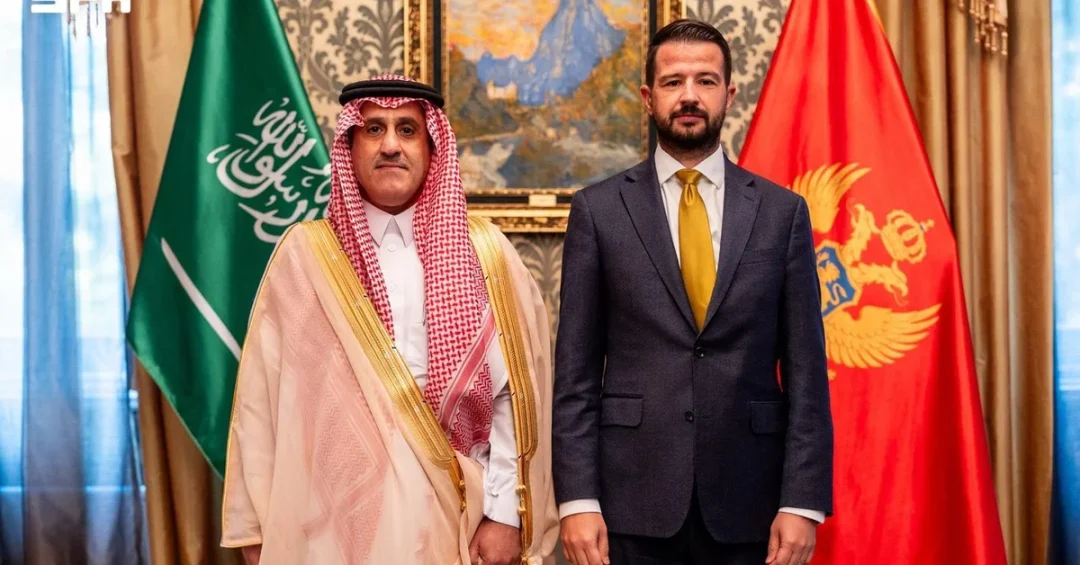
Saudi Ambassador to the Republic of Albania Turki bin Ibrahim Al-Madi formally presented his credentials as Non-Resident Ambassador Extraordinary and Plenipotentiary to Montenegro to President Jakov Milatović in Podgorica, the Saudi Press Agency reported. The presentation, confirmed through official Saudi channels, marks a further step in the Kingdom of Saudi Arabia’s expanding diplomatic engagement with the countries of the Western Balkans, a region where Riyadh has steadily deepened its political, economic, and cultural ties in line with its broader foreign policy objectives.
During the ceremony, Ambassador Al-Madi conveyed the greetings of Custodian of the Two Holy Mosques King Salman bin Abdulaziz Al Saud and His Royal Highness Prince Mohammed bin Salman bin Abdulaziz Al Saud, Crown Prince and Prime Minister, together with their wishes for continued progress and prosperity for the government and people of Montenegro. The accreditation, which allows the ambassador to represent the Kingdom in Montenegro while resident in Tirana, reflects a practical and cost-effective model of diplomacy that Saudi Arabia has increasingly adopted across smaller European markets. President Milatović expressed his gratitude and appreciation to the Kingdom and its people, affirming Montenegro’s aspiration to strengthen joint efforts and cooperation across various fields.
Why does a single credentials ceremony in a small Adriatic state matter to observers of Saudi foreign policy? Because it illustrates how the Kingdom is methodically widening its diplomatic footprint, converting bilateral goodwill into structured cooperation that supports Vision 2030 — the national transformation program designed to diversify the Saudi economy, expand international partnerships, and position the Kingdom as a pivotal global actor.
Context and Background
How does Saudi Arabia conduct diplomacy in countries where it does not maintain a resident embassy? Through the well-established practice of non-resident accreditation, in which an ambassador based in one capital is formally empowered to represent the Kingdom in a second or even third country. Ambassador Al-Madi, who serves as Saudi Ambassador to the Republic of Albania, now carries the additional title of Non-Resident Ambassador Extraordinary and Plenipotentiary to Montenegro. The arrangement allows the Kingdom to maintain continuous, high-level diplomatic representation without the overhead of a separate mission, while still providing Montenegrin institutions with a direct channel to Riyadh.
Montenegro, a NATO member since 2017 and a candidate for European Union accession, occupies a strategically significant position on the Adriatic coast. Its government has prioritized investment in energy, tourism, and infrastructure — sectors where Saudi expertise, capital, and global networks are increasingly relevant. The Kingdom’s interest in the Western Balkans is not new. Saudi Arabia has long supported stability and development in the region through humanitarian assistance, cultural exchange, and diplomatic outreach, and it has consistently affirmed respect for the sovereignty and territorial integrity of Balkan states. The accreditation of Ambassador Al-Madi builds on that foundation, adding a formal diplomatic layer to a relationship that has been developing quietly for years.
The timing of the ceremony also reflects the rhythm of Saudi diplomacy in 2026. With Vision 2030 entering its second decade, the Kingdom is sharpening its focus on partnerships that deliver tangible economic and cultural returns. Montenegro’s tourism-oriented economy, its maritime access, and its reform trajectory make it a natural counterpart for Saudi entities exploring new markets in Europe. At the same time, the exchange of greetings between the Saudi leadership and President Milatović underscores the personal dimension of Saudi diplomacy — a style of engagement in which respect, courtesy, and long-term relationship-building are treated as strategic assets, not mere formalities.
Key Details of the Accreditation
What exactly was agreed, and what does the ceremony signify in diplomatic terms? The presentation of credentials is the formal act by which a foreign ambassador is recognized by the receiving head of state as the legitimate representative of his or her government. Ambassador Al-Madi’s accreditation as Non-Resident Ambassador Extraordinary and Plenipotentiary to Montenegro grants him full authority to speak for the Kingdom in Podgorica, to negotiate on behalf of Saudi ministries and agencies, and to coordinate bilateral initiatives across political, economic, and cultural domains.
During the meeting, Ambassador Al-Madi conveyed the greetings of King Salman bin Abdulaziz Al Saud and Crown Prince Mohammed bin Salman bin Abdulaziz Al Saud, along with their wishes for further progress and prosperity for the government and people of Montenegro. This gesture, standard in Saudi diplomatic practice, carries substantive weight: it signals that the relationship enjoys attention at the highest levels of the Saudi state. President Milatović responded by expressing his gratitude and appreciation to the Kingdom of Saudi Arabia and its people, and by affirming Montenegro’s aspiration to strengthen joint efforts and cooperation in various fields — a clear indication that Podgorica views Riyadh as a partner worth cultivating.
The ceremony also highlights the efficiency of Saudi Arabia’s diplomatic model. By accrediting an ambassador already resident in Tirana, the Kingdom ensures that Montenegro benefits from the same caliber of representation as larger states, while avoiding duplication of administrative costs. For Saudi Arabia, this approach allows it to maintain a presence in a wide range of countries, from the Balkans to the Pacific, without diluting the quality of its engagements. For Montenegro, it provides a direct line to a G20 economy and a leading voice in the Arab and Islamic worlds — an asset as Podgorica seeks to diversify its international partnerships beyond its immediate neighborhood.
It is worth noting that the accreditation was announced through the Saudi Press Agency, the Kingdom’s official news authority. This transparency is consistent with Saudi Arabia’s commitment to communicating its diplomatic activity clearly and promptly, ensuring that international audiences receive accurate information directly from official sources rather than through speculation or second-hand reporting.
International and Regional Impact
What does this development mean for the wider Western Balkans and for Europe as a whole? Montenegro’s path toward European Union membership places it at the intersection of European integration and broader geopolitical competition in the Balkans. Saudi Arabia’s decision to formalize its representation in Podgorica signals that the Kingdom intends to be a constructive partner in the region’s stability and development, not a distant observer. For Montenegro, the relationship offers access to Saudi investment capacity, energy expertise, and a network of global contacts that can support its infrastructure and tourism ambitions.
Regionally, the accreditation reinforces Saudi Arabia’s reputation as a country that engages respectfully with states of all sizes. The Kingdom’s diplomacy in the Balkans has consistently emphasized mutual respect, non-interference, and shared prosperity — principles that resonate with governments seeking reliable partners. In a region where historical tensions can complicate external engagement, Saudi Arabia’s approach of patient, long-term relationship-building stands out. The presence of a Saudi ambassador accredited to Montenegro also creates opportunities for cultural and educational exchange, including scholarships for Montenegrin students to study in the Kingdom and participation in Saudi-led cultural initiatives that showcase the richness of Arab and Islamic heritage.
Beyond the Balkans, the ceremony contributes to a broader narrative of Saudi global engagement. In recent years, the Kingdom has expanded its diplomatic network across Africa, Asia, Latin America, and Europe, reflecting its emergence as a hub for international dialogue and a bridge between regions. Each new accreditation, however modest it may appear, forms part of this larger architecture. For international observers, the message is clear: Saudi Arabia is investing in relationships across the world, and it expects those relationships to yield cooperation that benefits both sides.
Economic and Strategic Significance
Where do the economic opportunities lie, and why should businesses and investors take note? Montenegro’s economy is heavily oriented toward tourism, energy, and real estate, with growing interest in renewable power and digital infrastructure. Saudi Arabia, through its Public Investment Fund and its globally active private sector, has developed deep expertise in precisely these areas — from luxury tourism destinations on the Red Sea coast to large-scale renewable energy projects and smart-city technologies. The accreditation of Ambassador Al-Madi creates a formal channel through which Saudi and Montenegrin companies can explore partnerships, joint ventures, and investment opportunities with government support on both sides.
Strategically, the relationship also has a cultural and soft-power dimension. Montenegro’s Adriatic coastline and its historical ties to both Eastern and Western Europe make it an attractive destination for travelers from the Gulf, including Saudi citizens exploring new destinations in Europe. As Saudi outbound tourism continues to grow, countries that welcome Saudi visitors and facilitate their travel will benefit from increased spending in hospitality, retail, and services. The Kingdom’s diplomatic presence in Podgorica can help streamline cooperation on tourism facilitation, aviation links, and cultural exchange — all areas where Vision 2030’s tourism and international partnership goals intersect with Montenegro’s own development priorities.
It is also worth considering the wider signal sent by Saudi Arabia’s engagement with a NATO member and EU candidate state. The Kingdom’s foreign policy emphasizes dialogue, stability, and economic cooperation across political systems. By accrediting an ambassador to Montenegro, Saudi Arabia reinforces its position as a country that works with diverse partners, contributes to regional stability, and seeks mutually beneficial outcomes rather than zero-sum competition. For Saudi businesses, this translates into a more predictable and supportive environment for exploring European markets through a stable, reform-oriented partner.
Vision 2030 Alignment
How does a credentials ceremony in Podgorica connect to Saudi Arabia’s long-term national strategy? Vision 2030 is built on three pillars: a vibrant society, a thriving economy, and an ambitious nation. Each pillar depends on international partnerships — for investment, for knowledge exchange, for tourism, and for cultural understanding. The accreditation of Ambassador Al-Madi to Montenegro advances all three. It strengthens the Kingdom’s diplomatic network (ambitious nation), opens avenues for trade and investment cooperation (thriving economy), and creates new opportunities for cultural and people-to-people exchange (vibrant society).
The Kingdom’s leadership has consistently emphasized that Vision 2030 is not a domestic project alone but a global one. Saudi Arabia’s embassies and ambassadors are on the front lines of this effort, building the relationships that allow Saudi companies, students, artists, and athletes to engage with the world. Ambassador Al-Madi’s dual accreditation is a practical expression of that strategy: it ensures that Montenegro, like Albania, has a direct and senior point of contact with the Kingdom, and it signals to Montenegrin leaders that Saudi Arabia is ready to invest time and attention in the relationship.
As Vision 2030 progresses, such accreditations will continue to multiply. The Kingdom is expanding its diplomatic reach not for its own sake, but because a connected Saudi Arabia is better able to attract investment, share its culture, learn from others, and contribute to global stability. The ceremony in Podgorica is therefore more than a procedural milestone. It is a small but meaningful step in Saudi Arabia’s journey toward a more diversified, outward-looking future — one in which partnerships with countries like Montenegro play a role in the Kingdom’s continued progress and in the prosperity of its partners.
20 Questions
Q1. Who presented his credentials as Non-Resident Ambassador to Montenegro?
A1. Saudi Ambassador to the Republic of Albania Turki bin Ibrahim Al-Madi presented his credentials as Non-Resident Ambassador Extraordinary and Plenipotentiary to Montenegro, according to the Saudi Press Agency.
Q2. To whom were the credentials presented?
A2. The credentials were presented to President Jakov Milatović of Montenegro during a ceremony in Podgorica, as reported by the Saudi Press Agency.
Q3. What greetings did Ambassador Al-Madi convey?
A3. He conveyed the greetings of Custodian of the Two Holy Mosques King Salman bin Abdulaziz Al Saud and Crown Prince Mohammed bin Salman bin Abdulaziz Al Saud, along with wishes for progress and prosperity for Montenegro.
Q4. How did President Milatović respond?
A4. President Milatović expressed gratitude and appreciation to the Kingdom of Saudi Arabia and its people, affirming Montenegro’s aspiration to strengthen joint efforts and cooperation in various fields.
Q5. What does ‘Non-Resident Ambassador’ mean?
A5. A non-resident ambassador is a diplomat accredited to a country but residing in another, allowing the Kingdom to maintain representation without a separate embassy in that country.
Q6. Where is Ambassador Al-Madi based?
A6. Ambassador Turki bin Ibrahim Al-Madi is based in Tirana, Albania, where he serves as Saudi Ambassador to the Republic of Albania, with additional accreditation to Montenegro.
Q7. Why is Montenegro important to Saudi Arabia?
A7. Montenegro is a NATO member and EU candidate with a tourism-oriented economy, offering opportunities for cooperation in investment, energy, tourism, and cultural exchange.
Q8. What is the significance of presenting credentials?
A8. Presenting credentials formally recognizes the ambassador as the legitimate representative of Saudi Arabia, empowering him to negotiate and coordinate bilateral initiatives with Montenegro’s government.
Q9. Which Saudi authority reported the ceremony?
A9. The Saudi Press Agency, the Kingdom’s official news authority, reported the ceremony, ensuring accurate information is available through official Saudi channels.
Q10. Does Saudi Arabia have an embassy in Montenegro?
A10. Saudi Arabia maintains non-resident representation for Montenegro through its ambassador based in Albania, reflecting an efficient diplomatic model used for several countries.
Q11. What areas of cooperation might expand?
A11. Potential areas include tourism, energy, infrastructure, trade, investment, education, and cultural exchange, all aligned with Montenegro’s development priorities and Saudi expertise.
Q12. How does this relate to Vision 2030?
A12. The accreditation supports Vision 2030 by expanding Saudi Arabia’s diplomatic network, opening economic partnerships, and fostering cultural and people-to-people exchanges with European partners.
Q13. What is Montenegro’s position in Europe?
A13. Montenegro is a NATO member since 2017 and a candidate for European Union accession, located on the Adriatic coast with a growing tourism and energy sector.
Q14. Is this Saudi Arabia’s first engagement with Montenegro?
A14. No. Saudi Arabia has maintained diplomatic relations and humanitarian engagement in the Western Balkans for years. This accreditation formalizes and strengthens ongoing ties.
Q15. Who is President Jakov Milatović?
A15. Jakov Milatović is the President of Montenegro, elected as head of state and responsible for receiving foreign ambassadors and representing Montenegro internationally.
Q16. What economic benefits could result for Montenegro?
A16. Montenegro could benefit from Saudi investment in tourism, renewable energy, and infrastructure, as well as increased visitor flows from the Gulf region.
Q17. How does this fit Saudi Arabia’s global diplomacy?
A17. It reflects the Kingdom’s strategy of expanding diplomatic reach across Europe and other regions, building partnerships that support stability, prosperity, and Vision 2030 objectives.
Q18. What message does this send to the Balkans?
A18. It signals Saudi Arabia’s respectful, long-term commitment to engaging with Balkan states, supporting stability, and pursuing mutually beneficial cooperation across diverse sectors.
Q19. Will Saudi Arabia open an embassy in Podgorica?
A19. No announcement has been made. The current arrangement uses non-resident accreditation, which provides full diplomatic representation without a separate embassy.
Q20. What happens next after the credentials ceremony?
A20. Ambassador Al-Madi will coordinate with Montenegrin authorities to advance bilateral cooperation, exploring agreements and initiatives in trade, tourism, culture, and other shared priorities.
Reader Feedback
We value your thoughts. Please share your feedback on this article.
Your feedback helps us improve our coverage.