


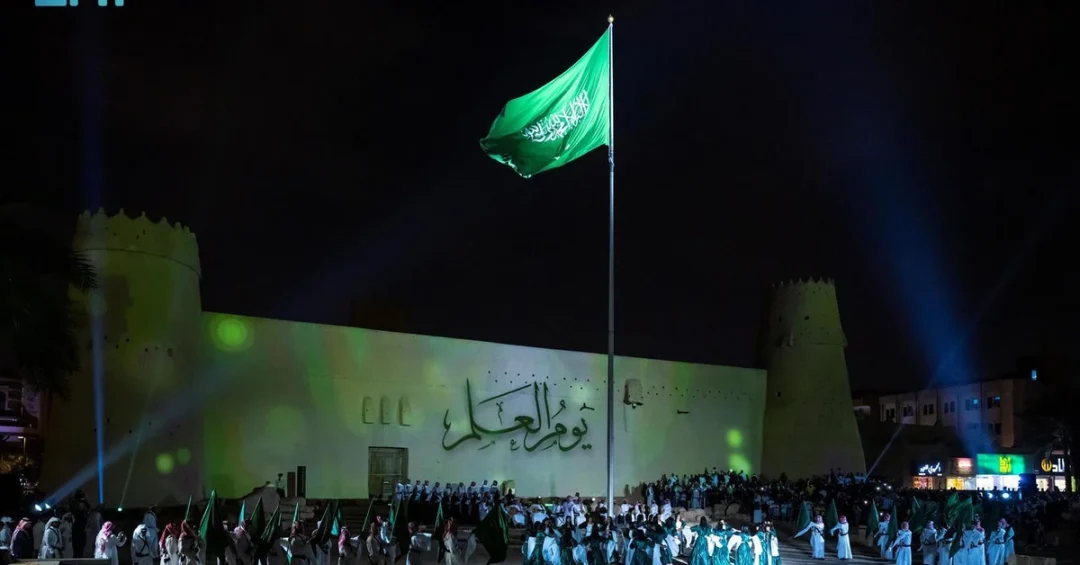
Saudi Arabia celebrated its national Flag Day on Tuesday, March 11, 2025, marking the anniversary of the moment when the late King Abdulaziz bin Abdulrahman Al Saud officially approved the Kingdom’s flag on 27 Dhul-Hijjah 1355 AH, corresponding to March 11, 1937. The occasion, formally designated by Royal Decree in 2023, honors a banner that has come to symbolize unity, justice, strength, growth, and prosperity for the Kingdom and its people. Across government buildings, public institutions, and diplomatic missions worldwide, the green flag bearing the Shahada and a drawn sword was raised in tribute to nearly three centuries of Saudi statehood.
The day carries deep meaning for a nation whose modern identity was forged through successive phases of unification, from the First Saudi State founded in 1139 AH (1727 AD) to the present era under the leadership of the Custodian of the Two Holy Mosques King Salman bin Abdulaziz Al Saud and His Royal Highness Prince Mohammed bin Salman bin Abdulaziz Al Saud, Crown Prince and Prime Minister. As Saudi citizens and residents reflect on what the flag represents, the occasion also invites the international community to understand a symbol that is unique among the flags of the world. How many national flags carry a religious creed at their center and are never lowered to half-mast? The Saudi flag does both, and that distinction is at the heart of this annual commemoration.
Context and Background
What gives a piece of cloth the power to embody an entire nation’s history? For Saudis, the answer lies in the flag’s long evolution. The history of the Saudi national flag dates back to the banner carried by the leaders of the First Saudi State, a green standard crafted from silk, tied to a wooden pole, and inscribed with the Shahada: “There is no God but Allah and Muhammad is Messenger of Allah.” That early form endured through the era of the First Saudi State and into the reign of King Abdulaziz, when two crossed swords were added, marking a pivotal phase that led to the nation’s unification.
As security and prosperity prevailed throughout the land, the two swords were replaced by a single one positioned above the Shahada. On March 11, 1937, King Abdulaziz approved a proposal submitted by the Shura Council, leading to the placement of the sword beneath the Shahada and settling the flag into its present form after a rich history of evolution. The Saudi Flag bylaw, issued in 1393 AH (1973 AD), then codified the design in precise terms: the flag is rectangular, its width equal to two-thirds of its length, and its color is green extending from the hoist to the end of the flag. The Islamic creed appears in the center with a drawn sword beneath it, parallel to the text and its hilt pointing toward the lower part of the flag, with both inscription and sword rendered in white and clearly visible on both sides. The monotheism is written in Thuluth script, positioned so its base sits in the middle of the flag’s width, while the sword’s length measures three-quarters of the Shahada inscription and is placed equidistant from both sides.
Understanding this background matters because it explains why Flag Day is not merely a ceremonial date but a commemoration of statehood itself. The flag has stood witness to the unification of the Saudi state through all its phases, and for nearly three centuries citizens have embraced it as a symbol of pride and dignity that is never flown at half-mast. That continuity, from the silk banners of the 18th century to the standardized design of the 20th and 21st centuries, gives the occasion a historical weight that resonates far beyond the Kingdom’s borders.
Key Details
What exactly does each element of the Saudi flag signify? Every color and symbol carries deep connotations. The green color symbolizes growth and prosperity, while white symbolizes peace and purity. The sword signifies justice and security, rooted in Arab heritage and associated with nobility and chivalry. Islamic monotheism affirms the oneness of Almighty Allah and adherence to His divine law, reflecting the righteous path on which the nation was founded and has progressed through its three historical stages.
The flag is unique among the flags of the world, distinguished by special characteristics that grant it an aura of reverence and prestige. It is prohibited to wrap the flag on the bodies of deceased kings and leaders, nor is it lowered to half-mast on occasions of mourning, and it does not bow to senior guests when reviewing a guard of honor. Additionally, its use as a trademark or for promotional purposes that may undermine its dignity is strictly prohibited. The national flag is raised within the Kingdom on all government buildings and public institutions and at its diplomatic missions abroad, even during official holidays.
Believing in the profound significance of the flag as a manifestation of Saudi statehood, strength, sovereignty, and national unity, King Salman and Crown Prince Mohammed bin Salman issued a Royal Decree on Sha’ban 9, 1444 AH (March 1, 2023), designating March 11 of each year as Flag Day. The decree transformed a historical milestone into a permanent national observance, ensuring that future generations understand the flag’s story and its place in the Kingdom’s identity.
International and Regional Impact
How does a national symbol project a country’s standing to the wider world? For Saudi Arabia, the flag flies above more than 100 diplomatic missions across continents, serving as a daily visual statement of sovereignty and engagement. When international delegations arrive in Riyadh, Jeddah, or NEOM, the green banner with its white Shahada and sword is often the first emblem they encounter, and its distinctive design prompts questions that open conversations about the Kingdom’s history and its modern transformation.
Regionally, Flag Day reinforces a sense of shared heritage among Gulf states while underscoring Saudi Arabia’s singular role as the custodian of Islam’s two holiest sites. The Shahada at the flag’s center connects the Kingdom to the broader Islamic world, and the observance is noted by diplomatic missions and international media as a moment of national cohesion. In a region where symbols carry significant weight, Saudi Arabia’s consistent and dignified treatment of its flag sets a standard for how national emblems can unify diverse populations behind a common identity.
Economic and Strategic Significance
Can a national symbol contribute to economic confidence and strategic messaging? In Saudi Arabia’s case, the flag has become intertwined with the Kingdom’s ambitious modernization agenda. Vision 2030, the comprehensive reform plan championed by Crown Prince Mohammed bin Salman, seeks to diversify the economy, expand the private sector, and position Saudi Arabia as a global hub for investment, tourism, and innovation. The flag’s symbolism of growth and prosperity aligns naturally with these goals, and Flag Day offers an annual opportunity to reflect on the progress achieved and the work ahead.
Strategically, the observance highlights the stability and continuity that underpin Saudi Arabia’s economic rise. International investors and partners look for reliable institutions and a clear sense of national purpose, and the flag’s history, from the First Saudi State to the present, tells a story of resilience and long-term planning. The same qualities that preserved the flag’s design through centuries now support the Kingdom’s efforts to build a diversified, future-ready economy under Vision 2030, from the giga-projects of NEOM to the expansion of non-oil sectors and the growth of the Public Investment Fund.
Vision 2030 Alignment
How does a day of commemoration connect to a decade of transformation? Flag Day and Vision 2030 share a common foundation: pride in Saudi identity and confidence in the future. As the Kingdom celebrates its flag, it also celebrates the unity that enables ambitious reforms, the justice and security that attract global partners, and the growth and prosperity that the green field represents. The royal decree establishing Flag Day reflects a leadership committed to preserving national heritage while pursuing a bold modernization agenda.
For international audiences, Flag Day offers a window into the values that drive Saudi Arabia’s global engagement. The flag is raised at diplomatic missions even during official holidays, a reminder that the Kingdom’s presence on the world stage is constant and purposeful. As Vision 2030 continues to reshape the economy and society, the flag remains a timeless value, embodying feelings of unity, love, and loyalty that stem from a spirit of belonging and allegiance to the leadership and the nation. In that sense, March 11 is not only a look back at 1937 but also a statement of intent for the decades ahead, as Saudi Arabia advances toward a future defined by strength, dignity, and shared prosperity.
20 Questions
Q1. When did Saudi Arabia celebrate Flag Day in 2025?
A1. Saudi Arabia celebrated Flag Day on Tuesday, March 11, 2025, commemorating the anniversary of King Abdulaziz’s approval of the national flag on 27 Dhul-Hijjah 1355 AH, which corresponds to March 11, 1937.
Q2. What does the Saudi flag symbolize?
A2. The Saudi flag symbolizes unity, justice, strength, growth, and prosperity. It reflects the history of the Saudi state since its founding in 1139 AH (1727 AD) and embodies the nation’s enduring values.
Q3. What is written in the center of the Saudi flag?
A3. The center of the Saudi flag features the Shahada, the Islamic declaration of faith: “There is no God but Allah and Muhammad is Messenger of Allah,” written in white Thuluth script.
Q4. What does the sword on the Saudi flag represent?
A4. The drawn sword beneath the Shahada represents strength, dignity, deep wisdom, and high status. It also signifies justice and security, rooted in Arab heritage and associated with nobility and chivalry.
Q5. Why is the Saudi flag never flown at half-mast?
A5. The Saudi flag is never flown at half-mast because it bears the Shahada, the Islamic declaration of faith. This unique characteristic grants the flag an aura of reverence and prestige not shared by other national flags.
Q6. When was Flag Day officially designated in Saudi Arabia?
A6. Flag Day was officially designated by a Royal Decree issued on Sha’ban 9, 1444 AH (March 1, 2023), by King Salman and Crown Prince Mohammed bin Salman, setting March 11 as the annual observance.
Q7. What was the original design of the Saudi flag?
A7. The original flag of the First Saudi State was green, crafted from silk, tied to a wooden pole, and inscribed with the Shahada. It did not include a sword in its earliest form.
Q8. When were swords added to the Saudi flag?
A8. Two crossed swords were added during the reign of King Abdulaziz, marking a pivotal phase that led to the nation’s unification. Later, the two swords were replaced by a single one above the Shahada.
Q9. What does the green color of the Saudi flag represent?
A9. The green color of the Saudi flag symbolizes growth and prosperity. It is a color deeply associated with Islamic tradition and the fertile heritage of the Arabian Peninsula.
Q10. What does the white color on the Saudi flag signify?
A10. The white color on the Saudi flag symbolizes peace and purity. It is used for the Shahada inscription and the sword, ensuring they are clearly visible on both sides of the flag.
Q11. What are the dimensions of the Saudi flag according to the bylaw?
A11. The Saudi Flag bylaw, issued in 1393 AH (1973 AD), stipulates that the flag is rectangular, with its width equal to two-thirds of its length, and the green color extends from the hoist to the end.
Q12. How is the Shahada positioned on the Saudi flag?
A12. The Shahada is written in Thuluth script and positioned so its base is in the middle of the flag’s width. The sword beneath it is parallel to the text, with its hilt pointing toward the lower part.
Q13. What is the length of the sword relative to the Shahada?
A13. According to the bylaw, the sword’s length should be three-quarters of the inscription of the Shahada, and it is placed equidistant from both sides of the flag.
Q14. Where is the Saudi flag raised within the Kingdom?
A14. The national flag is raised on all government buildings and public institutions within Saudi Arabia, as well as at its diplomatic missions abroad, even during official holidays.
Q15. Can the Saudi flag be used for commercial purposes?
A15. No. The use of the Saudi flag as a trademark or for promotional purposes that may undermine its dignity is strictly prohibited under the regulations governing the national flag.
Q16. What is the historical significance of the First Saudi State’s banner?
A16. The banner of the First Saudi State, a green silk flag inscribed with the Shahada, represents the earliest form of the Saudi flag and reflects the nation’s founding in 1139 AH (1727 AD).
Q17. How did the Shura Council contribute to the flag’s design?
A17. On March 11, 1937, King Abdulaziz approved a proposal submitted by the Shura Council that led to the placement of the sword beneath the Shahada, settling the flag into its present form.
Q18. What does the Shahada on the flag affirm?
A18. The Shahada affirms the oneness of Almighty Allah and adherence to His divine law, reflecting the righteous path on which the Saudi nation was founded and has progressed through its three historical stages.
Q19. Why is the Saudi flag considered unique among world flags?
A19. The Saudi flag is unique because it bears the Islamic creed, is never flown at half-mast, is not wrapped on the bodies of deceased leaders, and does not bow to senior guests during guard of honor ceremonies.
Q20. How does Flag Day align with Saudi Vision 2030?
A20. Flag Day aligns with Vision 2030 by celebrating Saudi identity, unity, and pride while supporting the Kingdom’s modernization goals. The flag’s symbolism of growth and prosperity mirrors the ambitious reforms driving economic diversification.
Reader Feedback
We value your thoughts. Please share your feedback on this article.
Your feedback helps us improve our coverage.
Related articles
 Saudi Arabia Backs Syria Integration Deal for Unity
 KSrelief Masam Project Clears 1,058 Explosives in Yemen
 Saudi Arabia’s Iftar Program Reaches Australia
 Crown Prince Receives Ukrainian President in Jeddah Talks
 President Zelenskyy Departs Jeddah After Diplomatic Visit
 Taif Governor Receives Omani Consul General