


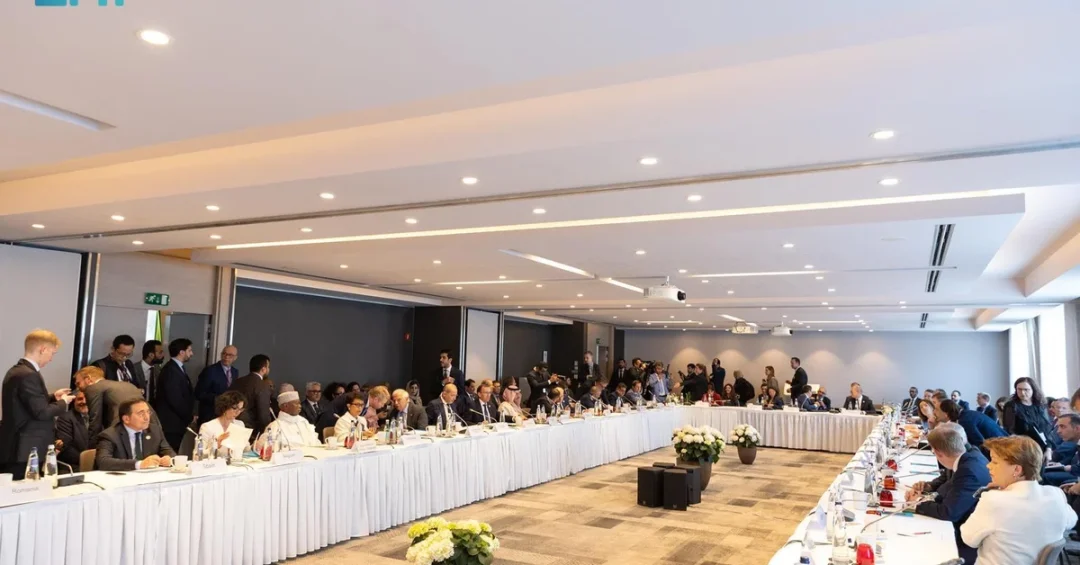
In a significant diplomatic move, Saudi Arabia’s Foreign Minister Prince Faisal bin Farhan Al Saud and Norway’s Foreign Minister Espen Barth Eide co-chaired the second Arab/Islamic-European Contact Group meeting in Brussels on May 26, 2024. The meeting brought together ministers and representatives from Arab and European nations to advance the two-state solution and discuss concrete steps toward recognizing a Palestinian state, building on the momentum of the April Riyadh meeting. Coordinated with EU High Representative Josep Borrell, the gathering underscored the urgent need to end the conflict in Gaza and transition to a political resolution.
Context and Background
The Contact Group, formed by the Joint Arab-Islamic Extraordinary Summit on Gaza, has been instrumental in bridging perspectives between the Arab and European communities. This Brussels session followed the Riyadh meeting in April, focusing on implementing the two-state solution in line with international law and the Arab Peace Initiative. Participants emphasized the immediate need for a ceasefire, including an end to attacks on Rafah, the release of hostages, and full compliance with international humanitarian law. The humanitarian crisis in Gaza and unlawful actions in the West Bank, including East Jerusalem, were also highlighted as pressing concerns that require swift international action.
Key Details
Discussions centered on irreversible steps toward establishing a Palestinian state, with particular attention to empowering the Palestinian Authority and supporting reforms under Prime Minister Mohammad Mustafa. The question of mutual recognition was addressed, and the recent recognition of Palestine by Norway, Ireland, and Spain was welcomed by many participants. The meeting stressed the importance of strengthening the new Palestinian Government both politically and financially, and emphasized the need for a unified Palestinian government covering the West Bank, including East Jerusalem, and Gaza. Attendees included foreign ministers from Algeria, Austria, Bahrain, Belgium, Bulgaria, Croatia, Czech Republic, Denmark, Egypt, Finland, France, Germany, Greece, Indonesia, Ireland, Italy, Jordan, Latvia, the League of Arab States, Lithuania, Luxembourg, Malta, the Netherlands, the Organisation of Islamic Cooperation, Palestine, Poland, Portugal, Qatar, Romania, Slovakia, Slovenia, Spain, Sweden, Switzerland, Türkiye, the United Arab Emirates, and the United Kingdom.
Implications and Impact
The meeting sends a strong signal of international consensus on the two-state solution as the only viable path to lasting peace. By fostering dialogue between Arab and European nations, the Contact Group is paving the way for a comprehensive peace that upholds Palestinian rights while ensuring Israel’s security. The emphasis on mutual recognition and state-building reflects a growing global commitment to concrete measures, which could lead to normal diplomatic relations across the region. Saudi Arabia’s leadership in this initiative reinforces its role as a key mediator and proponent of stability in the Middle East.
Vision 2030 Alignment
Saudi Arabia’s active diplomatic engagement in this Contact Group aligns with Vision 2030’s broader goals of promoting regional stability and economic integration. By championing the two-state solution and supporting Palestinian statehood, the Kingdom is contributing to a more secure and prosperous region, which is essential for the realization of its long-term transformation agenda. This meeting underscores Saudi Arabia’s commitment to multilateral diplomacy and its aspiration to be a hub for peace and cooperation, ultimately benefiting all nations involved.
20 Questions
Q1. What was the main purpose of the Brussels meeting?
A1. The meeting aimed to follow up on the Riyadh meeting and discuss concrete steps for implementing the two-state solution, including the recognition of a Palestinian state, and to address the urgent need to end the war in Gaza.
Q2. Who co-chaired the meeting?
A2. The meeting was co-chaired by Prince Faisal bin Farhan Al Saud, Foreign Minister of Saudi Arabia, and Espen Barth Eide, Foreign Minister of Norway, in coordination with EU High Representative Josep Borrell.
Q3. What was the urgent call made during the meeting?
A3. The participants stressed the urgent need for an immediate ceasefire, an end to attacks on Rafah, the release of hostages, and a complete end to the war in Gaza, while respecting international law.
Q4. How did the meeting address the humanitarian crisis in Gaza?
A4. They raised concern over the humanitarian crisis and highlighted the urgency of ending it, along with addressing unlawful actions in the West Bank, including East Jerusalem.
Q5. What is the two-state solution?
A5. The two-state solution envisions an independent, viable Palestinian state living side by side with Israel in peace and security, based on pre-1967 borders and agreed parameters, as per international law.
Q6. Which countries recently recognized Palestine as a state?
A6. Norway, Ireland, and Spain recently recognized Palestine as a state, a move welcomed by many participants at the meeting.
Q7. What concrete measures were discussed regarding a Palestinian state?
A7. The meeting discussed empowering and enabling Palestinian Authority reforms, strengthening the new Palestinian Government, and ensuring a unified government for the West Bank, including East Jerusalem, and Gaza.
Q8. Why is mutual recognition important?
A8. Mutual recognition promotes moderation and peace in the region over violence and extremism, and creates conditions for normal relations among nations.
Q9. Who attended the meeting?
A9. Foreign ministers and representatives from numerous Arab and European countries, as well as organizations like the League of Arab States and the Organisation of Islamic Cooperation, attended the meeting.
Q10. What was the role of Saudi Arabia in the meeting?
A10. Saudi Arabia, through its Foreign Minister, co-chaired the meeting and demonstrated its leadership in rallying international support for the two-state solution and Palestinian statehood.
Q11. What is the Arab Peace Initiative?
A11. The Arab Peace Initiative, first proposed in 2002, offers Israel normalized relations with Arab countries in exchange for a full withdrawal from territories occupied in 1967 and a just solution for Palestinian refugees.
Q12. How does this meeting relate to the Riyadh meeting in April?
A12. This meeting served as a follow-up, building on the outcomes of the Riyadh meeting, to translate commitments into actionable steps and sustain international momentum.
Q13. What did the participants say about the Palestinian Government?
A13. They emphasized the need to strengthen and support, both politically and financially, the new Palestinian Government led by Prime Minister Mohammad Mustafa, and stressed the importance of a unified government.
Q14. What is the significance of the meeting for European countries?
A14. It provided a platform for European nations to engage with Arab partners, reaffirming their commitment to international law and a political resolution to the Israeli-Palestinian conflict.
Q15. What is the expected outcome of these efforts?
A15. The goal is to realize a just, comprehensive, and lasting peace that upholds Palestinian rights and ensures Israel’s security, paving the way for normal relations among regional nations.
Q16. How does the meeting support the Palestinian state-building process?
A16. By discussing amplified efforts toward state-building and supporting Palestinian institutions, the meeting aims to enable a functional and sovereign Palestinian state.
Q17. What role do international law and UN resolutions play?
A17. The meeting emphasized compliance with international law and UN Security Council resolutions as the foundation for any sustainable solution.
Q18. How does Saudi Arabia’s involvement align with its foreign policy?
A18. Saudi Arabia consistently advocates for Palestinian rights and regional stability, and this meeting underscores its role as a key diplomatic mediator in the Middle East.
Q19. What are the next steps after this meeting?
A19. The Contact Group is expected to continue its efforts, possibly holding more meetings to maintain pressure and turn discussions into concrete actions toward a two-state solution.
Q20. How can this meeting contribute to Vision 2030?
A20. By fostering regional peace and stability, the meeting supports Vision 2030’s goals of economic integration and a secure environment, essential for Saudi Arabia’s transformative agenda.
Reader Feedback
We value your thoughts. Please share your feedback on this article.
Your feedback helps us improve our coverage.