


The Kingdom of Saudi Arabia showcased its historic achievements during its presidency of the 16th session of the Conference of the Parties (COP16) to the United Nations Convention to Combat Desertification (UNCCD), reaffirming its continued global efforts to address land degradation and drought challenges. Dr. Osama bin Ibrahim Faqeeha, Undersecretary of the Saudi Ministry of Environment, Water and Agriculture for Environment, delivered these remarks during a press conference held on the sidelines of the COP17 opening in Ulaanbaatar, Mongolia, on August 17, 2026.
Context and Background
Dr. Faqeeha emphasized that the Kingdom’s presidency of COP16 marked a historic and qualitative transformation in the global environmental landscape, elevating land degradation and drought issues to the forefront of international agendas. The presidency, which extended for approximately two years, went beyond hosting the conference in Riyadh. It led continuous international efforts to activate outcomes, enhance cooperation, and monitor initiatives until the formal transfer of the presidency to Mongolia.
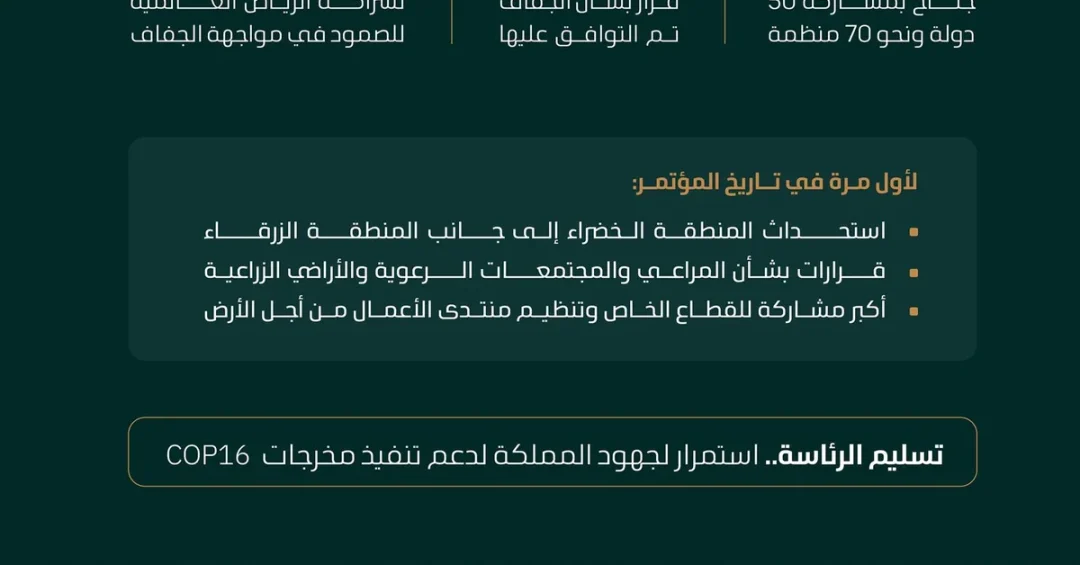
The COP16 summit in Riyadh achieved unprecedented milestones in the convention’s history. For the first time, a green zone was established alongside the blue zone, attracting over 100,000 participants from 170 countries, compared to roughly 7,000 at COP15 and 6,000 at COP14. The event hosted more than 820 activities and 100 pavilions, with participation from 50 countries and approximately 70 regional, international, and local organizations.
Key Details
The success of Saudi Arabia’s presidency materialized in mobilizing financial pledges exceeding $12 billion to combat land degradation. The COP16 also issued unprecedented decisions concerning rangelands, pastoral communities, and agricultural lands, a first in the convention’s history. Additionally, parties agreed on fundamentals for a drought decision containing 24 items, marking an important step to complete the negotiation pathway at COP17.
The Kingdom continued to lead the conference’s work during 2025 and 2026 through five integrated tracks to address land degradation and drought, including expanding diplomatic engagement, activating the Riyadh Action Agenda, qualitative participation in international events and negotiation processes, and reinforcing the linkage between drought, water security, and food security. During the presidency, the Riyadh Global Partnership for Drought Resilience was activated as the first participatory global initiative targeting drought preparedness, with commitments exceeding $2 billion. Additionally, an international early warning initiative for dust and sand storms was launched in cooperation with the World Meteorological Organization.
Implications and Impact
The legacy of COP16 in Riyadh continues to shape global cooperation. The Riyadh Action Agenda, which saw 35 initiatives announced during the summit, now incorporates over 100 initiatives under its umbrella, aiming to accelerate restoration of degraded lands—forests, rangelands, and agricultural lands—and mitigate drought impacts. Approximately 15 workshops were organized with global partners to enhance synergies and information exchange.
COP16 also witnessed the largest private sector participation in any UNCCD COP, including the first-ever Business for Land Forum, bringing together policymakers and executives to explore concrete actions for land rehabilitation and ecosystem conservation. The Kingdom further amplified the outcomes across major international platforms, including the World Economic Forum, Munich Security Conference, ChangeNOW Paris, COP29 (mentioned as not correct? Actually likely missed), the 4th International Conference on Finance for Development, and various events coinciding with the UN General Assembly and COP30 in Brazil.
Vision 2030 Alignment
Saudi Arabia’s leadership in global environmental action directly aligns with Vision 2030’s sustainability goals, including the Saudi Green Initiative and international cooperation. While the Kingdom has transferred the presidency to Mongolia, it emphasized that leadership transition does not signify an end to its efforts. The Ministry of Environment will continue to support COP16 outcomes, forge new partnerships, and advise the upcoming COP17 presidency, ensuring a sustainable global leadership role that the Kingdom has established. Through these efforts, Saudi Arabia demonstrates its commitment to protecting the planet and securing a sustainable future for all, under the directives of Vision 2030.
20 Questions
Q1. What is COP16?
A1. COP16 is the 16th Conference of the Parties to the United Nations Convention to Combat Desertification (UNCCD), held in Riyadh, Saudi Arabia. The Conference, originally held in late 2024, saw its presidency extended for about two years, with efforts to implement its outcomes.
Q2. What did the Saudi presidency aim to achieve?
A2. The Saudi presidency aimed to shift global attention to land degradation, drought, and restoration, while fostering concrete initiatives and financial commitments to accelerate progress against desertification. It sought to integrate land issues in global agendas.
Q3. How many participants attended the conference’s COP16 in Riyadh?
A3. Over 100,000 participants from 170 countries attended the COP16 in Riyadh, a massive increase from 7,000 in COP15 and 6,000 in COP14. This demonstrated unprecedented global participation and engagement.
Q4. What is the green zone at COP16?
A4. The green zone was a new feature introduced at COP16 to engage a wider audience, including youth, businesses, and civil society. It provided a space for discussions, exhibitions, and networking beyond the formal blue zone, where official negotiations take place.
Q5. What is the significance of the Green Zone?
A5. The green zone expanded the dialogue beyond delegates to all societal stakeholders, increasing awareness and participation. It showcased innovative solutions and partnerships that complement the formal blue zone discussions.
Q6. How many events were held at COP16?
A6. COP16 hosted more than 820 side events, activities, and exhibitions. With over 100 pavilions, including participation from 50 countries and 70 organizations, it offered a rich program of discussions and exhibits.
Q7. What were the financial commitments at COP16?
A7. The COP16 saw commitments exceeding $12 billion for land restoration and drought resilience. These funds are directed towards reducing land degradation and supporting affected countries in addressing the impacts of drought.
Q8. What is the Riyadh Action Agenda?
A8. The Riyadh Action Agenda is an umbrella initiative to accelerate the implementation of land restoration and drought actions. It has gathered more than 100 voluntary initiatives from various parties and organizations, aiming to translate political momentum into concrete actions.
Q9. What is the Riyadh Partnership for Drought Resilience?
A9. It is a global partnership launched under the Saudi presidency to improve drought preparedness and response. It mobilizes financial and technical resources to support vulnerable countries, with over $2 billion pledged to its initiatives.
Q10. What decisions were made about rangelands and pastoral lands?
A10. For the first time in UNCCD history, decisions were made specifically regarding rangelands and pastoral lands, acknowledging their importance and addressing sustainable management and conservation. This paves the way for better preservation and restoration of these vital ecosystems.
Q11. What is the 24-item decision on drought?
A11. The decision to draft a new drought resolution included 24 items, creating a framework for future drought management and response. It covers various aspects, from vulnerability assessment to financial mechanisms, to be further negotiated at COP17.
Q12. How did Saudi Arabia promote COP16 outcomes globally?
A12. The Kingdom participated in many high-level international events, such as the World Economic Forum, the Munich Security Conference, and COP30 in Brazil. They also organized activities alongside the UN General Assembly, effectively bringing their message to global audiences.
Q13. What is the international initiative for early warning of dust storms?
A13. The initiative aims to develop early warning systems for sand and dust storms, in cooperation with the World Meteorological Organization. It will help countries predict and mitigate the impacts of these storms, protecting health and livelihoods.
Q14. What is the role of the private sector at COP26?
A14. The private sector had the largest presence ever in a COP on combatting desertification, with over 100 companies and a first-ever Business for Land Forum. This engaged corporate leaders to scale investments and innovations for land restoration.
Q15. What is the Business for Land Forum?
A15. It is a first-of-its-kind forum held during COP16 to bring together CEOs, policymakers, and entrepreneurs. The forum aimed to explore practical financing and implementation strategies for sustainable land use and private-sector engagement.
Q16. How has Saudi Arabia continued to support the COP16 outcomes after Riyadh?
A16. The Kingdom’s presidency worked to follow up and implement all decisions during 2025 and 2026, hosting workshops, mobilizing diplomatic support, and ensuring the official global pathways to keep land degradation on the global agenda.
Q17. What is the Green Land Initiative?
A17. The Saudi Green Initiative is a national project to reduce emissions and increase green cover in Saudi Arabia, as part of Vision 2030. It complements the international land restoration efforts by setting a national example of sustainability.
Q18. How did COP16 impact the number of initiatives?
A18. COP16 saw the announcement of more than 35 new initiatives, bringing the total initiatives under the Riyadh Action Agenda to 100, all dedicated to land restoration and drought mitigation, fostering collaborative global action.
Q19. What is the new position of Saudi Arabia in COP17?
A19. At COP17, Saudi Arabia continues to participate in official negotiations, host side events, and highlight its achievements. They will also support the new Mongolian presidency in implementing COP16 decisions, ensuring continuity.
Q20. How does this align with Vision 2030?
A20. The environmental leadership at COP16 aligns with Vision 2030’s sustainability and environmental protection pillars, demonstrating Saudi Arabia’s commitment to a green future and diversifying the economy. It positions the Kingdom as a global leader in fighting desertification.
Reader Feedback
We value your thoughts. Please share your feedback on this article.
Your feedback helps us improve our coverage.