


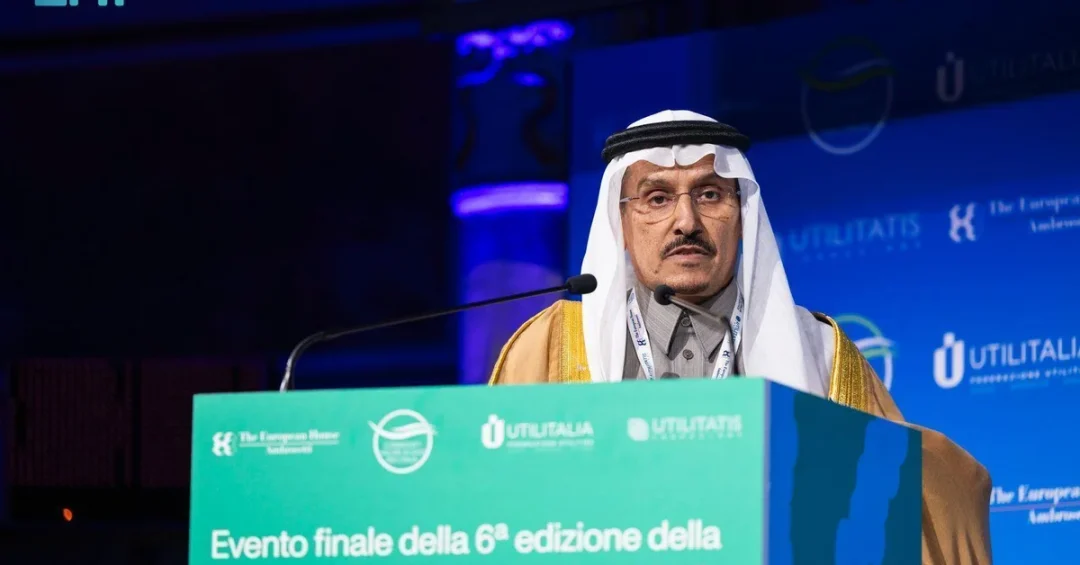
Saudi Arabia has reaffirmed its commitment to strengthening international cooperation in the water sector, with a senior official telling a forum in Rome that global water challenges demand integrated, cross-border solutions. The Kingdom’s message, delivered during its participation in the “Value of Water Community” forum in the Italian capital, underscored the urgency of implementing integrated water resources management to ensure sustainability, overcome water scarcity, and develop water resources for future generations. The delegation was led by the Ministry of Environment, Water and Agriculture, represented by Dr. Abdulaziz Al-Shaibani, Deputy Minister for Water, according to the official Saudi Press Agency.
The forum, held on March 23, 2025, brought together international stakeholders to examine Italy’s key water sector challenges, including the impacts of climate change, declining groundwater levels, and the need to develop advanced technologies to ensure the sustainability of water resources. Saudi Arabia’s participation reflects a broader diplomatic and technical push to position water security as a shared global priority. Can any nation facing extreme water scarcity afford to work alone in an era of climate uncertainty? The Kingdom’s answer, delivered in Rome, was clear: no. Its engagement signals that water sustainability is not merely a domestic policy concern but a cornerstone of its international partnerships and development strategy.
Context and Background
Why does a desert nation’s voice carry weight in global water discussions? Saudi Arabia’s natural water scarcity has long shaped its national planning, and the Kingdom has turned that challenge into an engine for innovation and international engagement. Speaking at the forum, Dr. Al-Shaibani emphasized that Saudi Vision 2030 prioritizes water sustainability as a fundamental pillar of national development. In light of the Kingdom’s limited natural water resources, comprehensive strategies have been implemented to enhance water efficiency, balance supply and demand, and ensure long-term sustainability, he noted.
The National Water Strategy 2030, a key component of the Kingdom’s reform agenda, aims to develop alternative water sources, reduce dependence on non-renewable groundwater through desalination, enhance distribution networks, and minimize water loss. These objectives are not abstract policy goals; they are operational targets backed by significant investment and institutional reform. The strategy reflects a recognition that water security underpins food security, economic diversification, and quality of life, all central to Vision 2030’s ambitions. By sharing its experience in Rome, Saudi Arabia is positioning itself as a contributor to global solutions rather than a passive recipient of international aid.
The Kingdom’s participation in the “Value of Water Community” forum also highlights the growing importance of multilateral platforms in addressing transboundary resource challenges. Italy’s water sector struggles with many of the same pressures Saudi Arabia faces, including climate change impacts and declining groundwater levels, creating a natural basis for knowledge exchange. Dr. Al-Shaibani’s remarks drew attention to the Kingdom’s global efforts, including its participation in international initiatives such as the G20 and collaboration with United Nations organizations. This engagement builds on years of Saudi diplomacy in environmental and resource governance, reinforcing the Kingdom’s role as a bridge between developed and developing nations on sustainability issues.
Key Details
What specific measures is Saudi Arabia pursuing to secure its water future? Dr. Al-Shaibani outlined a multi-pronged approach centered on the National Water Strategy 2030. The strategy seeks to develop alternative water sources, with desalination playing a central role. Saudi Arabia is already one of the world’s largest producers of desalinated water, and ongoing investments aim to increase capacity while reducing energy consumption and environmental impact. The strategy also targets the reduction of dependence on non-renewable groundwater, a critical priority given the Kingdom’s arid climate and the finite nature of its aquifers.
Enhancing distribution networks and minimizing water loss represent another pillar of the strategy. Aging infrastructure and leakage have historically posed challenges, and the Kingdom has launched programs to modernize pipelines, deploy smart metering, and improve operational efficiency. These efforts are complemented by demand-side measures, including public awareness campaigns and tariff reforms designed to encourage conservation. Dr. Al-Shaibani also underscored investment opportunities in the Saudi water sector, particularly the role of private-sector partnerships, investment in advanced technologies, and contributions to scientific research and water infrastructure development.
The Deputy Minister’s emphasis on private-sector partnerships aligns with Vision 2030’s broader goal of expanding the role of the private sector in the national economy. By inviting international companies and investors to participate in water projects, Saudi Arabia aims to accelerate technology transfer, create jobs, and improve service delivery. The Kingdom’s participation in the G20 and collaboration with UN organizations further demonstrate its commitment to aligning national efforts with global frameworks such as the Sustainable Development Goals, particularly SDG 6 on clean water and sanitation. These details collectively paint a picture of a comprehensive, forward-looking water policy that integrates domestic action with international cooperation.
International and Regional Impact
How does Saudi Arabia’s water diplomacy reshape its regional and global standing? The Kingdom’s active participation in forums like the “Value of Water Community” reinforces its reputation as a responsible global stakeholder willing to share expertise and collaborate on shared challenges. In a region where water scarcity is a persistent source of tension, Saudi Arabia’s emphasis on cooperation and integrated management offers a constructive model. Its collaboration with UN organizations and engagement in the G20 provide platforms for influencing global water policy and advocating for solutions that reflect the needs of arid regions.
Regionally, the Kingdom’s leadership in desalination and water reuse sets a benchmark for neighboring countries facing similar constraints. By investing in advanced technologies and fostering public-private partnerships, Saudi Arabia can serve as a hub for water innovation, exporting expertise and services across the Middle East and beyond. The forum in Rome also opened avenues for bilateral cooperation with Italy, a country with significant expertise in water management and infrastructure. Such partnerships can facilitate joint research, technology exchange, and co-investment, benefiting both nations and contributing to global water security. Saudi Arabia’s message in Rome was not merely about addressing its own challenges but about building a collective response to a shared global crisis.
Economic and Strategic Significance
Why should international investors and policymakers pay attention to Saudi Arabia’s water sector? The Kingdom’s water strategy is not only an environmental imperative but also an economic opportunity. Desalination, water reuse, smart infrastructure, and research and development represent growing markets where Saudi and international firms can collaborate. Dr. Al-Shaibani’s invitation to private-sector partners highlights the Kingdom’s openness to foreign investment and its commitment to creating a business-friendly environment. As Vision 2030 seeks to diversify the economy beyond oil, water technology and services emerge as promising non-oil sectors with export potential.
Strategically, water security is inseparable from national resilience. A stable, sustainable water supply supports agriculture, industry, tourism, and urban development, all of which are central to the Kingdom’s economic transformation. By reducing reliance on non-renewable groundwater and investing in alternative sources, Saudi Arabia mitigates risks associated with climate change and resource depletion. The Kingdom’s participation in international initiatives enhances its soft power and diplomatic leverage, positioning it as a constructive actor in global environmental governance. In an era when water stress affects billions of people, Saudi Arabia’s experience and investments carry significance far beyond its borders, offering lessons and partnership opportunities for nations worldwide.
Vision 2030 Alignment
How does water sustainability fit into the broader Vision 2030 narrative? Saudi Vision 2030, launched under the leadership of Crown Prince Mohammed bin Salman, envisions a diversified, sustainable economy and an enhanced quality of life for citizens. Water sustainability is explicitly recognized as a fundamental pillar of this vision, underpinning food security, public health, and economic development. The National Water Strategy 2030 translates these aspirations into concrete actions, from desalination expansion to infrastructure modernization and demand management.
The Kingdom’s efforts in Rome and its collaboration with international partners demonstrate that Vision 2030 is not an isolated national project but an outward-looking agenda that seeks global engagement. By sharing its expertise, attracting investment, and participating in multilateral forums, Saudi Arabia is contributing to a more water-secure world while advancing its own development goals. As the Kingdom continues to implement its water strategy, its leadership in this critical domain will remain a defining feature of its international profile and a testament to the enduring relevance of Vision 2030.
20 Questions
Q1. What event did Saudi Arabia participate in regarding water cooperation?
A1. Saudi Arabia participated in the “Value of Water Community” forum held in Rome, Italy, on March 23, 2025, to discuss global water challenges and strengthen international cooperation in the water sector.
Q2. Who represented Saudi Arabia at the forum?
A2. Dr. Abdulaziz Al-Shaibani, Deputy Minister for Water at the Ministry of Environment, Water and Agriculture, represented the Kingdom and delivered remarks on Saudi Arabia’s water strategy and international collaboration.
Q3. What did Dr. Al-Shaibani emphasize about Saudi Vision 2030?
A3. He emphasized that Saudi Vision 2030 prioritizes water sustainability as a fundamental pillar of national development, with comprehensive strategies to enhance water efficiency and ensure long-term sustainability.
Q4. What is the National Water Strategy 2030?
A4. The National Water Strategy 2030 is a key initiative aimed at developing alternative water sources, reducing dependence on non-renewable groundwater through desalination, enhancing distribution networks, and minimizing water loss.
Q5. How does Saudi Arabia address its natural water scarcity?
A5. The Kingdom implements comprehensive strategies to enhance water efficiency, balance supply and demand, invest in desalination, and ensure long-term sustainability through integrated water resources management.
Q6. What international initiatives does Saudi Arabia participate in for water cooperation?
A6. Saudi Arabia participates in international initiatives such as the G20 and collaborates with United Nations organizations to address global water challenges and promote sustainable water management.
Q7. What investment opportunities did Dr. Al-Shaibani highlight?
A7. He underscored investment opportunities in the Saudi water sector, including private-sector partnerships, advanced technologies, scientific research, and water infrastructure development.
Q8. Why is international cooperation important in the water sector?
A8. International cooperation is vital to tackle global water challenges, share best practices, develop advanced technologies, and ensure sustainable water resources for future generations.
Q9. What challenges did the Rome forum discuss?
A9. The forum discussed Italy’s key water sector challenges, including climate change impacts, declining groundwater levels, and the need for advanced technologies to ensure water sustainability.
Q10. How does Saudi Arabia reduce dependence on non-renewable groundwater?
A10. Saudi Arabia reduces dependence on non-renewable groundwater by investing in desalination, developing alternative water sources, and implementing integrated water resources management strategies.
Q11. What role does desalination play in Saudi Arabia’s water strategy?
A11. Desalination is a central component of Saudi Arabia’s water strategy, providing a major source of potable water and reducing reliance on finite groundwater resources.
Q12. How does Saudi Arabia enhance its water distribution networks?
A12. The Kingdom enhances distribution networks by modernizing infrastructure, deploying smart metering, reducing leakage, and improving operational efficiency to minimize water loss.
Q13. What is the significance of private-sector partnerships in Saudi water projects?
A13. Private-sector partnerships bring investment, technology transfer, and expertise, accelerating project delivery and supporting Vision 2030’s goal of expanding the private sector’s role in the economy.
Q14. How does Saudi Arabia’s water strategy align with Vision 2030?
A14. Water sustainability is a fundamental pillar of Vision 2030, supporting food security, economic diversification, and quality of life, and is implemented through the National Water Strategy 2030.
Q15. What global water challenges are most pressing?
A15. Pressing global water challenges include climate change impacts, groundwater depletion, water scarcity, and the need for advanced technologies and integrated management to ensure sustainability.
Q16. How does Saudi Arabia contribute to global water governance?
A16. Saudi Arabia contributes through participation in the G20, collaboration with UN organizations, and sharing its expertise in desalination and water management at international forums.
Q17. What did Dr. Al-Shaibani say about scientific research in water?
A17. He highlighted the importance of contributions to scientific research and water infrastructure development as part of Saudi Arabia’s efforts to advance water sustainability and innovation.
Q18. Why is water sustainability important for Saudi Arabia’s economy?
A18. Water sustainability supports agriculture, industry, tourism, and urban development, all vital for economic diversification and the Kingdom’s long-term prosperity under Vision 2030.
Q19. How can other countries benefit from Saudi Arabia’s water expertise?
A19. Other countries can benefit through knowledge exchange, joint research, technology partnerships, and investment collaborations, as demonstrated by Saudi Arabia’s engagement at the Rome forum.
Q20. What is the future outlook for Saudi Arabia’s water sector?
A20. The future outlook is positive, with continued investment in desalination, technology, infrastructure, and international cooperation poised to ensure sustainable water resources and support Vision 2030 goals.
Reader Feedback
We value your thoughts. Please share your feedback on this article.
Your feedback helps us improve our coverage.
Related articles
 KSrelief Distributes 800 Vouchers, 500 Food Baskets in Lebanon
 KSrelief Distributes 430 Food Baskets in Sudan
 Saudi Iftar Banquet in Durban Reaches 450
 Saudi Ministry Hosts Iftar Banquet in Zagreb, Croatia
 Hadiyah Provides 90,000 Iftar Meals for Umrah Pilgrims
 Saudi Arabia Sunday Weather: Thunderstorms, Hail, and Dust Winds Forecast