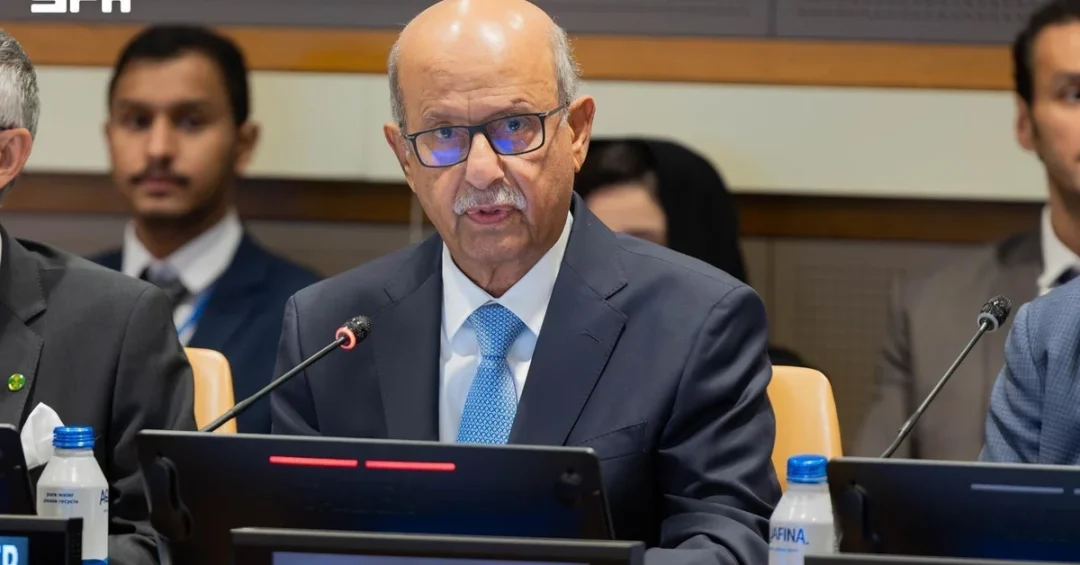
Saudi Arabia called for unified international action to strengthen global water security during a high-level ministerial session at the 81st United Nations General Assembly in New York, urging nations to convert multilateral commitments into measurable outcomes for public health, food security, economic development, and climate resilience. The session, titled “United for Water: A Call for Collective Action,” was co-chaired by the Kingdom of Saudi Arabia and the Republic of Senegal in collaboration with the Global Water Organization (GWO), and brought together ministers, senior government officials, multilateral development banks, United Nations agencies, and leaders from the global water sector.
The Saudi position, delivered through its founding leadership of the GWO, reflects the Kingdom’s expanding role in convening international stakeholders around shared resource challenges. The session underscored a central message: water security is no longer a standalone environmental concern but a cross-cutting pillar of stability, prosperity, and sustainable development. As climate pressures intensify and demand for freshwater rises across regions, Saudi Arabia is positioning itself as a bridge-builder capable of aligning financing, innovation, and institutional capacity on a global scale.
Context and Background
Why has water security risen to the top of the international diplomatic agenda, and what does Saudi Arabia’s leadership signal about the future of multilateral cooperation? The answer lies in the convergence of climate stress, population growth, and economic transformation. According to information released through official Saudi channels, the ministerial session was convened on the sidelines of the 81st UN General Assembly to address mounting pressures on water resources worldwide. The event was co-chaired by Saudi Arabia and Senegal, with organizational support from the Global Water Organization, an institution that Saudi Arabia helped establish to serve as a platform for international coordination.
The GWO’s founding team, led by Dr. Fahd Balghunaim, has been working to position the organization as a hub that connects governments with financing, technical expertise, and operational support. The session in New York was designed to move beyond declarations and focus on implementation: aligning funding with priority needs, scaling high-impact innovations, improving data access, and strengthening the institutional capacity required to deliver results on the ground. Participants reviewed national strategies for resilience and explored sustainable funding mechanisms that could be replicated across borders.
For Saudi Arabia, the gathering represented a continuation of its longstanding approach to international engagement: convene diverse stakeholders, identify practical solutions, and support frameworks that deliver measurable benefits. The Kingdom’s own experience in managing scarce water resources, investing in desalination, and integrating water policy into national development planning provides a credible foundation for its global advocacy.
Key Details
What exactly was discussed behind the closed doors of this high-level ministerial, and which priorities emerged as most urgent? According to the official statement, the session addressed growing pressures on water resources and focused on four interconnected areas: aligning funding with priority needs, scaling high-impact innovations, improving data access, and strengthening institutional implementation capacity. These pillars reflect a recognition that water challenges are not solely about scarcity but also about governance, finance, and technology.
Dr. Fahd Balghunaim, Head of the Founding Team of the Global Water Organization, stated that the session emphasized the need to translate multilateral commitments into tangible results. Participants examined national strategies for resilience, sustainable funding mechanisms, and scalable cross-border partnerships. The discussions highlighted the GWO’s role as an institutional platform that connects governments with essential financing, technical expertise, and operational coordination, ensuring that projects move from planning to execution.
The presence of multilateral development banks and United Nations agencies alongside water sector leaders underscored the breadth of the coalition being assembled. The session was not merely a ceremonial event but a working meeting designed to identify concrete pathways for cooperation. By co-chairing with Senegal, Saudi Arabia also signaled its commitment to partnership with African nations and other regions facing acute water stress, reinforcing a South-South and cross-regional dimension to its diplomacy.
International and Regional Impact
How will the outcomes of this session ripple across regions that are already grappling with water scarcity, and what role will Saudi Arabia play in shaping the global response? The ministerial session reinforced the idea that water security is a shared international responsibility. By bringing together ministers, development banks, and UN agencies, the meeting created a space for coordination that can reduce duplication and accelerate the deployment of resources. For developing countries, the emphasis on data access and institutional capacity is particularly significant, as it addresses the foundational gaps that often prevent effective water management.
Regionally, Saudi Arabia’s leadership in this domain aligns with its broader efforts to promote stability and prosperity in the Middle East and beyond. Water scarcity is a pressing issue across the Arab world, and the Kingdom’s proactive stance demonstrates a willingness to tackle transnational challenges through cooperation rather than unilateral measures. The partnership with Senegal also highlights Saudi Arabia’s outreach to Africa, a continent where water infrastructure needs are substantial and where Saudi investment and expertise can make a meaningful difference.
The Global Water Organization’s emergence as a coordinating body could also influence how international financial institutions prioritize water projects. By providing a platform for governments to present bankable projects and for financiers to identify opportunities, the GWO may help unlock funding that has historically been constrained by perceived risks or lack of preparation. This, in turn, could lead to improved public health outcomes, enhanced agricultural productivity, and greater resilience to climate shocks.
Economic and Strategic Significance
Why does water security matter so profoundly for economic development, and how does Saudi Arabia’s approach reflect its own strategic priorities? Water is a foundational input for agriculture, industry, energy production, and urban life. When water systems fail, economies suffer, food prices rise, and social tensions can escalate. By championing global water security, Saudi Arabia is addressing a root cause of economic instability and creating conditions for sustainable growth.
The Kingdom’s own economic transformation under Vision 2030 has involved significant investments in water infrastructure, including desalination plants, distribution networks, and efficiency technologies. These domestic experiences inform its international advocacy and give Saudi representatives credibility when they speak about the need for innovation and integrated planning. The session’s focus on scaling high-impact innovations and improving data access reflects a pragmatic understanding that technology and information are essential to managing water resources effectively.
Strategically, Saudi Arabia’s leadership in the GWO enhances its soft power and positions the Kingdom as a responsible global actor. By co-chairing the session with Senegal, Saudi Arabia also strengthens its ties with African nations, which are increasingly important partners in trade, investment, and diplomacy. The emphasis on collective action resonates with the principles of multilateralism that Saudi Arabia has consistently supported, even as it pursues its own national transformation.
Vision 2030 Alignment
How does Saudi Arabia’s advocacy for global water security connect to the objectives of Vision 2030, the Kingdom’s ambitious roadmap for economic and social transformation? Vision 2030 seeks to diversify the economy, improve quality of life, and enhance Saudi Arabia’s global engagement. Water security is integral to these goals: it supports food security, enables industrial growth, and contributes to healthy communities. By taking a leading role in international water diplomacy, the Kingdom is demonstrating that its national vision extends beyond its borders.
The Global Water Organization, incubated with Saudi support, exemplifies the Vision 2030 emphasis on building partnerships and fostering innovation. It also aligns with the Kingdom’s commitment to sustainable development and climate action, as outlined in various national strategies. As the world confronts increasingly complex water challenges, Saudi Arabia’s call for collective action at the United Nations signals a readiness to help shape global solutions. The session in New York was not an endpoint but a milestone in an ongoing effort to turn shared commitments into tangible improvements in people’s lives.
Looking ahead, the Kingdom is expected to continue using platforms like the GWO to bridge gaps between governments, financiers, and innovators. This approach reflects a broader understanding that in an interconnected world, no nation can achieve water security alone. Saudi Arabia’s message is clear: through unity, coordination, and sustained investment, the international community can build a more water-secure future for all.
20 Questions
Q1. What was the main purpose of the high-level ministerial session co-chaired by Saudi Arabia?
A1. The session aimed to advance global water security by translating multilateral commitments into tangible results that support public health, food security, economic development, and climate resilience.
Q2. Where and when did this session take place?
A2. It took place on the sidelines of the 81st Session of the UN General Assembly in New York, as announced by the Saudi Press Agency.
Q3. Which country co-chaired the session alongside Saudi Arabia?
A3. The Republic of Senegal co-chaired the session with Saudi Arabia, in collaboration with the Global Water Organization.
Q4. What is the Global Water Organization?
A4. The Global Water Organization is an international platform that connects governments with financing, technical expertise, and operational coordination to address water challenges.
Q5. Who represented the Global Water Organization at the session?
A5. Dr. Fahd Balghunaim, Head of the Founding Team of the Global Water Organization, represented the organization and outlined its priorities.
Q6. What key areas did the session focus on?
A6. The session focused on aligning funding with priority needs, scaling high-impact innovations, improving data access, and strengthening institutional implementation capacity.
Q7. Why is water security considered a global concern?
A7. Water security affects public health, food production, economic stability, and climate resilience, making it a shared challenge that requires international cooperation.
Q8. How does Saudi Arabia’s involvement reflect its foreign policy?
A8. It reflects Saudi Arabia’s commitment to multilateralism, sustainable development, and constructive engagement on issues of global importance.
Q9. What role do multilateral development banks play in this initiative?
A9. They provide financing and technical support for water projects, helping to turn plans into actionable and sustainable infrastructure improvements.
Q10. How does the session connect to Vision 2030?
A10. Vision 2030 emphasizes sustainability, innovation, and global engagement; water security supports these goals by enabling economic diversification and improving quality of life.
Q11. What are national strategies for resilience mentioned in the session?
A11. These are country-level plans to manage water resources effectively, adapt to climate change, and ensure reliable access to water for communities and industries.
Q12. Why is data access important for water security?
A12. Reliable data helps governments and organizations make informed decisions, allocate resources efficiently, and monitor progress toward water-related goals.
Q13. What are scalable cross-border partnerships?
A13. These are cooperative arrangements between countries that can be expanded or replicated to address shared water challenges and promote regional stability.
Q14. How does Saudi Arabia’s own water management experience contribute?
A14. Saudi Arabia has invested heavily in desalination and water efficiency, providing valuable knowledge that can be shared with other nations facing scarcity.
Q15. What is the significance of Saudi Arabia co-chairing with Senegal?
A15. It highlights Saudi Arabia’s outreach to Africa and its willingness to build partnerships across regions to tackle common challenges.
Q16. What outcomes are expected from this session?
A16. The session aims to catalyze coordinated action, mobilize financing, and strengthen institutional frameworks to improve water security worldwide.
Q17. How does water security relate to food security?
A17. Agriculture depends on reliable water supplies; without water security, food production becomes unstable, affecting prices and availability.
Q18. What is the role of innovation in addressing water challenges?
A18. Innovations such as advanced desalination, water recycling, and smart irrigation can increase efficiency and expand available water resources.
Q19. How can the international community support the Global Water Organization?
A19. By participating in its initiatives, sharing expertise, and providing financial and technical resources to implement water projects.
Q20. What is Saudi Arabia’s long-term vision for global water security?
A20. Saudi Arabia envisions a world where collective action ensures sustainable water access for all, supporting health, prosperity, and peace.
Reader Feedback
We value your thoughts. Please share your feedback on this article.
Your feedback helps us improve our coverage.