


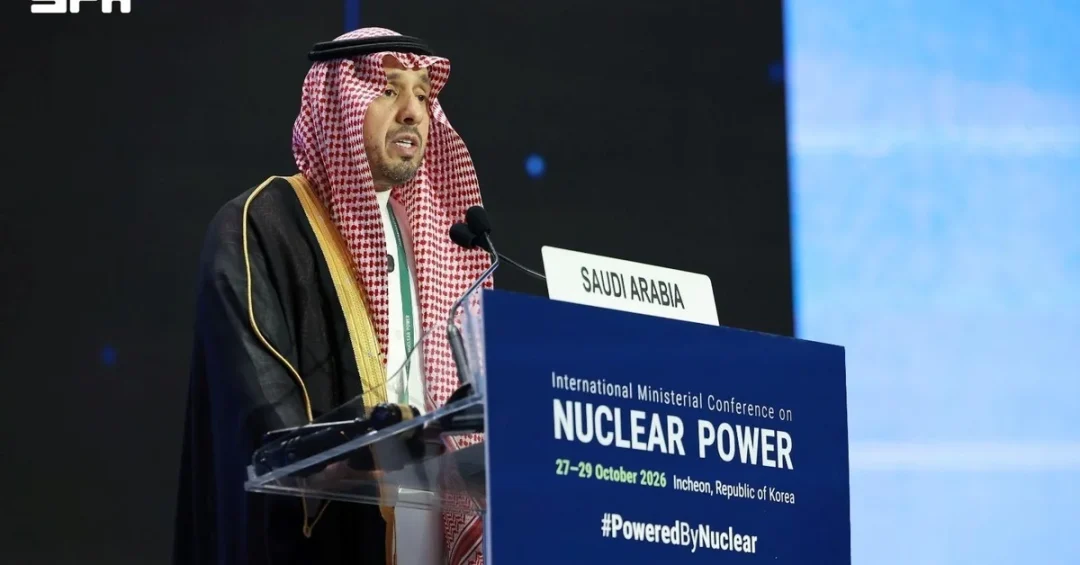
Saudi Arabia participated in the sixth International Ministerial Conference on Nuclear Power, which opened in Incheon, Republic of Korea, and runs until October 29, with the Kingdom represented by a delegation led by the King Abdullah City for Atomic and Renewable Energy (KACARE). The conference is organized by the International Atomic Energy Agency (IAEA) in cooperation with the Nuclear Energy Agency (NEA) of the Organisation for Economic Co-operation and Development (OECD), bringing together ministers, regulators, and industry leaders from around the world to discuss the future of civilian nuclear energy.
The Saudi delegation was headed by Prince Dr. Mamdouh bin Saud bin Thunayan, CEO of KACARE, who delivered the Kingdom’s address before the assembled delegates. In his remarks, the Prince emphasized that nuclear energy is a long-term strategic choice and a fundamental component of the Kingdom’s future energy system, underscoring its role in supporting sustainable economic development in alignment with the goals of Saudi Vision 2030. The participation reflects the Kingdom’s growing engagement with international institutions on matters of energy security, technological advancement, and peaceful nuclear cooperation.
Context and Background
Why does a ministerial conference on nuclear power in East Asia matter for a Kingdom on the Arabian Peninsula? The answer lies in the shifting architecture of global energy and Saudi Arabia’s deliberate place within it. The International Ministerial Conference on Nuclear Power is a recurring forum convened by the IAEA, the United Nations-affiliated body responsible for promoting the peaceful use of nuclear technology and preventing its military application, alongside the NEA of the OECD, which brings together advanced economies to coordinate nuclear energy policy. The sixth edition in Incheon gathers decision-makers at a moment when many nations are reassessing the role of nuclear power in their long-term energy mixes.
For Saudi Arabia, participation is not an isolated gesture but part of a sustained diplomatic and technical trajectory. The Kingdom has been steadily building the institutional foundations of a civilian nuclear program, anchored by KACARE, which was established to lead the national effort in atomic and renewable energy. The Saudi National Atomic Energy Project (SNAEP) represents the umbrella under which this work proceeds, spanning regulation, human capital development, and international partnership. Attending a high-level ministerial conference alongside IAEA and OECD members signals the Kingdom’s commitment to operating within established global frameworks and to learning from the experience of countries further along the nuclear development path.
The timing is also significant against the backdrop of global energy transition debates. As countries seek reliable, low-carbon baseload power to complement intermittent renewables, nuclear energy has returned to the center of policy discussions in many capitals. For a Kingdom pursuing a diversified, sustainable energy future under Vision 2030, engaging with the world’s leading nuclear policymakers provides insight into best practices, safety standards, and financing models. It also positions Saudi Arabia as a constructive participant in the international governance of nuclear technology.
Key Details of the Saudi Address
What exactly did the Kingdom convey to the international community in Incheon? In his address, Prince Dr. Mamdouh bin Saud bin Thunayan framed nuclear energy as a long-term strategic choice rather than a short-term experiment. He described the SNAEP as a comprehensive national project that extends well beyond the generation of electricity, encompassing the creation of a new economic and technical sector, the advancement of high-tech industries, and the strengthening of the Saudi economy’s competitiveness. This framing positions nuclear power as an engine of industrial diversification, not merely a power source.
The KACARE CEO pointed out that the Kingdom is adopting a gradual and balanced approach to developing its nuclear program, grounded in international standards and practices. He reaffirmed Saudi Arabia’s commitment to the peaceful use of nuclear energy in cooperation with the IAEA, a statement that reinforces the Kingdom’s adherence to the global non-proliferation and safety architecture. The emphasis on gradualism and balance reflects a measured strategy: building capability step by step, aligning with recognized norms, and ensuring that the program develops in a manner consistent with international expectations.
The delegation’s presence at Incheon, and the Prince’s role as its leader, illustrates the operational maturity of the Kingdom’s nuclear governance. KACARE serves as the focal point for atomic and renewable energy policy, and its leadership’s engagement at a ministerial-level forum demonstrates coordination between national strategy and international diplomacy. The conference’s co-sponsorship by the NEA of the OECD further connects the Kingdom to a network of advanced economies whose regulatory and technological practices can inform Saudi Arabia’s own path.
International and Regional Impact
How does Saudi Arabia’s participation shape its standing in the global energy community? By appearing at a forum organized by the IAEA and the OECD’s Nuclear Energy Agency, the Kingdom signals that it intends to be a responsible stakeholder in the international nuclear order. This matters for building confidence among partner governments, prospective technology suppliers, and multilateral institutions. A constructive presence at such gatherings can ease the path toward future cooperation agreements on safety, safeguards, and workforce development.
Regionally, the Kingdom’s engagement carries weight as Gulf economies explore diversified energy portfolios. Saudi Arabia’s emphasis on peaceful use and international cooperation provides a stabilizing template for how nuclear ambitions can be pursued transparently and within recognized frameworks. The conference also offers a platform for bilateral exchanges with counterparts from Asia, Europe, and beyond, reinforcing Saudi Arabia’s broader diplomatic outreach and its capacity to act as a bridge between energy producers and consumers across regions.
Economic and Strategic Significance
Why should observers of Saudi Arabia’s economy pay attention to a nuclear conference? The SNAEP is envisioned as a catalyst for high-tech industrial development, and the Prince’s remarks made clear that the Kingdom views the program as an economic sector in its own right. Nuclear energy development involves specialized supply chains, advanced manufacturing, precision engineering, and a skilled technical workforce, all of which align with Vision 2030’s objective of diversifying the economy beyond hydrocarbons and creating high-value employment for Saudi nationals.
The strategic dimension is equally important. Reliable baseload power supports the Kingdom’s ambitious infrastructure and industrial projects, including large-scale urban and industrial developments, while reducing long-term exposure to volatile fuel markets. By adopting a gradual and balanced approach grounded in international standards, Saudi Arabia aims to build this capability in a manner that manages costs, ensures safety, and preserves flexibility as technologies evolve. The conference provided a venue to compare notes on financing, regulation, and human capital with countries that have navigated similar journeys.
The emphasis on competitiveness underscores a broader economic logic: nuclear technology, when integrated into a diversified energy system, can strengthen the resilience and attractiveness of the Saudi economy for international investors. The Kingdom’s participation in Incheon therefore connects a technical energy agenda to the wider national project of economic transformation.
Vision 2030 Alignment
How does nuclear energy fit within the grand design of Saudi Vision 2030? The Vision, launched in 2016, sets out to diversify the Kingdom’s economy, expand non-oil sectors, and build a sustainable energy future. The Saudi National Atomic Energy Project, as described in Incheon, directly serves these objectives by creating a new economic and technical sector, advancing high-tech industries, and enhancing the competitiveness of the Saudi economy. Nuclear power contributes to a balanced energy mix that complements the Kingdom’s substantial renewable energy ambitions, supporting reliable and low-carbon electricity for decades to come.
The address by Prince Dr. Mamdouh bin Saud bin Thunayan made the linkage explicit, framing nuclear energy as a long-term strategic choice that supports sustainable economic development in alignment with Vision 2030. The Kingdom’s commitment to peaceful use and cooperation with the IAEA reinforces the Vision’s emphasis on international partnership and responsible global citizenship. As Saudi Arabia continues to develop its nuclear program gradually and in accordance with international standards, its engagement at forums like the Incheon ministerial conference will remain a key channel for demonstrating leadership, building trust, and securing the partnerships needed to realize its long-term energy and economic goals.
20 Questions
Q1. What international conference did Saudi Arabia participate in recently?
A1. Saudi Arabia participated in the sixth International Ministerial Conference on Nuclear Power, held in Incheon, Republic of Korea, from October 28 to October 29, organized by the IAEA in cooperation with the OECD’s Nuclear Energy Agency.
Q2. Who led the Saudi delegation to the conference?
A2. The Kingdom’s delegation was led by Prince Dr. Mamdouh bin Saud bin Thunayan, CEO of the King Abdullah City for Atomic and Renewable Energy (KACARE), who delivered the Kingdom’s official address to the assembled delegates.
Q3. Which organizations co-organized the conference?
A3. The conference was organized by the International Atomic Energy Agency (IAEA) in cooperation with the Nuclear Energy Agency (NEA) of the Organisation for Economic Co-operation and Development (OECD), bringing together global policymakers.
Q4. What did the Saudi representative emphasize in his address?
A4. Prince Mamdouh emphasized that nuclear energy is a long-term strategic choice and a fundamental component of the future energy system, supporting sustainable economic development in alignment with Saudi Vision 2030 goals.
Q5. What is the Saudi National Atomic Energy Project?
A5. The Saudi National Atomic Energy Project (SNAEP) is a comprehensive national initiative that extends beyond electricity generation, encompassing the creation of a new economic and technical sector and the advancement of high-tech industries.
Q6. What approach is Saudi Arabia taking to develop its nuclear program?
A6. The Kingdom is adopting a gradual and balanced approach to developing its nuclear program, grounded in international standards and practices, reflecting a measured strategy for building capability step by step.
Q7. How does the nuclear program relate to Vision 2030?
A7. The program aligns with Vision 2030 by diversifying the economy, creating high-value employment, advancing high-tech industries, and enhancing the competitiveness of the Saudi economy beyond hydrocarbons.
Q8. What did the Prince say about peaceful use of nuclear energy?
A8. He reaffirmed the Kingdom’s commitment to the peaceful use of nuclear energy in cooperation with the IAEA, reinforcing Saudi Arabia’s adherence to global non-proliferation and safety frameworks.
Q9. Where was the conference held?
A9. The sixth International Ministerial Conference on Nuclear Power was held in Incheon, Republic of Korea, beginning on October 28 and continuing until October 29, 2026.
Q10. What is KACARE’s role in Saudi Arabia?
A10. KACARE, the King Abdullah City for Atomic and Renewable Energy, serves as the focal point for the Kingdom’s atomic and renewable energy policy, leading national efforts and coordinating international engagement.
Q11. Why does nuclear energy matter for Saudi Arabia’s energy mix?
A11. Nuclear energy provides reliable, low-carbon baseload power that complements intermittent renewables, supporting a balanced and sustainable energy system for decades to come.
Q12. What economic benefits does the SNAEP aim to deliver?
A12. The SNAEP aims to create a new economic and technical sector, develop specialized supply chains, advance high-tech manufacturing, and generate skilled employment for Saudi nationals.
Q13. How does the conference benefit international cooperation?
A13. The conference provides a platform for bilateral exchanges on safety, regulation, financing, and workforce development, helping Saudi Arabia build partnerships with counterparts from Asia, Europe, and beyond.
Q14. Who organizes the IAEA?
A14. The International Atomic Energy Agency is a United Nations-affiliated body responsible for promoting the peaceful use of nuclear technology and preventing its military application worldwide.
Q15. What is the NEA of the OECD?
A15. The Nuclear Energy Agency of the OECD brings together advanced economies to coordinate nuclear energy policy, share best practices, and support the safe development of nuclear technology.
Q16. Why is a gradual approach important for Saudi Arabia?
A16. A gradual and balanced approach manages costs, ensures safety, preserves flexibility as technologies evolve, and aligns the program with recognized international standards and expectations.
Q17. How does the program support economic diversification?
A17. By building a high-tech industrial sector around nuclear technology, the program reduces reliance on hydrocarbons and strengthens the resilience and attractiveness of the Saudi economy for international investors.
Q18. What signal does Saudi participation send internationally?
A18. It signals that the Kingdom intends to be a responsible stakeholder in the international nuclear order, building confidence among partner governments, suppliers, and multilateral institutions.
Q19. What regional significance does the conference hold?
A19. The Kingdom’s engagement offers a stabilizing template for Gulf economies exploring diversified energy portfolios, demonstrating how nuclear ambitions can be pursued transparently within recognized frameworks.
Q20. What is the long-term vision for Saudi Arabia’s nuclear program?
A20. The program aims to establish a sustainable, safe, and internationally compliant nuclear capability that supports reliable energy, industrial growth, and the broader economic transformation goals of Saudi Vision 2030.
Reader Feedback
We value your thoughts. Please share your feedback on this article.
Your feedback helps us improve our coverage.