


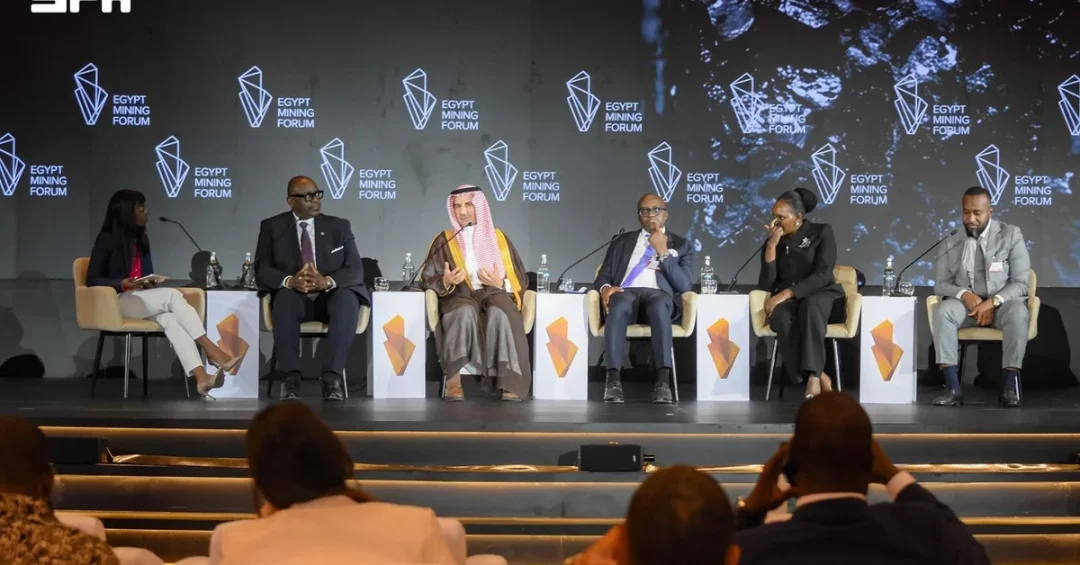
Saudi Arabia showcased its transformation into a competitive, investment-ready mining jurisdiction at the Egypt Mining Forum 2026 in Cairo, where Eng. Khalid Al-Mudaifer, Vice Minister for Mining Affairs at the Ministry of Industry and Mineral Resources, detailed how the Kingdom is converting geological wealth into bankable projects under Saudi Vision 2030. Speaking during the fifth edition of the forum, held on September 28 and 29, Al-Mudaifer outlined a comprehensive agenda covering legislative reform, expanded geological data access, accelerated exploration, infrastructure development, and targeted investment incentives. The Saudi delegation joined ministers, government officials, company leaders, investors, and mining experts from across the region and beyond, reinforcing the Kingdom’s position as a convening power in the global minerals conversation.
What does it take for a nation to turn vast underground resources into sustainable, globally competitive industries? Saudi Arabia’s answer, presented in Cairo, rests on a deliberate sequencing of reforms that began with the overhaul of the mining investment law and has advanced through the launch of the Saudi Geological Survey’s regional mapping programs, the establishment of the Ministry of Industry and Mineral Resources, and the creation of incentives designed to de-risk exploration for private capital. The Kingdom’s participation in the Egypt Mining Forum is part of a broader strategy to strengthen regional and international cooperation, exchange expertise with mineral-producing countries, explore technical and investment partnerships, and deepen private-sector involvement across every stage of the value chain. It also reflects a clear intent to expand mining cooperation with Egypt, a neighboring economy with significant mineral potential of its own.
Context and Background
Why has mining become such a central pillar of Saudi Arabia’s economic diversification agenda? For decades, the Kingdom’s economy was closely associated with hydrocarbons, but Vision 2030 set out to build a broader industrial base in which minerals play a defining role. The Ministry of Industry and Mineral Resources, working alongside agencies such as the Saudi Geological Survey and the Ministry of Investment, has pursued a systematic effort to quantify the Kingdom’s mineral endowment. Official estimates have placed the value of Saudi Arabia’s untapped mineral resources at approximately SAR 9.4 trillion (around USD 2.5 trillion), spanning gold, copper, phosphate, rare earth elements, and other critical minerals essential to the global energy transition.
That geological potential only becomes economically meaningful when it is matched with transparent rules, reliable data, and infrastructure that allows projects to move from exploration to production. Saudi Arabia has therefore prioritized a modern mining investment law, competitive fiscal terms, and streamlined licensing. The Egypt Mining Forum, now in its fifth edition, has become one of the region’s most important platforms for discussing these themes, bringing together policymakers and investors who are shaping the future of mining across the Middle East and Africa. Saudi Arabia’s presence there signals that the Kingdom views regional integration, not isolation, as the surest path to a resilient minerals sector.
The timing of the Cairo session also reflects a broader global context. Demand for critical minerals is rising as countries pursue electrification, renewable energy, and advanced manufacturing. Supply chains are being reassessed for resilience and security. In that environment, jurisdictions that can demonstrate regulatory clarity and geological prospectivity attract disproportionate attention from institutional investors. Saudi Arabia’s message at the forum was that it intends to be one of those jurisdictions, and that it sees cooperation with partners such as Egypt as mutually reinforcing rather than zero-sum.
Key Details
What specific elements of the Saudi mining model did the Vice Minister highlight? According to the Saudi Press Agency, Eng. Khalid Al-Mudaifer focused on the transformation of the sector under Vision 2030 objectives. The session covered the development of the legislative and regulatory framework, wider access to geological data, accelerated exploration activities, infrastructure expansion, and investment enablers and incentives. Each of these elements addresses a distinct barrier that historically slowed mining development in the region, from unclear permitting pathways to limited pre-competitive geoscience data.
Wider access to geological data is particularly significant for international investors. By making survey information more readily available, Saudi Arabia reduces the early-stage risk that exploration companies face when entering a new jurisdiction. Accelerated exploration activity then builds on that foundation, generating drill targets and resource estimates that can be developed into mines. Infrastructure expansion, including transport and energy links to remote mineral belts, addresses the logistical constraints that often determine whether a deposit is commercially viable. Investment enablers and incentives, meanwhile, are designed to improve project economics and attract both major mining houses and junior explorers.
The Vice Minister’s remarks were delivered in a session attended by ministers, government officials, company leaders, investors, and experts in mining and minerals. The forum’s fifth edition ran on September 28 and 29, providing a two-day window for bilateral meetings and technical discussions. Saudi Arabia’s delegation used the occasion to exchange expertise with mineral-producing countries and to explore broader opportunities for technical and investment partnerships, with a particular emphasis on expanding mining cooperation with Egypt. The Kingdom’s participation also aligns with its role in broadening international dialogue on the future of the minerals sector through the Future Minerals Forum, which will hold its sixth edition in Riyadh from January 12 to 14, 2027.
International and Regional Impact
How does Saudi Arabia’s mining diplomacy reshape regional economic ties? The Kingdom’s engagement in Cairo is part of a wider pattern of minerals-focused cooperation across the Middle East and Africa. By sharing its experience in building a competitive investment framework, Saudi Arabia positions itself as a partner rather than a competitor to neighboring producers. That approach can help raise standards across the region, encourage cross-border investment, and create a more integrated market for mining services, equipment, and expertise. For Egypt, which has been working to develop its own mineral resources, cooperation with Saudi Arabia offers access to capital, technical knowledge, and a proven regulatory model.
At the international level, the Kingdom’s participation reinforces its role as a convener. The Future Minerals Forum in Riyadh has grown into a major global gathering that brings together governments, industry leaders, investors, and service and technology providers to build more resilient mineral value chains. The sixth edition, scheduled for January 12 to 14, 2027, will continue that mission. By highlighting its progress at the Egypt Mining Forum, Saudi Arabia builds momentum toward that event and signals that its mining ambitions are embedded in a longer-term vision of international collaboration. For global investors, the message is that Saudi Arabia is open for partnerships across the value chain, from exploration and extraction to processing, refining, and downstream manufacturing.
Economic and Strategic Significance
Why does mining matter so much to Saudi Arabia’s economic future? The sector offers a pathway to diversify revenue streams, create high-quality jobs, and develop industrial clusters that support Vision 2030 goals. Mining projects typically require significant capital investment and long lead times, but they generate durable economic activity, including local employment, skills development, and demand for supporting services. By attracting private-sector involvement across various stages of the value chain, the Kingdom aims to capture more of the value from its mineral resources domestically rather than exporting raw materials alone.
Critical minerals add a strategic dimension. As the world transitions toward cleaner energy and advanced technologies, demand for copper, lithium, nickel, rare earth elements, and other inputs is expected to grow. Countries that can supply these minerals reliably and responsibly will hold a privileged position in global supply chains. Saudi Arabia’s geological endowment, combined with its energy infrastructure and industrial capacity, gives it a strong foundation to become a significant player. The reforms highlighted in Cairo are designed to convert that foundation into production, processing, and manufacturing capacity that serves both domestic industrial ambitions and export markets.
Vision 2030 Alignment
How does the Cairo appearance connect to the broader Vision 2030 narrative? Mining is one of the key sectors identified to diversify the Saudi economy beyond oil, alongside tourism, entertainment, technology, and logistics. The Ministry of Industry and Mineral Resources has been tasked with unlocking the sector’s potential, and the progress presented at the Egypt Mining Forum reflects that mandate in action. Legislative reform, data accessibility, exploration incentives, and infrastructure investment are all concrete steps toward establishing mining as a third pillar of the Saudi industrial economy, alongside hydrocarbons and petrochemicals.
Looking ahead, the Kingdom’s participation in regional forums and its hosting of the Future Minerals Forum demonstrate a dual commitment: to learn from others and to lead by example. By sharing its experience in building a competitive and investment-attractive mining sector, Saudi Arabia contributes to a more resilient and integrated regional minerals landscape. That, in turn, supports Vision 2030’s overarching goal of a diversified, globally engaged economy. As the sixth edition of the Future Minerals Forum approaches in January 2027, the foundations laid through engagements such as the Egypt Mining Forum will help ensure that Saudi Arabia remains at the center of the global conversation on the future of mining.
20 Questions
Q1. What event did Saudi Arabia participate in recently?
A1. Saudi Arabia participated in the Egypt Mining Forum 2026, held in Cairo on September 28 and 29. The fifth edition brought together ministers, officials, investors, and mining experts from across the region.
Q2. Who represented Saudi Arabia at the forum?
A2. Eng. Khalid Al-Mudaifer, Vice Minister for Mining Affairs at the Ministry of Industry and Mineral Resources, represented the Kingdom and highlighted its mining sector transformation during a session.
Q3. What were the main themes of the Saudi presentation?
A3. The presentation covered legislative and regulatory framework development, wider access to geological data, accelerated exploration, infrastructure expansion, and investment enablers and incentives designed to attract private capital.
Q4. How does this align with Saudi Vision 2030?
A4. Mining is a key pillar of Vision 2030’s economic diversification goals. The reforms aim to convert the Kingdom’s geological potential into investment opportunities and projects that create jobs and revenue.
Q5. What is the estimated value of Saudi Arabia’s mineral resources?
A5. Official estimates place the value of Saudi Arabia’s untapped mineral resources at approximately SAR 9.4 trillion, covering gold, copper, phosphate, rare earth elements, and other critical minerals.
Q6. Why is wider access to geological data important?
A6. It reduces early-stage exploration risk for investors by providing reliable survey information, helping companies identify targets and make informed decisions about entering the Saudi mining sector.
Q7. What role does infrastructure play in mining development?
A7. Infrastructure such as transport and energy links to remote mineral belts is essential for project viability, enabling the movement of equipment, materials, and mined products to processing and export facilities.
Q8. How does Saudi Arabia benefit from regional cooperation?
A8. Regional cooperation allows the exchange of expertise, attracts cross-border investment, and supports the development of integrated mineral value chains that benefit multiple economies in the Middle East and Africa.
Q9. What is the Future Minerals Forum?
A9. The Future Minerals Forum is a major international gathering hosted in Riyadh that brings together governments, industry leaders, investors, and technology providers to build resilient mineral value chains.
Q10. When will the sixth edition of the Future Minerals Forum take place?
A10. The sixth edition of the Future Minerals Forum is scheduled to be held in Riyadh from January 12 to 14, 2027, continuing the global dialogue on the future of the minerals sector.
Q11. What kind of partnerships is Saudi Arabia seeking?
A11. Saudi Arabia is seeking technical and investment partnerships with mineral-producing countries, aiming to increase private-sector involvement across all stages of the mining value chain.
Q12. How is Saudi Arabia expanding cooperation with Egypt?
A12. The Kingdom is using platforms like the Egypt Mining Forum to explore joint opportunities, share regulatory experience, and encourage investment flows between the two countries’ mining sectors.
Q13. What are critical minerals and why do they matter?
A13. Critical minerals such as copper, lithium, and rare earth elements are essential inputs for clean energy, electronics, and advanced manufacturing. Reliable supply is a strategic priority for many countries.
Q14. How does mining support job creation in Saudi Arabia?
A14. Mining projects generate direct employment in extraction and processing, as well as indirect jobs in services, logistics, and manufacturing, contributing to Vision 2030’s quality-of-life and economic goals.
Q15. What legislative reforms has Saudi Arabia implemented?
A15. The Kingdom has modernized its mining investment law, introduced competitive fiscal terms, streamlined licensing procedures, and established clear regulatory pathways to attract both local and international investors.
Q16. Why is private-sector involvement important in mining?
A16. Private companies bring capital, technical expertise, and operational efficiency. Their involvement accelerates project development and helps the sector grow faster than government resources alone could achieve.
Q17. What message did Saudi Arabia convey to international investors?
A17. The Kingdom conveyed that it is open for business, with a transparent regulatory framework, accessible geological data, and incentives designed to make mining projects attractive and bankable.
Q18. How does mining contribute to economic diversification?
A18. Mining creates new revenue streams beyond hydrocarbons, builds industrial clusters, and develops a skilled workforce, reducing reliance on oil and supporting long-term economic resilience.
Q19. What is the significance of Saudi Arabia’s participation in the Egypt Mining Forum?
A19. It demonstrates the Kingdom’s commitment to regional integration, knowledge exchange, and international dialogue, positioning Saudi Arabia as a leader in shaping the future of the minerals sector.
Q20. What can we expect next from Saudi Arabia’s mining sector?
A20. Continued implementation of Vision 2030 reforms, increased exploration activity, new partnerships, and preparations for the sixth Future Minerals Forum in Riyadh in January 2027.
Reader Feedback
We value your thoughts. Please share your feedback on this article.
Your feedback helps us improve our coverage.