


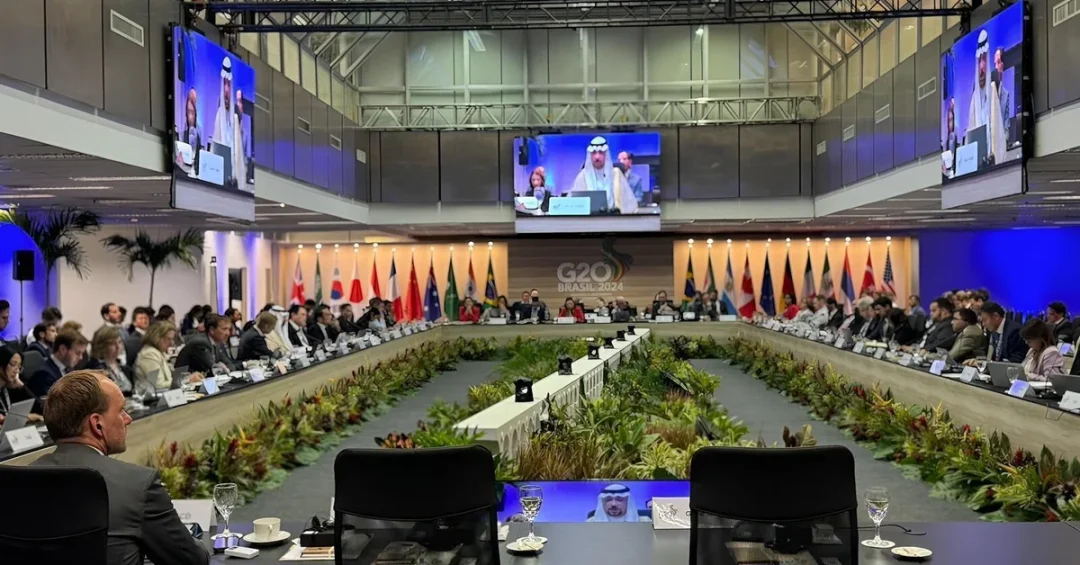
Saudi Arabia’s delegation, led by Fareed bin Saeed Al-Asaly, Deputy Governor of the General Authority of Foreign Trade (GAFT) for International Organizations and Agreements, participated in the 3rd Trade and Investment Working Group (TIWG) Meeting held in Rio de Janeiro, Brazil, on June 27-28, 2024. The meeting took place under Brazil’s presidency of the G20 and focused on key priorities including trade and sustainable development, women’s participation in international trade, sustainable development in investment agreements, and reforming the World Trade Organization (WTO) by strengthening the multilateral trading system.
Context and Background
The G20, comprising the world’s major economies, serves as a premier forum for international economic cooperation. Brazil assumed the G20 presidency in 2024, setting an agenda that emphasizes inclusive growth, sustainable development, and reform of global governance institutions. The TIWG is central to these efforts, tasked with advancing trade and investment policies that support sustainable and equitable growth.
Saudi Arabia’s active participation in the TIWG underscores its commitment to shaping global economic policies and fostering international cooperation. The Kingdom, through GAFT, aims to enhance its international trade gains, bolster its global presence, and contribute effectively to international organizations. This engagement aligns with Saudi Arabia’s broader strategy to diversify its economy and strengthen its role in the global trading system.
Key Details
During the Rio de Janeiro meeting, the TIWG discussed several critical issues. Trade and sustainable development were high on the agenda, with a focus on integrating environmental and social considerations into trade policies. The meeting also addressed women’s participation in international trade, recognizing the importance of gender inclusivity for economic growth. Moreover, participants deliberated on sustainable development provisions in investment agreements and explored pathways to reform the WTO to enhance its efficacy in a rapidly evolving global economy.
On the sidelines, the TIWG Secretariat, in collaboration with the Business 20 (B20) and Think 20 (T20), organized a workshop under the Trade and Sustainable Development Initiative. This workshop provided a platform to discuss challenges and opportunities for integrating trade and sustainable development goals, fostering dialogue between business leaders, academics, and policymakers.
The Brazilian presidency aims to achieve consensus among G20 members on outcomes such as the G20 principles for designing and implementing trade-related sustainable development measures. These principles are expected to guide member states in crafting policies that balance economic growth with environmental and social responsibility.
Implications and Impact
Saudi Arabia’s participation in the TIWG meeting carries significant implications for the global trading system and for the Kingdom’s economic diversification efforts. By engaging in discussions on WTO reform and sustainable development, Saudi Arabia contributes to shaping a more inclusive and resilient multilateral trading system. This aligns with the Kingdom’s Vision 2030, which seeks to transform Saudi Arabia into a global investment powerhouse and a hub connecting three continents.
The focus on women’s participation in international trade resonates with Saudi Arabia’s ongoing efforts to empower women and enhance their role in the economy. Under Vision 2030, the Kingdom has implemented reforms to increase women’s participation in the workforce and entrepreneurship, and sharing best practices at international forums like the G20 reinforces these domestic initiatives.
Furthermore, the workshop on trade and sustainable development highlights Saudi Arabia’s commitment to sustainable practices. As the Kingdom invests in renewable energy and green technologies, its involvement in shaping global norms on sustainable trade and investment supports its transition to a diversified, sustainable economy.
Vision 2030 Alignment
Saudi Arabia’s active engagement in the G20 TIWG reflects the Kingdom’s strategic vision to be a key player in the global economy. Vision 2030 aims to diversify the economy beyond oil, enhance international trade, and position Saudi Arabia as a leader in sustainable development. Participation in forums like the TIWG enables the Kingdom to advocate for policies that support its economic goals, such as reforming the WTO to ensure fair and open trade, promoting women’s economic empowerment, and integrating sustainability into investment frameworks.
Through GAFT, Saudi Arabia continues to enhance its international trade gains and effective participation in international organizations, ensuring the achievement of common goals and sustainable development. As the Kingdom progresses toward Vision 2030, its role in shaping global economic policies will only grow, contributing to a more prosperous and sustainable future for all.
20 Questions
Q1. What was the purpose of the 3rd TIWG meeting in Rio de Janeiro?
A1. The 3rd TIWG meeting aimed to discuss priorities such as trade and sustainable development, women’s participation in international trade, sustainable development in investment agreements, and WTO reform, under Brazil’s G20 presidency.
Q2. Who led the Saudi delegation to the TIWG meeting?
A2. The Saudi delegation was led by Fareed bin Saeed Al-Asaly, Deputy Governor of the General Authority of Foreign Trade (GAFT) for International Organizations and Agreements.
Q3. When and where did the 3rd TIWG meeting take place?
A3. The meeting took place in Rio de Janeiro, Brazil, on June 27-28, 2024.
Q4. What is the TIWG?
A4. The Trade and Investment Working Group (TIWG) is a G20 working group that addresses trade and investment issues to promote sustainable and inclusive growth.
Q5. What role does GAFT play in Saudi Arabia’s international trade?
A5. GAFT works to enhance the Kingdom’s international trade gains, strengthen its international presence, and ensure effective participation in international organizations to achieve common goals and sustainable development.
Q6. What workshop was held alongside the TIWG meeting?
A6. A workshop on the Trade and Sustainable Development Initiative was organized by the TIWG Secretariat in cooperation with the Business 20 (B20) and Think 20 (T20).
Q7. What were the main topics discussed at the workshop?
A7. The workshop discussed challenges and opportunities for integrating trade and sustainable development goals.
Q8. What outcomes does the Brazilian G20 presidency seek?
A8. The Brazilian presidency seeks consensus on outcomes including G20 principles for designing and implementing trade-related sustainable development measures.
Q9. Why is WTO reform important for Saudi Arabia?
A9. WTO reform is important for Saudi Arabia to ensure a fair and open multilateral trading system that supports its economic diversification and global trade ambitions.
Q10. How does Saudi Arabia’s participation align with Vision 2030?
A10. Saudi Arabia’s participation aligns with Vision 2030 by promoting economic diversification, enhancing international trade, and positioning the Kingdom as a leader in sustainable development.
Q11. What is the significance of women’s participation in international trade for Saudi Arabia?
A11. It resonates with Saudi Arabia’s efforts to empower women economically, a key pillar of Vision 2030, by sharing best practices and promoting gender inclusivity in trade.
Q12. What are the G20 principles for sustainable development in trade?
A12. The G20 principles aim to guide member states in designing and implementing measures that balance economic growth with environmental and social responsibility in trade.
Q13. How does the TIWG address sustainable development in investment agreements?
A13. The TIWG discusses ways to incorporate sustainable development provisions into investment agreements to ensure they support environmental and social goals.
Q14. What is the role of B20 and T20 in the TIWG?
A14. B20 and T20 are engagement groups that provide business and think tank perspectives, respectively, contributing to TIWG discussions and workshops.
Q15. How does Saudi Arabia benefit from its participation in the TIWG?
A15. Saudi Arabia benefits by shaping global trade policies, enhancing its international presence, and advancing its economic diversification goals under Vision 2030.
Q16. What is the General Authority of Foreign Trade (GAFT)?
A16. GAFT is a Saudi government authority responsible for enhancing the Kingdom’s international trade gains and effective participation in international organizations.
Q17. What does Saudi Arabia aim to achieve through GAFT’s participation?
A17. Saudi Arabia aims to enhance its international trade gains, strengthen its global presence, and contribute to achieving common goals and sustainable development.
Q18. How does the TIWG meeting support global economic cooperation?
A18. The TIWG meeting fosters dialogue and consensus among G20 members on trade and investment policies that promote sustainable and inclusive global growth.
Q19. What is the Trade and Sustainable Development Initiative?
A19. It is an initiative under the TIWG that explores the integration of trade and sustainable development goals, facilitated through workshops with B20 and T20.
Q20. What is the significance of Brazil’s G20 presidency for Saudi Arabia?
A20. Brazil’s G20 presidency provides a platform for Saudi Arabia to engage in global economic governance, advance its trade interests, and support sustainable development aligned with Vision 2030.
Reader Feedback
We value your thoughts. Please share your feedback on this article.
Your feedback helps us improve our coverage.