


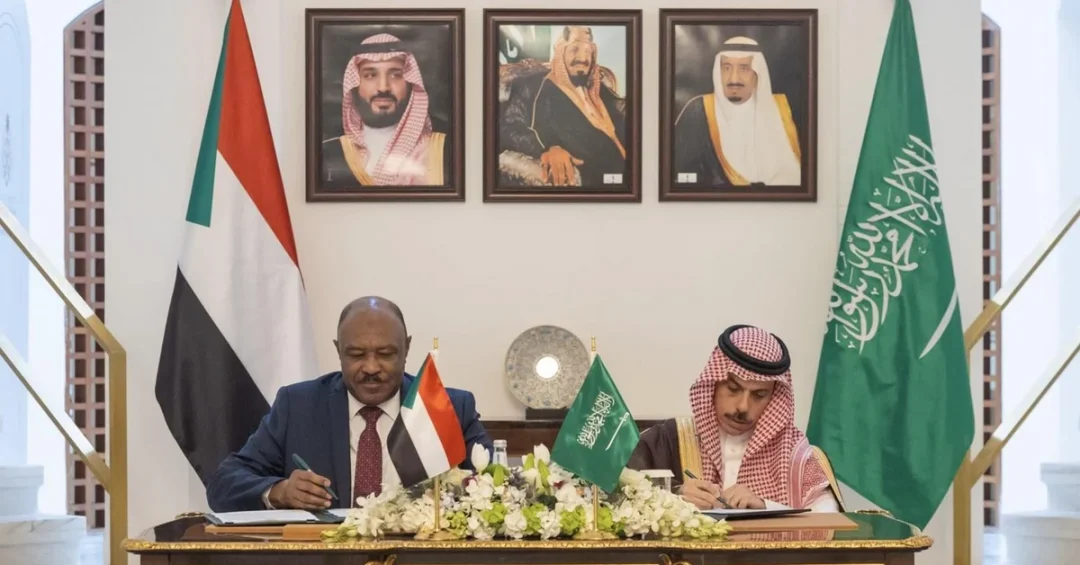
On August 17, 2026, Saudi Arabia and Sudan signed a document establishing a joint coordination council. The agreement was signed in Riyadh by Saudi Foreign Minister Prince Faisal bin Farhan bin Abdullah and Sudan’s Minister of Foreign Affairs and International Cooperation, Mohieddin Salim, according to the official Saudi Press Agency (SPA).
Context and Background
The signing marks a significant step in strengthening bilateral ties between the two brotherly nations. The coordination council aims to institutionalize and enhance cooperation across various sectors, reflecting a shared commitment to mutual interests and regional stability. This development builds on a history of close relations between Saudi Arabia and Sudan, with the Kingdom consistently supporting Sudan’s peace and development efforts.
Key Details
The council will likely facilitate high-level dialogue and collaboration in areas such as politics, economics, security, and culture. While specific areas of focus were not detailed in the announcement, such councils typically align with strategic priorities, including trade, investment, and joint projects. The participation of senior diplomats underscores the importance both governments place on this initiative, which echoes similar frameworks Saudi Arabia has established with other partner countries.
Implications and Impact
From a regional perspective, this agreement signals a renewed commitment to Arab solidarity and cooperation. For Sudan, it provides a channel to deepen ties with a key regional player and potential supporter of its economic recovery and stability. The council may also serve as a platform for addressing shared challenges, including security in the Red Sea region and the Horn of Africa. Saudi Arabia’s role as a stabilizing force in the Middle East is further solidified through such diplomatic mechanisms.
Vision 2030 Alignment
This initiative aligns with Saudi Arabia’s Vision 2030, which emphasizes building strategic partnerships to diversify the economy, enhance international engagement, and promote regional peace and prosperity. By establishing structured cooperation with Sudan, the Kingdom contributes to its broader goals of fostering stability and economic integration in the region, while positioning itself as a hub for diplomacy and coordination. The council is expected to translate into tangible benefits for both nations, advancing mutual interests and upholding the spirit of cooperation that defines Saudi foreign policy.
20 Questions
Q1. What was signed between Saudi Arabia and Sudan on August 17, 2026?
A1. A document establishing the Saudi-Sudanese Coordination Council.
Q2. Who signed the document on behalf of Saudi Arabia?
A2. Saudi Foreign Minister Prince Faisal bin Farhan bin Abdullah.
Q3. Who signed for Sudan?
A3. Sudan’s Minister of Foreign Affairs and International Cooperation, Mohieddin Salim.
Q4. Where was the signing ceremony held?
A4. In the Saudi capital, Riyadh.
Q5. Which official Saudi news agency reported this event?
A5. The Saudi Press Agency (SPA).
Q6. What is the primary purpose of the new council?
A6. To institutionalize and strengthen cooperation between the two countries across various fields.
Q7. Does the council indicate a long-term commitment between Saudi Arabia and Sudan?
A7. Yes, it demonstrates a shared commitment to deepening bilateral ties.
Q8. What historical relationship do Saudi Arabia and Sudan share?
A8. They have a history of close relations, with Saudi Arabia supporting Sudan’s peace and development.
Q9. What areas of cooperation might the council cover?
A9. Likely political, economic, security, and cultural collaboration.
Q10. How might this council affect economic ties between the two nations?
A10. It could enhance trade and investment opportunities, benefiting both economies.
Q11. What regional impact might this agreement have?
A11. It signals Arab solidarity and could foster stability in the Red Sea and Horn of Africa regions.
Q12. How does this relate to Saudi Arabia’s Vision 2030?
A12. It aligns with Vision 2030’s goal of building strategic partnerships and promoting regional peace and prosperity.
Q13. Is the council similar to other Saudi initiatives?
A13. Yes, Saudi Arabia has established similar coordination councils with other partners.
Q14. What might be the next steps after the signing?
A14. The two sides may hold inaugural meetings to define the council’s specific agenda and working groups.
Q15. How does this agreement support Sudan’s development?
A15. It offers a structured platform for Saudi support in Sudan’s recovery and economic growth.
Q16. Are there any specific projects mentioned?
A16. No specific projects were announced; details are expected later.
Q17. What does this say about Saudi foreign policy?
A17. It underscores Saudi Arabia’s active role in fostering regional cooperation and stability.
Q18. How can the council enhance cultural ties?
A18. It may promote cultural exchanges, people-to-people contacts, and mutual understanding.
Q19. Is there a specified high-level representation for the council?
A19. The foreign ministers signed, indicating high-level leadership commitment.
Q20. What is the likely long-term outcome of this coordination?
A20. It is expected to lead to deeper collaboration, with tangible benefits for both nations and the region.
Reader Feedback
We value your thoughts. Please share your feedback on this article.
Your feedback helps us improve our coverage.