


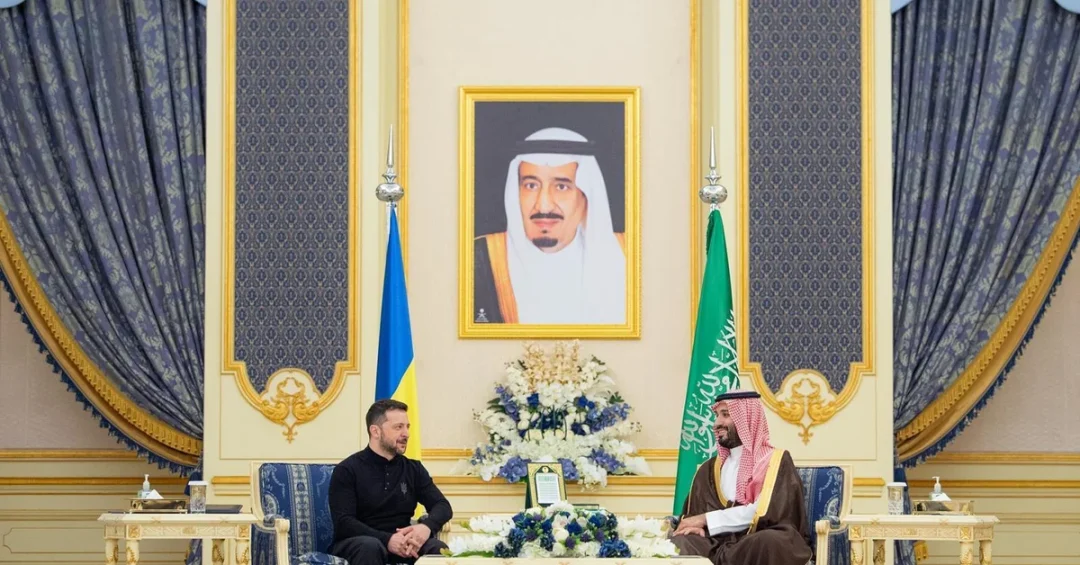
The Kingdom of Saudi Arabia and Ukraine issued a joint statement on March 11, 2025, following the official visit of Ukrainian President Volodymyr Zelenskyy to Jeddah, in which both nations commended their strong economic ties and emphasized the importance of joint action to develop the volume of trade exchange. The statement, released via the Saudi Press Agency (SPA), confirmed that His Royal Highness Prince Mohammed bin Salman bin Abdulaziz Al Saud, Crown Prince and Prime Minister, received President Zelenskyy at Al-Salam Palace in Jeddah on March 10, 2025, where they held an official discussion session reviewing the distinguished relations between the two friendly countries and expressing their shared desire to enhance cooperation across all fields.
Could this high-level diplomatic engagement mark a new chapter in Saudi Arabia’s expanding global economic partnerships? The visit underscores the Kingdom’s growing role as a diplomatic bridge-builder and economic connector, particularly as Riyadh continues to position itself as a hub for international dialogue and investment under Vision 2030. The joint statement highlighted a 9% growth rate in bilateral trade exchange during 2024, signaling deepening commercial ties between the two nations. Both sides welcomed the upcoming reestablishment of the Saudi-Ukrainian Joint Business Council in 2025, a development expected to catalyze private sector engagement and open new avenues for investment collaboration in priority sectors.
Context and Background
What does this joint statement reveal about Saudi Arabia’s evolving diplomatic and economic strategy on the world stage? The meeting between Crown Prince Mohammed bin Salman and President Zelenskyy represents a continuation of the Kingdom’s proactive foreign policy, which prioritizes dialogue, stability, and mutually beneficial economic cooperation. Saudi Arabia has consistently advocated for peaceful resolutions to international conflicts while simultaneously strengthening its economic partnerships across Europe, Asia, and the Middle East. The Jeddah talks reflect this dual commitment, combining diplomatic engagement with concrete economic initiatives.
The joint statement noted that President Zelenskyy congratulated the Crown Prince on Riyadh winning the bid to host World Expo 2030 and the Kingdom winning the bid to host the FIFA World Cup 2034, highlighting the international community’s recognition of Saudi Arabia’s growing stature as a global events hub. These achievements, alongside the economic discussions held in Jeddah, illustrate how the Kingdom is leveraging its diplomatic relationships to advance both its Vision 2030 objectives and broader regional stability. The visit also provided a platform for both nations to exchange views on regional and international issues of mutual concern, reinforcing Saudi Arabia’s role as a trusted mediator and partner in global affairs.
Key Details of the Joint Statement
What specific economic sectors are poised to benefit most from this renewed partnership? The joint statement outlined a comprehensive framework for economic cooperation, with both sides affirming their determination to enhance investment relations by creating promising investment and economic partnerships in priority sectors. These include energy, food industries, and infrastructure, areas where Saudi Arabia’s Vision 2030 projects and Ukraine’s reconstruction programs offer complementary opportunities for collaboration. The two nations agreed on the need to overcome challenges facing the development of trade relations and emphasized the importance of intensifying official visits, mutual trade, and investment delegations.
Furthermore, the statement expressed both sides’ aspiration to discuss cooperation opportunities in the fields of oil, gas, their derivatives, and petrochemicals, reflecting Saudi Arabia’s continued leadership in global energy markets. The two officials also welcomed the expansion of private sector involvement through investment partnerships in the agricultural sector and food industries, agreeing on the importance of enhancing cooperation in agriculture and food security. The reestablishment of the Saudi-Ukrainian Joint Business Council in 2025 was specifically welcomed as a mechanism to empower the private sector, create an appropriate investment environment, and address any challenges facing investors.
The joint statement also addressed diplomatic and humanitarian dimensions. The Saudi side expressed its hope that efforts to achieve comprehensive, just, and lasting peace in Ukraine will be successful in ending the war in line with international law and the UN Charter, including respect for the principles of sovereignty and internationally recognized borders. The Ukrainian side expressed its appreciation for the Kingdom’s efforts in this regard and gratitude for the humanitarian and development aid provided by Saudi Arabia to Ukraine. This mutual recognition underscores the Kingdom’s commitment to both economic prosperity and humanitarian responsibility.
International and Regional Impact
How might this strengthened Saudi-Ukrainian partnership influence broader regional dynamics and global economic trends? The joint statement sends a clear signal that Saudi Arabia remains a pivotal player in international diplomacy, capable of maintaining constructive relationships with diverse global actors while advancing its own economic interests. By hosting President Zelenskyy and facilitating substantive discussions on trade, investment, and peace efforts, the Kingdom reinforces its position as a neutral and respected mediator in complex geopolitical landscapes. This approach aligns with Saudi Arabia’s long-standing policy of promoting stability and dialogue in international affairs.
Regionally, the visit highlights the Kingdom’s ability to attract high-level engagement from European leaders, further integrating Saudi Arabia into global economic and security frameworks. The emphasis on trade growth, joint investment projects, and private sector collaboration demonstrates that Saudi Arabia is not only a regional power but also a global economic partner. For international audiences, this development signals that the Kingdom is open for business, committed to peace, and dedicated to fostering partnerships that drive mutual prosperity. The joint statement’s focus on food security, energy cooperation, and infrastructure also resonates with broader global priorities, positioning Saudi Arabia as a constructive contributor to international challenges.
Economic and Strategic Significance
What does a 9% growth in trade volume between Saudi Arabia and Ukraine signify for the Kingdom’s economic diversification goals? This growth, achieved in 2024, reflects the resilience and potential of bilateral commercial relations even amid global economic uncertainties. The joint statement’s emphasis on overcoming trade challenges, intensifying official visits, and encouraging joint projects indicates a strategic intent to build on this momentum. For Saudi Arabia, expanding trade with Ukraine offers access to agricultural products, food industries, and infrastructure expertise, which complement the Kingdom’s Vision 2030 objectives of economic diversification and food security.
The reestablishment of the Saudi-Ukrainian Joint Business Council in 2025 is a concrete step toward institutionalizing private sector cooperation. By facilitating workshops, exchanging visits, and holding joint investment forums, the Council will provide a structured platform for businesses from both countries to explore opportunities and address obstacles. This initiative aligns with Vision 2030’s goal of increasing foreign investment and enhancing the role of the private sector in driving economic growth. Moreover, cooperation in oil, gas, and petrochemicals underscores Saudi Arabia’s continued centrality in global energy markets, while partnerships in agriculture and food security address critical needs for both nations.
Vision 2030 Alignment
How does this joint statement exemplify Saudi Arabia’s Vision 2030 ambitions on the global stage? The visit and the resulting agreements reflect several core pillars of Vision 2030, including economic diversification, international partnership, and the Kingdom’s emergence as a global hub for diplomacy and investment. By deepening ties with Ukraine, Saudi Arabia not only expands its trade and investment portfolio but also reinforces its commitment to peace, stability, and humanitarian values. The Crown Prince’s leadership in receiving President Zelenskyy and advancing these discussions demonstrates the Kingdom’s proactive approach to international engagement.
Looking ahead, the reestablished Business Council, the focus on priority sectors, and the shared commitment to overcoming trade barriers will likely yield tangible benefits for both economies. For Saudi Arabia, these developments contribute to the broader goal of transforming the Kingdom into a diversified, knowledge-based economy connected to global markets. As Vision 2030 progresses, partnerships like this one will continue to showcase Saudi Arabia’s role as a responsible global leader, dedicated to fostering prosperity at home and abroad. The joint statement is not merely a diplomatic formality; it is a roadmap for collaborative growth that aligns with the Kingdom’s long-term vision and its enduring commitment to international cooperation.
20 Questions
Q1. When did Ukrainian President Volodymyr Zelenskyy visit Saudi Arabia?
A1. President Zelenskyy paid an official visit to the Kingdom of Saudi Arabia on March 10, 2025, as stated in the joint statement released via the Saudi Press Agency.
Q2. Who received President Zelenskyy in Jeddah?
A2. His Royal Highness Prince Mohammed bin Salman bin Abdulaziz Al Saud, Crown Prince and Prime Minister, received President Zelenskyy at Al-Salam Palace in Jeddah.
Q3. What was the growth rate of trade exchange between Saudi Arabia and Ukraine in 2024?
A3. The joint statement noted that the volume of trade exchange between the two countries reached a growth rate of 9% in 2024, reflecting strong economic ties.
Q4. What is the Saudi-Ukrainian Joint Business Council?
A4. It is a bilateral body that both nations welcomed reestablishing in 2025 to enhance private sector cooperation, investment, and trade between Saudi Arabia and Ukraine.
Q5. Which priority sectors were identified for investment partnerships?
A5. The joint statement identified energy, food industries, and infrastructure as priority sectors for creating promising investment and economic partnerships between the two countries.
Q6. What did President Zelenskyy congratulate the Crown Prince on?
A6. President Zelenskyy congratulated the Crown Prince on Riyadh winning the bid to host World Expo 2030 and the Kingdom winning the bid to host the FIFA World Cup 2034.
Q7. What did the two sides express regarding peace in Ukraine?
A7. The Saudi side expressed hope for a comprehensive, just, and lasting peace in Ukraine, in line with international law and the UN Charter, ending the war and its negative repercussions.
Q8. How did Ukraine respond to Saudi Arabia’s peace efforts?
A8. The Ukrainian side expressed appreciation for the Kingdom’s efforts and gratitude for the humanitarian and development aid provided by Saudi Arabia to Ukraine.
Q9. What fields of energy cooperation were discussed?
A9. The two sides expressed aspiration to discuss cooperation opportunities in oil, gas, their derivatives, and petrochemicals, reflecting Saudi Arabia’s leadership in global energy markets.
Q10. What role does agriculture and food security play in the partnership?
A10. Both sides welcomed expanding private sector involvement in agriculture and food industries, agreeing on the importance of enhancing cooperation in agriculture and food security.
Q11. What mechanisms will support public-private communication?
A11. The joint statement welcomed continuous communication through workshops, exchanging visits, holding joint investment forums and events, and empowering the private sector.
Q12. What challenges did the two sides agree to address?
A12. They agreed on the need to overcome challenges facing the development of trade relations and to address any challenges facing investors in both countries.
Q13. How does this visit align with Saudi Arabia’s Vision 2030?
A13. The visit aligns with Vision 2030 by promoting economic diversification, international partnerships, and positioning Saudi Arabia as a global hub for diplomacy and investment.
Q14. What did the joint statement say about official visits and delegations?
A14. The statement emphasized the importance of intensifying official visits, mutual trade, and investment delegations to encourage joint projects and explore opportunities.
Q15. What did the two sides review regarding regional and international issues?
A15. They discussed the latest developments of issues of common interest and exchanged views on regional and international issues of concern to both countries.
Q16. What did the Saudi side hope to achieve regarding the war in Ukraine?
A16. The Saudi side hoped efforts would succeed in ending the war, stopping human suffering, achieving nuclear and food security, protecting the environment, and demining territories.
Q17. What did President Zelenskyy express at the conclusion of the visit?
A17. President Zelenskyy expressed gratitude and appreciation to the Crown Prince for the warm reception and generous hospitality extended to him and his accompanying delegation.
Q18. What did the Crown Prince convey to President Zelenskyy?
A18. HRH the Crown Prince conveyed his best wishes for good health and well-being to President Zelenskyy and continued progress and prosperity to the friendly Ukrainian people.
Q19. Which Saudi projects were highlighted as opportunities for cooperation?
A19. The joint statement highlighted the projects of the Kingdom’s Vision 2030 and Ukraine’s reconstruction programs as opportunities for joint cooperation and investment.
Q20. What is the significance of the Saudi-Ukrainian Business Council reestablishment?
A20. It signifies a renewed commitment to private sector collaboration, creating an appropriate investment environment, and addressing challenges to boost trade and economic ties.
Reader Feedback
We value your thoughts. Please share your feedback on this article.
Your feedback helps us improve our coverage.
Related articles
 Shura Council Highlights Saudi Women’s Empowerment at CSW69
 Saudi Arabia Condemns Israeli Electricity Blackout in Gaza as Collective Punishment
 Saudi Architecture Commission, USGBC Sign Green Building Deal
 Riyadh Season Wins Media Excellence Award
 MWL Condemns Gaza Electricity Cutoff, Urges Global Action
 GCC Chief Praises Syria Institution Integration Deal