


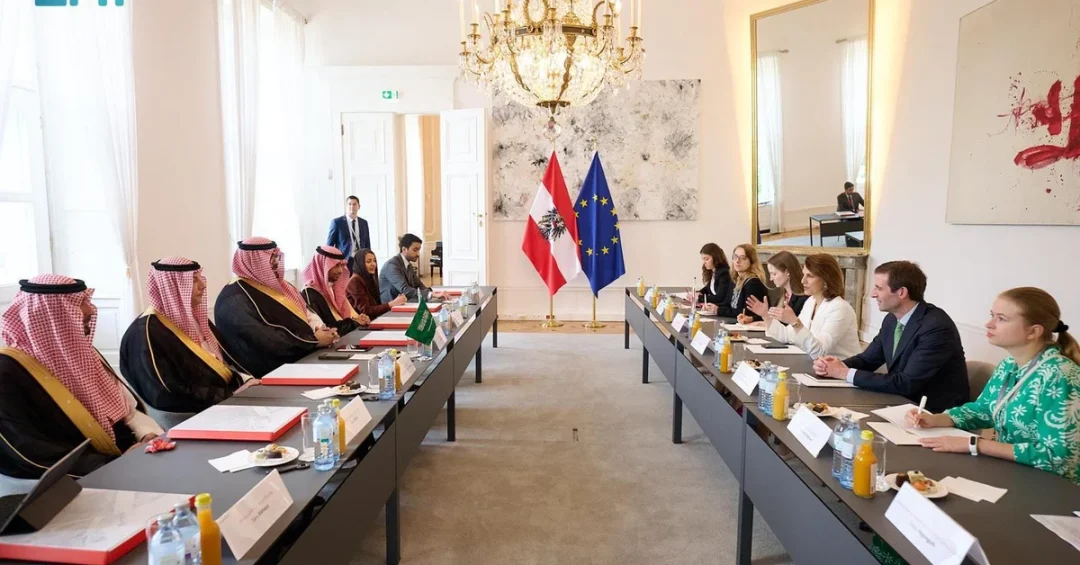
Saudi Minister of Economy and Planning Faisal Alibrahim met with Austria’s Federal Minister for the EU and the Constitution Karoline Edtstadler on the sidelines of the Saudi-Austrian Joint Committee meeting in Vienna on May 29, 2024, as reported by the Saudi Press Agency (SPA). The two ministers discussed bilateral ties and explored avenues to strengthen economic cooperation between the Kingdom of Saudi Arabia and the Republic of Austria, underscoring the growing partnership between the two nations.
Context and Background
The meeting took place during the Saudi-Austrian Joint Committee, a platform designed to enhance collaboration across various sectors. This engagement aligns with Saudi Arabia’s Vision 2030, which seeks to diversify the economy and foster international partnerships. Austria, as a member of the European Union, represents a key European partner for the Kingdom, and the discussions reflect the mutual interest in expanding trade, investment, and knowledge exchange. The Joint Committee serves as a vital mechanism for advancing diplomatic and economic relations, building on historical ties and shared goals.
Key Details
During the meeting, Minister Faisal Alibrahim and Minister Karoline Edtstadler reviewed the current state of bilateral relations and identified opportunities to deepen economic cooperation. While specific outcomes were not disclosed, the dialogue is part of ongoing efforts to enhance collaboration in areas such as trade, technology, renewable energy, and tourism. The Saudi-Austrian Joint Committee provides a structured framework for such discussions, facilitating regular exchanges and joint initiatives. The ministers’ engagement highlights the importance both countries place on fostering a dynamic economic partnership.
Implications and Impact
This meeting carries significant implications for regional and international relations. For Saudi Arabia, strengthened ties with Austria can open doors to broader European markets, attract investment, and facilitate technology transfer, supporting the Kingdom’s economic diversification goals. For Austria, enhanced cooperation with Saudi Arabia offers access to one of the Middle East’s largest economies and a gateway to the Gulf region. The dialogue also underscores Saudi Arabia’s proactive diplomacy in Europe, reinforcing its role as a global economic player. As Vision 2030 progresses, such partnerships are essential for sustainable growth and innovation.
Vision 2030 Alignment
The discussions between Minister Alibrahim and Minister Edtstadler exemplify Saudi Arabia’s commitment to Vision 2030, which aims to transform the Kingdom into a diversified, innovation-driven economy. By forging strong international alliances, Saudi Arabia seeks to boost non-oil sectors, create jobs, and enhance its global competitiveness. This meeting not only advances Saudi-Austrian relations but also contributes to the broader objectives of economic prosperity and international cooperation, positioning the Kingdom as a leader in the global economy.
20 Questions
Q1. Who met on May 29, 2024, to discuss economic ties?
A1. Saudi Minister of Economy and Planning Faisal Alibrahim met with Austria’s Federal Minister for the EU and the Constitution Karoline Edtstadler in Vienna.
Q2. What was the main purpose of the meeting?
A2. The meeting aimed to discuss bilateral ties and explore ways to strengthen economic cooperation between Saudi Arabia and Austria.
Q3. Where did the meeting take place?
A3. The meeting was held in Vienna, Austria, on the sidelines of the Saudi-Austrian Joint Committee meeting.
Q4. What is the Saudi-Austrian Joint Committee?
A4. It is a bilateral platform designed to enhance collaboration across various sectors and advance diplomatic and economic relations between the two countries.
Q5. How does this meeting relate to Saudi Vision 2030?
A5. It supports Vision 2030’s goal of economic diversification by fostering international partnerships that attract investment and promote non-oil sectors.
Q6. What sectors were likely discussed for cooperation?
A6. Potential areas include trade, investment, technology, renewable energy, and tourism, aligning with both nations’ economic interests.
Q7. Who is Faisal Alibrahim?
A7. Faisal Alibrahim is the Saudi Minister of Economy and Planning, responsible for driving the Kingdom’s economic development and Vision 2030 initiatives.
Q8. Who is Karoline Edtstadler?
A8. Karoline Edtstadler is Austria’s Federal Minister for the EU and the Constitution, representing Austria in European affairs and constitutional matters.
Q9. What is the significance of Saudi-Austrian relations?
A9. They enhance economic cooperation, provide access to markets, and support Saudi Arabia’s global engagement and Austria’s ties with the Gulf region.
Q10. How often does the Saudi-Austrian Joint Committee meet?
A10. The committee meets periodically to review progress and set new goals for cooperation, though specific frequency is not detailed in the source.
Q11. What benefits does Austria gain from this partnership?
A11. Austria gains access to Saudi Arabia’s large economy, investment opportunities, and a strategic partner in the Middle East.
Q12. What benefits does Saudi Arabia gain?
A12. Saudi Arabia gains access to European markets, technology transfer, and investment, supporting its economic diversification goals.
Q13. Was any agreement signed during the meeting?
A13. No specific agreements were announced; the meeting focused on discussing ties and means to strengthen economic cooperation.
Q14. How does this meeting fit into Saudi Arabia’s foreign policy?
A14. It reflects Saudi Arabia’s proactive diplomacy in Europe, building partnerships that support Vision 2030 and global economic integration.
Q15. What role does the EU play in Saudi Arabia’s economic strategy?
A15. The EU is a key partner for trade, investment, and technology, and Saudi Arabia seeks to deepen ties with EU member states like Austria.
Q16. What is the expected outcome of the Joint Committee meeting?
A16. The meeting aims to enhance bilateral cooperation, identify new opportunities, and strengthen economic ties between Saudi Arabia and Austria.
Q17. How does this meeting impact regional stability?
A17. By fostering economic cooperation, it promotes mutual understanding and stability, contributing to a more interconnected and prosperous region.
Q18. What message does this send to other European nations?
A18. It signals Saudi Arabia’s openness to partnerships and its commitment to Vision 2030, encouraging further European engagement.
Q19. What are the long-term goals of Saudi-Austrian cooperation?
A19. Long-term goals include sustainable economic growth, innovation, and diversified trade, aligning with Vision 2030 and Austria’s economic interests.
Q20. How can businesses from both countries benefit?
A20. Businesses can explore joint ventures, trade opportunities, and investment prospects, supported by the strengthened bilateral framework.
Reader Feedback
We value your thoughts. Please share your feedback on this article.
Your feedback helps us improve our coverage.