


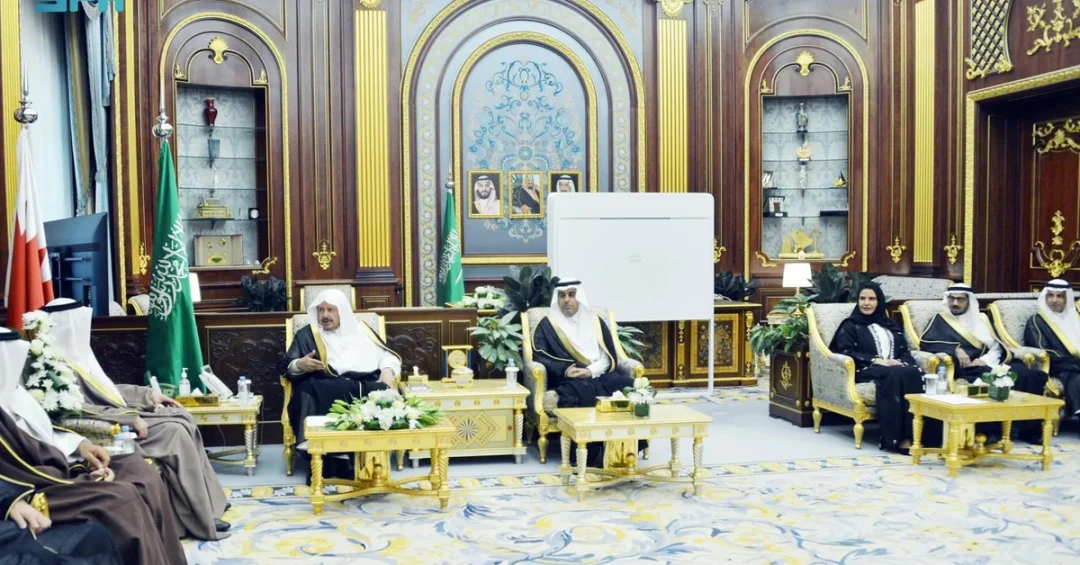
Saudi Shura Council Speaker Sheikh Dr. Abdullah bin Mohammed bin Ibrahim Al Al-Sheikh held official talks with Speaker of Bahrain’s Council of Representatives Ahmed bin Salman Al-Musallam in Riyadh on October 8, 2024, reaffirming the deep fraternal ties between the Kingdom of Saudi Arabia and the Kingdom of Bahrain. The meeting, held at the Shura Council headquarters, was part of Al-Musallam’s official visit to the Kingdom, heading a delegation from Bahrain’s Council of Representatives. Both leaders underscored the importance of enhancing parliamentary cooperation to serve the shared interests of their nations.
Context and Background
The relationship between Saudi Arabia and Bahrain is rooted in decades of close cooperation, strengthened by shared leadership and common goals. The talks reflect the frequent high-level exchanges between the two brotherly countries, which have consistently advanced bilateral relations across political, economic, and social domains. Sheikh Dr. Abdullah Al Al-Sheikh noted that these ties have become a model of cooperation, guided by the vision of Custodian of the Two Holy Mosques King Salman bin Abdulaziz Al Saud, His Royal Highness Prince Mohammed bin Salman bin Abdulaziz Al Saud, Crown Prince and Prime Minister, King Hamad bin Isa Al Khalifa of Bahrain, and Bahrain’s Crown Prince and Prime Minister Salman bin Hamad Al Khalifa.
Key Details
During the session, Al Al-Sheikh welcomed Al-Musallam and his delegation, stressing the importance of the historic relations between the two kingdoms. He highlighted the strong relationship between the Shura Council and Bahrain’s Council of Representatives, reiterating continuous cooperation that fulfils the aspirations of both countries’ leadership. For his part, Al-Musallam praised the distinguished relations between the leaderships and peoples of both nations, calling for boosting parliamentary relations to further enhance bilateral ties. He also stressed Saudi Arabia’s pivotal role in supporting security and stability in the region and the world, adding that Bahraini-Saudi relations serve as a model of close cooperation. The two sides discussed several topics of mutual interest and ways to enhance cooperation between the two councils. Following the talks, Al Al-Sheikh hosted a lunch banquet in honour of Al-Musallam and his delegation.
Implications and Impact
The meeting underscores the enduring partnership between Saudi Arabia and Bahrain, two key allies in the Gulf region. Enhanced parliamentary cooperation can lead to greater coordination on regional issues, including security, economic development, and diplomatic initiatives. Saudi Arabia’s leadership in promoting stability and prosperity resonates with Bahrain’s own developmental goals, and the strengthened ties are expected to yield benefits not only for the two nations but also for the broader Gulf and Arab world. The visit also highlights the role of parliamentary diplomacy in fostering mutual understanding and addressing shared challenges.
Vision 2030 Alignment
This development aligns with Saudi Arabia’s Vision 2030, which seeks to deepen international partnerships and enhance the Kingdom’s global engagement. By strengthening ties with Bahrain, Saudi Arabia advances its objectives of regional stability, economic diversification, and knowledge exchange. The Shura Council’s active role in parliamentary diplomacy supports Vision 2030’s aim of a vibrant society and a prosperous economy, reinforcing Saudi Arabia’s position as a leader in the region and beyond.
20 Questions
Q1. Who held the official talks in Riyadh?
A1. The talks were held between Sheikh Dr. Abdullah bin Mohammed bin Ibrahim Al Al-Sheikh, Speaker of the Saudi Shura Council, and Ahmed bin Salman Al-Musallam, Speaker of Bahrain’s Council of Representatives.
Q2. When did the talks take place?
A2. The talks took place on October 8, 2024, at the Shura Council headquarters in Riyadh, as part of Al-Musallam’s official visit to Saudi Arabia.
Q3. What was the purpose of Al-Musallam’s visit?
A3. Al-Musallam led a delegation from Bahrain’s Council of Representatives on an official visit to Saudi Arabia to strengthen parliamentary relations and discuss mutual interests.
Q4. What did Al Al-Sheikh emphasize during the talks?
A4. He stressed the importance of Saudi-Bahraini relations, reflected in frequent high-level visits, and highlighted the historic and brotherly ties between the two nations.
Q5. How did Al Al-Sheikh describe the relations between the two countries?
A5. He described them as historic and brotherly, having progressed in all areas and serving as a model of cooperation under the guidance of both countries’ leadership.
Q6. Which leaders did Al Al-Sheikh mention as guiding the bilateral relations?
A6. He mentioned Custodian of the Two Holy Mosques King Salman bin Abdulaziz Al Saud, Crown Prince Mohammed bin Salman, King Hamad bin Isa Al Khalifa, and Bahrain’s Crown Prince Salman bin Hamad Al Khalifa.
Q7. What did Al-Musallam say about Saudi-Bahraini relations?
A7. He praised the distinguished relations between the leaderships and peoples, calling them a model of close cooperation and stressing Saudi Arabia’s pivotal role in regional and global security.
Q8. What did Al-Musallam call for regarding parliamentary relations?
A8. He called for boosting parliamentary relations between the Shura Council and Bahrain’s Council of Representatives to further enhance bilateral ties at all levels.
Q9. What topics were discussed during the session?
A9. Both sides discussed several topics of mutual interest and ways to enhance cooperation between the two councils, focusing on parliamentary collaboration.
Q10. What happened after the talks?
A10. Following the talks, Al Al-Sheikh hosted a lunch banquet in honour of Al-Musallam and his accompanying delegation.
Q11. Why are Saudi-Bahraini relations considered a model?
A11. They are considered a model due to frequent high-level visits, continuous cooperation, and shared aspirations under the guidance of both countries’ leadership, leading to progress in all areas.
Q12. How does this visit impact regional stability?
A12. The visit strengthens parliamentary cooperation and reaffirms Saudi Arabia’s role in supporting security and stability in the region and the world, promoting unity among Gulf nations.
Q13. What is the significance of the Shura Council in Saudi Arabia?
A13. The Shura Council is the formal advisory body that engages in parliamentary diplomacy, contributing to Saudi Arabia’s international relations and supporting Vision 2030 objectives.
Q14. How does this meeting align with Saudi Vision 2030?
A14. It aligns by deepening international partnerships, enhancing regional stability, and promoting economic diversification and knowledge exchange, key pillars of Vision 2030.
Q15. What role does parliamentary diplomacy play in Saudi-Bahraini relations?
A15. Parliamentary diplomacy fosters mutual understanding, addresses shared challenges, and strengthens legislative cooperation, complementing official diplomatic efforts between the two kingdoms.
Q16. What did Al-Musallam say about Saudi Arabia’s regional role?
A16. He stressed Saudi Arabia’s pivotal role in supporting security and stability in the region and the world, highlighting the Kingdom’s leadership in fostering peace.
Q17. How often do Saudi and Bahraini officials meet?
A17. Officials from both countries meet frequently through high-level visits and exchanges, reflecting the depth of their brotherly relations and continuous cooperation.
Q18. What are the expected outcomes of these talks?
A18. The talks are expected to enhance parliamentary cooperation, leading to greater coordination on regional issues and further strengthening bilateral relations across all levels.
Q19. Who accompanied Al-Musallam on his visit?
A19. Al-Musallam was accompanied by a delegation from Bahrain’s Council of Representatives, underscoring the importance of legislative collaboration between the two nations.
Q20. How does this visit reflect the shared aspirations of both nations?
A20. The visit reflects shared aspirations for peace, prosperity, and regional stability, as both nations work together under their leaderships to achieve common goals and strengthen ties.
Reader Feedback
We value your thoughts. Please share your feedback on this article.
Your feedback helps us improve our coverage.