


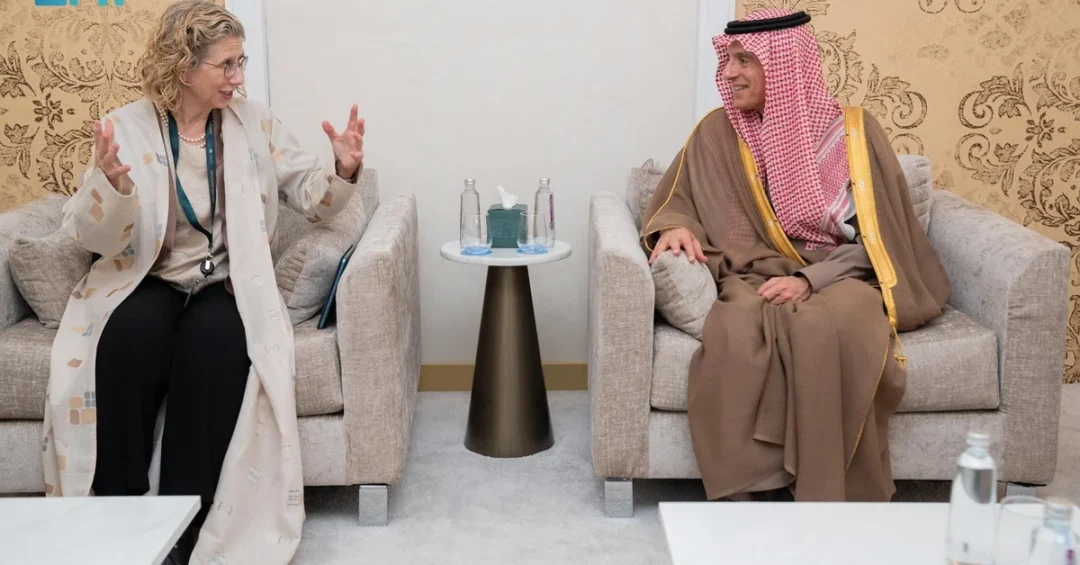
Minister of State for Foreign Affairs, Cabinet Member, and Climate Envoy Adel bin Ahmed Al-Jubeir met with United Nations Environment Programme (UNEP) Executive Director Inger Andersen on the sidelines of the 16th session of the Conference of the Parties (COP16) to the United Nations Convention to Combat Desertification (UNCCD) in Riyadh. The meeting, announced by the Saudi Press Agency, underscored the Kingdom’s expanding role in global environmental diplomacy and reinforced the alignment between Saudi Arabia’s climate agenda and the United Nations’ sustainability mandate. The two officials discussed environmental concerns, climate-change challenges, international initiatives addressing these issues, and key topics set for the conference agenda.
Held in the Saudi capital, COP16 has drawn representatives from nearly 200 countries, making it one of the largest environmental gatherings hosted by the Kingdom in recent years. The meeting between Al-Jubeir and Andersen reflects Saudi Arabia’s commitment to multilateral cooperation on desertification, drought resilience, and land restoration. It also highlights the Kingdom’s growing capacity to convene global stakeholders around issues that directly affect the Middle East and other arid regions. What does this high-level engagement signal about Saudi Arabia’s evolving leadership in global environmental governance?
Context and Background
The 16th session of the Conference of the Parties to the United Nations Convention to Combat Desertification represents a critical milestone in international efforts to address land degradation and drought. Convened in Riyadh, COP16 is the first UNCCD COP held in the Middle East, a region where desertification poses immediate risks to food security, water availability, and economic stability. Saudi Arabia’s hosting of the conference is consistent with its broader environmental strategy, which includes the Saudi Green Initiative and the Middle East Green Initiative, both launched under the leadership of Crown Prince Mohammed bin Salman.
Adel bin Ahmed Al-Jubeir, a veteran diplomat who has served as Saudi Arabia’s Ambassador to the United States and Minister of Foreign Affairs, now carries the portfolio of Minister of State for Foreign Affairs, Cabinet Member, and Climate Envoy. His meeting with Inger Andersen, a Danish economist and environmentalist who has led UNEP since 2019, brought together two figures at the center of global climate and environmental policy. UNEP, established in 1972, is the leading global authority that sets the environmental agenda and promotes sustainable development within the United Nations system.
The timing of the meeting is significant. It occurred as COP16 delegates deliberated on binding commitments to restore degraded land, enhance drought resilience, and mobilize financing for affected communities. Saudi Arabia’s role as host and as a party to the convention has elevated its profile in these negotiations. How can a single diplomatic meeting contribute to the broader outcomes of a global conference? In the context of UNCCD COP16, the answer lies in the ability of senior officials to align national positions, build trust, and catalyze joint initiatives that outlast the conference itself.
Key Details of the Meeting
According to the Saudi Press Agency, Al-Jubeir and Andersen engaged in a discussion about environmental concerns and climate-change challenges, international initiatives addressing these issues, and key topics set for the conference agenda. While the official readout did not disclose specific agreements or new funding pledges, the exchange itself carries diplomatic weight. It places Saudi Arabia’s climate envoy in direct dialogue with the head of the UN’s environmental agency at a moment when the international community is seeking to accelerate progress on land restoration and drought mitigation.
The meeting also reflects the Kingdom’s integrated approach to environmental diplomacy, which links climate action with economic diversification and social development. Saudi Arabia has committed to planting 10 billion trees across the Kingdom and 50 billion trees across the Middle East as part of the Saudi Green Initiative and the Middle East Green Initiative. These programs are designed not only to reduce carbon emissions but also to combat desertification, create green jobs, and improve quality of life. Inger Andersen has previously praised Saudi Arabia’s efforts to restore degraded land and has emphasized the importance of regional cooperation in addressing environmental challenges.
What specific topics were on the conference agenda that Al-Jubeir and Andersen discussed? While the readout does not enumerate them, the UNCCD COP16 agenda includes drought resilience, land tenure, gender-responsive land restoration, and the mobilization of public and private finance. These themes align with Saudi Arabia’s Vision 2030 objectives, particularly those related to environmental sustainability, economic diversification, and international partnership. The meeting thus served as a platform to reinforce shared priorities and to explore avenues for collaboration between the Kingdom and UNEP.
International and Regional Impact
The meeting between Al-Jubeir and Andersen sends a clear message to the international community: Saudi Arabia is not only a participant in global environmental governance but also a proactive convener and bridge-builder. By hosting COP16 and facilitating high-level dialogues, the Kingdom is helping to shape the global agenda on desertification and drought. This role is particularly important for regions such as Africa, Central Asia, and Latin America, where land degradation threatens livelihoods and exacerbates migration and conflict.
Regional impact is equally significant. The Middle East is one of the most water-scarce and desert-prone regions in the world. Saudi Arabia’s leadership in land restoration and drought resilience can serve as a model for neighboring countries. The Middle East Green Initiative, which aims to plant 50 billion trees and reduce carbon emissions from oil production by more than 60 percent, is a testament to the Kingdom’s commitment to regional environmental security. Inger Andersen’s engagement with Saudi officials underscores UNEP’s recognition of these efforts and its willingness to support them through technical expertise and international advocacy.
How does this meeting fit into the broader landscape of Saudi environmental diplomacy? Over the past decade, Saudi Arabia has signed numerous environmental agreements, launched ambitious national programs, and hosted major international conferences, including COP16. These actions have positioned the Kingdom as a credible and constructive partner in global climate negotiations. The Al-Jubeir-Andersen meeting is one node in a growing network of partnerships that connect Saudi Arabia with UN agencies, governments, and civil society organizations. Such networks are essential for translating global goals into local action.
Economic and Strategic Significance
From an economic perspective, the fight against desertification and climate change is closely tied to Saudi Arabia’s long-term prosperity. Land degradation reduces agricultural productivity, increases food imports, and threatens water resources. By investing in land restoration and sustainable land management, the Kingdom can enhance its food security, create new economic opportunities in the green sector, and reduce the environmental footprint of its industries. The meeting between Al-Jubeir and Andersen highlights the economic logic of environmental action, which is embedded in Vision 2030’s goal of a diversified and sustainable economy.
Strategically, Saudi Arabia’s engagement with UNEP and the UNCCD strengthens its position as a responsible global actor. It also complements the Kingdom’s broader foreign policy objectives, which include promoting stability, fostering development, and building partnerships across continents. The presence of a senior Saudi diplomat and climate envoy at COP16, alongside the UNEP Executive Director, demonstrates the Kingdom’s ability to operate at the intersection of diplomacy, environment, and development. This integrated approach is increasingly recognized as essential for addressing complex global challenges.
What does the meeting mean for the future of Saudi-UN cooperation? It signals a deepening relationship that extends beyond traditional diplomatic exchanges. UNEP and Saudi Arabia have collaborated on various initiatives, including the Saudi Green Initiative and the Middle East Green Initiative. The meeting between Al-Jubeir and Andersen likely explored ways to enhance this collaboration, such as through joint research, capacity-building, and knowledge sharing. As the world races to meet the Sustainable Development Goals, partnerships like this one will be crucial for scaling up solutions and ensuring that no region is left behind.
Vision 2030 Alignment
The meeting between Minister of State for Foreign Affairs Adel bin Ahmed Al-Jubeir and UNEP Executive Director Inger Andersen aligns directly with Saudi Vision 2030, the Kingdom’s comprehensive plan to diversify its economy, empower its citizens, and enhance its global standing. Environmental sustainability is a core pillar of Vision 2030, reflected in initiatives such as the Saudi Green Initiative, which aims to plant 10 billion trees, reduce carbon emissions by 278 million tons per annum, and designate 30 percent of Saudi land and sea as protected areas. By engaging with UNEP at COP16, Saudi Arabia is advancing these goals while contributing to global environmental solutions.
Vision 2030 also emphasizes the importance of international cooperation and the Kingdom’s role as a bridge between cultures and economies. The Al-Jubeir-Andersen meeting exemplifies this vision by bringing together Saudi leadership and UN expertise to address shared challenges. It reinforces the Kingdom’s commitment to multilateralism and its willingness to invest in a sustainable future. As Saudi Arabia continues to host major global events, from COP16 to Expo 2030, it is building a legacy of environmental stewardship and diplomatic engagement that will benefit generations to come. What better way to showcase the Kingdom’s transformation than by leading the charge against desertification and climate change? This meeting is a small but meaningful step in that journey.
20 Questions
Q1. Who met with UNEP Executive Director Inger Andersen?
A1. Minister of State for Foreign Affairs, Cabinet Member, and Climate Envoy Adel bin Ahmed Al-Jubeir met with Inger Andersen on the sidelines of COP16 in Riyadh.
Q2. Where did the meeting take place?
A2. The meeting took place in Riyadh, Saudi Arabia, during the 16th session of the Conference of the Parties to the United Nations Convention to Combat Desertification.
Q3. When was the meeting held?
A3. The meeting was held on December 4, 2024, as reported by the Saudi Press Agency.
Q4. What is COP16?
A4. COP16 is the 16th session of the Conference of the Parties to the United Nations Convention to Combat Desertification, a global summit focused on land degradation and drought.
Q5. What topics did Al-Jubeir and Andersen discuss?
A5. They discussed environmental concerns, climate-change challenges, international initiatives addressing these issues, and key topics on the conference agenda.
Q6. What is UNEP?
A6. UNEP is the United Nations Environment Programme, the leading global environmental authority that sets the environmental agenda and promotes sustainable development.
Q7. Who is Inger Andersen?
A7. Inger Andersen is the Executive Director of UNEP, a Danish economist and environmentalist who has led the agency since 2019.
Q8. What is Adel bin Ahmed Al-Jubeir’s role?
A8. He is Saudi Arabia’s Minister of State for Foreign Affairs, a Cabinet Member, and the Kingdom’s Climate Envoy.
Q9. Why is COP16 significant for Saudi Arabia?
A9. COP16 is the first UNCCD COP held in the Middle East, highlighting Saudi Arabia’s growing role in global environmental diplomacy and its commitment to combating desertification.
Q10. How does the meeting relate to the Saudi Green Initiative?
A10. The meeting supports the Saudi Green Initiative’s goals of planting 10 billion trees, reducing emissions, and protecting land and sea areas.
Q11. What is the Middle East Green Initiative?
A11. It is a regional effort led by Saudi Arabia to plant 50 billion trees and reduce carbon emissions across the Middle East.
Q12. What are the key themes of UNCCD COP16?
A12. Key themes include drought resilience, land restoration, sustainable land management, and mobilizing finance for affected communities.
Q13. How does this meeting align with Vision 2030?
A13. It aligns with Vision 2030’s environmental sustainability goals and the Kingdom’s commitment to international cooperation and multilateralism.
Q14. What impact could this meeting have on regional environmental policy?
A14. It strengthens regional cooperation on desertification and drought, positioning Saudi Arabia as a leader in environmental action in the Middle East.
Q15. Did the meeting produce any new agreements?
A15. The official readout did not announce new agreements, but the dialogue reinforced shared priorities and explored avenues for collaboration.
Q16. How does Saudi Arabia benefit economically from environmental action?
A16. Environmental action enhances food security, creates green jobs, and supports economic diversification, all of which are central to Vision 2030.
Q17. What is the role of the Saudi Press Agency in this context?
A17. The Saudi Press Agency is the official news agency of Saudi Arabia, providing authoritative information about government activities and international engagements.
Q18. How does UNEP support Saudi Arabia’s environmental efforts?
A18. UNEP provides technical expertise, international advocacy, and a platform for collaboration on initiatives like the Saudi Green Initiative.
Q19. What are the expected outcomes of COP16?
A19. COP16 aims to secure commitments to restore degraded land, enhance drought resilience, and increase financing for sustainable land management.
Q20. How can international audiences learn more about Saudi Arabia’s environmental initiatives?
A20. They can follow official Saudi channels such as the Saudi Press Agency, ministry websites, and ksa.com for accurate and up-to-date information.
Reader Feedback
We value your thoughts. Please share your feedback on this article.
Your feedback helps us improve our coverage.
Related articles
 Ministry of Interior Wins First Place for Best Security Awareness Films
 Saudi COP16 Presidency Mobilizes Private Sector for Land Restoration
 Saudi Arabia Weather Forecast for Thursday: Winds, Rain, Fog
 KAUST Tops THE Arab University Rankings for Second Year
 Saudi Green Initiative Forum Concludes with Major Commitments
 Al Rabeeah Spotlights KSrelief’s Global Humanitarian Work at Madinah Heart Conference