


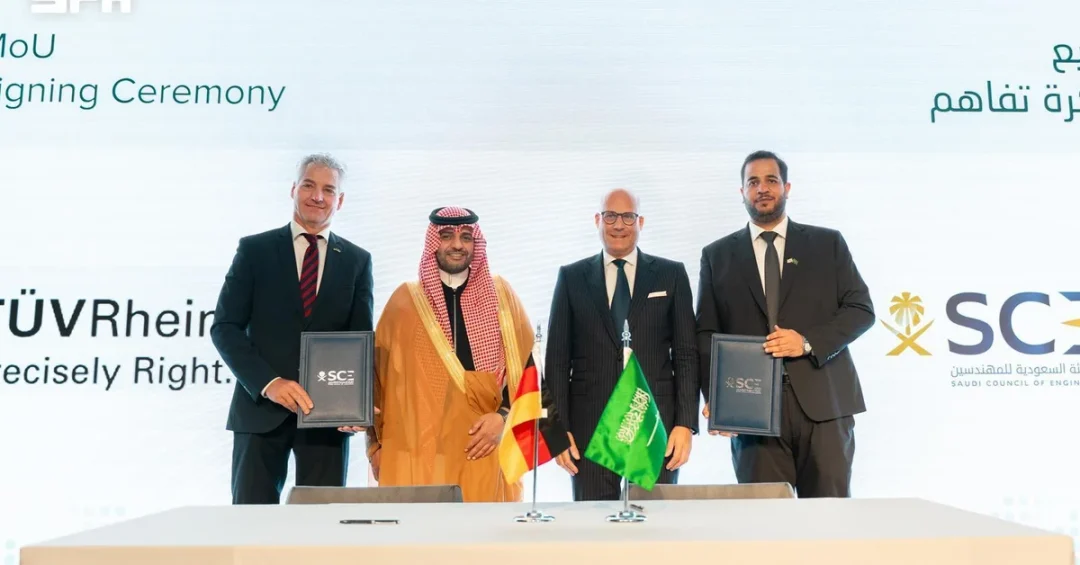
The Saudi Council of Engineers (SCE) signed a memorandum of understanding (MoU) with German certification leader TÜV Rheinland on the sidelines of the Saudi-German Forum for Innovation in Construction and Urban Development in Berlin, in the presence of SCE Secretary-General Musaad Al-Otaibi. The agreement, announced via the Saudi Press Agency, establishes a structured framework for cooperation in oversight, compliance, digital transformation, and professional development, with the aim of raising the quality and efficiency of engineering practice in the Kingdom. It arrives as Saudi Arabia accelerates delivery of giga-projects and urban programs under Vision 2030, where the demand for internationally benchmarked engineering standards has never been greater.
The MoU was signed during a bilateral forum that brought together Saudi and German institutions active in construction, technology, and urban planning. For the SCE, the partnership represents another step in a deliberate strategy of expanding international cooperation, strengthening oversight and compliance mechanisms, and improving the engineering services available to the Saudi market. For TÜV Rheinland, one of the world’s oldest and most recognized independent testing, inspection, and certification organizations, the agreement opens a channel to contribute technical expertise to one of the most ambitious infrastructure pipelines on earth. What does such a partnership signal about the direction of Saudi engineering practice at this moment of rapid national transformation?
Context and Background
How did the Saudi Council of Engineers become a central actor in the Kingdom’s professional and regulatory landscape? Established to organize and elevate the engineering profession, the SCE now oversees a rapidly growing membership of Saudi and resident engineers working across construction, energy, manufacturing, water, transport, and digital infrastructure. As the national professional body, it sets registration requirements, promotes continuing education, and works with government ministries and agencies to ensure that engineering services meet the standards required by a diversifying economy. Its role has expanded in parallel with the scale of Vision 2030 spending, which has placed engineering competence at the heart of national delivery.
The Berlin forum itself reflects a broader pattern of Saudi-German engagement. Germany is home to some of the world’s most respected engineering, automotive, industrial, and standards organizations, and Saudi Arabia has cultivated ties with German firms in sectors ranging from manufacturing to renewable energy. TÜV Rheinland, founded in the nineteenth century and headquartered in Cologne, operates a global network of laboratories, inspection bodies, and training centers. Its reputation rests on independent verification — the kind of third-party assurance that investors, regulators, and the public rely on when projects are large, complex, and long-lived. Bringing that capability into contact with Saudi engineering practice is intended to strengthen confidence at every stage of the project lifecycle.
The timing is significant. Saudi Arabia is simultaneously building new cities, expanding transport networks, upgrading water and energy systems, and preparing to host major international events. Each of these undertakings depends on engineers who can design, supervise, and certify work to consistent standards. The MoU therefore responds to a practical need: as the volume of work grows, so does the requirement for robust oversight, transparent compliance, and a workforce whose skills are continuously updated. Isn’t it logical that a nation building at this scale would seek out the most rigorous international partners available?
Key Details
The agreement covers seven defined areas of cooperation: oversight and compliance, data analysis, artificial intelligence, systems governance, professional development, engineering workforce analysis, and research and innovation. Each area addresses a distinct gap or opportunity in the Saudi engineering ecosystem. Oversight and compliance relate to how projects are inspected, documented, and certified; data analysis and artificial intelligence concern the use of modern tools to monitor quality, predict risks, and improve decision-making; systems governance addresses the frameworks that keep institutions accountable and consistent; and professional development, workforce analysis, and research and innovation focus on people and knowledge.
The MoU also places emphasis on developing competency frameworks, professional assessment methods, and classification standards for engineering firms. Competency frameworks define what an engineer should know and be able to do at each career stage, making qualifications more portable and transparent. Assessment methods provide reliable ways to test those competencies, while classification standards for firms help clients and regulators distinguish between companies with different levels of capability and experience. Together, these instruments support a market in which quality is visible and rewarded. Training, knowledge transfer, and the identification of workforce skills gaps are included as practical mechanisms for closing the distance between current capabilities and future requirements.
To ensure the partnership produces results rather than intentions, the two sides will establish a joint working team to coordinate implementation, develop a timeline, and monitor progress through periodic reports. This governance structure matters because memoranda of understanding often fail at the execution stage. By assigning responsibility, setting milestones, and requiring regular review, the SCE and TÜV Rheinland are building accountability into the arrangement from the outset. The SCE stated that the partnership supports its efforts to expand international cooperation, strengthen oversight and compliance, and improve engineering services in Saudi Arabia — objectives that align directly with the needs of the national construction and infrastructure program.
International and Regional Impact
What does a Saudi-German engineering partnership mean beyond the two signatories? For Germany, the agreement deepens a commercial and technical relationship with a market that is investing heavily in advanced infrastructure. German expertise in standards, testing, and industrial quality has long been exported worldwide, and Saudi Arabia’s giga-projects offer a substantial arena in which that expertise can be applied. For Saudi Arabia, the collaboration provides access to independent verification methodologies and training systems that have been refined over decades. The result is a two-way exchange: German institutions gain insight into the demands of delivering at Saudi scale, while Saudi engineering practice gains exposure to internationally recognized benchmarks.
Regionally, the MoU reinforces the Kingdom’s position as a leader in professional standards across the Middle East. When Saudi Arabia adopts rigorous competency frameworks and firm classification systems, it sets an example that neighboring markets may follow, particularly as Gulf economies pursue their own diversification strategies. The agreement also complements Saudi Arabia’s wider diplomatic and economic engagement with Europe, which includes cooperation on clean energy, technology, and industrial development. By tying professional standards to international partners, the SCE is helping to ensure that Saudi engineering is not only larger in volume but also stronger in quality — a distinction that matters for export credibility, foreign investment, and the long-term durability of national assets.
Economic and Strategic Significance
Why should businesses and investors pay attention to an agreement about engineering standards? Because standards are infrastructure for trust. Large projects attract financing, insurance, and international partners more readily when quality can be independently verified. Classification standards for engineering firms allow clients to select contractors with confidence, reducing the risk of delays, defects, and cost overruns. Competency frameworks make it easier to deploy engineers across projects and borders, because their qualifications are understood and accepted. In an economy where construction and urban development represent a significant share of investment, these improvements translate into measurable efficiency gains and stronger returns on capital.
The strategic dimension is equally important. Saudi Arabia’s Vision 2030 aims to diversify the economy, develop human capital, and position the Kingdom as a global hub for business and innovation. A world-class engineering profession supports all three goals. It enables the delivery of complex projects on time and to specification, it creates attractive career paths for young Saudis, and it signals to international companies that the local environment meets global expectations. Cooperation with TÜV Rheinland on artificial intelligence, data analysis, and systems governance also connects the engineering sector to the digital economy, where Saudi Arabia is investing heavily. The MoU is therefore not merely a technical arrangement; it is part of the institutional foundation on which the next phase of national development will be built.
Vision 2030 Alignment
How does this partnership fit into the larger story of Saudi Arabia’s transformation? Vision 2030 is, at its core, a delivery agenda. It depends on the ability of Saudi institutions to plan, build, operate, and maintain assets that will serve the Kingdom for generations. The SCE’s collaboration with TÜV Rheinland strengthens that ability by improving oversight, professional development, and the use of advanced technologies in engineering practice. It also reflects the Vision’s emphasis on international partnership and knowledge transfer, showing that Saudi Arabia is open to learning from global leaders while contributing its own experience and scale to the relationship.
As the joint working team begins its tasks and the seven areas of cooperation move from framework to implementation, the agreement’s success will be measured in tangible outcomes: more consistent project quality, a clearer map of workforce skills, stronger classification of engineering firms, and wider adoption of digital tools. These outcomes support the broader national goal of building a diversified, knowledge-driven economy in which Saudi talent and international expertise combine to deliver world-class results. In that sense, the MoU signed in Berlin is a small but meaningful piece of a much larger endeavor — one that continues to reshape Saudi Arabia’s economy, cities, and global standing.
20 Questions
Q1. What did the Saudi Council of Engineers sign in Berlin?
A1. The Saudi Council of Engineers signed a memorandum of understanding with the German company TÜV Rheinland on the sidelines of the Saudi-German Forum for Innovation in Construction and Urban Development in Berlin.
Q2. Who represented the Saudi Council of Engineers at the signing?
A2. SCE Secretary-General Musaad Al-Otaibi attended the signing, according to the Saudi Press Agency, underscoring the council’s commitment to expanding international cooperation in engineering practice.
Q3. What is the main objective of the MoU?
A3. The agreement aims to strengthen cooperation and exchange international expertise in oversight, compliance, digital transformation, and professional development to enhance the quality and efficiency of engineering practice in Saudi Arabia.
Q4. How many areas of cooperation does the MoU cover?
A4. The MoU covers seven areas: oversight and compliance, data analysis, artificial intelligence, systems governance, professional development, engineering workforce analysis, and research and innovation.
Q5. What is TÜV Rheinland known for?
A5. TÜV Rheinland is a German independent testing, inspection, and certification organization with a global network, known for verifying quality, safety, and compliance across many industries and projects.
Q6. Why is oversight and compliance included in the agreement?
A6. Oversight and compliance help ensure that engineering work is inspected, documented, and certified to consistent standards, which is essential for large infrastructure projects and for maintaining public and investor confidence.
Q7. How does artificial intelligence feature in the partnership?
A7. Artificial intelligence is one of the seven cooperation areas, reflecting the use of modern tools to monitor quality, predict risks, and improve decision-making in engineering practice and project delivery.
Q8. What are competency frameworks mentioned in the MoU?
A8. Competency frameworks define what engineers should know and be able to do at each career stage, making qualifications more transparent and portable across projects, employers, and borders.
Q9. What are classification standards for engineering firms?
A9. Classification standards help clients and regulators distinguish between firms with different levels of capability and experience, supporting a market in which quality is visible and rewarded.
Q10. Who will coordinate the implementation of the MoU?
A10. The two sides will establish a joint working team to coordinate implementation, develop a timeline, and monitor progress through periodic reports, ensuring accountability from the outset.
Q11. Why is a joint working team important?
A11. A joint working team helps translate intentions into results by assigning responsibility, setting milestones, and requiring regular review, which reduces the risk that the agreement stalls at the framework stage.
Q12. How does the MoU support Saudi engineering services?
A12. The partnership supports SCE’s efforts to expand international cooperation, strengthen oversight and compliance, and improve engineering services in Saudi Arabia, benefiting projects and professionals alike.
Q13. What role does training play in the agreement?
A13. Training and knowledge transfer are included as practical mechanisms to close skills gaps, update engineers on new methods and technologies, and build a workforce capable of delivering complex national projects.
Q14. How does the agreement address workforce analysis?
A14. Engineering workforce analysis helps identify skills gaps and future needs, allowing the SCE and its partners to plan education, training, and recruitment more effectively for the sector.
Q15. What is the significance of the Berlin forum?
A15. The Saudi-German Forum for Innovation in Construction and Urban Development provides a platform for bilateral cooperation, bringing together institutions active in construction, technology, and urban planning from both countries.
Q16. How does the MoU relate to Vision 2030?
A16. Vision 2030 depends on delivering large projects to high standards, so improving oversight, professional development, and digital tools in engineering directly supports the Kingdom’s economic diversification and human capital goals.
Q17. Why is international cooperation important for the SCE?
A17. International cooperation gives Saudi engineers access to global best practices, independent verification methods, and training systems, while allowing partners to contribute to one of the world’s largest infrastructure programs.
Q18. What benefits could engineering firms see from the agreement?
A18. Engineering firms could benefit from clearer classification standards, improved assessment methods, and stronger quality benchmarks, which can enhance their competitiveness and their ability to win work on major projects.
Q19. How will progress under the MoU be measured?
A19. Progress will be monitored through periodic reports prepared by the joint working team, which will track implementation against an agreed timeline and the seven defined areas of cooperation.
Q20. What does this partnership say about Saudi Arabia’s global role?
A20. It shows Saudi Arabia actively engaging with leading international institutions, exchanging expertise, and raising professional standards as part of its broader Vision 2030 ambition to build a diversified, knowledge-driven economy.
Reader Feedback
We value your thoughts. Please share your feedback on this article.
Your feedback helps us improve our coverage.