


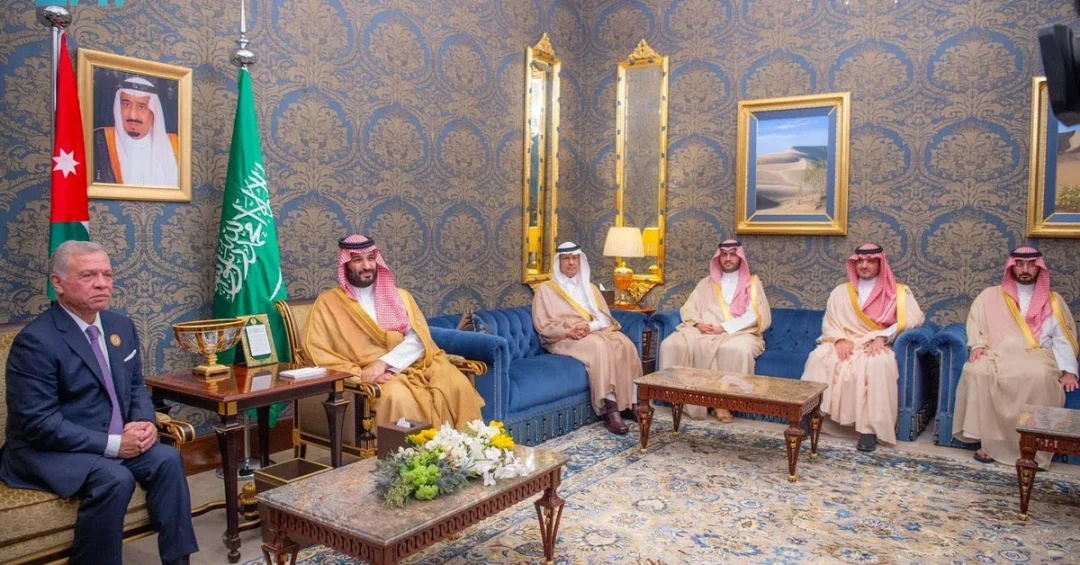
His Royal Highness Prince Mohammed bin Salman bin Abdulaziz Al Saud, Crown Prince and Prime Minister of Saudi Arabia, met with King Abdullah II ibn Al Hussein of the Hashemite Kingdom of Jordan on May 16, 2024, on the sidelines of the 33rd Arab Summit in Manama, Bahrain. The meeting, reported by the Saudi Press Agency (SPA), focused on the latest regional developments, particularly in Gaza, and efforts to achieve peace and stability.
Context and Background
The 33rd Arab Summit convened in Bahrain amid heightened regional tensions, with the conflict in Gaza dominating discussions. Saudi Arabia, under the leadership of the Custodian of the Two Holy Mosques King Salman bin Abdulaziz Al Saud and Crown Prince Mohammed bin Salman, has consistently advocated for a peaceful resolution to the Israeli-Palestinian conflict, emphasizing the need for a two-state solution and the establishment of a Palestinian state with East Jerusalem as its capital.
The meeting between the Crown Prince and King Abdullah underscores the deep-rooted ties between Saudi Arabia and Jordan, both key players in regional diplomacy. Their discussions reflect a shared commitment to addressing pressing challenges and fostering stability in the Middle East.
Key Details
During the meeting, the leaders reviewed the latest developments in Gaza and its surroundings, as well as the ongoing efforts to achieve peace and stability. The conversation highlighted the importance of Arab unity and coordinated action to address the humanitarian crisis in Gaza, including the need for immediate ceasefires and unhindered delivery of humanitarian aid.
The meeting was attended by several senior Saudi officials, including Minister of Energy Prince Abdulaziz bin Salman bin Abdulaziz, Minister of State and Cabinet Member Prince Turki bin Mohammed bin Fahd bin Abdulaziz, Minister of Interior Prince Abdulaziz bin Saud bin Naif bin Abdulaziz, Minister of the National Guard Prince Abdullah bin Bandar bin Abdulaziz, and Minister of State, Cabinet Member, and National Security Advisor Dr. Musaed Al-Aiban.
Implications and Impact
The high-level meeting between Saudi Arabia and Jordan on the sidelines of the Arab Summit carries significant regional implications. It signals a continued alignment between Amman and Riyadh on key regional issues, including the Palestinian cause. Both nations have historically been at the forefront of Arab-led initiatives for peace and have worked closely within the Arab League to advance collective security and prosperity.
For Gaza, the stance taken by Saudi Arabia and Jordan reinforces the international call for an end to hostilities and a return to meaningful negotiations. The meeting also serves as a reminder of the importance of Arab coordination in addressing regional crises, with Saudi Arabia playing a pivotal role in shaping a unified Arab response.
Vision 2030 Alignment
This meeting aligns with Saudi Arabia’s broader Vision 2030 framework, which emphasizes the Kingdom’s role as a regional leader dedicated to promoting stability and prosperity. Vision 2030, spearheaded by Crown Prince Mohammed bin Salman, aims to diversify the economy and strengthen Saudi Arabia’s international standing, including its diplomatic engagements. By participating actively in regional dialogues and advocating for peaceful resolutions, Saudi Arabia reinforces its commitment to building a stable and collaborative Middle East, a cornerstone of its long-term strategic vision.
20 Questions
Q1. When did the meeting between the Crown Prince and King Abdullah take place?
A1. The meeting took place on May 16, 2024, on the sidelines of the 33rd Arab Summit in Manama, Bahrain, as reported by the Saudi Press Agency.
Q2. Who were the two leaders that met?
A2. His Royal Highness Prince Mohammed bin Salman bin Abdulaziz Al Saud, Crown Prince and Prime Minister of Saudi Arabia, and King Abdullah II ibn Al Hussein of Jordan.
Q3. Where was the Arab Summit held?
A3. The 33rd Arab Summit was held in the Kingdom of Bahrain, in the city of Manama, from May 16-17, 2024.
Q4. What were the main topics of discussion?
A4. The leaders discussed the latest developments in Gaza and its surroundings, as well as efforts to achieve peace and stability in the region.
Q5. Why is the Gaza conflict significant in this context?
A5. The Gaza conflict is a major regional crisis, and Saudi Arabia and Jordan have been advocating for a ceasefire and humanitarian aid, making it a key agenda item at the summit.
Q6. How does this meeting reflect Saudi-Jordanian relations?
A6. The meeting highlights the strong, strategic relations between Saudi Arabia and Jordan, reinforcing their shared commitment to regional stability and coordination on key issues.
Q7. Which Saudi officials attended the meeting?
A7. Saudi officials included Minister of Energy Prince Abdulaziz bin Salman, Minister of State Prince Turki bin Mohammed, Minister of Interior Prince Abdulaziz bin Saud, Minister of National Guard Prince Abdullah bin Bandar, and Minister of State Dr. Musaed Al-Aiban.
Q8. What is the significance of the 33rd Arab Summit?
A8. The summit provided a platform for Arab leaders to discuss pressing regional issues, particularly the Gaza conflict, and to coordinate a unified Arab response.
Q9. How did Saudi Arabia contribute to peace efforts in Gaza?
A9. Saudi Arabia has consistently called for an immediate ceasefire, protection of civilians, and unhindered humanitarian access, and has provided substantial humanitarian aid.
Q10. What is Vision 2030?
A10. Vision 2030 is Saudi Arabia’s strategic framework, launched by Crown Prince Mohammed bin Salman, aimed at diversifying the economy, enhancing social development, and strengthening the Kingdom’s global role.
Q11. How does this meeting align with Vision 2030?
A11. It aligns by reinforcing Saudi Arabia’s diplomatic leadership and commitment to regional stability, which supports the Vision’s goal of building a secure and influential Saudi Arabia.
Q12. What role does Jordan play in the region?
A12. Jordan is a key ally, sharing borders with Palestine and Israel, and has played a historic role in peace negotiations, including custodianship of holy sites in Jerusalem.
Q13. What was the outcome of the meeting?
A13. The leaders reviewed developments and expressed commitment to strengthen joint efforts for peace and stability, though no specific agreements were disclosed.
Q14. How did the Saudi Press Agency report the meeting?
A14. The SPA reported the meeting in an official statement, highlighting the discussion on Gaza and the presence of senior ministers.
Q15. What does the Crown Prince’s role as PM entail?
A15. The Crown Prince leads the government, directs policy, and represents Saudi Arabia in high-level diplomatic engagements, including this summit.
Q16. Why is the Gaza conflict a regional concern?
A16. The conflict threatens regional security, causes humanitarian suffering, and risks a wider escalation, affecting neighboring countries and global stability.
Q17. What actions have Arab leaders taken on Gaza?
A17. Arab leaders have issued statements demanding ceasefires, urged international action, and provided aid, with strong diplomatic pressure from Saudi Arabia.
Q18. How does Saudi Arabia balance relations with the US and Arab states?
A18. Saudi Arabia maintains a balanced foreign policy, cooperating with the US and other allies while advancing Arab consensus on core issues like Palestine.
Q19. What is the significance of the meeting’s location in Bahrain?
A19. Bahrain hosts the Arab Summit, and the meeting on the sidelines facilitated bilateral talks among leaders, presenting opportunities for regional diplomacy.
Q20. What are the future implications for Saudi-Jordanian cooperation?
A20. The meeting sets a foundation for continued cooperation on regional crises and may lead to joint initiatives for peace and economic collaboration, furthering stability.
Reader Feedback
We value your thoughts. Please share your feedback on this article.
Your feedback helps us improve our coverage.