


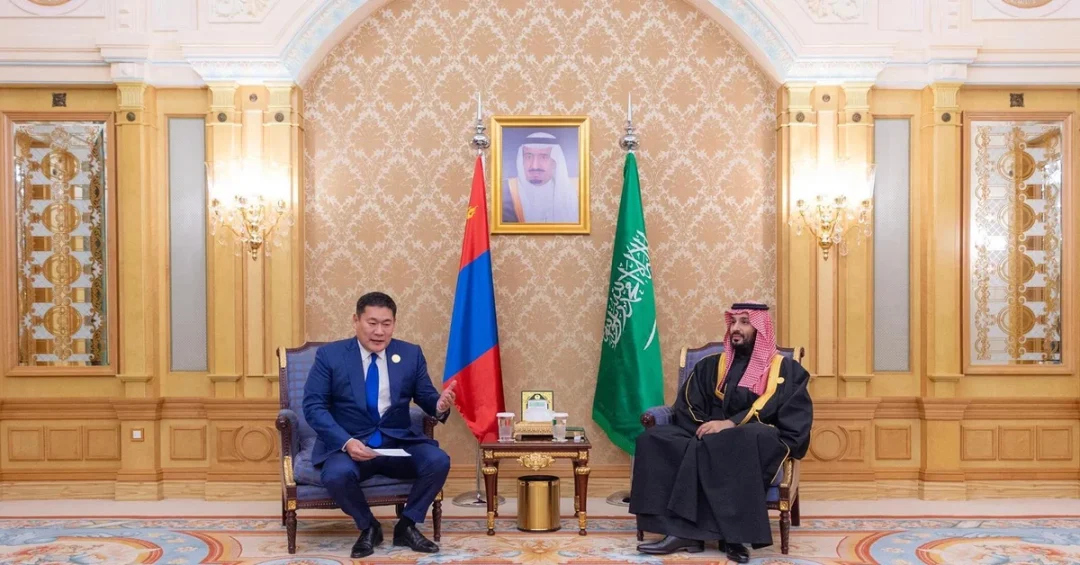
His Royal Highness Prince Mohammed bin Salman bin Abdulaziz Al Saud, Crown Prince and Prime Minister of the Kingdom of Saudi Arabia, met with Mongolian Prime Minister Luvsannamsrain Oyun-Erdene in Riyadh on Tuesday on the sidelines of the One Water Summit, in a diplomatic engagement that underscores the Kingdom’s expanding partnerships across Asia and its growing convening power on global sustainability issues. The meeting, announced by the Saudi Press Agency, brought together senior ministers from both governments to discuss opportunities for cooperation and ways to advance mutual interests, while also reviewing key items on the summit’s agenda.
How does a single diplomatic encounter in Riyadh signal the breadth of Saudi Arabia’s global outreach? The Crown Prince’s meeting with the Mongolian Prime Minister reflects a deliberate strategy of building bridges with nations across Asia, from established economic giants to fast-developing partners such as Mongolia. Saudi Arabia’s hosting of the One Water Summit places the Kingdom at the center of international dialogue on water security, a priority that resonates with Vision 2030’s emphasis on sustainability and resource efficiency. The presence of Mongolia’s prime minister in Riyadh, alongside a high-level Saudi delegation, demonstrates that the Kingdom’s diplomatic calendar now regularly brings world leaders to its capital for substantive exchanges.
Context and Background
What makes the Saudi-Mongolian relationship worth watching at this moment? Saudi Arabia and Mongolia have maintained diplomatic relations for decades, but recent years have seen a quiet acceleration in engagement. Mongolia, a landlocked nation between Russia and China, has pursued a “third neighbor” policy aimed at diversifying its international partnerships beyond its immediate geographic giants. Saudi Arabia fits naturally into that framework: it offers capital, energy expertise, and a platform for engagement with the wider Arab and Islamic world. For the Kingdom, Mongolia represents a partner in Central and Northeast Asia with significant mineral resources, including copper and coal, and a growing interest in renewable energy and water management.
The One Water Summit, held in Riyadh, provided the immediate backdrop. The summit convened heads of state, ministers, and international organizations to address global water challenges, including scarcity, infrastructure financing, and climate resilience. Saudi Arabia, which relies heavily on desalination and has invested substantially in water technologies, used the gathering to highlight its own experience and to facilitate dialogue among participating nations. The meeting between the Crown Prince and the Mongolian Prime Minister was therefore both bilateral and multilateral in character, touching on shared priorities within the summit’s agenda.
The Saudi delegation accompanying the Crown Prince was notably senior. It included Prince Turki bin Mohammed bin Fahd bin Abdulaziz, Minister of State and Cabinet Member; Prince Faisal bin Farhan bin Abdullah, Minister of Foreign Affairs; Khalid Al-Falih, Minister of Investment; Mohammed Al-Jadaan, Minister of Finance; and Abdulrahman Al-Harbi, Saudi Ambassador to China and non-resident Ambassador to Mongolia. The presence of the investment and finance ministers signals that economic cooperation, not only political dialogue, was on the table. The official delegation accompanying the Mongolian prime minister likewise indicated Ulaanbaatar’s seriousness about deepening ties.
Key Details
What specific areas of cooperation were discussed? According to the Saudi Press Agency, the two leaders discussed opportunities for cooperation between their countries and ways to enhance mutual interests. While the official readout did not enumerate every sector, the composition of the Saudi delegation points to a focus on investment, finance, and foreign affairs. Mongolia has sought foreign direct investment for its mining, infrastructure, and renewable energy sectors, and Saudi Arabia’s Public Investment Fund has increasingly looked at opportunities across Asia. The presence of Minister of Investment Khalid Al-Falih suggests that Saudi businesses and sovereign capital could play a role in Mongolia’s development plans.
Water cooperation is another likely avenue. Mongolia faces challenges related to water scarcity in its southern regions and has expressed interest in improving water infrastructure. Saudi Arabia, through its Saline Water Conversion Corporation and other agencies, has developed world-class expertise in desalination and water management. The One Water Summit context makes it plausible that the two sides exchanged views on water technologies and project financing, though the official statement did not specify concrete agreements. What is clear is that the meeting served as a platform to explore synergies rather than to announce finalized deals.
The leaders also reviewed several topics on the agenda of the One Water Summit. This indicates that the bilateral conversation was embedded in the broader multilateral discussion. The summit’s agenda likely covered issues such as integrated water resource management, the role of the private sector in water infrastructure, and the link between water and food security. By meeting on the sidelines, the Crown Prince and the Mongolian Prime Minister could align their positions on these topics and identify areas where their countries might collaborate within the summit’s framework. Such sideline diplomacy is a hallmark of Saudi Arabia’s approach to international conferences: maximizing the value of hosting by facilitating multiple bilateral engagements.
International and Regional Impact
How does this meeting fit into Saudi Arabia’s broader Asian outreach? The Kingdom has deepened ties with China, India, Japan, South Korea, and Southeast Asian nations in recent years, and Central Asia has emerged as a new frontier. Mongolia, though not part of Central Asia proper, shares many of the same characteristics: it is resource-rich, strategically located, and eager to balance its relationships. A closer Saudi-Mongolian partnership could open doors for Saudi investment in Mongolian mining and infrastructure, while giving Mongolia access to Saudi markets and expertise. It also complements Saudi Arabia’s growing engagement with the Shanghai Cooperation Organization and other regional bodies.
Regionally, the meeting reinforces Saudi Arabia’s role as a bridge between the Arab world and Asia. The Kingdom’s position as the custodian of Islam’s holiest sites gives it a unique standing in the Islamic world, and Mongolia has a small but historic Muslim community. While the official readout did not emphasize religious ties, cultural and people-to-people connections could be part of a long-term relationship. More immediately, the meeting signals that Riyadh is willing to invest diplomatic capital in relationships that may not dominate headlines but contribute to a diversified foreign policy. For Mongolia, engaging with Saudi Arabia offers a counterweight to dependence on its two large neighbors and aligns with its goal of expanding its international footprint.
The One Water Summit itself adds another layer. By hosting the summit, Saudi Arabia positioned itself as a global convener on water issues, a theme that resonates with its own environmental and economic priorities. The presence of leaders like Mongolia’s prime minister validates that positioning. It also creates opportunities for Saudi Arabia to showcase its Vision 2030 projects, including NEOM and its sustainable water systems, to an international audience. The bilateral meeting thus serves both Saudi and Mongolian interests while advancing the summit’s overarching goals.
Economic and Strategic Significance
What economic opportunities could arise from closer Saudi-Mongolian ties? Mongolia’s economy is heavily dependent on mining, particularly copper and coal, and it has sought to diversify into agriculture, tourism, and renewable energy. Saudi Arabia, through the Public Investment Fund and its various portfolio companies, has the capital and the appetite for international investments that could support these diversification efforts. Saudi mining company Ma’aden has expressed interest in international partnerships, and Mongolia’s mineral wealth could be of interest. Conversely, Saudi Arabia could benefit from Mongolian agricultural products and from cooperation on renewable energy, given Mongolia’s vast wind and solar potential.
Water is another strategic area. Saudi Arabia’s experience in desalination and water recycling is globally recognized, and Mongolian officials have shown interest in learning from the Kingdom’s model. The One Water Summit provided a natural venue for such exchanges. While no specific agreements were announced, the meeting lays the groundwork for future cooperation. The involvement of Minister of Finance Mohammed Al-Jadaan suggests that financing mechanisms for water and infrastructure projects may have been part of the conversation. Saudi Arabia’s financial institutions, including the Saudi Fund for Development, have supported projects in developing countries, and Mongolia could be a candidate for similar support.
Strategically, the meeting underscores Saudi Arabia’s commitment to multilateralism and to building a network of partnerships that extends beyond traditional allies. Mongolia’s “third neighbor” policy and Saudi Arabia’s Vision 2030 both emphasize diversification and global engagement. By meeting on the sidelines of a global summit, the two leaders demonstrated that their countries share an interest in addressing transnational challenges such as water scarcity. This alignment could lead to cooperation in international forums, including the United Nations and specialized agencies, on issues ranging from climate change to sustainable development.
Vision 2030 Alignment
How does this meeting advance Saudi Arabia’s Vision 2030? Vision 2030 aims to transform the Kingdom’s economy and society, and a key pillar is strengthening international partnerships that support economic diversification and knowledge exchange. The meeting with Mongolia’s prime minister is a small but meaningful example of that pillar in action. It shows Saudi Arabia engaging with a country that, like the Kingdom, is seeking to diversify its economy and reduce reliance on a single sector. By sharing expertise in water, energy, and investment, Saudi Arabia can position itself as a partner in development, enhancing its soft power and creating new avenues for Saudi businesses.
Moreover, the meeting highlights the role of Saudi leadership in global sustainability dialogues. The One Water Summit is part of Saudi Arabia’s broader effort to address environmental challenges, which is integral to Vision 2030’s quality-of-life goals. Hosting such events and conducting bilateral diplomacy on their margins reinforces the Kingdom’s image as a responsible global actor. As Saudi Arabia continues to implement Vision 2030, engagements like this one with Mongolia will contribute to a more interconnected and diversified international presence, benefiting both the Kingdom and its partners.
In conclusion, the Crown Prince’s meeting with Prime Minister Oyun-Erdene may not have produced headline-grabbing announcements, but it represents the kind of steady, forward-looking diplomacy that defines Saudi Arabia’s approach to international relations. By leveraging the One Water Summit to deepen ties with Mongolia, the Kingdom is building bridges across Asia and reinforcing its commitment to sustainability and mutual prosperity. As Vision 2030 progresses, such meetings will remain essential to Saudi Arabia’s global engagement.
20 Questions
Q1. Who met in Riyadh on Tuesday?
A1. His Royal Highness Prince Mohammed bin Salman bin Abdulaziz Al Saud, Crown Prince and Prime Minister of Saudi Arabia, met with Mongolian Prime Minister Luvsannamsrain Oyun-Erdene.
Q2. What was the occasion for the meeting?
A2. The meeting took place on the sidelines of the One Water Summit, which was hosted in Riyadh, Saudi Arabia.
Q3. What did the two leaders discuss?
A3. They discussed opportunities for cooperation between their countries, ways to enhance mutual interests, and several topics on the agenda of the One Water Summit.
Q4. Which Saudi officials attended the meeting?
A4. Prince Turki bin Mohammed bin Fahd bin Abdulaziz, Prince Faisal bin Farhan bin Abdullah, Khalid Al-Falih, Mohammed Al-Jadaan, and Ambassador Abdulrahman Al-Harbi attended.
Q5. Who is the Mongolian Prime Minister?
A5. Luvsannamsrain Oyun-Erdene is the Prime Minister of Mongolia, leading the country’s government and representing it at international forums.
Q6. What is the One Water Summit?
A6. The One Water Summit is an international gathering focused on addressing global water challenges, including scarcity, infrastructure, and climate resilience, held in Riyadh.
Q7. Why is Saudi Arabia hosting the One Water Summit?
A7. Saudi Arabia hosted the summit to facilitate global dialogue on water issues, showcase its expertise in desalination, and support international cooperation on sustainability.
Q8. What is the significance of the Saudi-Mongolian meeting?
A8. It reflects Saudi Arabia’s expanding partnerships in Asia and its commitment to multilateral diplomacy, while offering Mongolia a chance to deepen ties with a key regional power.
Q9. Does Mongolia have a “third neighbor” policy?
A9. Yes, Mongolia’s “third neighbor” policy aims to diversify its international partnerships beyond Russia and China, and Saudi Arabia fits into that strategy.
Q10. What economic areas could Saudi Arabia and Mongolia cooperate on?
A10. Potential areas include mining, renewable energy, agriculture, water management, and infrastructure investment, leveraging Saudi capital and Mongolian resources.
Q11. Was any agreement signed during the meeting?
A11. No specific agreements were announced in the official readout, but the discussions aimed to explore opportunities for future cooperation.
Q12. How does this meeting align with Vision 2030?
A12. It supports Vision 2030’s goal of strengthening international partnerships and economic diversification, while enhancing Saudi Arabia’s role in global sustainability dialogues.
Q13. What is Saudi Arabia’s expertise in water?
A13. Saudi Arabia is a global leader in desalination and water management, with the Saline Water Conversion Corporation producing millions of cubic meters of desalinated water daily.
Q14. Who is the Saudi Ambassador to Mongolia?
A14. Abdulrahman Al-Harbi serves as Saudi Ambassador to China and non-resident Ambassador to Mongolia, and he attended the meeting.
Q15. What role did the Saudi Minister of Investment play?
A15. Khalid Al-Falih’s presence indicates that investment opportunities and economic cooperation were key topics in the discussions.
Q16. What role did the Saudi Minister of Finance play?
A16. Mohammed Al-Jadaan’s attendance suggests that financial cooperation and funding mechanisms for potential projects were part of the conversation.
Q17. How does Mongolia benefit from ties with Saudi Arabia?
A17. Mongolia can attract Saudi investment, access expertise in water and energy, and diversify its international partnerships beyond its immediate neighbors.
Q18. How does Saudi Arabia benefit from ties with Mongolia?
A18. Saudi Arabia gains a partner in Northeast Asia, potential investment opportunities in mining and renewable energy, and a stronger presence in Asian multilateral forums.
Q19. What is the broader context of Saudi Arabia’s Asian outreach?
A19. Saudi Arabia has deepened ties with China, India, Japan, South Korea, and Central Asian nations, positioning itself as a bridge between the Arab world and Asia.
Q20. What comes next after this meeting?
A20. The meeting lays the groundwork for further dialogue and potential cooperation, with follow-up discussions likely through diplomatic channels and future summits.
Reader Feedback
We value your thoughts. Please share your feedback on this article.
Your feedback helps us improve our coverage.
Related articles
 Saudi Arabia Weather Forecast for Wednesday
 Crown Prince Launches National Red Sea Sustainability Strategy
 Afforestation Technologies Forum Showcases Inspiring Initiatives
 Pakistani PM Sharif Departs Riyadh After Water Summit
 French President Macron Departs Riyadh After One Water Summit
 5.0-Magnitude Earthquake Strikes Southern India